Your best investment?

Hello there,

I am currently going through an interesting time with a certain investment, and I was looking for some support from the forum regarding whether to sell or hold it. I couldn’t find a dedicated thread on this exact topic, so I thought I’d start one. If the topic interests you, great; if not—that’s okay too.

The shares in question are Hudson Technologies, Inc., which I bought in the spring for about €3,000. The stock price has been on quite a rally, and currently, their value has increased by 58%. For me, this is a significant investment in the sense that it currently represents nearly one-fifth of my portfolio. This is my best investment both in terms of euro amount and percentage.

In the investment world, discussions too rarely focus on holding investments, which at least to me feels challenging with a so-called “successful” investment like this. I would love to read about others’ experiences with your best investments! I’m particularly interested in those that represent a large portion of the portfolio in euros, as those involve significant stakes. If you have the time/inclination, I would like to hear answers to the following topics regarding your best investment (you can also answer this in a theoretical sense, i.e., if prices rose sharply at some point and this investment represented a large share of your portfolio, and you didn’t sell then and now prices are at a lower level):

1. How did you end up investing in this stock? Especially from the perspective of why you dared to commit a reasonably large amount of money to it relative to your portfolio?
2. How much has the stock risen in %?
3. How much did the stock represent of your total portfolio value before/after the price increase?
4. What is your thought process regarding selling/holding the stock? (Assuming, of course, that the company’s fundamentals are in order). Constantly keeping in mind the large relative share in your portfolio.
5. If some time has already passed since this best investment of yours, I would also ask you to tell whether the right decision was made at the time regarding selling/holding? Hindsight may not be the most useful, but it is at least interesting :slight_smile:

Thanks in advance for the answers! :saluting_face:

21 Likes
  1. I decided to invest in Sonera when it went public at the turn of the millennium. I thought that since Nokia had risen strongly, Sonera would also rise as it was in the same industry. I invested 3,600 marks.
  2. I sold the stock at the turn of the millennium because I thought it was too expensive and that few companies are gold mines. I received 36,000 marks from the sale. So, the timing of the sale was very successful then. Later on, timing my buys and sells hasn’t been as successful. Although timing is difficult, it’s still worth trying.
  3. the stock made up almost my entire portfolio.
  4. In my opinion, the stock was expensive.
  5. I think the decision was the right one, and as I recall, I didn’t return to the market until a couple of years later.
    This success, however, gave me faith in investing, which continues to this day.
    Childhood hobbies could also be considered a good investment. They have brought a lot of joy and provided many kinds of lessons for later life.
9 Likes

The best investment is the money I spent on a wedding ring. The second best is the money I invested in my studies. Third are stock market investments, the final outcome of which is not yet known, so it’s impossible to say which is best. One was actually up 140-fold at one point, though it’s a bit lower now. I trust that the real gem will be found in the risk portfolio once the situation in Europe stabilizes, reconstruction begins, and humanity grows wiser.

7 Likes

My best stock investment was and still is Harvia, despite all the decline.

I’m a bit of a “sauna, sisu, and Sibelius” type of person, and that was the main reason for buying the stock :smiley: Of course, the fundamentals and valuation multiples were also attractive. The expectation was for a slow grower paying a good dividend. If I recall correctly, it was 2018, and Harvia’s share price was between 5 and 6 euros. I eventually bought the stock in three installments, totaling 800 shares, and the average price was around 5.50. The investment in the company was in the same range as my other investments. I’ve always aimed for a fairly diversified portfolio.
At its peak, the stock was 10x the average purchase price; currently, it’s “only” +293%.

Before Covid, the rise had already been strong, and its share of the portfolio had risen to an estimated 10-15 percent. During the rise that started with the Covid boom, its share of the portfolio was probably over 30%, and in euro terms, we were talking about a pot of around 50k euros at its best, which was then and still is a big pot for me.

I sold 100 shares at a price of 57 euros, and later 200 more around the 30-euro mark, and a final batch of 100 shares at just over 22 euros. So, at the moment, I still have 400 shares in a long-term hold. Now the share of the portfolio is at a reasonable level again, and I have no plans to sell or buy unless something significant happens.

I must admit that I fell too much in love with the stock, its story, and its success. Combined with a desire to avoid taxes, I can’t now tell a story of how I sold Harvia shares that had risen 10x at exactly the right time. But regardless, this has been my best investment both in euros and in percentage terms. And I must admit that there was significantly more luck than skill behind it. On the other hand, I give myself credit for my perseverance, because I didn’t sell as soon as I started feeling dizzy for the first time at the 12-euro mark.

18 Likes

While the children are young, I aim to do billable work plus investment-related work totaling about 800 hours per year.

This is just under half of the average annual hours for a full-time job in Finland.

Furthermore, when my wife returns to work, I encourage her to work reduced hours and take unpaid leave whenever and as much as it feels right for her quality of life.

I invest time in mostly small-scale ways to make daily life more relaxed and to improve the quality of life for my family and myself.

I am quite confident that this partial sacrifice of income while the children are young will turn out to be the best investment of our lives.

In 2021–22, I was foolish with my time management, but apparently, I am an individual capable of learning every now and then.

35 Likes

I bought Amanda Capital, the predecessor to eQ, over 10 years ago. I thought I knew something about that business back then; in hindsight, it’s hard to tell if it was luck or skill. The world has changed around us, and the company’s corporate structure and business have also changed a great deal. No one could have known these changes at the time of investment; anyone can make educated guesses. One of those views then turns out to be correct in hindsight, while others are more or less wrong.

For eQ, things have gone well so far. Originally, my stock portfolio was 50% eQ’s predecessor; today it is less, and that share will intentionally continue to decrease in the future. I make additional investments in other companies, and dividends likewise go into other companies. This way, in the long term, by retirement age at the latest, eQ’s weight will likely drop to around the 10% level. The intention is never to sell if the current business remains viable and the dividend flow is abundant. The stock has nearly ten-folded, but as a crown jewel, I am not selling. I believe I would regret it in 10 years if I sold today. The price fluctuates, but let it fluctuate. Latent tax liability has mentally prevented sales (the price has halved from its peak; in hindsight, it would have been worth trimming the position earlier).

There is risk in technology firms. The ability to generate earnings in the coming years will be the deciding factor. Has the stock price risen because the acceptable valuation level has simply increased among speculative investors, has the company become a general talking point, and has the interest in buying the stock risen for that reason? Or is some future thing being hyped up, only to fall flat later, causing the stock to drop like a stone. This is probably the biggest risk.

I feel confident owning eQ. At the other extreme in Finland is, for example, Duell, whose business was thought (by experts and analysts alike) to be really good previously, but it has turned out to be an absolutely terrible investment story this year. You cannot invest a large part of your stock portfolio in something like this, even if everything looks good today.

6 Likes

As a not-so-experienced or knowledgeable investor, it’s hard to answer, especially since my own investment horizon is the proverbial long term.

However, I’ll share my current thoughts from two perspectives.

  1. My most profitable investment: Remedy
    I bought in around €10, more or less based on gut feeling, but having played some video games myself, it felt like a semi-sensible buy. I didn’t sell when the share price shot up, even though in hindsight it might have been worth it given the price development. However, I’m still confident, at least regarding AW2, and I’m not planning to sell based on the current situation. Diving deeper into Remedy has been more enjoyable with a bit of “skin in the game.”
    This was one of the first stocks I bought, and I probably fell into the famous “this is easy” trap. Not all of my stock purchases since then have gone this way.
  1. My most considered investment: Terveystalo
    By this, I mean the stock purchase that, relative to my current learning, I’ve been best able to justify to myself both at the time of purchase and right now. The acquisition where my knowledge at the time was best put to use, and where I’ve relied most on my own judgment. I bought it earlier this year.
    There is a lot to learn in this game, and TTALO probably won’t stay at the top of this category in the long run as my expertise grows and my investment strategy becomes clearer. I’m also not claiming that I bought at the right time or even the right company; the market will decide that over time.
5 Likes

By far my best investment has been Luckin Coffee. I picked it up for my portfolio when the user Kaira brought it to the forum’s attention—might have been in the hype stocks thread. I bought my first and only position on June 26, 2020: 3,000 shares. It was pure luck timing-wise, and my purchase price for the stock was $1.42, right at rock bottom; now the return is +2,308% (EUR). I managed to sell 900 shares once. So now my holding is 2,100 shares. It’s a really tricky situation with this OTC stock because about a year ago, there were restrictions placed on selling them.

When you want to sell, you have to exit the entire position. My own interest would be to trim it slightly, but that’s not possible until the stock lists or gets permission to list back on Nasdaq or NYSE.

LKNCY recently reported good results, and stores are being opened at a breakneck pace in China. Fingers and toes crossed, I’m waiting for the stock to get back onto one of those exchanges. Do forum members have any information on what is behind such tightening/rule changes, and if they are consistent in other countries compared to Finland? This has definitely been “tasty,” so to speak, so far: bought at 1.42, now 32.51 USD, even hit 38.88 USD. Let’s see how it goes? A risky stock, regardless…

8 Likes

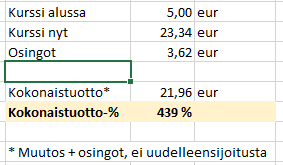
My biggest success, at least measured in euros, is Harvia. I have been involved since the IPO and gradually built up a nice-sized position. At one point, I sold some shares to finance a large purchase, but it is still the largest investment in my portfolio.

Looking at the numbers, the total return for those involved from the start consists of capital appreciation and hefty dividends. The company has paid out so much in dividends that it already equals 72% of the original price. The capital appreciation has also been significant; in just over five years, the stock value has multiplied several times over.

At today’s share price, the returns look like this:

image

So why did I buy Harvia originally? I dug up my notes from before the IPO; it’s good to write these things down and compare later what was expected versus what actually happened. In summary, it went like this:


The company’s strengths and weaknesses now and in the future

Pros:

  • strong brand
  • investments in R&D
  • market leadership
  • steadily growing market (meaning predictability is good)
  • management has significant share ownership
  • the company has good dividend-paying capacity
  • small niche market

Cons:

  • is the decline in profitability (partly due to an acquisition) temporary or a symptom of longer-term issues
  • significant changes occurred in company management in 2014 during the change of ownership
  • industry growth is quite small (4% per year)
  • IPO costs (€4M) will significantly weigh on the 2018 results

Growth potential

The industry is fragmented, and the company has room to grow faster than the market.

Valuation

At the IPO, P/E was approx. 12-14 for normalized earnings; listing costs push the 2018 P/E to around 26. Good dividend-paying capacity. As a small-cap company, liquidity might be weak, which reduces the stock’s attractiveness.

Summary:

Reasonable valuation, a company in a stable industry, market leader at a fair price, small-cap risk.


Well, that’s what I thought in 2018, and then the company grew much more than I would have guessed beforehand. The company has been a major success story overall, and in these challenging times, it has achieved a great defensive victory by maintaining good profitability despite the difficulties. The stock value shot up very high for a while (it was a ten-bagger and then some), later declined, and is now more than four times the figures from five years ago.

No one knows about the future, but I’ve decided to remain a Harvia owner; since the company is of such high quality, there’s no sense in switching to something worse. In the long run, high-quality, highly profitable companies can be excellent investments.

Edit: In the 2018 notes, there were, of course, some numbers crunched, etc., but I left them out because the post was getting too long anyway. :smiley:

24 Likes

My best investment has clearly been Incap.

1. How did you end up investing in this stock?

  • After a moment of reflection and because “others were investing too.”

2. How much has the stock risen in %?

  • The return briefly went over +1000%, but I later reduced my position first at +700% returns and more at +500% returns. There is still some Incap in my portfolio, but significantly reduced, though still well in the green.

3. How much did the stock represent of your portfolio’s total value before/after the appreciation?

  • A couple of percent at first, at most around 15%. The portfolio size has also grown, meaning the percentage after the appreciation would have been much higher if I hadn’t continued buying other stocks over the years.

4. How does your thinking go regarding selling/holding the stock?

  • I wanted to reduce the risk in my portfolio once the stock started to decline after a long rise, and there wasn’t any more complex reasoning behind the sales. I reinvested the proceeds into other companies and I’m continuing with my current amount of Incap shares; I still like being involved.

5. If some time has passed since this best investment of yours, I’d ask you to share whether you think you made the right decision back then regarding selling/holding?

  • I think the sales hit a pretty good spot; it was nothing but pure profit on offer, even though I didn’t sell at the peak. I actually wanted to test if I could get a return of over 1000% on this stock, and I succeeded.
11 Likes

My best investment is Heidelberg Materials AG.
I bought a small amount of this as an experiment on April 6, 2022. Generally speaking, I bought my first ever shares about three months prior to that.
In the case of Heidelberg, I used my own judgment without any recommendations or warnings.
The biggest factor was probably that it is very close to my own professional field. The company’s debt or dividend-paying ability didn’t carry much weight in the decision.
Heidelberg has apparently risen 37.10% since the beginning of the year, and 24.65% in my portfolio.
It only takes up 9% of my portfolio, so there is plenty of room for my poorer-performing companies.
This is the kind of company I aim to top up as my funds allow whenever there is a small dip.
I will keep this for the long term—at least five years, but likely ten to fifteen years.
This is a pretty guaranteed bright spot when I look at my portfolio’s performance weekly; it really is a profit driver.
It represents a cyclical industry, but apparently the foundations are made of the strongest reinforced concrete.

4 Likes

So far, my best investments have been Canopy Growth: bought at 5.81 CAD, half sold at 43.20 CAD, and the rest at 71.22 CAD. Genovis: bought at 6.88 SEK, now +550%. Also Qt with an average price of €11.35, of which a small amount was sold at €103 and €156 (and of course, it’s annoying that I didn’t sell everything back then). Qt is still the largest holding in my portfolio. There are heaps of bad investments, but those weren’t asked about now.

6 Likes

It’s not a stock, but just for laughs, I put 200 euros into Shiba Inu cryptocurrency a couple of years ago. At its best, that sum was nearly sixfold, and I didn’t sell because I thought it would go even higher. Then it crashed and stayed below or around the cost basis for a long time, and right now I’m up about +335%, meaning around 670 euros; within the past month, the investment peaked at 950 euros. You can certainly make money with these, but the risk is just as massive as the potential return. And if you’re going to put in larger sums, it really should be extra cash and you shouldn’t mind if you lose everything.

5 Likes

I consider the shares I acquired in four different Lapland-based jointly owned forests to be my best investments. Since 2006, the annual return (capital appreciation + surplus distribution) has been over 6%. Back in the day, those shares were sold at quite a significant discount. Nowadays, the pricing for the largest jointly owned forests corresponds to fair market value, so similar returns are not expected in the near future. And since I am a hunter, a major benefit is also that permits are available for next to nothing for the entire season across many different parts of Lapland. I invested in two of the jointly owned forests with cash, and in the other two by merging a property I owned into the forest.

9 Likes

Years ago, Nordnet had model portfolios from Nordic investors. Kim Lindström from Finland, for example. Then there was a Norwegian making good returns, and others too. I followed their lead: I bought Finnish stocks mentioned as value stocks and got the idea for Microsoft from the Norwegian.

I didn’t have much money; I bought Microsoft for maybe €3k. Well, it really took off. I sold half about two or three years ago because I thought it couldn’t just keep going up forever.

Now it’s up about 2,200%. Value is around €37k.

I don’t understand much about these things. I’ve just noticed that when you shamelessly follow those who are wiser, diversify, and let the years roll by, even an ordinary guy like me can do well.

The ones I copied from Lindström—Huhtamäki, Kemira, Wärtsilä, etc.—have also been solid performers.

14 Likes

My TOP 3
1: Incap
2. Revenio
3. Rakentajain Konevuokraamo (Builders’ Equipment Rental)

Financially, the best is probably a 15 ha forest plot bought in 2006 for €30,000; over a hundred thousand worth of timber has been sold, and the value of the standing timber is currently €130,000. It has certainly required time and effort for management and planning.

In my brief stock-picking hobby, the best performer so far is Wärtsilä, up by about 140%.

In its own way, the best has been the Plymouth I acquired as a teenager, or subsequent classic cars. That kind of hobby is a financial black hole, but it certainly evokes a wide range of emotions, from euphoria to despair.

8 Likes

Two equally strong ones come to mind—both funds with excellent risk-reward ratios.

A long time ago, I held the first batch of a Russia fund in my portfolio for 16 months, and the rest for a shorter period. The return over those 16 months averaged +165%.

Another similar case was a Baltic fund, which I first bought at a price of 155 euros and sold at 455 euros. The fund went up practically all the time. It felt as if even on down days, the fund was +0.3%. Shortly after I sold, the fund’s value dropped sharply—about two weeks after the sale.

4 Likes

My best investments—and I’m having to peek at my notes here—these are only from my international portfolio, as my domestic portfolio is moving a bit… “more steadily”…

In terms of percentages, my top four look like this:

AMD: +403.65%, bought back in the day in two batches with an average price of $33

Nvidia: +328.33%, bought a few years back when I sold my Teslas, which were starting to head south. Bought in one go, and the purchase price for these was $223 per share

Microsoft: +206.25% I bought these back when the price was $138, and I vividly remember how I split the sum I intended to invest that day in half with the fourth company…

Meta: +152.84% Meaning exactly this one. Purchase price at the time was $188

The common thread for all of these is that if only I’d had a crystal ball, I would have invested more in them.

On the other hand, I don’t know if my post is pointless, because I still hold these stocks, and if everything crashes in a single day, this post will age very quickly. I haven’t cashed them out yet, since they seem to be on a good run, partly due to actual results and partly due to the AI hype and its consequences.

I was going to sell Nvidia when it crossed $500… then it just kept climbing and climbing, and now I’ve been thinking that if it crosses $1000, it’ll be payday… We’ll see, it’s almost time for the earnings report again :face_with_peeking_eye:

10 Likes

Regarding this, it’s worth remembering that the semiconductor industry has always been a very cyclical boom & bust industry. The PC boom decades ago, the dotcom boom, the mobile boom, etc. Usually, very little has reached the bottom line, and there is almost never any profit distribution. Nvidia has also been part of the same pattern, although those earlier rollercoasters are overshadowed by the current trip to the moon when looking at the price chart. Major customers have filled their data centers with H100 hardware and such, and next they’ll be wondering what to actually do with them. This is not a sell recommendation, though; instead of the Moon, the stock could go to Jupiter.

4 Likes