I guess many of us have stocks in mind that we’d like to own, but they seem too expensive. For example, QT seems to be a stock that many have always felt was “too expensive,” but it has continued its upward climb. On the other hand, companies like Modulight, Inderes, or Spinnova might be very interesting, but the valuation feels far too tight.
In my case, the stories of Modulight, Spinnova, and Inderes are indeed interesting, but the prices feel so incredibly tight that I don’t really want to add to my current position (though I already sold my Modulights at €11, as that also felt incredibly high).
With Tecnotree, I was already regretting in the summer that my base position had remained so small, but the price started to soar. For some reason, I didn’t even add during the September-October dip, and now we’re in the same boat again; adding to a rapidly rising price feels difficult.
Additionally, among non-stocks, I’d like to add Ethereum and Bitcoin to the riskier end of my portfolio, but with these too, I only got excited about the topic with the price increase.
I recognize a small FOMO as the unifying factor for all of these—what if the real rocketing is just starting from here? That’s why I’m scared to press the buy button at this stage, as usually, by the time FOMO hits, it’s already too late.
Resentment is a poor investment strategy. We need to look forward… I’m only interested in one thing: how my portfolio performs compared to its chosen benchmark index. Whether a historically successful company X belongs in the portfolio or not, whether company X is “expensive” at current prices, etc., is pretty irrelevant to me.
Oh my goodness. Now that’s a question. Should I list my entire watchlist? =D
To simplify, I’ll only list US/Canadian stocks, as I can compile them quicker than those from other countries. I’d like to own all of these at the right price.
Apple Inc
Abbott Laboratories
Albemarle Corp
A O Smith Corp
Alimentation Couche-Tard Inc
Broadcom Inc*
American Water Works Company Inc
BlackRock Inc
Canadian National Railway Co
Costco Wholesale Corp
Carlisle Companies Inc
Fortis Inc
Gentex Corp*
Granite Real Estate Investment Trust
Home Depot Inc
Honeywell International Inc
Innovative Industrial Properties Inc
Johnson & Johnson
LeMaitre Vascular Inc
Lam Research Corp
Mastercard Inc
Mondelez International Inc
Magna International Inc
3M Co
Metro Inc
Microsoft Corp
National Bank of Canada
Nextera Energy Inc
Nike Inc
Oracle Corp
Open Text Corp
Qualcomm Inc
Royal Bank of Canada
Starbucks Corp
Tecsys Inc
Tractor Supply Co
Texas Instruments Inc
UnitedHealth Group Inc
Visa Inc
Xcel Energy Inc
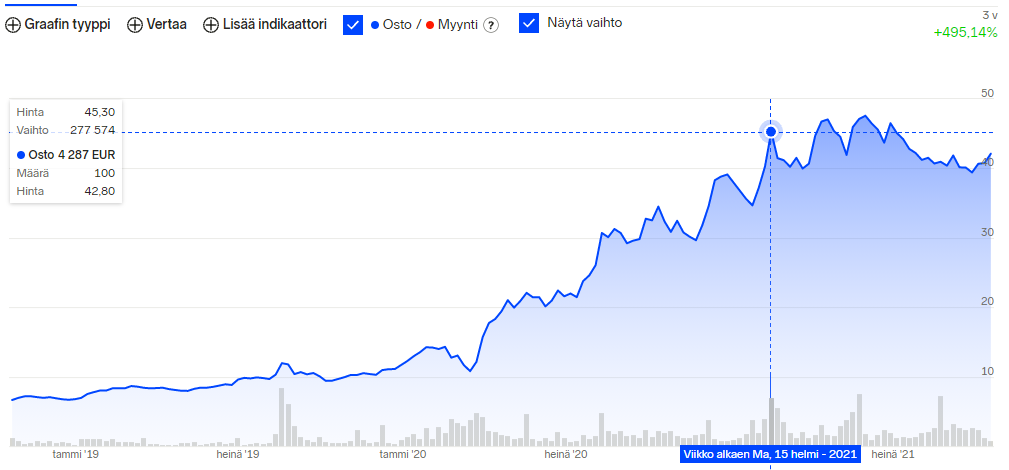
This is a bit off-topic, but I was going to buy Remedy during the COVID dip, the price was probably 10.XX euros.
Well, the order was one tick away, so I think it was ten cents even then. Remedy made an Epic deal; I underestimated the impact on the share price and didn’t buy, thinking “it’ll surely come back down.”
So then I watched it quadruple from the sidelines, but of course, I eventually corrected this mistake and bought shares for my portfolio during the offering.
Frustration is precisely a good thing up to a certain point. It indicates that a person is not satisfied with their performance and is willing to improve. Too much complacency brought by success is truly poison for an investor.
It’s not at all surprising that today your favorite stock, or the one you’d like to add to, is too expensive. I believe that it’s during times like these that an investor’s discipline and patience are tested. Do you have the guts to sit on cash and wait for better buying opportunities when stocks are rising and those who jump on the hype are rewarded? At this point, some kind of plan might be in order: which stock do you want to add? At what price or multiples will you start adding? Is the margin of safety in place then?
I can comfort you by saying that there has probably never been a stock in the world that hasn’t, so to speak, returned to the station to pick up latecomers. So, if you have enough patience, opportunities will surely come again. That’s why it’s worth making a plan now, so you can act decisively and without worry when your time comes. How many times has Revenio’s stock price plummeted by ~40% during its stock market history?
It’s getting harder and harder. I have a plan, but at the same time, I want to put my money to work and fear high valuation levels. It’s certainly not the easiest time for a semi-value investor.
Heh, the exact same thing happened to me. I missed buying it during the COVID spring by about ten cents and thought, “Oh well.” Now, in the summer, I ended up becoming an owner, and almost at the same average price of €42.20
On the other hand, if one considered QT expensive at a €100 price and waited for it to return to €60, the train likely won’t be leaving for purchases in the future. Or if the current price drops that low, the company has likely experienced a significant negative turn, and the investment case is no longer as interesting.
The list is long, but there’s no point regretting these too much afterward. Fortunately, there have been many successes too. What I regret most right now is probably not having gotten on board with QT, even though I’ve been following it for years. It always felt too expensive, and I didn’t fully trust the potential to materialize.
I also followed Harvia from under ten euros, but I only joined when the stock price was 46 euros.
I was with Incap between 8 and 15 euros, after which I jumped off the train. Too early, then.
I can’t name individual companies I expect to return to their purchase price. Any company from the “long-term” portfolio will do, as the investment horizon is long.
Yes, I understand. I don’t mean actual anchoring to any particular price. It could be considered affordable at €300 in 5 years. I mainly mean that Qt will surely be available at a good price again someday, though it probably won’t drop to €60 anymore. It was already ruthlessly sold off during the corona crisis. Someone could argue that it was available at a good price there all along for several years. For example, Kone has always been chronically expensive, but from time to time, it has been available cheaper than usual.
I tried to buy ETH at $40 in 2016, but my knowledge ran out, especially since the tax situation wasn’t very clear. I also wanted to start mining at that time, but my better half wasn’t keen on the idea. I don’t regret it, but I have learned that if you want to try something, you should definitely take at least a small position, so you don’t have to be left licking your fingers.
This is why, among other things, I have a forever position in Facebook locked in until the end of the world, which I will not give up. I have been hunting Amazon for the past few years, but I have never found the right moment to jump in. I even sold Google in the summer to buy an apartment, which I deeply regret, as these are the super performers that you always have to pay painfully for, but which you can always be proud of after the purchase. The situation is even more difficult now, as I would have to return at an even higher price. Perhaps someday I will find the courage to jump back in.
For me, Kone and Elisa have always been those eternally expensive quality stocks. Historically, however, it has always been worth buying both.
Fortunately, I became an owner of Elisa this year at a price of 46 euros in a couple of batches, and it has recovered well to prices over fifty euros.
I had owned Kone since around 2015-16 at an average cost of 35e, until I unfortunately sold it during the COVID-19 crash, if I recall correctly, for 46e, so with a clear profit of course, but it was still a bad sale. Fortunately, that capital did go into better-performing horses, at least.
Isn’t that a pretty successful sale if you were able to swap the capital from Kone into investments that gave you a better return than you would have gotten from Kone? Or did I misunderstand something in your text?
Well, that’s true. In that sense, yes, I would have gladly owned that KONE at its acquisition price, if only for diversification purposes, in retrospect.