Savosolar has been on my watchlist for a long time, but only from a distance. I’ve been thinking about whether there would be room for this in my risk pocket.
There are quite a few owners, but most probably only have a few shares as a souvenir from the past. On average 3,400 shares per owner = 500 euros. Did I calculate that correctly?
These presentations didn’t help my thoughts at all, nor did the general look of the website.
https://savosolar.com/fi/news-media/investor-events-presentations/
A few reflections. From an investor’s point of view, what is actually the key competitive advantage of a solar collector compared to a solar panel? The Danish market is going down, even though it’s the best example? Why isn’t Finland the most significant market? Is it even worth doing this in Finland then?
The follow-up questions were good in the top one, which it seems wasn’t the latest one after all. The presentation emphasizes the change in the global situation and the markets, but didn’t really present the company and the market situation.
Solar district heating has been very unprofitable in the past. Even now, this form of energy is an economically viable method of heat production mainly with sufficiently large collector fields and only if the price of district heating remains high enough. Smaller systems can be cost-effective mainly in new areas (before connection fees, etc.). Geothermal heating, etc., creates competition and puts pressure on district heating as well, so there are plenty of risks.
Messages about companies, both rising and falling, are increasing. Such question marks are met with silence. But these might hold the big pike in the reeds. If the 10 largest owners are removed, the average stake is 360 euros. Disappointments have probably already been dealt with. A potential 10x, if (or when) a suitable deal is announced and the masses notice the existence of the shop. But many portfolios might need a shake-up to get the normal 10k dose when potential emerges. Big chests are not easily opened then, or if they are, oh-no.
Well, I haven’t followed the company long enough to ponder whether now could be a turning point.
Even if one watched the video on Inderes’ website from June with pessimistic eyes, some of the CEO’s comments still make sense.
The fight against climate change will soon be on every company’s agenda, which is why every possible stone will surely be turned. For some companies, solar collectors can be a smart solution, for example, due to location or inadequate infrastructure.
Now, apparently, new orders have come in towards the end of the year, and even the management exercised their option rights. The key question is likely whether Savosolar will be profitable if trade begins to increase?
Certainly, in the long run, profitability is important. From the perspective of shares, the expected value, even if it doesn’t materialize  Collectors have their good sides, of course.
It’s worth looking at Savo-Solar’s history. It seems that even major deals have only resulted in losses, and the entire company relies on continuous share issues. In other words, they finance their operations and orders by asking shareholders for money. The flow is in the wrong direction. I’d keep it far away from my portfolio.
One of the biggest threats to solar thermal collectors is solar panels.
Collectors would be most profitable when large amounts of heat are needed during warm periods, replacing some expensive thermal energy. For example, a spa in Southern Europe where domestic hot water is normally produced with gas. Even then, solar panels + a heat pump might be a more cost-effective option.
In Finland, slightly larger solar collector systems usually replace district heating, and district heating, in turn, is priced very affordably by at least some district heating companies during the summer. The reason why district heating production is not profitable for collectors in Finland is largely due to the fact that district heating companies can produce heat very cost-effectively during the summer anyway. In addition, the temperatures required for the district heating network are high, which can reduce the cost-effectiveness of collectors, especially at the beginning and end of the production season.
It may be that small, single-family home-sized collectors would be the most economically sensible; in small houses in Finland and abroad, domestic water is often heated with electricity. Small collectors are indeed seen to some extent in Southern European countries. Savo-Solar, as I understand it, has focused specifically on large systems.
Savo-Solar’s situation is not entirely hopeless, as I understand the product is good and there aren’t too many competitors, unlike often with small solar panel manufacturers.
Does water come into a detached house (or an apartment building or any dwelling) at around 5 degrees Celsius summer and winter? Then the tap water is heated to about 80 degrees Celsius. And then diluted back to the usage temperature. At least in the summer, preheating with free outdoor air would be an efficient way to save energy, so you don’t have to heat every degree with electricity. There’s a free idea for Savo-Solar or anyone else. And when water is discharged into the sewer at up to 80 degrees Celsius, energy is wasted. In Germany, heat was recovered from apartment building wastewater. Why not in Finland? There are still many such untapped ideas on different scales.
Yes
It’s heated to about 55-60 degrees, and at that temperature, it’s taken all the way to the mixer (i.e., the “tap”) (of course, with a slight temperature drop along the way), where the user then adjusts the temperature to their liking.
Domestic hot water is primarily heated with electricity in some detached houses. In larger buildings, a more affordable heating method is generally used. The most common is district heating, the price of which is often less than €30/MWh in summer. Additionally, district heating companies define how, for example, solar collectors (or wastewater heat recovery) can be connected to the circulation. Some companies prohibit, for example, a series connection where warm domestic water (or radiator network water) is heated by one heat source, e.g., from 5 to 30 degrees, and then by district heating from 30 onwards.
Such high temperatures are used at most in radiator networks during severe frosts. Depending on the dimensioning, such high temperatures are not needed anywhere.
In Finland, at least two manufacturers offer wastewater heat recovery devices. The average temperature of wastewater is in the order of 20-25 degrees. So, depending on the flow, without heat pump technology, wastewater heat could preheat domestic hot water, for example, from about 5 to 10-15 degrees. With a heat pump, it could be even warmer, of course.
The economic viability of these is often poor, as the same investment cost often yields better savings elsewhere. They are most profitable, for example, in swimming pools where a lot of warm water is discharged into the sewer. In new swimming pools, these shower waters can be drained separately from toilet waters, which further increases the temperature of the water going to the heat recovery device and, on the other hand, reduces the risk of the heat recovery device clogging and other possible maintenance needs. These are indeed used in swimming pools.
This is very true. There are many ways, and ultimately it all depends on the economic viability the property owner requires for the investments. If the kWh prices of electricity and/or heat were doubled, these wastewater heat recovery systems and solar collectors, for example, would certainly become more common.
In small hot water tanks, I have seen temperatures of almost 90 degrees, when the use is large compared to the tank. For example, in some holiday cabins. Then there are those who boil the tank for fear of Legionella.
Water heated to almost boiling goes down the drain, e.g. from a dishwasher, where the last rinse is usually over 80 degrees.
The German example was decades ago, they have been far ahead in this matter. I googled and indeed there are already alternatives in Finland and that’s a good thing.
Innovation is only at the beginning in this area and Savo-Solar probably still has its place when the real pressure to consider climate change comes. However, my faith in S-S is not enough for me to still add it to my portfolio.
If one cannot afford to invest in a larger water heater or a different method of heating domestic hot water than electric heating, then one probably cannot afford to invest in wastewater heat recovery solutions either.
The amount of rinse water from dishwashers is likely a small percentage of household water consumption, so we are talking about very marginal things. A quick Google search shows that a dishwasher consumes about 1 kWh per wash cycle, and if 20% of that could be recovered, it would be about €0.02, or a couple of euros a year, etc. The cheapest wastewater heat recovery systems I have come across for such a building would have cost around €20,000 each with installation, I don’t remember how many apartments’ water one system could have “treated”.
Perhaps these systems make more sense if hybrid systems are implemented that utilize, for example, solar collectors, condensation heat from cooling devices, etc. In building-specific solar thermal systems, it is probably also essential to have sufficiently large storage tanks so that heat collected during the day can be utilized in the evenings and mornings, when the need for hot domestic water is greater, at least in residential buildings.
Sometimes it’s about space utilization; limited cubic footage is wanted for efficient use. With a small water heater and electric heating, pre-heating would be especially beneficial. A simple pipe through a “solar collector” that heats cold tap water, even above washing temperature, completely free of charge. I saw such a solution in France.
The idea is: raising the temperature cheaply and recovering energy from the drain. The price indicates a market niche.
Well, I bought some of these penny stocks for a try. What if it turns out like with Tecnotree. “Bought for one, sold for three, that’s two percent profit”.
At its simplest, you can make something like this by bending copper tubing into suitable loops, and if you add a reflective surface behind it and an enclosure, the efficiency improves even further. “A friend of a friend” has some DIY version like this; at best, the water might even boil in the tube, which would cause its own challenges. At least the temperature rises from 5 degrees in summer weather even if the sun isn’t shining. For winter, of course, the system must be emptied and the water directed to the accumulator via another route.
Legionella shouldn’t be a big problem either if the water circulates through the accumulator and the accumulator is large and warm enough for the water to heat up properly before use.
That’s exactly what I was looking for. The system I saw in France was also homemade from black plastic pipe. This should be made standard in houses. Easy, as long as you remember to empty it for winter. There would be a market for Savo-Solar here, as long as they make the most efficient solution on the market.
If you want to pump water with solar power, the easiest way would probably be to get solar panels and an electric pump.
{“content”:“Solar power neither returns nor takes.”}
Mukava, että täällä on ketju myös näinkin “huonolle” firmalle kuin Savosolar. (Jos tarkkoja halutaan olla, niin firman nimi ei ole Savo-Solar, mitä Inderes käyttää. Näytti nimi vaihtuneen joku vuosi sitten. Ehkäpä Inderes voisi korjata nimen sivuilleen, jos katsoo, että tällä pienellä erolla on väliä, vai Savo kuin Savo?)
Tutustuin vähäisesti firmaan kesällä, kun pientä antispekulaatiota harrastelin. Tuoreen Ranskan oikeudenkäyntipäätöksen jälkeen tulin mukaan ehkä enempi pitkäaikaisesti. Riskipitoinen osake on kyseessä, mutta sanoisin, että Savo olisi ainakin voinut olla hyvä valinta vuoden top3-nousijoihin palstalla ja voisi ehkä vihdoinkin jopa olla hyvä myös sijoituskohteena. Heitän joitain perusteluita näille väitteilleni tässä viestissä. Ja diskleimerinä sanottakoon, että aurinkoenergiasta toimialana en mitään tiedä.
Savosolarin historiallinen “huonous” firmana ja sijoituskohteena on käsittääkseni paljolti perustunut tuotteiden hitaaseen markkinapenetraatioon, vaatimattomaan menekkiin ja huonoihin toteutuneisiin katteisiin. Ala on ollut aika vaikea tehdä tulosta? Lisäksi Savossa voi olla jotain omia asioitakin pahemminkin pielessä, mutta tähän puoleen en ole kummemmin perehtynyt. Ja luonnollisesti kaikkien kasvufirmojen täytyy ensin saavuttaa riittävä volyymi, jotta voi saavuttaa hyväksyttäviä katteita. Ja tässä kehityksessä Savolla on mennyt liian kauan, rahaa on palanut, aiemmat toiveikkaat sijoittajat ovat pahasti pettyneet ja siksikin on oikeutettua epäillä saavuttaako firma koskaan kannattavuuteen riittävää volyymia.
Itse ja luulenpa, että muutkin, jotka pohtivat Savosolaria sijoituskohteena, yrittävät nähdä siinä aliarvostetun potentiaalisen käänneyhtiön, jonka käänne voisi olla pian käsillä. Olen näkevinäni merkkejä tästä, mutta luonnollisesti olen epävarma asiasta firman historiaa hieman tuntevana, ja maallikkona. Aloitan käänneteorian puolustamisen listaamalla firman hyviä puolia, jotka voisivat edesauttaa tietä kohti voitollista tulevaisuutta, mutta jotka yksinään eivät tietenkään vielä mitään takaa.
-
Tuote ( ja tuotekehitys) on ilmeisesti varsin hyvä ja laajalti arvostettu. Näin firma itse ainakin sanoo ja jotain näyttöä asiasta olen lukenut, mutta en oikeasti osaa ottaa tähän itse kantaa.
-
Tuotantokapasiteettia on valmiina riittävästi (20-30 Meuron myyntiin). Eli tarvittaisiin vain yks pikkujuttu eli riittäviä tilauksia asiakkailta
 . Tällä hetkellä liikutaan valitettavasti vain muutamissa miljoonissa euroissa vuosittaisessa myynnissä. Lisäkapasiteetin tarve on kovin spekulatiivista tällä hetkellä, mutta tilanne voi muuttua parin vuoden sisällä. Jäljempänä esittämieni potentiaalisten uusien markkinoiden avautuminen voisi hyvässä skenariossa kyllä johtaa lisäkapasiteetin hankkimiseen, mutta silloin tämä tehtäisiin varmaankin esim. Saksaan (Uniper) tai Kiinaan, ei Mikkeliin.
 -
Kilpailutilanne on merkittävästi parantunut sen jälkeen kun 2020 alkupuolella alan ykköstoimija Arcon-Sunmark lopetti keräimien valmistamisen. Itseään pienempiä paikallisia valmistajia vastaan Savo voisi tarjouskilpailuissa ehkäpä tosiaan välillä pärjätäkin. Parempi kilpailutilanne A-S-lopetuksen takia lienee tällä hetkellä oikeasti totta ainakin jossain määrin, vaikka en tiedä, minkälaista tahtia A-S:n jättämä aukko on paikkaantumassa, jos nyt “vaikealle” alalle joku enää haluaa
 .
. -
Suuri tuki uusiutuville energioille erityisesti EU:ssa (mm. osana suurta koronatukipakettia tuleville vuosille). Firman kertoman mukaan tämä lisää merkittävästi kysyntää heidänkin tuotteille Euroopassa lähivuosina. Ja jos ymmärrän oikein, joissakin kilpailutuksissa tulee olla eurooppalainen firma, jotta hanke on oikeutettu tukeen, mikä poissulkenee esim. kiinalaiset firmat, jos ne siis haluaisivat tulla ottamaan Arcon-Sunmarkin jättämää ja muidenkin markkinaosuutta Euroopassa, tämä yksityiskohta siis kysymysmerkillä tietämättömyyteni takia. Joku positiivinen vaikutus tällä lisääntyvällä EU- ym. tuella lienee joka tapauksessa Savon tulevien vuosien kysynnässä, potentiaalisesti suurikin merkitys.
-
Uudet viime vuosina saavutetut markkina-avaukset merkkeinä laajentuvasta asiakaskunnasta ja tulevista tilauksista. Vuonna 2020 raportoitiin avaukset esim. Puolassa ja Saksassa (markkinointisopimukset ja oliko se ensimmäinen toimitus Saksaan). Odotuksia luo myös se runsas vuosi sitten solmittu aiesopimus Uniperin kanssa. Kiinassa pitäisi firman itsensä mukaan olla potentiaalisesti liipaisimella olla joku ensimmäinen varsinainen toimitus tms. jotakuinkin näinä aikoina. (Ja on Kiinassa kai kaksikin erillistä projektia menossa, tarkkaa tietoa niistä ei varmaan edes ole saatavilla.) Varauksella Kiinan suunnan juttuihin aina täytyy suhtautua, etenkin kun vastaavia toimijoita kuin Savo käsittääkseni sieltäkin löytyy ja kaipa ne ulkomaiset tuotteet voidaan kopioida jossain määrin ainakin. Täysin ei vielä voitane myöskään unohtaa vanhempia markkinointiavauksia Ausseihin tai Etelä-Amerikkaan, joissa myyntiä ei vielä ole saatu aikaiseksi. Joka tapauksessa kokonaisuudessaan jotain uutta markkinaa/asiakasta lienee tulossa, kunhan koronasta selvitään.
-
Katteet ovat tulossa paremmaksi. Näin firmassa väitetään ja erikseen osoitetaan Tanskan vanhojen toimitusten erityisen huonot katteet, kun tuolloin maa oli käytännössä ainoa, jossa aurinkokeräimiä laajalti otettiin käyttöön ja em. sittemmin lopettanut markkinajohtaja piti hintatasoa siellä erityisen alhaalla tasolla. Katteet ovat tuon jälkeen oikeastikin menneet paremmiksi, mutta jätän yksityiskohdat pois. Toisaalta tällä hetkellä tietenkin katteet ovat huonoja jo pelkästään koronan aiheuttamien toimitusviivästysten/vaikeuksien takia eli katetilannetta ei ole helppo arvioida. Korona mennee ohi jossain vaiheessa, ja varmaan lopulta volyymien suuruus isolta osin ratkaisee, millaisiin katteisiin päästään. Ja nyt Savo on ainakin Euroopassa markkinajohtaja suurissa keräimisä; sen tuskin tarvitsee nykyisessä markkinatilanteessa ottaa Arcon-Sunmarkin aiempaa halpojen hintojen riskitaktiikkaa käyttöön.
Mitä käänne käytännössä tarkoittaisi?
- Heitänpä vähän raflaavan skenarion, että tämän vuoden lopussa tai vuoden 2022 puolessa välissä olisi Savon tilauskirja “täynnä”, mikä tarkoittaisi nykykapasiteetin (liki) täyttä käyttöä ja ehkäpä esim. 15-22 Meuron liikevaihtoa tuleville vuosille, siis alkaen ensi vuonna aikaisintaan. Tämä olisi käsittääkseni kaikilla talousmittareilla katsottuna erittäin onnistunut käänne. Tässä hyvä huomata tietenkin, että matka voitollisuuteen vaatiikin isoa kasvua nykytilanteesta, mutta kapasiteetin (liki) täysi käyttö riittäisi varmaan selvästikin. Lisäkapasiteetti, jos sellaista vaikkapa Uniper tarvitsisi, voisi käytännössä tarkoittaa lisensointisopimusta eli Saksassa valmistettaisiin tuotteet.
Mitä käänne vaatisi?
-
Koronan loppuminen. Vaikeana koronavuonna 2020 tuloutui ilmeisesti lopulta kovin vähän toimituksia, toki kasvua edellisvuodesta prosentteina kyllä, mutta tästä ei paljoa toivoa vielä sijoittaja saa. Lisäksi tilauskirja on aika ohut tällä hetkellä ja siksi lomautuksia tarvittiin loppuvuodeksikin. Numeroista toivoa antavat lähinnä vain myyntiputkessa olevat projektit sekä tarjousvaiheessa olevat projektit, jotka molemmat ovat kasvaneet jo varsin suuriksi. (Numeroita en viitsi laittaa, koska lukemalla firman viimeisimpiä tiedotteita saa nopeasti paljon enemmän tietoa kuin mitä tästä viestistäni saa.) Toimitusvolyymien/liikevaihdon numeroiden takaa löytyy kuitenkin toivonpilkahduksia kuten esim. näinä aikoina toimitettava firman historian arvokkain projekti Ranskaan (arvo 3,8 Meuroa). Monin tavoin firma itse ilmaisee, että Ranskassa ja Saksassa tilanne on kehittyvässä paremmaksi. Eikä siis montaa tuollaista tai suurempaa projektia tarvitse tulla (pienempien lisäksi), kun kapasiteetti olisi aika täynnä. Ja Savo kertoo, että suurimmat kaupungit Euroopassa tarvitsevat enemmän aikaa investointipäätösten tekoon… Pieni positiivinen kehitys toimituksissa (sekä etenkin suurempi kehitys myyntiputkessa) kuitenkin viitannee kasvavaan menekkiin sitten “normi tilanteessa” koronan helpotettua. Korona on siirtänyt sekä toimituksia että tilauksia. Onko niin, että Q2 2021 alkaen näitä tilauksia sitten “satelee” useita. Lisäksi ne Puolan, Saksan, Kiinan ym. avaukset ehkä jo tuottavat jotain jo puoli-isompaa tänä vuonna? Ja kuten yllä yritin perustella, taustalla vaikuttaa se, että Savon kilpailuasema lienee hyvä ja EU:n antama tukiraha lisää kysyntää ja tuki osaltaan vähentänee myös mahdollista matalien katteiden ongelmaa.
-
Niin, tuo edellinen “koronan loppuminen”-kohta näköjään kattoi muutkin ajatukseni käänteen onnistumisen vaatimuksista. Eli vedän mutkat suoriksi ja jätän koronapandemian loppumisen esittämäni käännenäkemykseni ainoaksi vaatimukseksi, tietyin todennäköisyyksin. Tietenkään asia ei näin yksinkertaista ole oikeasti, mutta varsinkin kun asiasta en paljoa tiedä, niin yksinkertaistaminen on helppoa
 .
.
Eli kysymykseksi sijoittajalle (joudun tässä puhumaan ehkä lähinnä vain itselleni, koska lukijoista iso osa ymmärtää Savon tilanteen itseäni paremmin) jää, riittävätkö nämä esittämäni ajurit täyttämään tilauskirjat nykyisen maksimikapasiteetin mukaisiksi ja millä aikataululla.
Osaketta ostin itse vasta sen jälkeen kun tuli tieto, että Ranskan oikeudenkäynnistä tuli “vain” 130 Keuron lasku. Tuossa tiedotteessa poistui pahimmaksi sijoitusesteeksi ajattelemani skenario uhkaavista jopa 2 Meuron korvauksista. Jokainen voi laskea, että kertaluonteinen 130 k ei käytännössä mitään merkkaa osakkeen arvostuksessa, ainakaan laskennallisesti. Tämä oikeudenkäynnin tuloksen arvaamattomuus oli oikeasti syy, miksi en edes harkinnut mukaantuloa. (Toivottavasti kumpikaan osapuoli ei valita päätöksestä.) Nyt on fiilis, että uutisvirta olisi todennäköisesti varsin positiivista tänä vuonna, etenkin loppuvuonna.
Ei ehkä pitäisi lopettaa negatiiviseen tätä juttua, mutta pakko kritisoida Savoa tämän merkintäoikeusantisysteemin toteuttamisesta. Kesän isomman annin jälkeen jäi loppuvuodelle yksi, maaliskuulle yksi ja ensi syksylle yksi lisämerkkarianti. Ei tuossa mitään vikaa ole, mutta ikävää on takausten hankkiminen Ruotsista vielä jollain prosenttialennuksella, kun normisijoittajat ovat ansainneet tuon 30 prossan alennuksen päivän hinnasta joko osallistumalla kesän antiin tai ostamalla merkkareita. Eli ison kokonaisalennuksen saavat takaajat ilman riskiä. Ja tämän päälle myyvät osakkeet pikavoitolla pois kurssia alentavasti. Myynnit tapahtuvat Tukholman pörssissä, mutta markkinatakaajat tasaavat tilanteen Helsingin kanssa. Ehkä vielä loppuvuoden annin takaus oli ok, koska silloin oli epäselvää, tuleeko se oikeudenkäyntitulos juuri sen jälkeen kun antihinta määräytyy, mutta ainakaan kahta jäljellä olevaa pikku antia varten en näe takaukselle tarvetta. Takauksen sijaan olisi helppoa sallia toissijainen merkintä, kun noiden merkkareiden käyttämättä tai myymättä jättäminenhän on puhtaasti tyhmyyttä tai laiskuutta.
Eipä kummempaa ole sydämellä liittyen Savosolariin tällä hetkellä. Toivotaan parempaa firmalle tänä vuonna, erityisesti kunhan koronatilanne helpottaa!
In my opinion too, Savosolar’s collectors are good, but the company seems to be in a similar situation with collectors as the world’s best typewriter manufacturer would be. Savosolar’s solar collectors don’t so much compete against other collectors as against other technologies. It’s easier to be the best in the field if competitors cease operations after the market dries up.
In heat energy production, competition is against, for example, heat pumps, which have developed a lot over the last decade. The utilization of various waste heats has developed and become more common, and there is still a lot of unused potential here. Usable waste heats often arise precisely at the same times when collectors also produce the most.
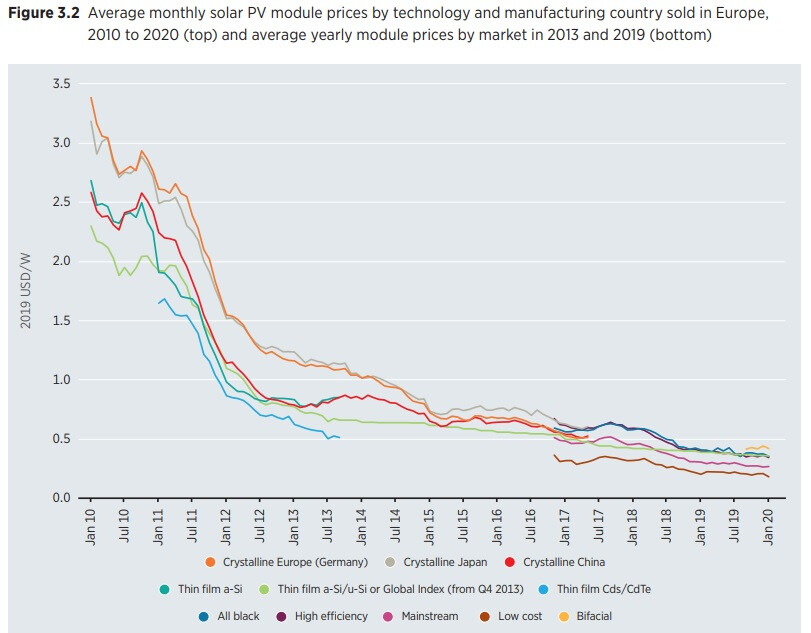
In the utilization of solar energy, competition is against solar PV panels, and their prices have fallen a lot even in the last 10 years, and thanks to the development of panels and their control/regulation systems, annual yields have improved.
If 10 years ago a solar collector and a solar panel had been equal alternatives in some potential project, the cost-effectiveness of solar collectors would have had to develop dramatically in 10 years to be a better alternative than solar panels today. If collectors had competed equally with a heat pump solution back then, the situation would be similar, depending on the trend of electricity prices.
I haven’t delved into how the cost-effectiveness of solar collectors has developed, but the pressure is high if they intend to succeed in the competition.
That’s been my understanding too, that Savo is largely competing against other technologies. (I might have read about it on this forum  ), and it sounds logical. All the more reason why just better market conditions and other positive factors I mentioned earlier don’t guarantee success. More evidence is needed to at least strongly believe in both sufficient demand and sufficient margins.
Since there hasn’t been demand yet, I’ll add the numerical values for sales pipeline development. (And even this doesn’t guarantee anything yet, and we’ll probably only start seeing to what extent the pipeline turns into deliveries once the corona situation eases, if it does.)
Q3 review:
“The value of projects in our sales pipeline at the end of the review period was approximately 279 million euros, compared to approximately 260 million euros at the end of June. Of this, projects in the bidding and design phase amounted to approximately 103 million euros (94 million at the end of June). The sales pipeline includes active projects in various stages recorded in the company’s sales management system.”
The H1 review, on the other hand, shows the development of the previous year, which is surprisingly large, meaning some really big deals might be up for grabs:
“The value of projects in the sales pipeline at the end of the review period was approximately 260 (121) million euros. Of this, projects in the bidding and design phase amounted to approximately 94 (54) million euros. The growth is due, among other things, to increased activity in the French and German markets for the production of clean thermal energy. The sales pipeline includes active projects in various stages recorded in the company’s sales management system.”
So, based on this, there are hopes for better, at least in terms of revenue.
There are indeed no guarantees for margins in the future, even though they have apparently improved from very poor prices. In some report, the company seemed to state a target of 30 percent margin, could it have been gross margin, and in the Q&A section of the late autumn presentation, they spoke of an operating margin that would be a two-digit number and not start with a one. One can strive for that, I’d say, so we are indeed waiting for evidence on this too. And we will have to wait for a time when capacity is in greater use to see the situation then. Oh, and there was some production automation project underway, which could also reduce costs, but such automation is probably quite standard in these types of operations, more broadly.