Magnora ASA - At the forefront of the green transition

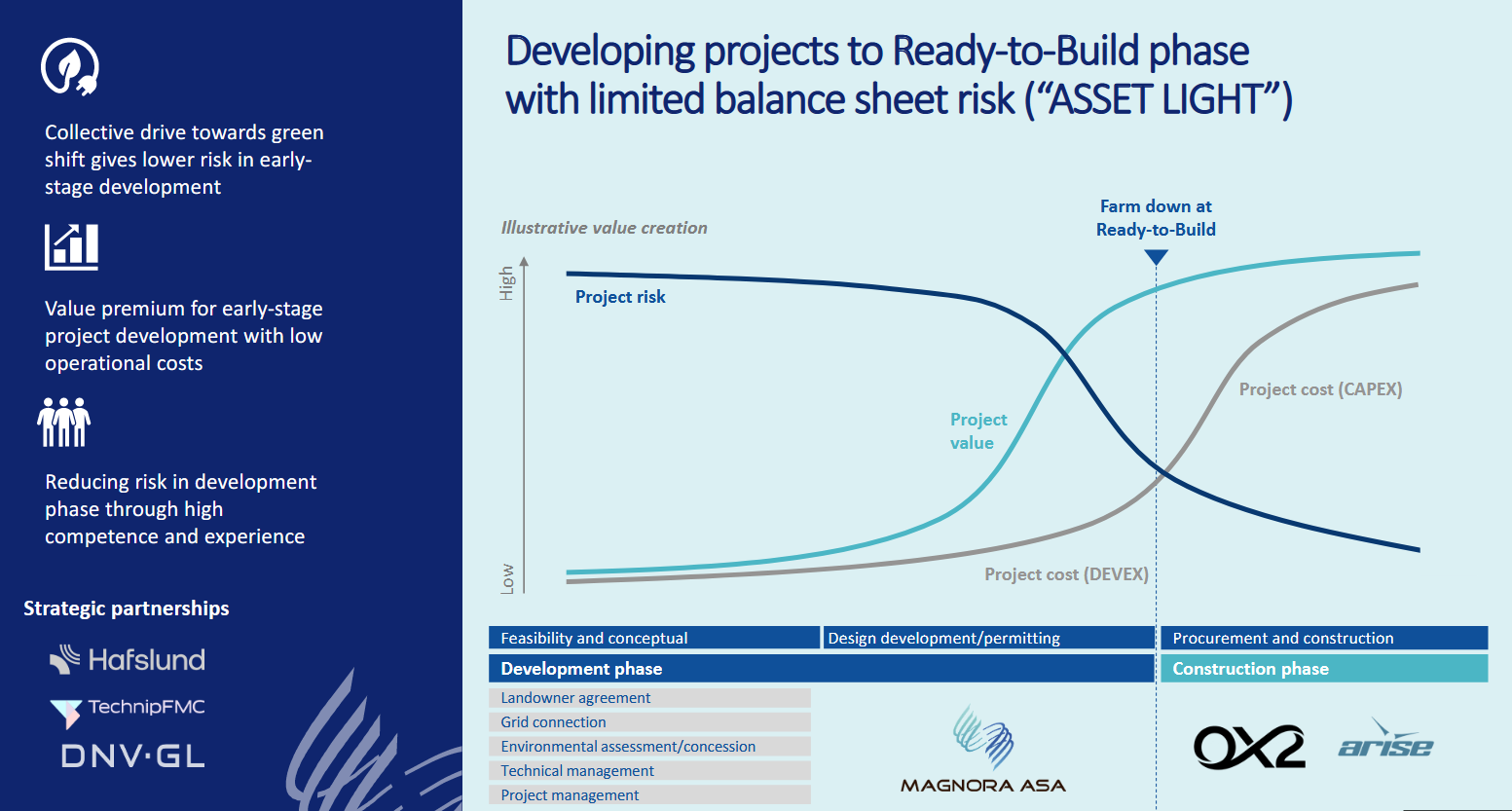
Magnora is a Norwegian renewable energy development company with a market cap of approximately €150 million. While construction companies aim to build and production companies aim to produce, development companies like Magnora operate primarily at the early stages of renewable energy projects, aiming to develop them toward the construction phase. Once a project’s value has multiplied, they begin selling stakes (farm-down) to interested parties, after which the company mainly acts in support roles, providing services such as Owner’s Engineer services and technical support throughout the project’s lifecycle.
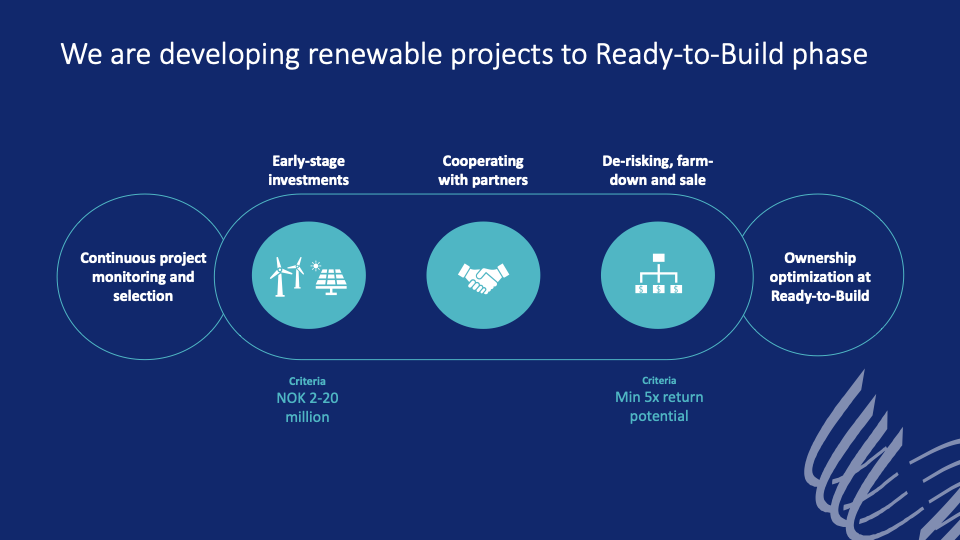
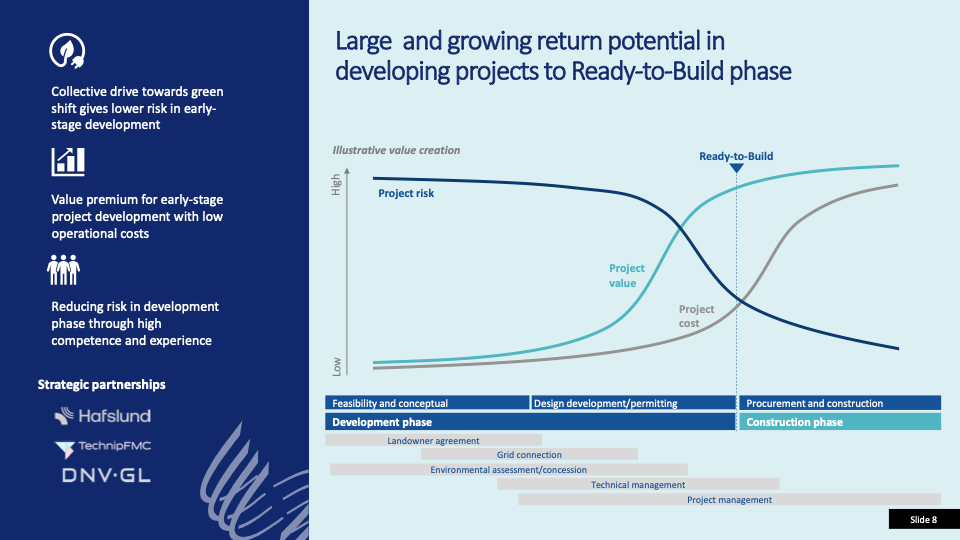
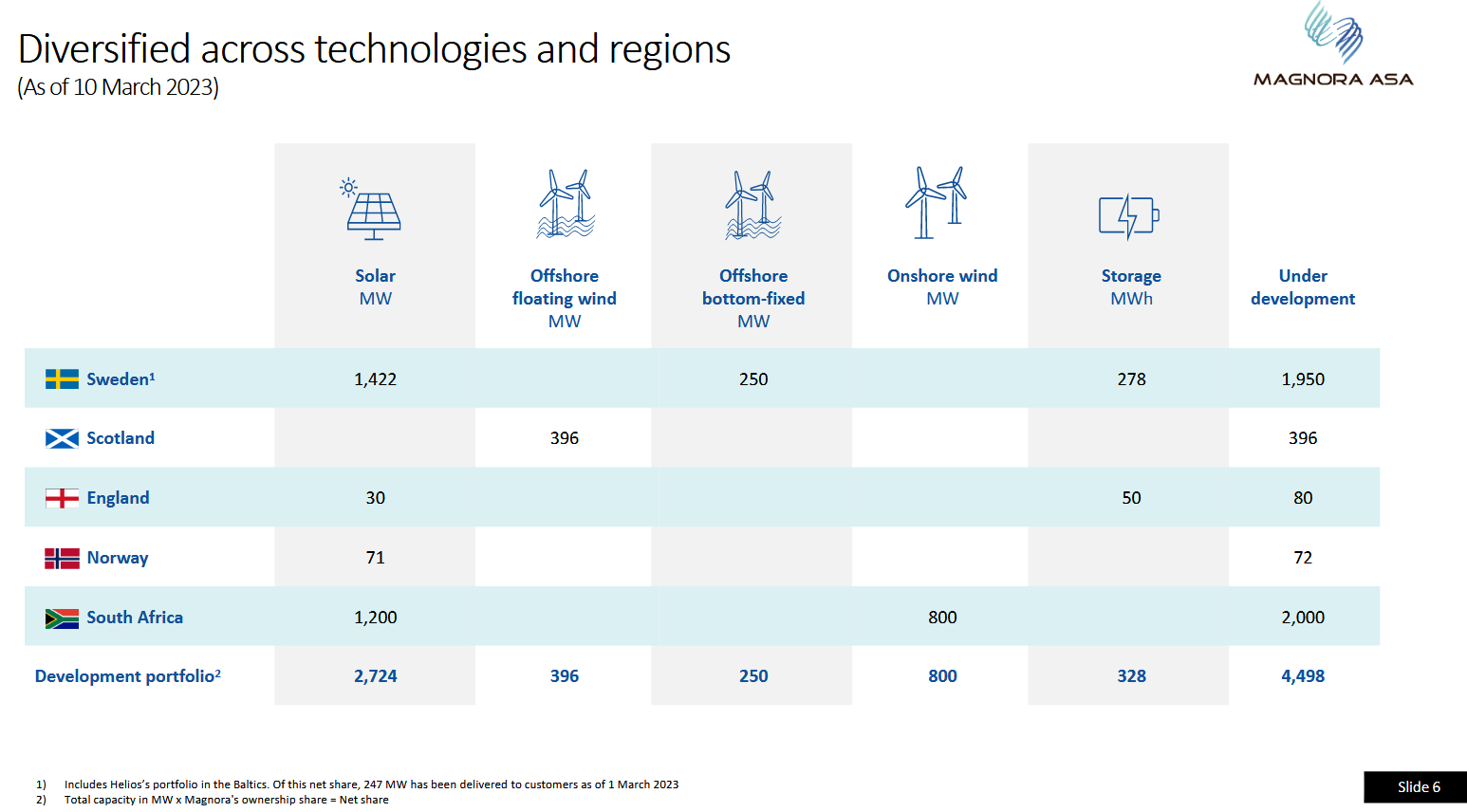
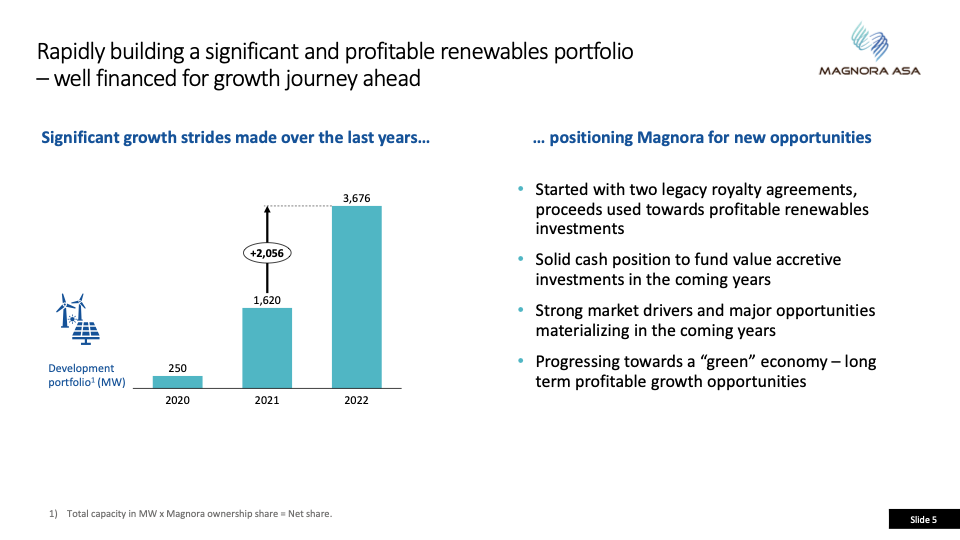
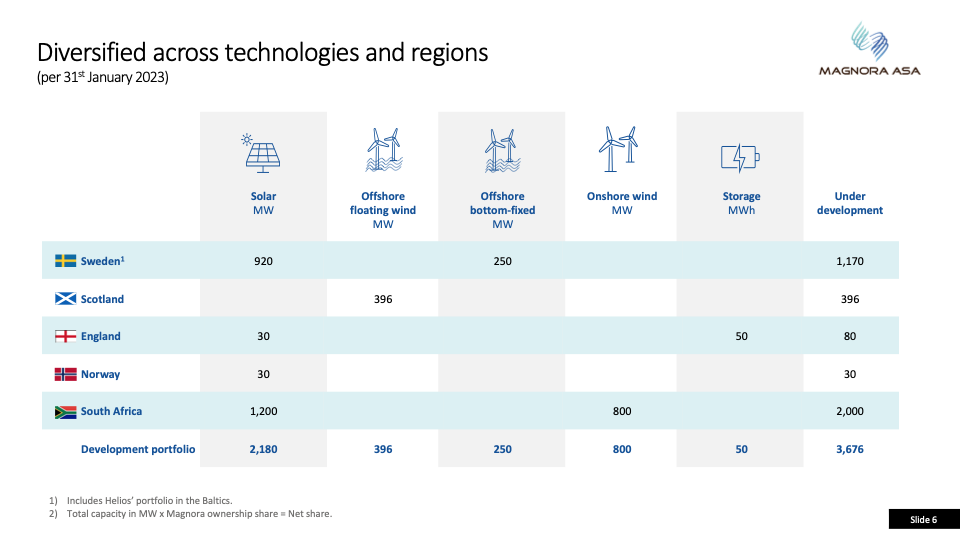
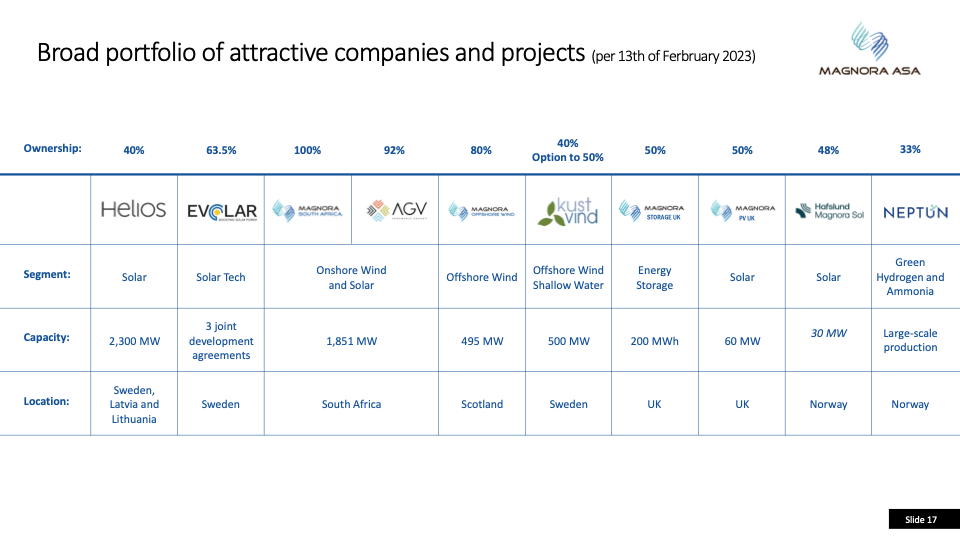
The company has its roots in a profitable oil sector business, which pivoted towards the renewable energy sector in 2018 following corporate restructuring. A massive number of new projects have been initiated in recent years, and the company’s portfolio of projects under development is consequently in a strong growth trend. At the end of the year, projects totaling over 3.5 GW were under development, most of which focus on solar power, with a significant portion directed toward the lucrative South African markets suffering from electricity shortages. They rarely own 100% of projects themselves; instead, local partners and operators are involved to ensure technical success and that development does not stall due to political or bureaucratic issues.
What remains of the legacy oil business are royalty and license fees from two Floating Production Storage and Offloading (FPSO) vessels, which are a type of tanker moored next to oil fields.

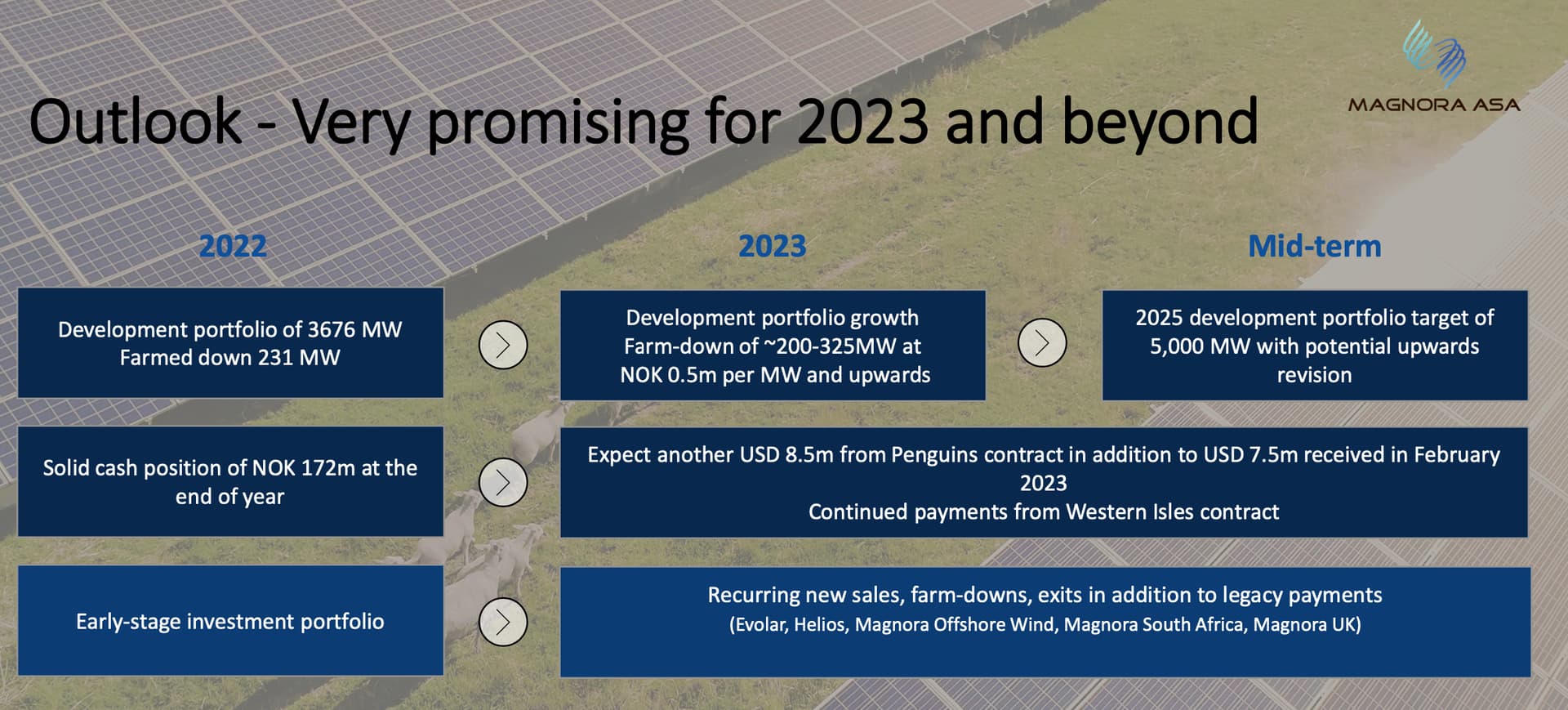
A one-time license fee of 7.5 MUSD was received from the Penguins vessel in December 2022, appearing in the February 2023 cash flow, and the final 8.5 MUSD should be received from Shell later this year, provided the handover is successful and Greenpeace’s disruptions do not succeed.

From the Western Isles vessel, on the other hand, royalties of $0.5 per produced barrel of crude oil are received from the ship’s owner. The production capacity is 44,000 barrels per day for the next 20–25 years, making it a nice sum of income with a 100% margin, but Magnora has indicated that this vessel’s royalty right will be sold for a large lump sum in the near future to exit the oil business entirely.

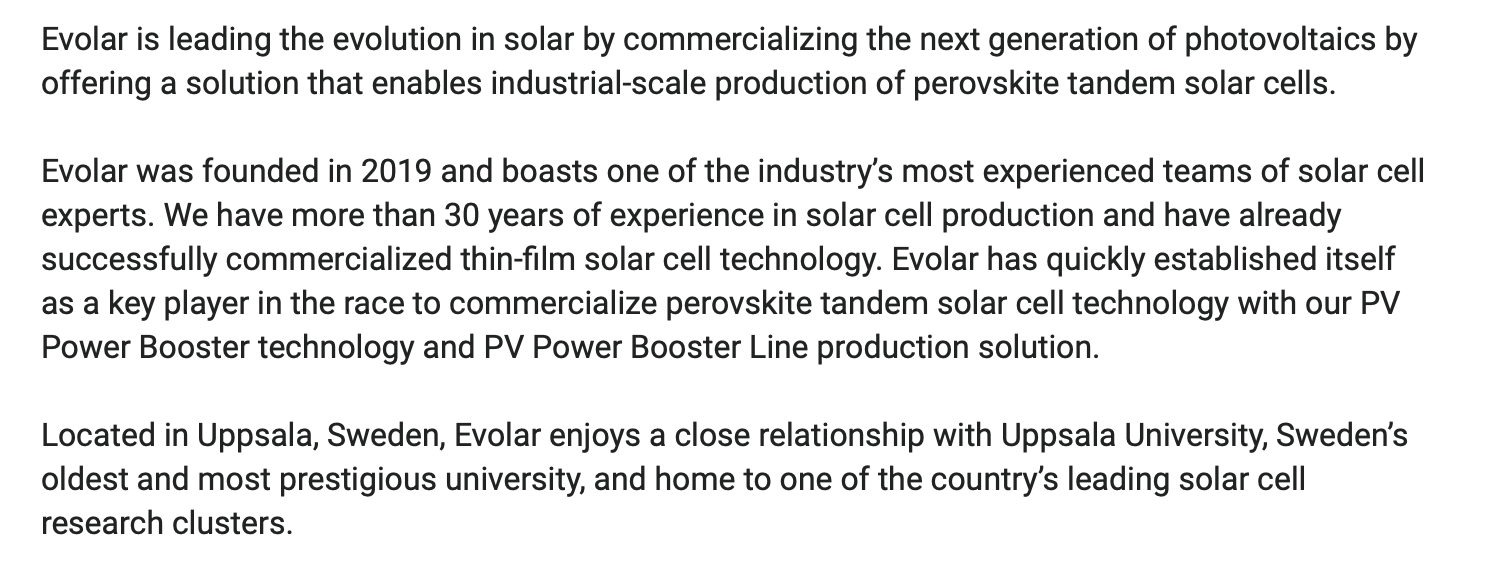
Magnora also holds a controlling stake in Evolar, a very promising solar panel technology startup. Magnora is currently investigating whether to sell the company to investors or conduct an IPO on the Swedish stock exchange.
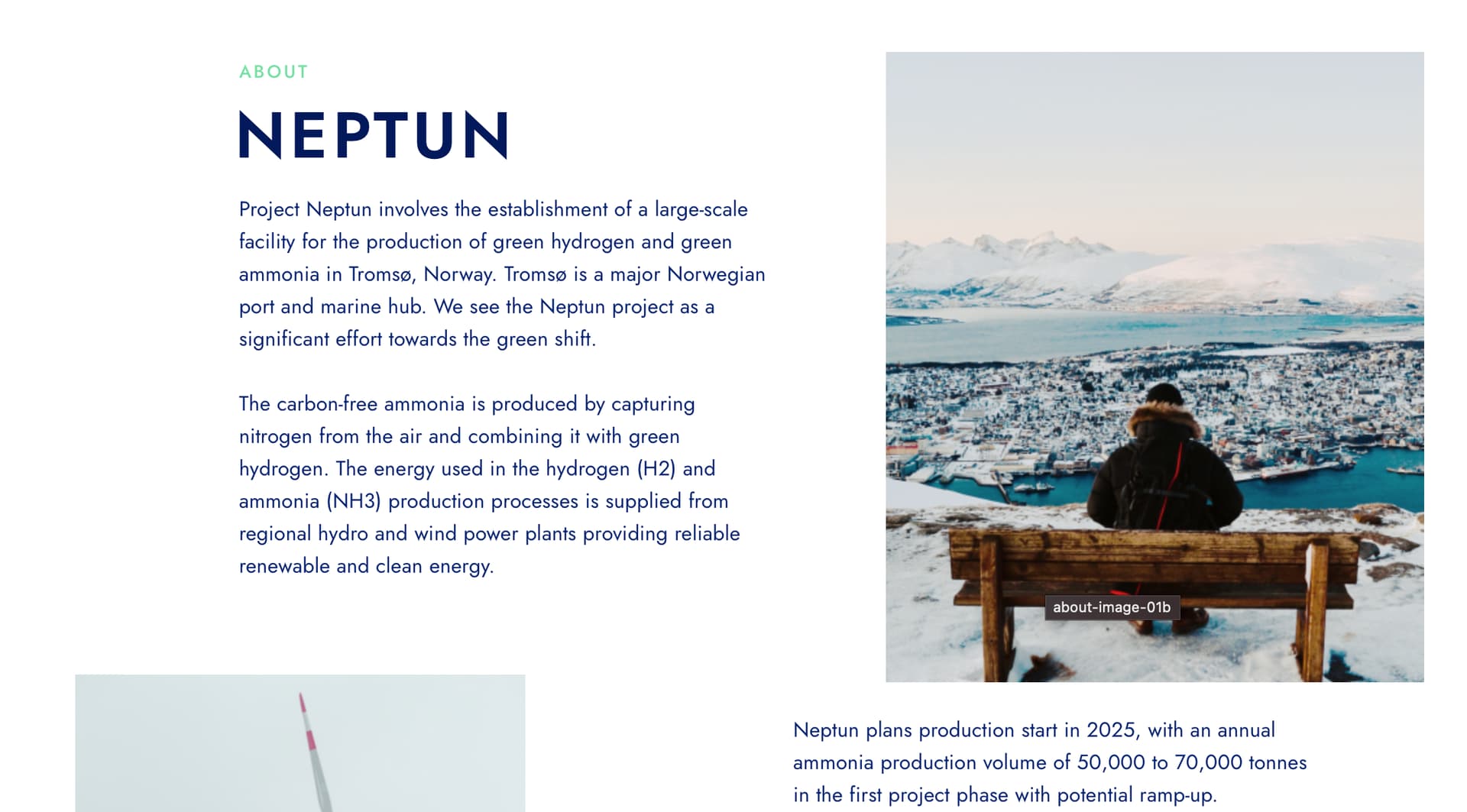
A newer opening is a one-third stake in Neptun, which aims to start producing green hydrogen and ammonia in Tromsø, Norway.
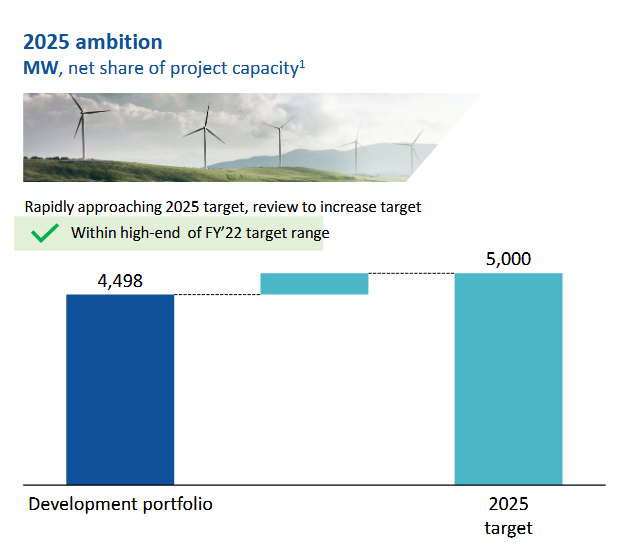
For a small company, there is a lot of interesting activity and catalysts for share price appreciation and value creation. The business also seems to be doing quite well. In 2022, farm-downs generated slightly less than 1 MNOK per MW, but for 2023, the upper limit of the 0.5–1.5 MNOK per MW guidance had to be removed because demand for renewable energy projects is exceptionally high. Additionally, management still needs to consider whether the 5000 MW target for 2025 is too modest, as it currently looks set to be exceeded easily. A real growth company indeed :sunglasses:

75 Likes

It’s good that you’ve mastered Saario’s teachings, and Eka is probably one of the best people to talk to about them.

Some thoughts that came to mind off the top of my head regarding Magnora.

Magnora resembles the business of a junior mining company, but without the risk of not finding anything in the excavation area. Other uncertainties associated with junior mining companies, on the other hand, are certainly present.

It’s worth outlining some time windows for Magnora’s projects and what the realization time for all that work might be—i.e., when the project starts, when money is committed, and when the proceeds from the sale are received. If a realization time has been announced for a project, you can safely extend that timeline quite a bit. Unfortunately, things tend to get delayed. After that, you can consider whether the time window in which the company operates is suitable for you.

Next, it’s good to consider how much the company itself has to invest and under what terms before a project is bought out. Even though the company has a capable project team, they need external design work for permitting. When a project is in its early stages, they might not yet get proper free tendering/design work from suppliers. Design work is likely partly outsourced and partly done in-house. At least the EU offers funding for green energy projects—I don’t know about Norway—but they also expect companies to pay their share.

Another thing is the land. Do they have to buy the land themselves, and how far in advance of the project sales?

Their business is apparently to develop the most cost-effective solution possible, obtain the permits for it, and sell the project with the permits, but are there buyers for these projects?

The margins from selling a project are likely determined by how cost-effective an idea they have managed to develop. This leads to the question: why doesn’t everyone do this?

A different company, but for example, when news about this broke, there was a lot of talk that it might be very likely the project won’t actually happen.

Fortum was mentioned as a partner, I think, but I wonder if that relates more to Inkoo’s new LNG terminal rather than Fortum wanting to buy the steel mill in question later or buy products from there. Who knows.

One thing I’ve been reflecting on regarding these oil company organizational changes is why companies are typically split in two. Atypically, Neste, for example, continues with an oil-green energy mix, but companies like Dong (now Örsted) and Aker have clearly separated their green energy projects into different companies. Örsted sold its oil operations and Aker spun off companies. Does this involve a complex web of subsidies, for instance? How does that affect Magnora?

Well… you don’t always have to overthink these things. Sometimes you can make money on a stock simply because it’s popular.

21 Likes

Good opening from Eka. The first thing that comes to mind is that it would be good if it were on a more reliable exchange, e.g., the TSXV, but I’m trying to be open-minded and get past this shortcoming.

Quick question about the business model: is all revenue based on a so-called project model, or is there some recurring revenue? Perhaps the answer was already buried in the text, but it didn’t catch my eye immediately, and it would be nice to hear an answer to this.

6 Likes

I got a general timeframe of 2–5 years for wind farm construction, for example, from ChatGPT, but I don’t know about Magnora, as an upstream player is likely just dependent on contract preparation and such; it probably takes less time since they are only involved in the early stages. I also don’t know where to track work-in-progress projects or their completion. There’s already 3.5GW of them, though. If @Pohjolan_Eka knows, maybe they could link a site here.


I can’t answer how much money goes into that “cooperating with partners” part in between. However, you can probably guess some labor costs, e.g., how much working hours normally cost for contract preparation, measurements, and other things.


I found a couple of examples online. They are at least verbally willing to support wind power. I don’t know under what terms, or if cases are looked at individually.

I think that answers it quite well. Additionally, it seems that dividends come from partially owned companies, and if they are sold, their share of the proceeds naturally goes into Magnora’s coffers.

Good questions; I answered quite vaguely, of course, but I did my best. It’s really great to get to justify one’s company choices, as it forces one to get to know the company more deeply.

Edit: I made a few changes to the beginning.

15 Likes

CEO Eric Sneve has a pretty decent stake. 1.2 million shares, or just under 2% of the company.

6 Likes

If it takes 2-5 years, a company spun off in 2018 should already have references to look into. Of course, ChatGPT goes through a lot of written data, and I don’t know how critical it can be of its sources. In my own field, it gives wrong answers at least, even though it gives good answers when you’re looking for general, indicative responses.

Sometimes those projects can get stuck for as long as 10 years due to neighbors and macro phenomena.

If there aren’t many references, it’s worth considering whether that 3.5GW project accumulation is due to a lack of sales.

I’m sure others have already considered these. :hugs: I just thought I’d bring it up since you were looking for a challenge. Personally, I’ve mainly focused on Finnish stocks.

1 Like

I’m replying again because my previous response was a bit sloppy. It’s great that you’re challenging me.

The “goal” was 5GW, so it could be interpreted as a good thing if they want many projects and are now actually getting them. Additionally, the CEO, for one, has a lot of money tied up in this. I personally took it more as a sign of management’s confidence in future demand.

Edit: Also, I believe those projects were sold at a pretty high annual growth rate, I don’t remember the exact percentage… Of course, it’s easy to multiply figures on paper if the business is in its early stages. And we are by no means at the stock price levels where we should be yet, but the direction of the trend seems right.

Yeah, honestly, I couldn’t seem to find the construction time for a wind farm, so ChatGPT gave a better guess than I would have come up with myself. How do you personally search for references on project durations in the project business, for example?

Usually, I have some kind of sense of how long a project might take. That initial phase can, in some cases, last a very long time. And that’s quite alright. That’s when things are reviewed thoroughly.

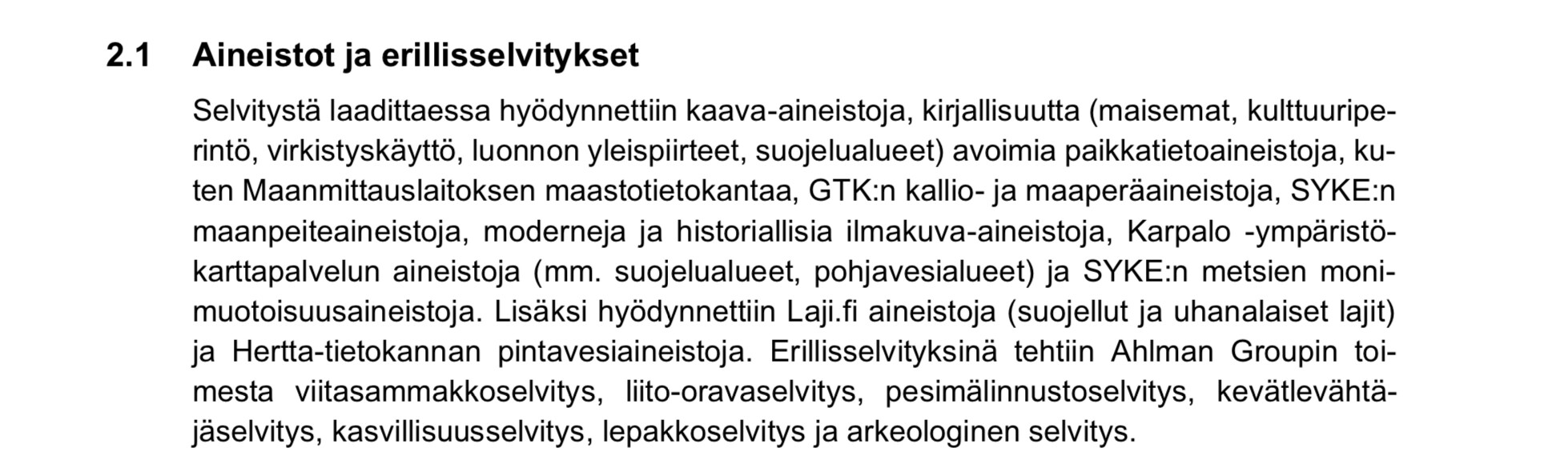
Here is something about the Finnish process of the Environmental Authorities.

https://julkaisut.valtioneuvosto.fi/bitstream/handle/10024/79057/OH_5_2016.pdf?sequence=1

For example, in Norway, wind turbines have been put up faster than here.

Information about solar energy projects can be found, for example, on Fortum’s website. Fortum likely had a business model where it develops solar power plants in India and then sells them to a local operator. Of course, Fortum probably joins the picture at a later stage.

Suomen Hyötytuuli is one where information about its studies is easily available. 15 wind turbines are being completed at Oosinselkä. Zoning was approved in 2013. Before the zoning approval, some kind of plan naturally had to be hammered out. In 2018, project rights were transferred from Pori Energia to Suomen Hyötytuuli. In October 2022, it was reported that excavation and blasting work were continuing.

The mere amount of environmental studies made me smile. :sweat_smile:

If I remember correctly, the cottage neighbors weren’t very excited about this, and there were concerns about birds being hypnotized. Of course, technical matters also need to be considered.

Here are some permit issues that require a bit of inquiry. They don’t necessarily go through on the first try.

https://tuulivoimayhdistys.fi/tietoa-tuulivoimasta-2/tuulivoimasta-kunnille/tuulivoimahanke/tuulivoimaloille-haettavat-luvat

Well, yeah…

Just as an example, I did a quick search showing that these projects can take a while. Of course, outside Europe, there might not be quite this kind of hassle.

Hopefully, permit matters will become easier here too.

Companies likely often have a reference list on their websites, or you can ask the company itself.

4 Likes

2-5 years is an excellent estimate that covers the majority of the company’s projects. Some individual projects might be even faster, like the UK battery project, or take longer, like the Norwegian solar panels. Since Magnora has a geographically and technologically diversified portfolio of different development projects whose development schedules can fluctuate by years in either direction, I don’t necessarily see it as a sensible use of time to dig into the details of each one, except perhaps for those large South African projects.

Speaking of South Africa, our dear oil drilling company Panoro has a very strange project for an oil firm going on there; specifically, they are mapping out environmentally friendly helium production. Panoro’s CEO is also on Magnora’s board, and both companies have local subsidiaries in South Africa, so maybe some kind of joint venture will start within the next year? :cowboy_hat_face:

Smaller cash flows do exist, but the most significant income comes at the moment of exit. Since projects are constantly under development and geographically diversified, in practice, the income stream is continuous as a certain percentage of the project portfolio is completed and sold every year. I expect significant growth in farm-down MW sales volume from 2024 onwards, as this massive growth in the development portfolio that started in 2021 begins to manifest as completed and saleable projects.

Currently, most of the projects are still very young, and in practice, only Helios is responsible for the company’s farm-down sales. The money received from those has now started to flow from Helios as dividends, and Magnora is constantly discussing the company’s future with the three founders. One wild card has been an IPO for Helios, but Magnora could also buy out the founders.

There are often partners involved in the projects, which allows for the cost-effective use of external expertise and labor. There aren’t really any Opex costs for those projects beyond the company’s own personnel costs, so the business scales very nicely once it reaches a large enough size in terms of project volumes. Since, in the company’s view, most of the value creation happens specifically during project development, there doesn’t seem to be a huge urge to get involved in building or operating the power plants themselves. This could, of course, change in the future if management so decides.

The development business naturally includes traditional risks with bureaucracy, which can delay or, at worst, sink the company’s projects. Demand can also change depending on electricity prices and the amount of green financing. As I mentioned in the original post, Magnora has removed the price ceiling from its guidance because the current high demand seems to be driving prices sky-high. I would personally track demand development mainly by looking at the annual volume of farm-downs and the realized price in MNOK per MW. If you believe in the green transition, I wouldn’t be very worried about the demand side at this stage, as the supply is still so limited.

14 Likes

I didn’t mean that they would start building the project; rather, the project’s selling price and buyer interest are likely based on:

  • how much electricity can be produced
  • what the future plant’s opex costs are
  • how much building the plant costs.

These are of interest to a private buyer, unless the buyer ends up being some non-profit entity that has an obligation to produce electricity.

Entities considering their obligations are likely also considering other forms of energy. :hugs:

These and the prices of local emission allowances.

5 Likes

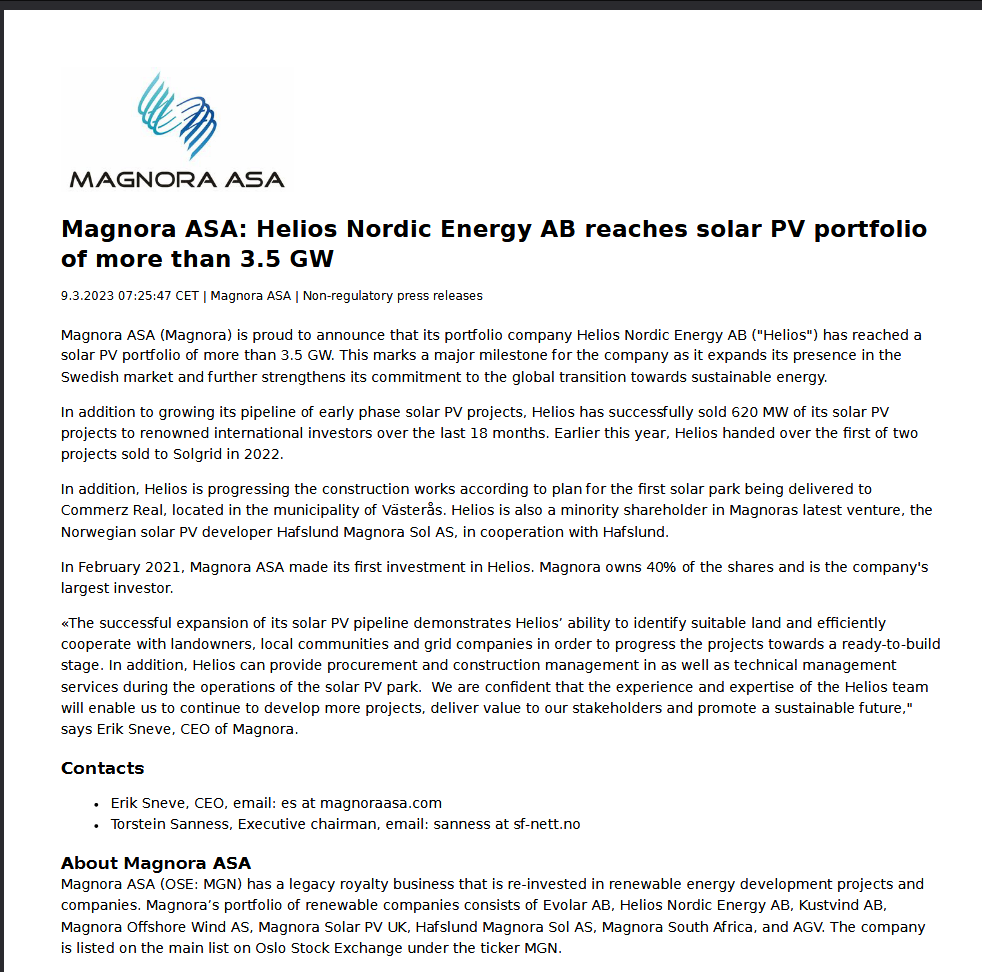
The stock price has fallen a frustrating amount, but the business is moving forward well. Helios’s solar power portfolio just keeps expanding. Last month, the size of Helios’s portfolio was reported at 2.3 GW and now it’s already over 3.5 GW! Magnora’s share has thus mathematically increased by about 0.5 GW!

8 Likes

Helios is just pumping out projects on an assembly line :star_struck:

7 Likes

Magnora’s annual report has been published, and I thought I’d highlight a few points from it:

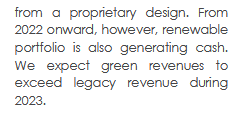
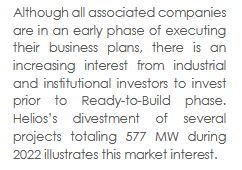
Last year, the renewables portfolio finally started generating cash, and this year the company’s revenue is expected to increasingly rely on renewable energy projects:

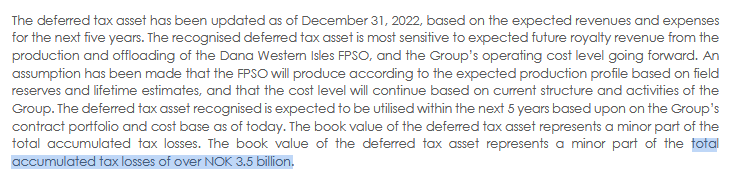
The company has tax losses amounting to several times its market cap, which means they won’t have to pay much tax at all on the company’s own income for several years:

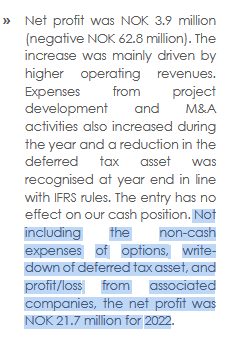
Magnora’s earnings look much worse than they actually are, as write-downs of portfolio companies and tax benefits eat into the profit. This probably partly explains why the market doesn’t seem to have discovered the company yet.

Demand is already so high that some customers want to get involved at an even earlier stage. In the long run, however, this could be a threat if customers start turning into competitors.

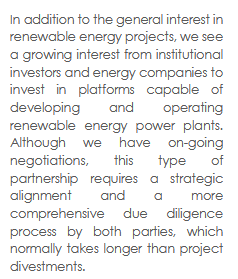
Magnora is also considering deeper relationships with customers, where they would co-operate power plants. This step will likely be taken at some point, but for now, money is being made through development projects.

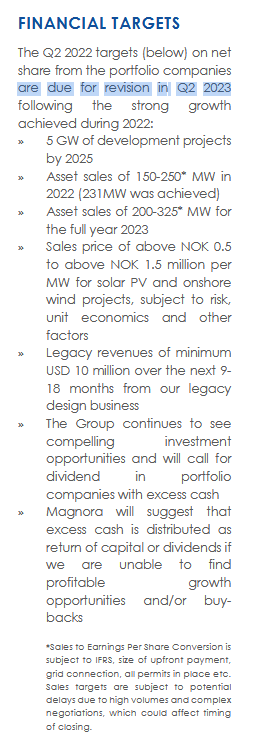
A positive profit warning is coming in Q2 2023, as guidance will have to be raised:

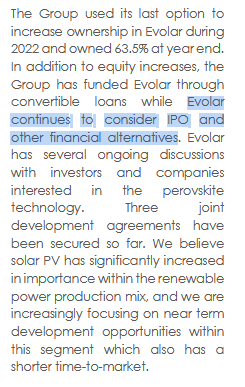
At Evolar, they are still considering whether they dare to IPO in the current market:

That Evolar is a genuinely interesting case, and it might not have been fully revealed just how high-caliber a company it is.

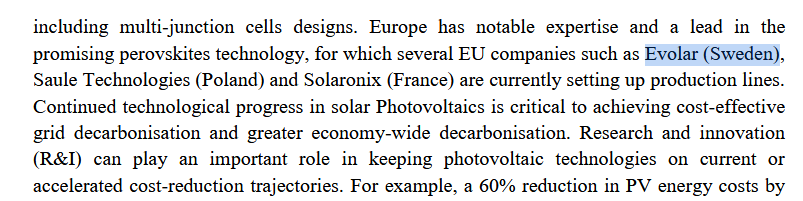
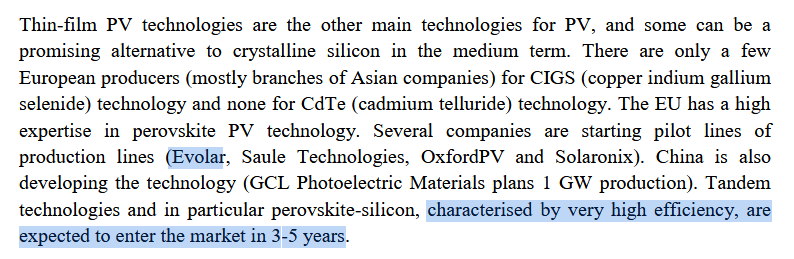
In the European Commission’s brand-new Investment needs assessment and funding availabilities to strengthen EU’s Net-Zero technology manufacturing capacity paper, the company was mentioned as one of Europe’s technology leaders in next-generation solar panel technology.

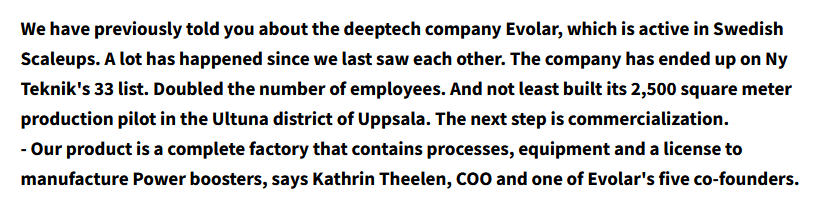
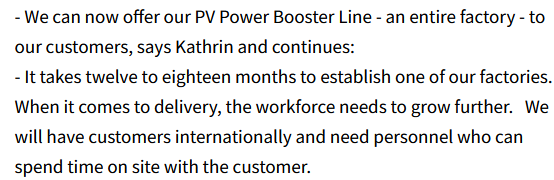
The Swedish Scaleups website had a good story about Evolar last month and how it is rapidly progressing to the commercialization phase:


https://swedishscaleups-se.translate.goog/nyhet/evolar-forbattrar-verkningsgraden-pa-solceller/?_x_tr_sl=auto&_x_tr_tl=en&_x_tr_hl=fi&_x_tr_pto=wapp

If Evolar wins the technology race, it could well be even more valuable than Magnora, and in my opinion, you’re practically getting it for free along with Magnora’s other businesses :thinking:

34 Likes

This thread is turning into quite a monologue, which is why I was a bit reluctant to open it, but I’ll post this since the new investor presentation has all kinds of good stuff:

Magnora’s development portfolio has grown by almost a gigawatt since the last update! (3646 MW). Growth is largely in Swedish solar and battery projects, with a small addition to Norwegian solar. In Norway, investments of 1000 MW in development projects are planned, and an offshore wind auction round is coming soon, so one would expect more growth from there soon as well.

There is a pretty good chance that the 2025 target will be reached already during this year, which makes a positive profit warning and a guidance hike during Q2 almost inevitable :partying_face:

Apparently, there were previously some misunderstandings regarding the business model. The Magnora logo has now been added to the familiar diagram to make it even clearer to investors that the company focuses on capital-light development in its business, rather than construction and operation:

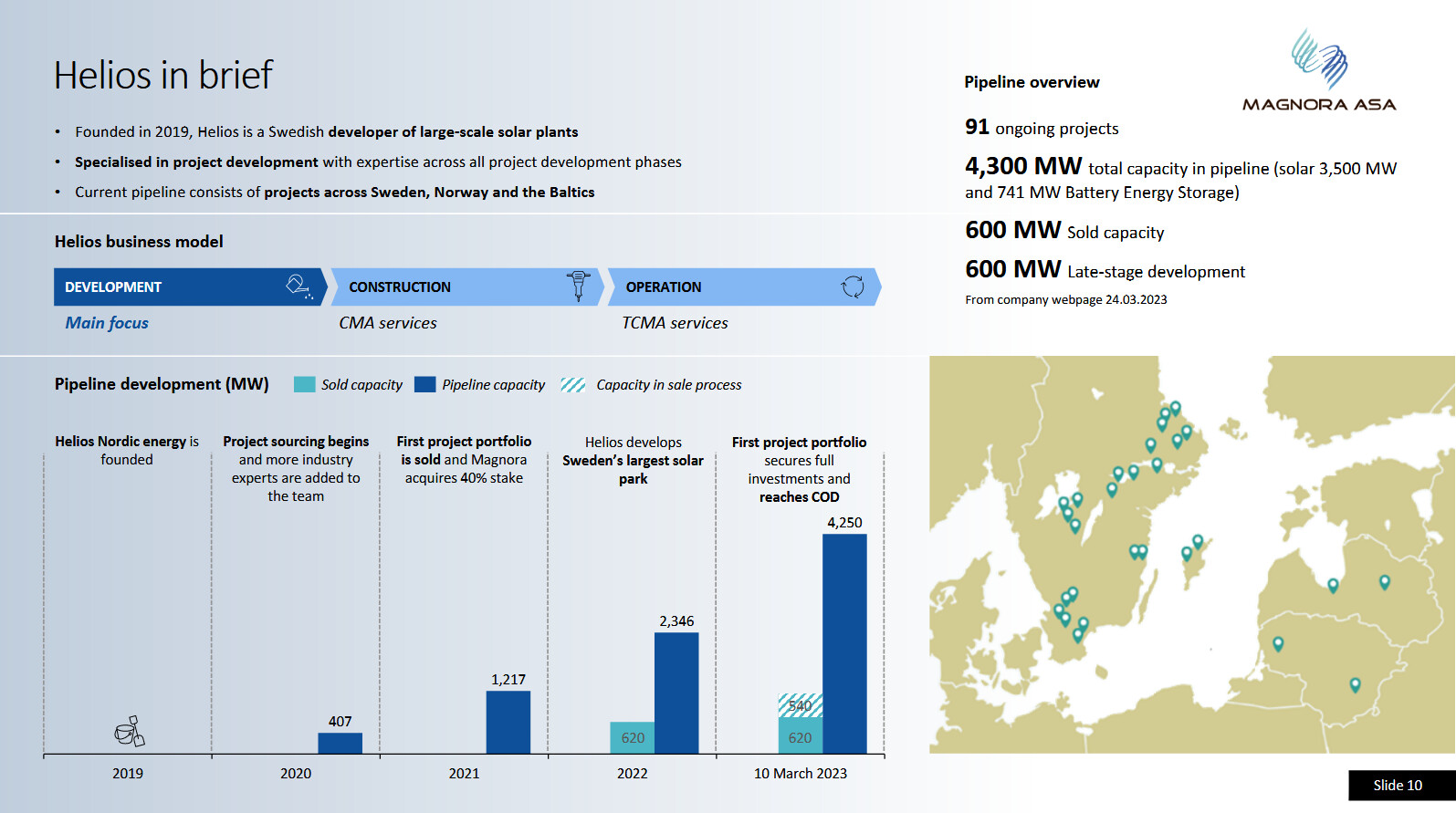
Helios is Magnora’s most important holding, and its situation has been clarified in the slides. They have grown at an insane pace, and finally, money is starting to flow from that development pipeline in the other direction as well, in the form of dividends. Sales should grow quite significantly based on the project volumes started in 2024-2025.

A few useful abbreviations if you’re not familiar with them:
CMA = Commercial Management Agreement
COD = Commercial Operation Date
RTB = Ready-to-Build
TCMA = Technical and Commercial Management Agreement

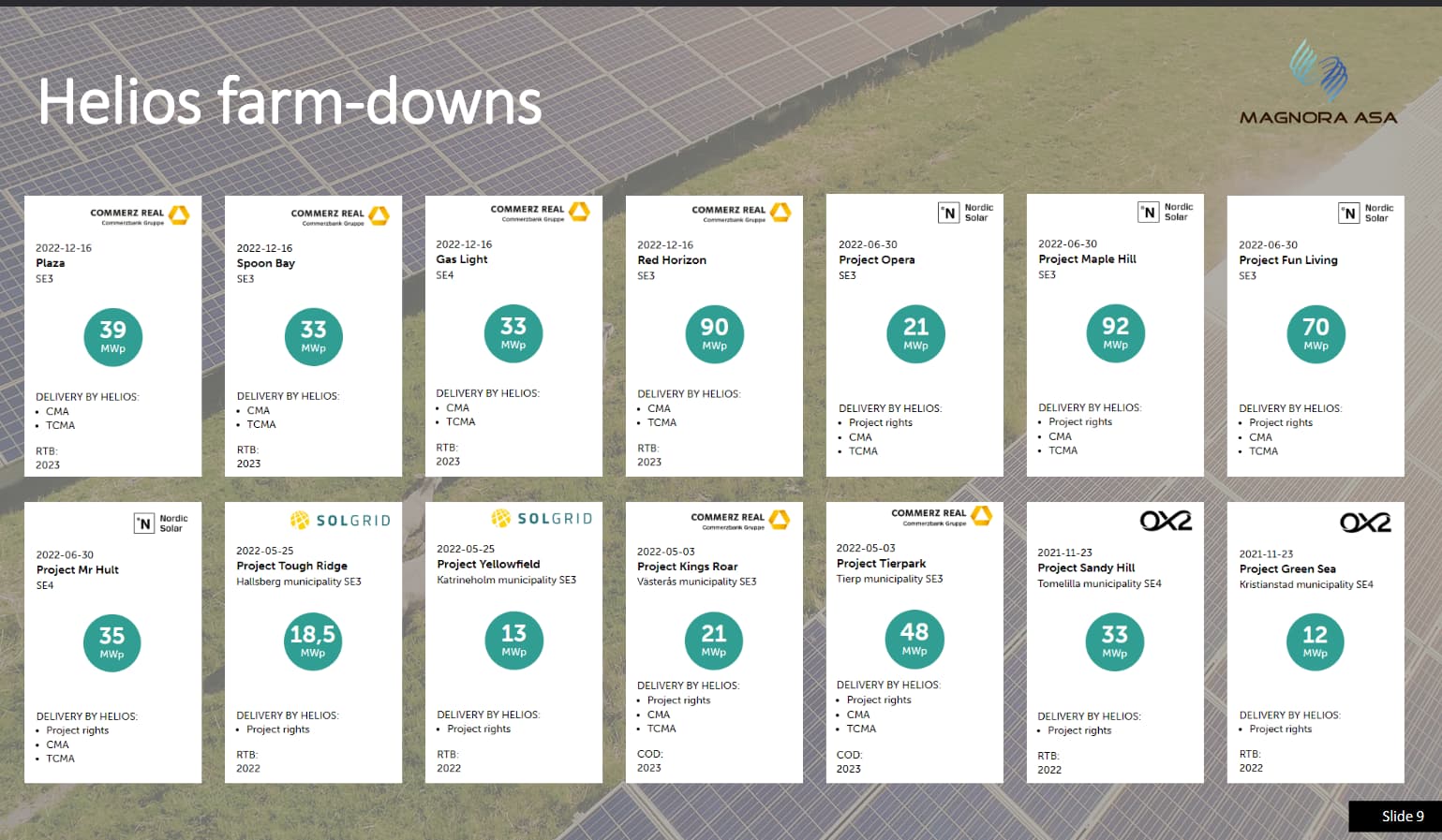
These previously sold 610 MWp have also been nicely broken down individually on cards:

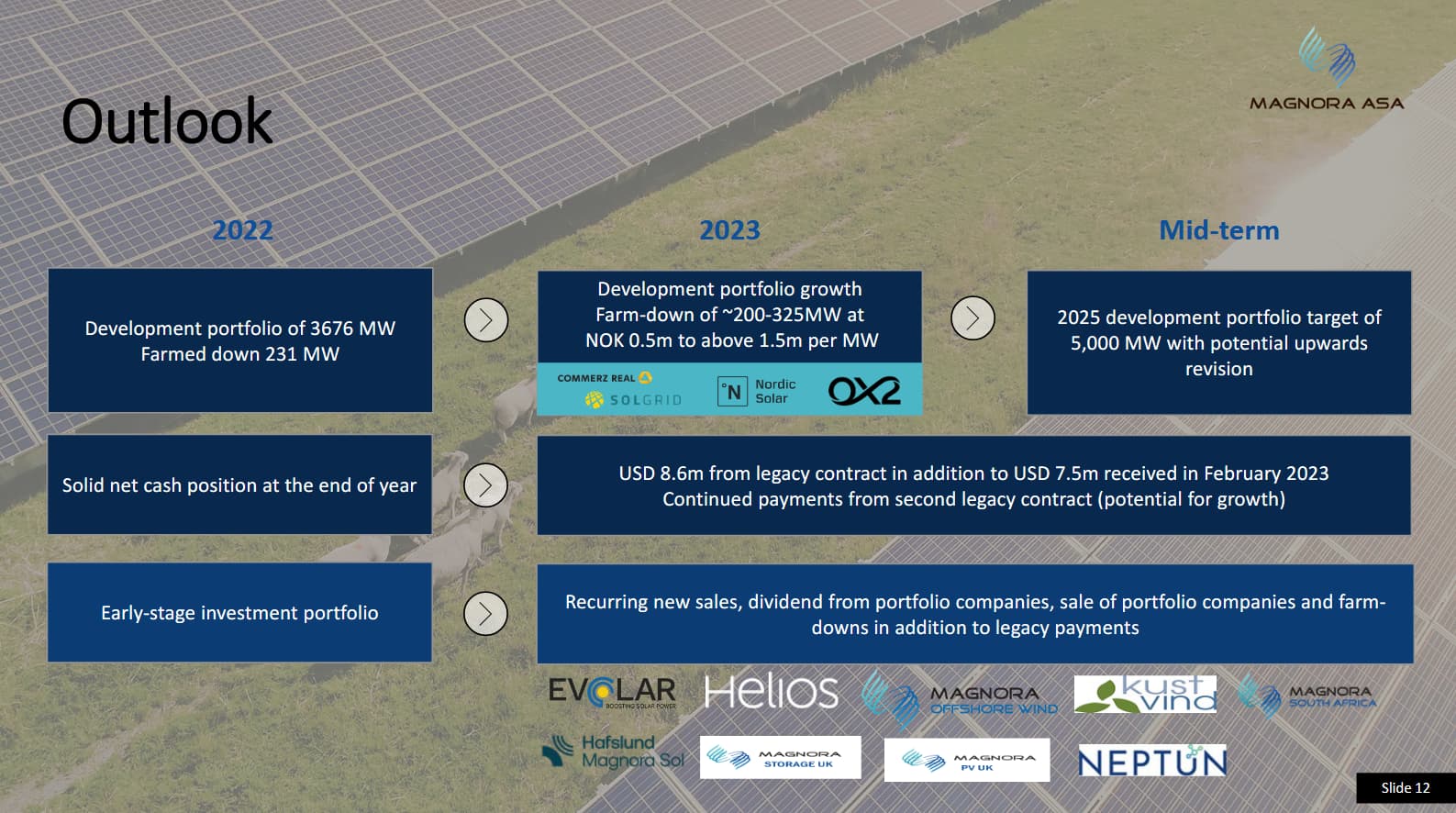
Outlook remains unchanged, but mid-term guidance will be updated soon due to the good progress. “Sale of portfolio companies” likely refers to Evolar.

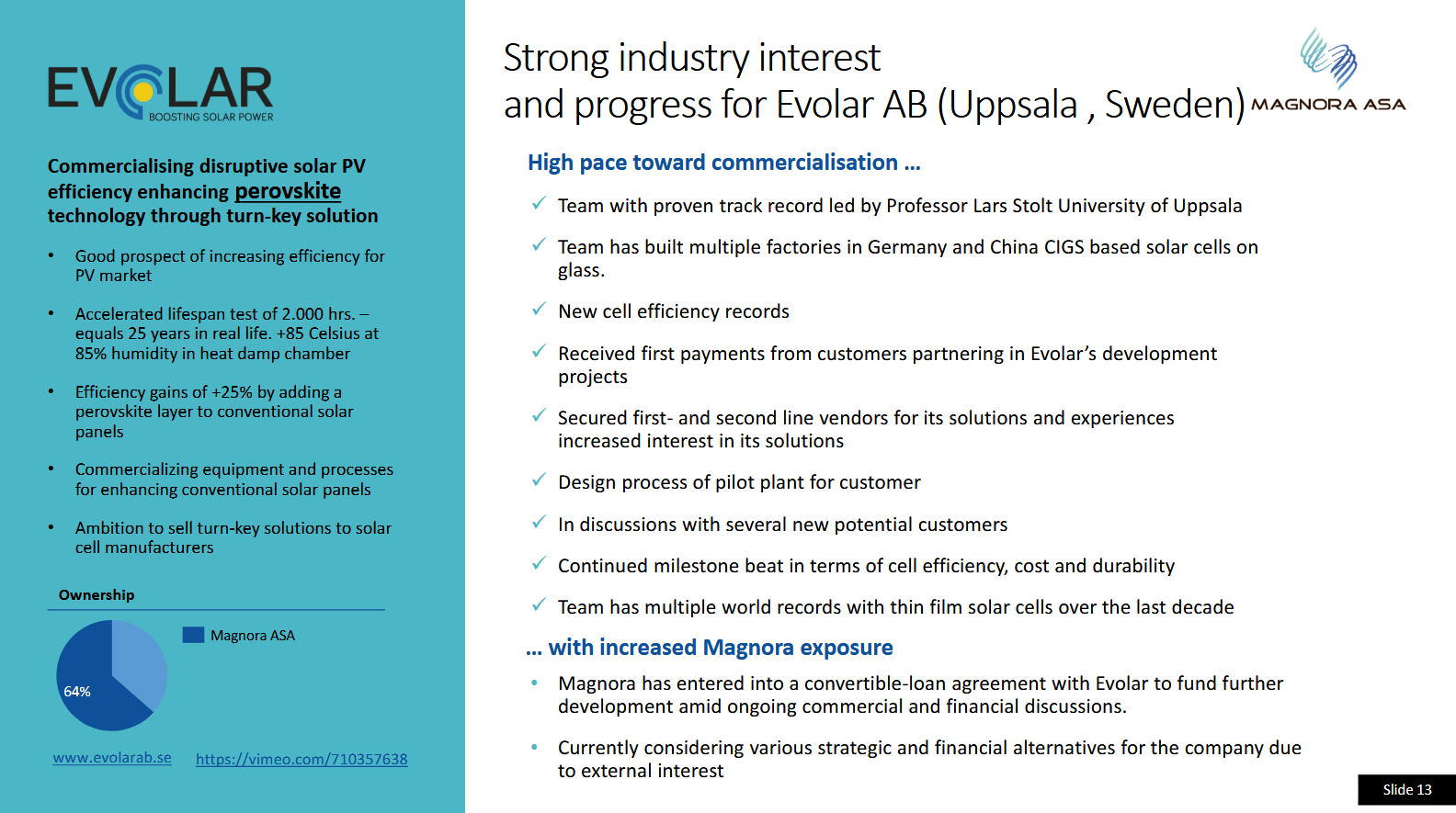
There was a new slide for Evolar, mentioning good results obtained in previous durability tests. Durability has previously been a massive challenge in perovskite technology, so this builds confidence that Evolar’s solution is functional. The slide mentions that the first payments from customers have already been received and resale agreements have been signed. Now the goal is to get the customer’s pilot plant running and secure more funding. Fortunately, Magnora has provided funding via convertible loans, which allow the ownership stake to be increased further in the future, unless the company is sold :star_struck:

53 Likes

I demand that the monologue continues! Could you elaborate on that possible Evolar IPO and how it affects the holdings of those invested in Magnora?

20 Likes

There is no direct impact unless Magnora decides to distribute its Evolar holdings to investors as dividends.
Evolar needs capital to implement its growth strategy, so in an IPO, Magnora would presumably dilute its stake to below 50% while still remaining the main shareholder. At a suitable stage in the future, once value creation has occurred, they would then start looking for a suitable industrial buyer for the stake or the entire company.

After the IPO, those Evolar shares owned by Magnora would be valued at market price, which would likely mean quite wild and unwanted volatility in the earnings, especially if Evolar goes public at an outrageous hype-driven price.

15 Likes

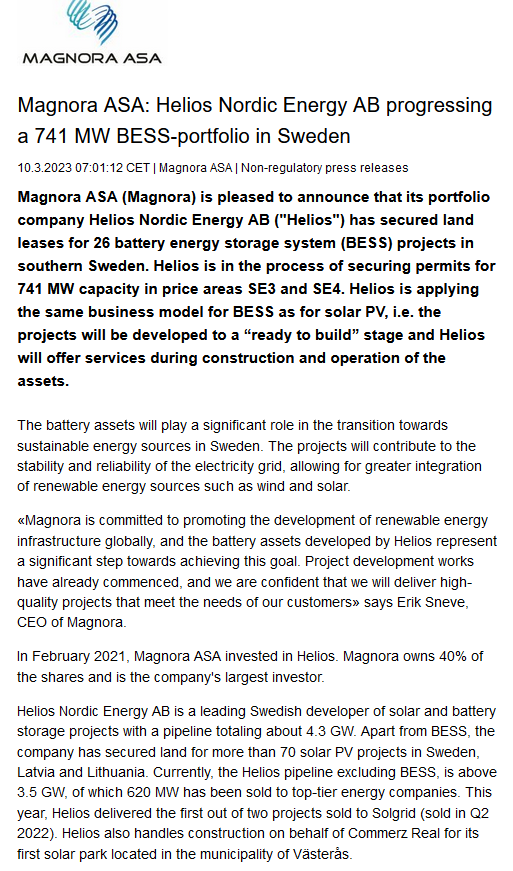
Sometimes risks materialize in these projects, and delays occur. Here is a story about how Helios’s 47 MW solar park project had to start the building permit application process from scratch after an incensed neighbor complained about the location of the substation.

https://www.tellerreport.com/news/2023-03-27-he-puts-an-end-to-sweden-s-largest-solar-park.BkEeg0sRg2.html

11 Likes
7 Likes

A question for those more knowledgeable: Can anything be inferred from these solar project handover announcements regarding which year the revenue is recognized?

Magnora outlined the following target for 2023 in its 2022 annual report:
“Asset sales of 200-325 MW for the full year 2023”.

My understanding is that most of the near-term sales would come from solar power projects, primarily through Helios, as it was the focus of the investor presentation. Furthermore, the Norwegian projects only started earlier this year, permits are still being sought in South Africa, and wind farm construction isn’t expected to begin for several years.

I’ve reviewed Helios’s projects, and by tracking and forecasting them, one could already get a decent idea of the likelihood of hitting the 2023 target; however, I’m not entirely sure when the funds actually change hands.

For example, on January 18, 2023, the following was announced:
“Magnora’s portfolio company Helios is now handing over the first of two projects sold to Solgrid in Q2 2022.”

Sold in Q2 2022, but handed over in early 2023.
Did the money change hands back in Q2 2022, or only upon handover at the start of 2023?

6 Likes

Hi,

Revenue is recognized in the same year the project is sold, but Magnora’s (Helios’s) involvement in the sold asset does not end completely, as they also provide high-margin expert services related to the project to customers. This is natural since they know the project best at that point.

This year, sales are planned to come from solar plants in Sweden, solar plants in South Africa, and batteries in England. If all of those reach the finish line, the upper end of the guidance will be exceeded, but the range is inevitably wide as individual projects are large in terms of megawatt figures and sales are lumpy. Sales have been ongoing in South Africa since last year, but the first deal in a new country can take as long as a year, as companies are reluctant to take risks with a new developer. Magnora predicts that as the deregulation of the South African electricity market progresses and moves toward competitive electricity markets, investor interest will skyrocket.

9 Likes