Lindex Group (Stockmann Group)

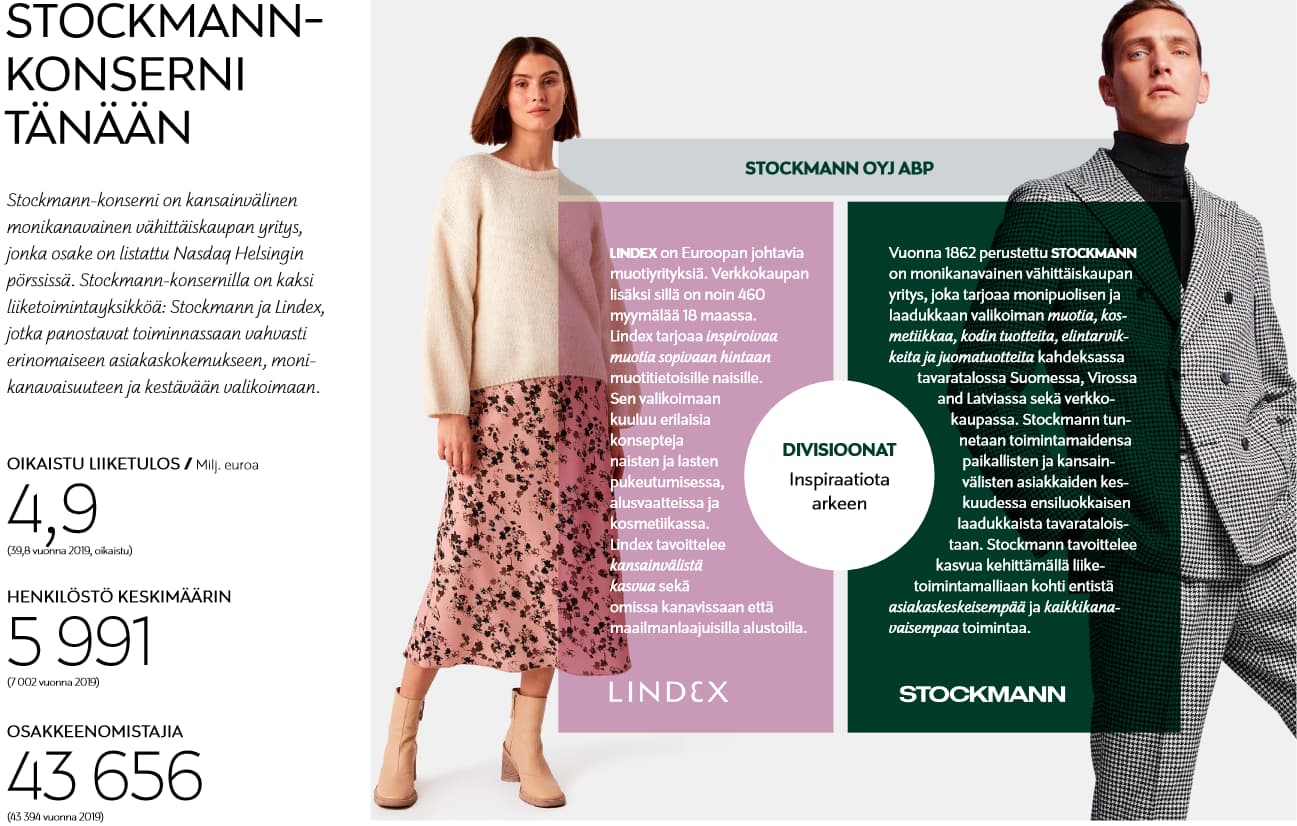
Stockmann is a traditional listed company known and previously loved by all Finns, which has been in major difficulties in recent years. To mark the turnaround, let’s open a thread on the Inderes forum as well.
image

As a result of years of mistakes and challenges, the Corona crisis eventually drove the renowned company into corporate restructuring.

Stockmann plc (Stockmann Oyj Abp) filed an application for corporate restructuring proceedings with the Helsinki District Court on April 6, 2020.

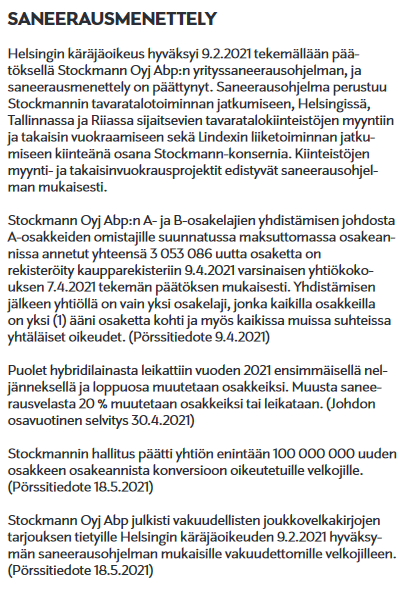
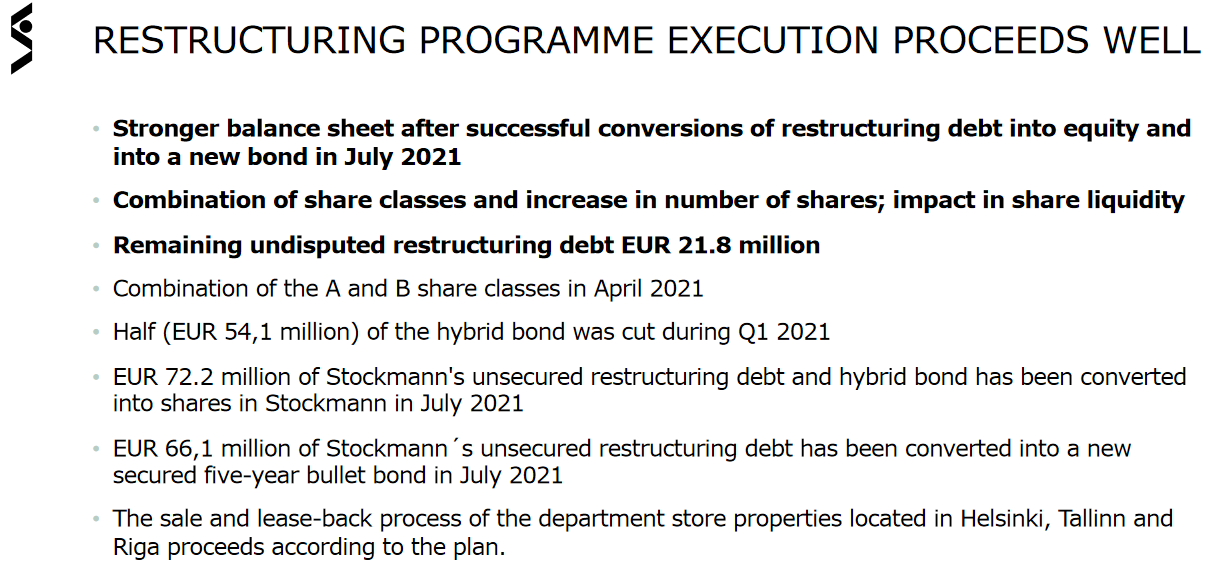
By its decision on February 9, 2021, the Helsinki District Court confirmed Stockmann plc’s restructuring program, and the restructuring proceedings have concluded. Attorney Jyrki Tähtinen was appointed as the supervisor of the restructuring program. The restructuring program is based on the continuation of Stockmann’s department store business, the sale and leaseback of the department store properties in Helsinki, Tallinn, and Riga, and the continuation of Lindex’s business as an integral part of the Stockmann Group.
image

The proceeds from the properties must be used to pay off debt, and in the best case, a significant amount will also remain in Stockmann’s cash reserves. The minimum sale amount is approximately €450 million, but management is talking about a possibility of over €1,000 million. The sale is promised to be completed during 2021, and there is time until the end of 2022 to implement it.

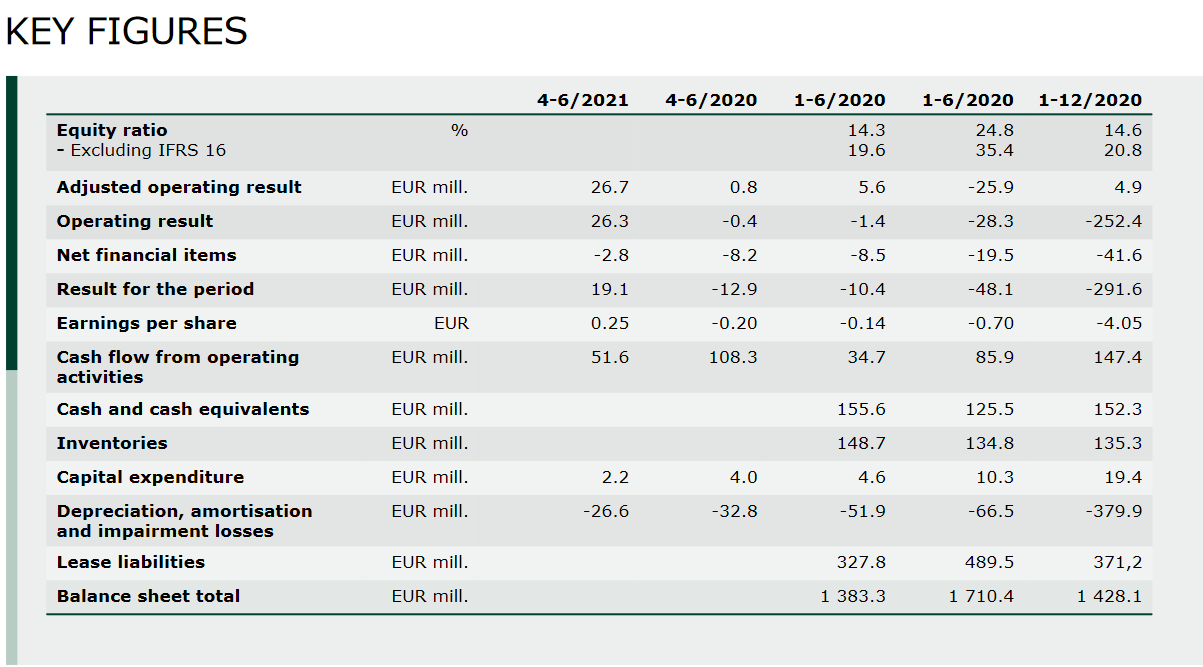
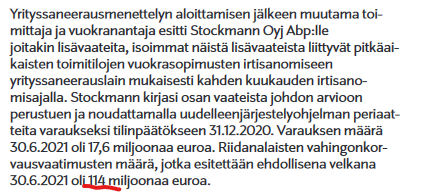
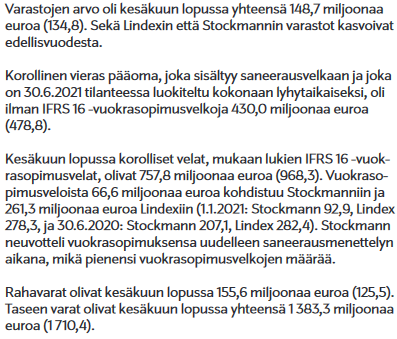
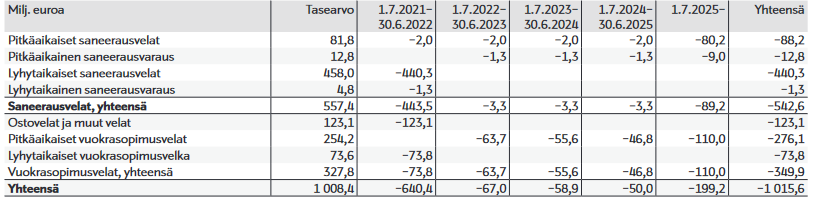
At the end of June, the company’s financial position was very stable with cash reserves of over €150 million. Total restructuring debt was slightly over €550 million. Remember the IFRS 16 change from a while back, due to which lease agreements are now recorded as debt on the balance sheet! This debt is therefore not a cash loan, but a rental cost!
image

image

Financially, the Stockmann Group’s position has indeed improved significantly as a result of recent measures and restructuring proceedings.
image

image

image

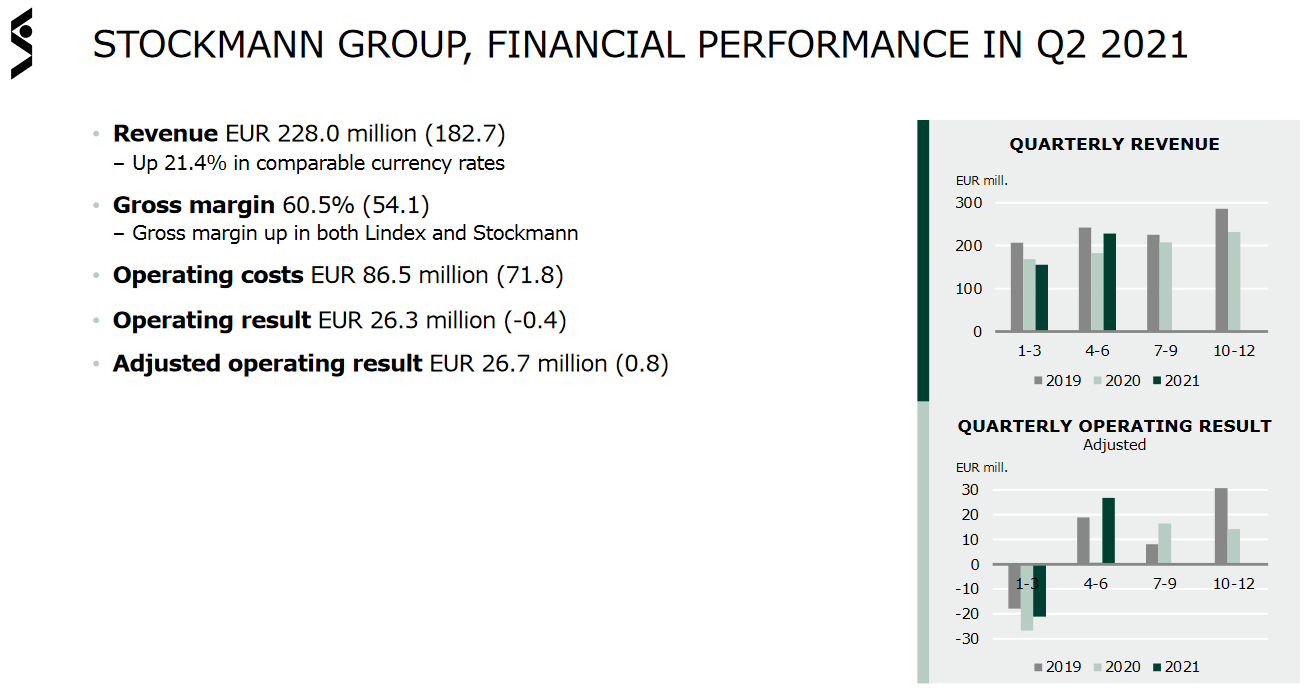
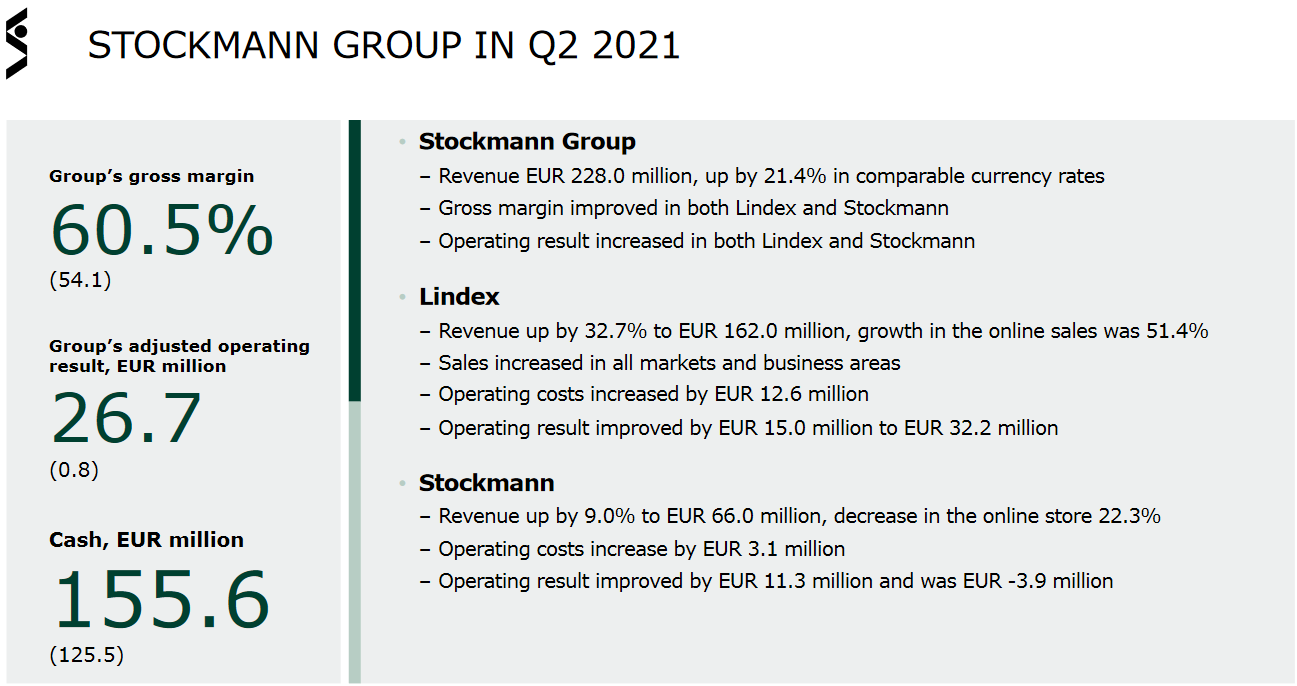
During Q2 2021, the tough measures have finally begun to bear fruit, and Stockmann Group made a historic turnaround in the middle of a difficult Corona situation, bouncing back from losses to a clearly profitable position! Of course, it should be noted here that Q2 and Q4 are usually clearly stronger for the company than Q1 and Q3, due to the strong seasonality of sales.
image

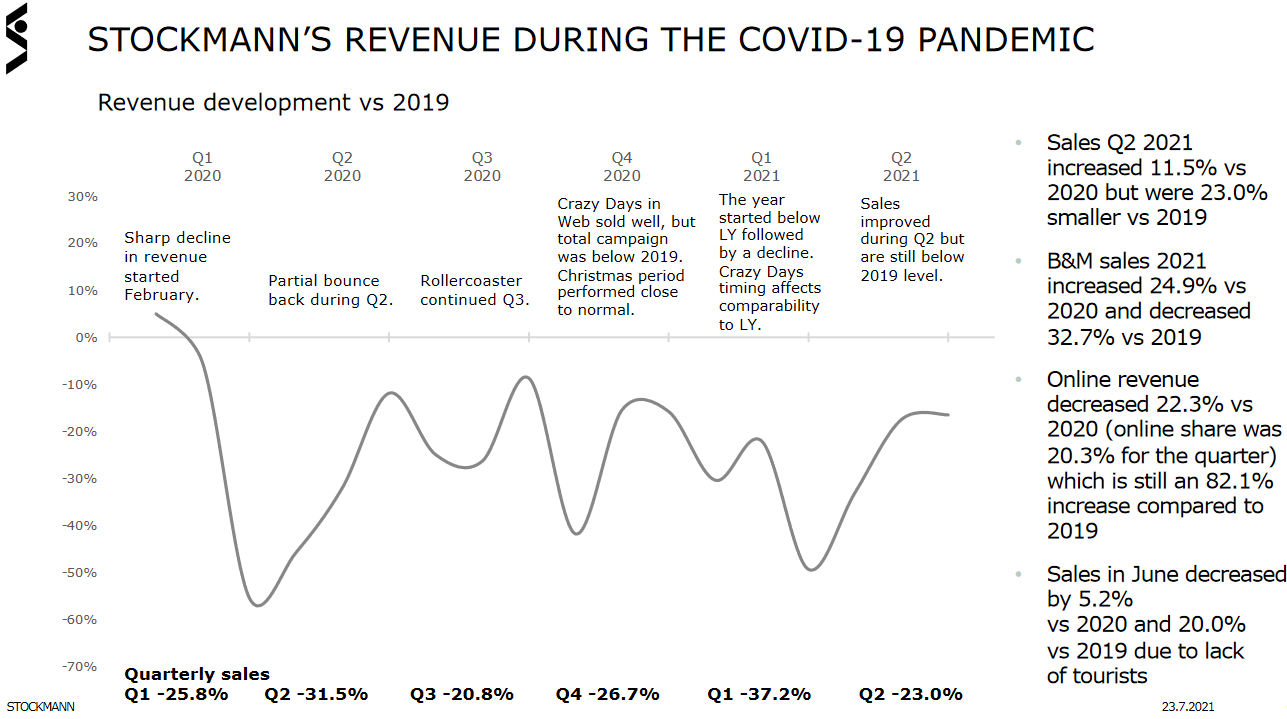
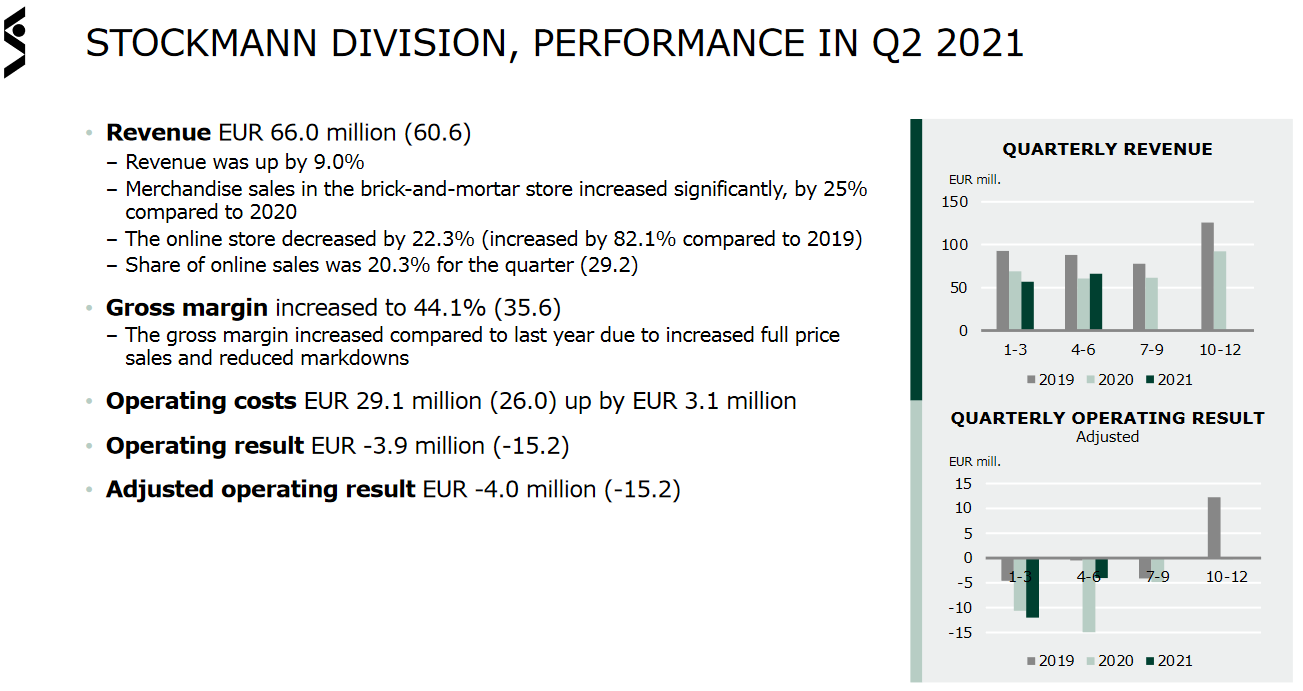
Stockmann retail’s revenue is still stagnating due to the after-effects of the Corona crisis. The retail turnaround is a crucial part of the company’s turnaround story; Stockmann’s management expects it to show clear signs of improvement as the Corona situation eases, vaccination coverage increases, and tourism returns to Finland.
image

image

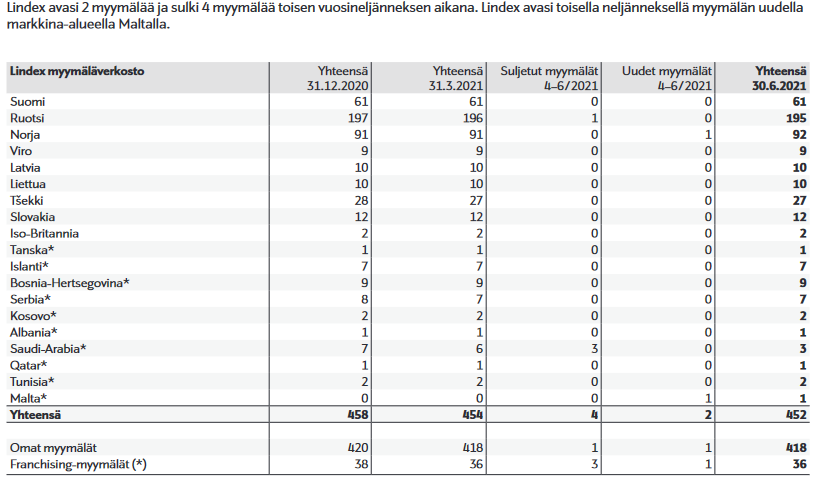
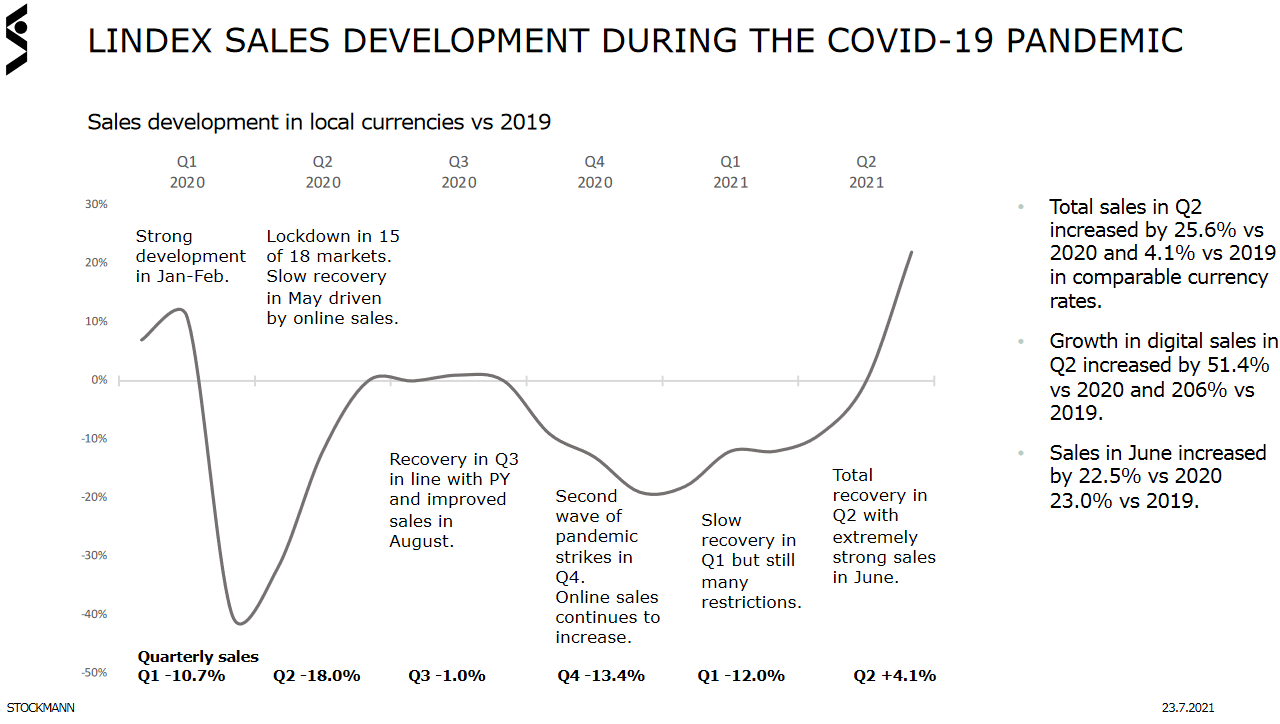
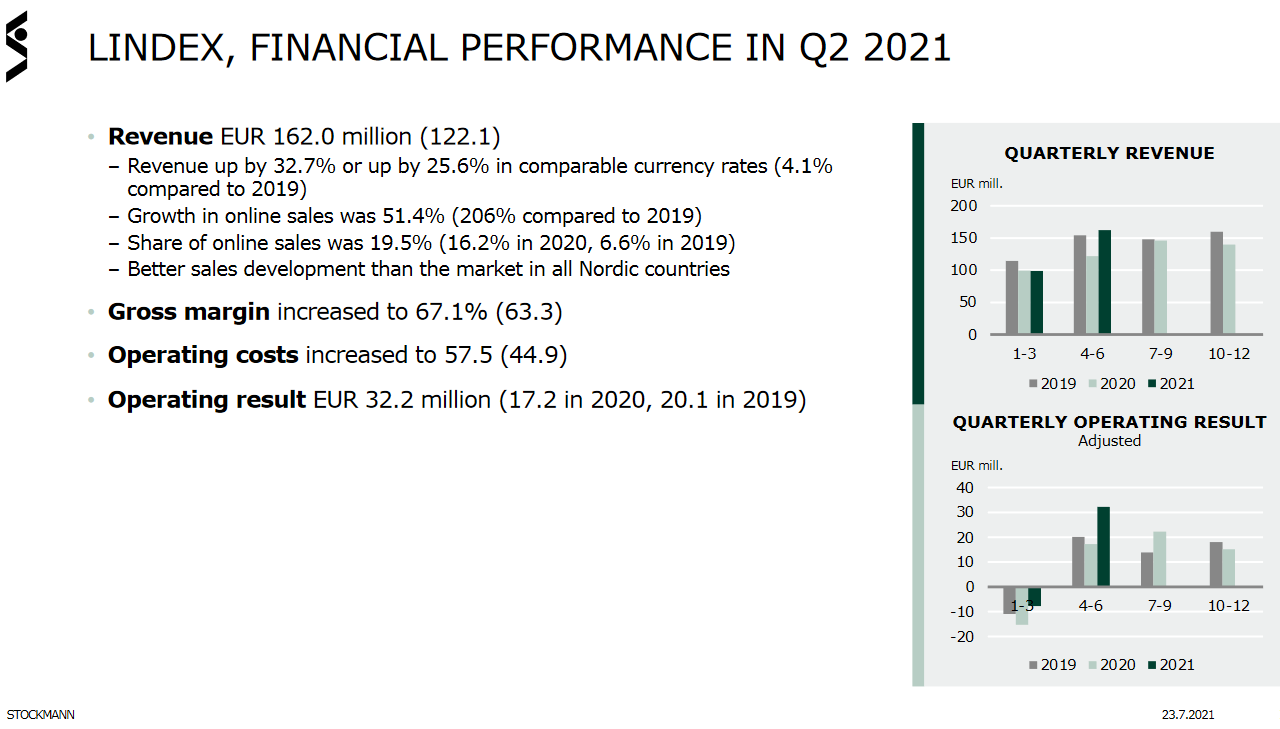
Lindex, on the other hand, continues to power ahead strongly despite store closures during the second quarter. The end of the international Corona crisis is expected to increase Lindex’s sales significantly unless new major restrictions are imposed.
image

image

image

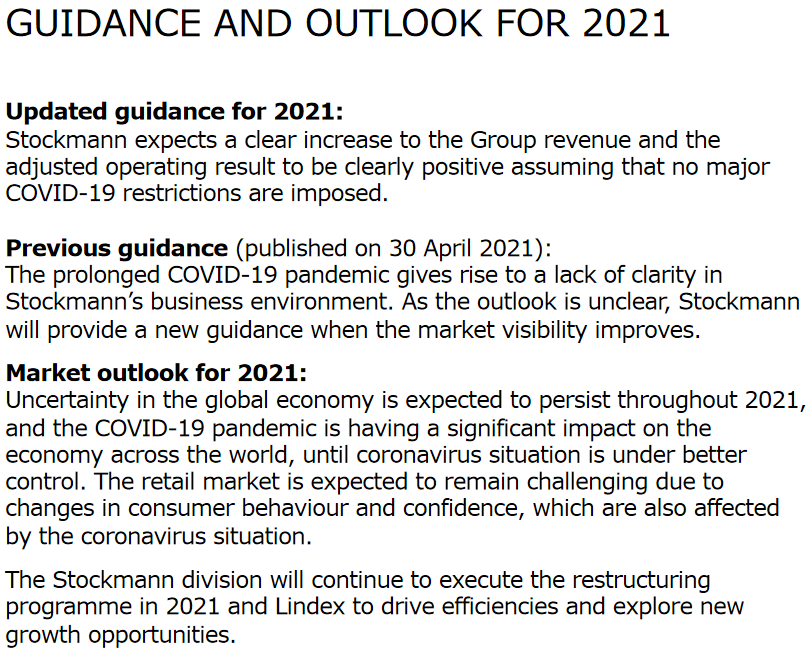
The guidance for 2021 is particularly positive, with the caveat that Corona does not cause significant additional problems. In particular, the aggressive spread of the delta variant is a significant risk for the company’s end of the year and especially for the crucial Christmas season.
image

Inderes’ last video on Stockmann so far, from January 2019:

https://www.youtube.com/watch?v=F2qJ1Ju67zk

And the latest (albeit very outdated) report:

https://www.inderes.fi/fi/seurannan-lopetus-0

Financial statements, presentations, webcasts, and interim reports can be found at the following link:

http://www.stockmanngroup.com/fi/tilinpaatokset-ja-osavuosikatsaukset

124 Likes

Well, the current debt isn’t free either, so I don’t know if more will go to rents than to interest on the current debt. When the properties are sold, the debt will be gone.

Stockmann department store was still at a loss in Q2, and Lindex is the part that makes a profit.

16 Likes

Interesting to see this getting attention. I took a position myself in early 2020 – just before COVID.

Since then, I’ve been stashing this away a bit shamefully at the bottom of my portfolio, but I haven’t sold it off.

My thinking is that these asset sales and restructurings could turn things around. If a turnaround were to happen, the share price could leverage upwards.

To be honest, I’m quite cynical about its future, but we’ll see. At least people have money burning a hole in their pockets after the restrictions, so I guess business will be booming on Aleksanterinkatu too.

4 Likes

Let’s wait for a few more earnings reports before getting excited about a turnaround. Of course, it’s great that we got positive numbers now. There was a similar echo before the corona pandemic when excellent Christmas sales surprised the market.

So, there is potential, but the big picture is still quite hazy. If Lindex is removed from the equation, what remains? What is the future vision with which the brand will compete against international giants?

The market still seems to be mostly waiting for this shop to go bust. I’ve been an owner for about a year and a half, and during that time, this is the only positive earnings report (if Q1 2020 is not counted). A lot is required for confidence in the long-term story to be restored.

8 Likes

A couple of years ago, Stockmann was in a really difficult situation, as Retail was operating at a loss, but on the other hand, the company didn’t have the money to pay for Retail’s termination costs (according to Inderes’ 2019 estimate, €100 - €200M). For this reason, the company considered, for example, selling Lindex and tried forcefully to turn Retail profitable or at least break even. Now that the properties are being sold, is it even worth keeping the Retail side afloat, given that it has so far been a bottomless money pit and trends have increasingly moved towards e-commerce after COVID-19?

One wild scenario I’ve been pondering is that Retail is completely shut down and Stockmann becomes Lindex in the future. Stockmann renegotiated its lease agreements during the restructuring process, which reduced the amount of lease liabilities and makes it possible to shut down Retail significantly cheaper than before:

Lease liabilities:
June 30, 2020: Stockmann €207.1M
Jan 1, 2021: Stockmann €92.9M
June 30, 2021: Stockmann €66.6M

Stockmann currently has over €150M in cash, and cash flow is positive thanks to Lindex’s profit generation, so a shutdown would not be difficult. Inderes estimated Lindex’s value at €220M in 2019, but the company is in much better shape today and generally accepted stock market valuation multiples are higher, so I think a market value of €500M would be a fair starting point for it. The minimum price allowed by the restructuring program for the sale of properties is €434M (a ridiculously low price), but there is a possibility of getting over a billion if management is to be believed!

image

If €600M of restructuring debt and other debts are paid with the proceeds from the sale, the share price of the new Lindex-Stockmann would then be in the range of €2.15 - €5.8. Of course, this is just simple napkin math, and factors such as taxes and other complicating calculations were not taken into account, but I think it is enough to demonstrate why there has been a small amount of hype around the company’s stock.

Balance sheet investments are quite rare in the 2021s, and it is also rare to come across a case where the majority of a company’s shareholder value depends on the sale price of a few properties. This inevitably offers opportunities to make significant returns if one correctly assesses Stockmann’s future, especially since Inderes does not follow the company and the opinions of basic bullish investors are either purely negative or hopelessly outdated.

78 Likes

Hopefully, the company’s management and owners will finally be smart enough to do this, but I’m a bit reserved about ending Retail because of the owners. At least previously, the largest owner, Föreningen Konstsamfundet, has stubbornly insisted that the Stockmann department store continue as it is now and in the future. Historical values and symbolism seem to have been more important to them than the interests of shareholders. So, I personally believe that Stockmann won’t turn into just Lindex anytime soon, as Konstsamfundet will surely want to see the Retail card played out now that the pandemic is easing. I suspect that this Retail shutdown is the very last card they want to play.

So, I approach this investment more as a pure turnaround story. I emphasize the word story. My greatest belief rests on the idea that Retail will finally and ultimately be made profitable. It won’t be easy, and it may still take time, but I see it as entirely possible. Stockmann’s core brand is solid, but I believe the concept and the brand’s relevance need refining and refreshing. Fortunately, steps in the right direction have been taken, at least judging by today’s Q2 figures.

However, there is still indeed a lot of work to be done. Stockmann, in my opinion, has unfortunately not been what it once was to people in recent years. Before the pandemic, the department store was, based on my observations, primarily a shopping destination for middle-aged and older female loyal customers. Some of these loyal customers have also been lost. Another iconic Finnish fashion and lifestyle company was in a very similar situation a few years ago regarding brand dustiness and an aging customer base. Everyone can see how Marimekko, which suffered from “grandma-fication,” is doing now.

Stockmann also has a magnificent history and traditions. It has survived the bombings of World War II and the pandemic. Next Christmas, people will gather in front of Stockmann’s Christmas window, no matter what happens in the world around them. Now, however, it’s the last time for this iconic but frail old company to rise again with its last strength. Stockmann must once again be the place everyone raves about and wants to get everything for their home and leisure. Otherwise, the lights in the Christmas window won’t come on many more times.

Or, alternatively, it will happen exactly as Eka so Platonically painted. The wise market economy will win. The Christmas window will be full of protein shake advertisements, and Stockmann’s clock will come down from Aleksanterinkatu. Historical values will be forgotten, but the once so useless and superfluous Swedish acquisition from Stockmann’s old golden years will save the entire company. This alternative would also be acceptable to me as a shareholder, although it would, of course, be finest to see Stockmann in its old glory.

36 Likes

Salkunrakentaja’s summary of Stockmann’s current situation:

4 Likes

What was behind this good Q2 result? Has the company made any significant changes to its product range, pricing, etc., or was it more due to a general boost in retail?

Due to COVID, deep-pocketed tourists have been absent; perhaps domestic demand has partly offset this as fewer people from Finland have gone abroad to shop.

What are Stockmann’s strengths nowadays? Once upon a time, thanks to its size, its prices could be reasonable, and during Crazy Days sales, it was cheap. Now, in many product segments, it’s probably at most a medium-sized player. If you then factor in the costs of an expensive location and glamour, why would anyone buy products there that they can get cheaper elsewhere?

Expensive branded products that can’t be found elsewhere are a different matter, but is there enough demand?

3 Likes

Sometimes a company doesn’t have to be good to be outrageously undervalued in the market, especially when there’s also a real estate sale situation baked into the same context, which could surprise the market.

I also like how over-hated the company in question is; it doesn’t even have its own thread here.

18 Likes

I’m on a similar wavelength, I couldn’t have imagined investing in this, but when the price is low and it looks like there could be a profit, then at least 1-3 quarters could be a good start.

What if Q3 is reasonable and Christmas sales bring a good Q4, and profits are in order, plus a few OK quarters, wouldn’t people start thinking that they should pay a bit more for this?

3 Likes

I, for one, think that the stock currently prices in the Retail segment remaining unprofitable and the proceeds from real estate sales staying at the lower end of the range (i.e., no extra cash in hand after debt repayment). OP, in its previous valuation, arrived at a target price of 1.7 euros based on an 80/20 split between its base scenario (2.0 euros per share) and its pessimistic scenario (0.5 euros per share). I expect them to raise the target price to around 1.8-1.9 euros next week due to minor forecast upgrade pressures stemming from a good Q2 result. However, I bet they will still be cautious enough not to change the 80/20 weighting.

P.S. I visited Stockmann in Helsinki city center about an hour or two ago. Customer traffic was steady, and there were customers at the checkouts. However, there were no queues or crowds anywhere. A relatively positive and somewhat surprising observation for me was the high proportion of couples aged 30-40 among the shoppers. These are customers with purchasing power, whose average purchase might be significant if, for example, the wife is giving her husband’s wardrobe a makeover, so to speak.

11 Likes

Here are a couple of graphs that explain why I invested in Stockmann on Friday.

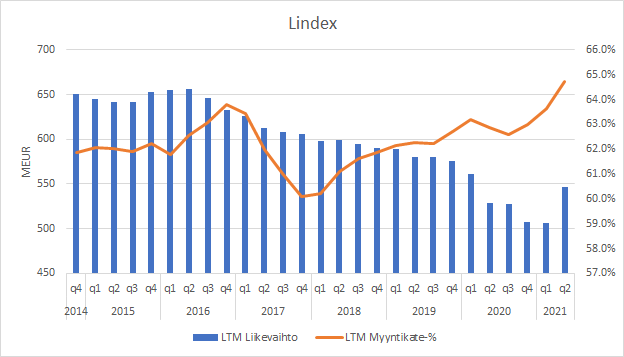
Lindex’s profitability has steadily improved, and currently, Lindex is in top shape. Sales have so far been in a steady decline, but I believe that the decline will now begin to level off, as it appears that less profitable stores have largely been closed and e-commerce has really started to pick up (accounting for 19.5% in Q2). Lindex’s sales margin has been steadily rising since the weaker period in 2017, and it seems that they have genuinely done the right things in recent years.

kuva

The adjusted EBIT for the last 12 months is also at an all-time high (ATH) of EUR 61.9 million for the period under review. If Lindex were valued at, for example, an EV/EBIT multiple of 10, its enterprise value would be a rather impressive EUR 619 million, which would be significantly above Stockmann’s current market capitalization of EUR 227 million. This quickly gives an idea of the hidden value within Stockmann’s parts, even if Retail + Real Estate had a net value of 0e, which, of course, cannot be possible no matter how pessimistic one is about Retail, considering the value of the properties.

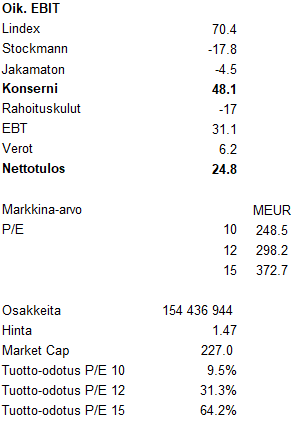
I estimate that Lindex could reach an operating profit of EUR 70.4 million this year, provided nothing radical happens in the rest of the year. Last year, Q3 was very strong, and in my analysis, I assumed it would be slightly weaker this year, but instead, Q4 was weak last year, and there is a clear opportunity for improvement, especially at the current performance level. My Q4 forecasts were also quite conservative, and I expect Q2-level sales with a 16.3% EBIT margin (Q2 19.9%). In previous years, Q4 sales have generally been higher than Q2, but the EBIT percentage slightly lower.

Here is a simple quick calculation of this year’s earnings potential. This is a scenario based on current fundamentals.

Everyone knows that the sum of Stockmann’s parts is significantly higher than the value it receives on the stock market. However, I have long avoided Stockmann as an investor because, in such a case, one might have to wait for who knows how long for the sum of the parts to materialize, and if the company’s performance steadily worsens, then the market will not easily paint positive scenarios.

Now, however, thanks to Lindex, Stockmann is a completely fundamentally justifiable case. Retail can also be expected to perform at least somewhat better in the future as the COVID-19 pandemic subsides. In addition, the restructuring process seems to have given Stockmann new impetus, and news about property sales can practically come at any time. When this is combined with the media buzz Stockmann can generate as the ship truly begins to turn, and Stockmann is still a familiar name to every investor. What makes this case even better is that there wasn’t even a dedicated thread for it here before Friday, meaning investor confidence in the company has been absolutely zero, so the direction is likely upwards. A clear negative driver for the stock is that new shareholders who received shares from loan conversions might start heavily offloading the stock now that liquidity is available, but with Lindex’s current performance, one can calmly sit in the ride and wait for people to start visiting shopping centers in droves again or for news of how many hundreds of millions will be obtained from property sales :sunglasses:

Edit. Lindex has received approximately EUR 7.5 million in Covid-19 support during the last 12 months. There is no precise mention of whether these have been included in the adjusted operating profit, but they probably have, as positive items are rarely adjusted out. Adjusted for these, LTM EBIT would be EUR 54.5 million, which does not change the big picture of excellent development even amidst the pandemic.

66 Likes

It’s been a long time since there was such an interesting start to the week, waiting for comments and updates. OP (Osuuspankki) at least seemed to be following it?

According to the http://www.stockmanngroup.com/fi/analyytikot page, updates could also be expected from at least: Evli + Handelsbanken?

9 Likes

If Stockmann came to its senses and shut down Retail while divesting its other properties, this could be a prime target. I’m a bit skeptical about whether Retail can ever return to profitability. Stockmann’s department store concept for the upscale crowd doesn’t really work as an extension of e-commerce in the same way that, for example, a profitable Gigantti does.

Another good option could have been to wind down retail and rent out the city center property, but that’s no longer possible due to the restructuring.

Selling valuable assets or a good business unit to support a bad “core business” isn’t very sustainable. It brings to mind Yahoo’s Alibaba deal or, from Finland, perhaps Primula, which sold its highly profitable hamburger bun bakery to invest in its other bakery business and later went bankrupt.

By the way, has there been any talk or even rumors about divesting Retail?

7 Likes

Great opening, Pilot! Your well-reasoned posts, especially about Nimbus, have inspired me to invest.

Now that you’ve clearly thought about this more and less, have you, or anyone else, had the same thought as me? Stockmann stopped reporting its real estate business in its own income statement after 2018, and it was merged into the retail business figures. Despite this, the profitability of the retail business is still in the doldrums, even though it was combined with a real estate business that generated tens of millions in profit annually.

Now that the properties are being sold, tens of millions in rental income will be lost. In addition, those previous incomes will turn into expenses as the company will have to start paying rent for the properties so that the retail operations can continue to incur significant losses in those spaces. Is the retail business actually much, much less profitable than the current figures suggest, because the rental income from the properties has been saving the situation (?)

19 Likes

This still seems to be the case, the Retail business is the big dark cloud, for which it is difficult to make radical decisions due to its history, among other things. Here, of course, it must be remembered that Corona has affected Retail’s operations very heavily, so it is difficult to draw any other reliable conclusions from the current numbers than that it is unlikely to get any worse after Corona. I don’t remember any public comments about shutting down Retail, and it’s unlikely there have been any. From a shareholder’s point of view, it would of course be a good decision, especially now that due to the restructuring process, it would be significantly cheaper than before. In my basic scenario, I assume that Retail will remain part of the group. I also believe that due to the restructuring process and Corona, stricter decisions have been made regarding improving profitability, but then decisions would have to be made to achieve top-line growth. In my own papers, however, Lindex’s top performance compensates for Retail’s weakness, so the current valuation is justified by the current earning capacity even in the middle of Corona.

It would also be interesting to hear if anyone could give an estimate of the probable amount of the disputed compensation claim that usually still has to be paid in such cases?

3 Likes

Didn’t a maximum of 30 million more shares potentially become available later as part of the restructuring debt conversion, or did I read too quickly?

This would still have a dilutive effect on your scenario.

1 Like

Lindex is doing well now, but Stokke’s (Stokkan) biggest problems remain unaddressed: e-commerce and customer loyalty. Additionally, the most important target group for the company is still across the border.

Unfortunately, even though there’s light at the end of the tunnel, the batteries will soon run out, and the light will dim. The real value is only in the property. Based on the fundamentals, the case is indeed attractive, at least for a couple of quarters.

I don’t understand the target audience for the monthly marketing leaflet for loyal customers; the goods aren’t interesting, the number of pages is steadily decreasing, and the same items can be found cheaper elsewhere. The offers don’t attract anyone to shop, and the leaflet probably only drops through the letterbox for level X exclusive customers nowadays. The removal of the free parking benefit in the city center was the last straw for me, at least.

Old customers no longer bother to shop, and even wealthy individuals have moved to online shopping. Young people only browse for options and order the same items cheaper online. Even the deli no longer entices shoppers to the department store in the same way, as its shine disappeared with the outsourcing. MustaPekka (MustaPekka) now offers a better selection and is open 24/7.

Yes, quick profits can be made from this, but I don’t believe in a major turnaround, but rather a slow death towards a real estate company that is forced to sell the rest of its properties and Lindex (Lindex) while they still have some value.

Thanks to the first poster for the opening and as a reminder that Stockmann’s (Stockan) selection of waterproof, overpriced jackets is wider than that of a lion – go choose yours before it’s too late.

19 Likes

I had also drafted some kind of opening for the Stockmann chain, but it’s good that someone finally opened a thread for this brand company on the forum.

Stockmann is very much a brand, even though its current brand value has faded a bit from its glory days and needs polishing.
I still see potential in the retail side, but it would require personnel changes.
I’ve been going to Stockmann almost weekly since I started earning my own money, and during that time, the department store side has lost its focus on what they really want to sell.
Stockmann consistently lags 12-18 months behind fashion trends with new clothing brands, and by the time Stockmann gets these brands to their departments, people have already bought them, for example, from Zalando.
This would require sharpening up and gaining insight from buyers, and daring to try some new brands, even with the risk that boomers might not have heard of the brand ever, or at least not in twenty years.

Another pebble in the shoe is the online store, from which I also made a support/research purchase a month ago. I chose pick-up from the city center department store as the delivery method, and it took eight business days for the product to arrive. Another product I ordered was apparently sold twice in the online store, and they were unable to deliver it. However, it took an incomprehensible 14 days to inform me of this, so there might be some inefficiencies in their processes. :roll_eyes:

All in all, the sum of Stockmann’s parts still holds much more value than the current stock price suggests, and short-term returns should be available if the properties can be sold at a decent price.

Another question is what happens to Stockmann after this? The costs of the department store side are rising and making it even more difficult to run that business profitably. Is the future development that Stockmann will only be Lindex, and perhaps the beauty side will remain as some small brick-and-mortar stores in the streetscape, reminding people of the brand’s glory days?

Time will tell, but this is an interesting case, and I personally hope that Stockmann will still be a part of the Helsinki cityscape far into the future.

14 Likes

Yes, it’s possible, but these shares, to my knowledge, are no longer convertible at the price of €0.9106, like those a few weeks ago. In this case, the debts would convert into shares 1:1, or likely slightly less.

The expected return I outlined is essentially just a possible short-term scenario, based on this year’s earnings capacity and next year’s potential earnings improvement. I wanted to highlight how Stockmann is currently a fully justified investment, also in terms of its earning potential.

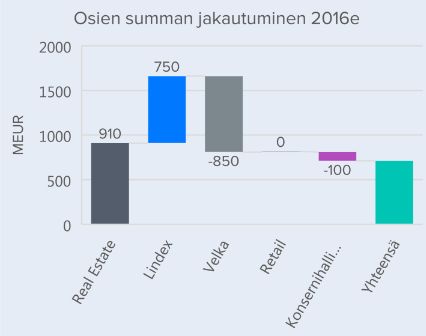
The real meat, in my opinion, lies in the value of the properties and Lindex, which I estimate to be significantly higher compared to how much the market currently values it, considering its debts. And right now, there is a clear path open for value realization compared to, for example, two years ago + as the graph shows, Lindex’s EBIT is about 2x what it was in 2019. Inderes estimated Lindex’s value at the end of 2016 to be €750 million. At that time, Lindex’s LTM EBIT was about the same level as it is now, and when considering that the share of online sales was minimal compared to the present, and higher gross margin + probable growth in operating profit in the coming years, then, for example, a €500 million valuation for Lindex already begins to feel like a conservative estimate, considering the conglomerate discount.

14 Likes