Lantheus - At the Forefront of Prostate Cancer Research

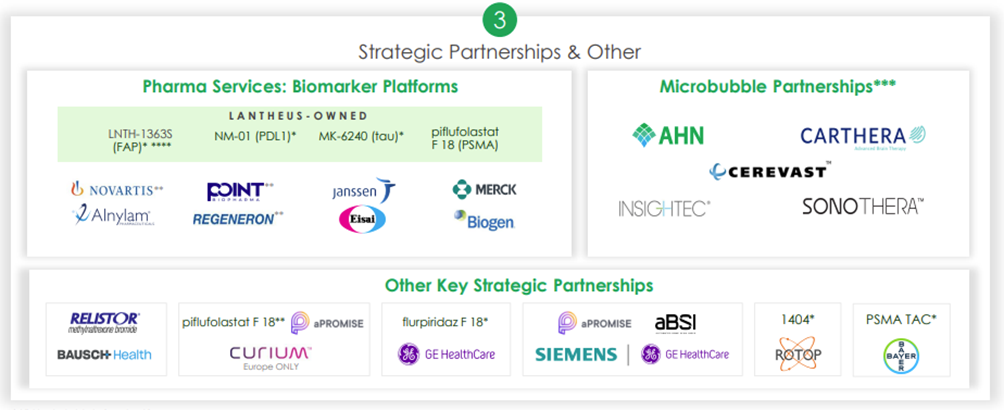
Lantheus provides innovative diagnostics, targeted therapies, and AI solutions that empower clinicians to find, fight, and follow diseases. Lantheus offers a wide range of products, including:

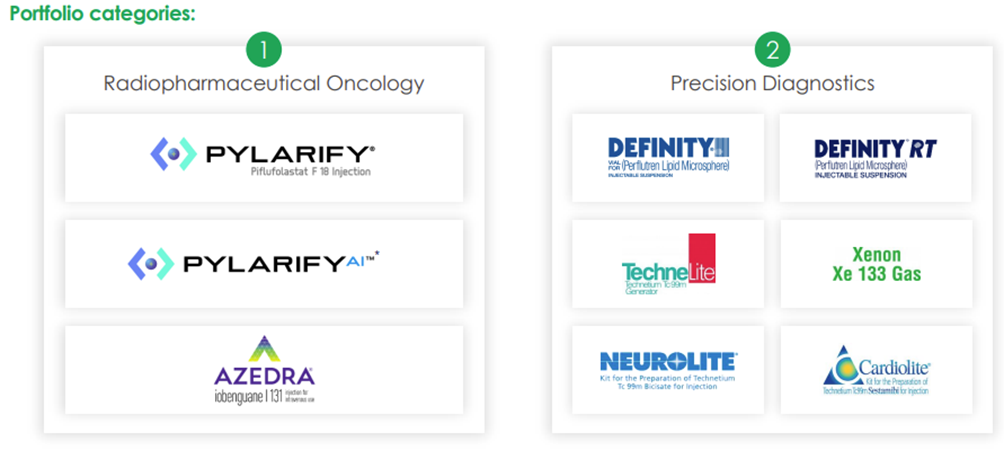
  • PYLARIFY (Piflufolastat F18, PSMA PET imaging agent) for the detection of suspected, recurrent, or metastatic prostate cancer
  • PYLARIFY AI (AI platform) to assist in evaluating PSMA PET images
  • DEFINITY (Perflutren Lipid Microsphere, injectable suspension), an ultrasound enhancing agent for patients with suboptimal echocardiograms
  • TECHNELITE (Technetium Tc99m Generator), which provides a key medical isotope used in nuclear medicine procedures
  • AZEDRA (Iobenguane I 131) for the treatment of certain rare neuroendocrine tumors.
image
image

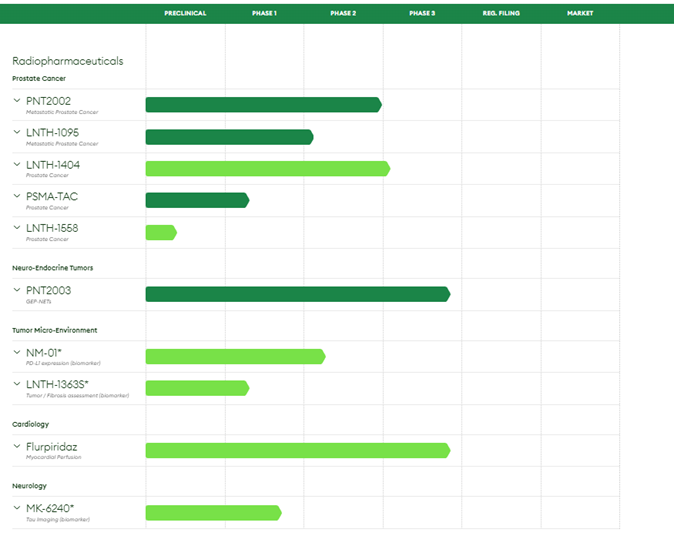
Lantheus’ revenue in 2023 was $1,296M, with Pylarify accounting for approximately 66%. In Q1 of this year, Pylarify’s sales grew by 32%, and its share of Lantheus’ total revenue has already increased to 70%. Based on current forecasts, Lantheus’ revenue is expected to grow by 17% this year, which would imply a PEG of 1.2 at a P/E ratio of approximately 20, with the share price at $115. Personally, I prefer to value Lantheus based solely on Pylarify’s figures, as there are plenty of growth drivers for its demand. Other business operations are “nice-to-haves,” so to speak. Definity is growing at an annual rate of just over 10%, and its demand is quite stable. The potential of strategic investments is also difficult to assess at this stage. If we assume that Lantheus’ entire market value is derived from Pylarify, its P/E ratio (using the same operating margin) for this year would be around 25 → 0.8 PEG. Furthermore, the company is completely net debt-free. In addition to these, there are numerous other potential growth prospects in the pipeline:
image

So, what exactly is this Pylarify? Pylarify is a radioactive diagnostic imaging agent administered as an intravenous injection. Pylarify is used to detect prostate-specific membrane antigen (PSMA) positive lesions in PET-CT scans for men with prostate cancer. Treatment targeted at the prostate-specific membrane antigen is a type of standard cancer treatment. It uses a unique combination of a PSMA-targeted small molecule and the radioactive tracer 18F to target and destroy PSMA, which is a protein found on the outside of prostate cancer cells. Pylarify helps detect metastases even when PSA levels are low.

image

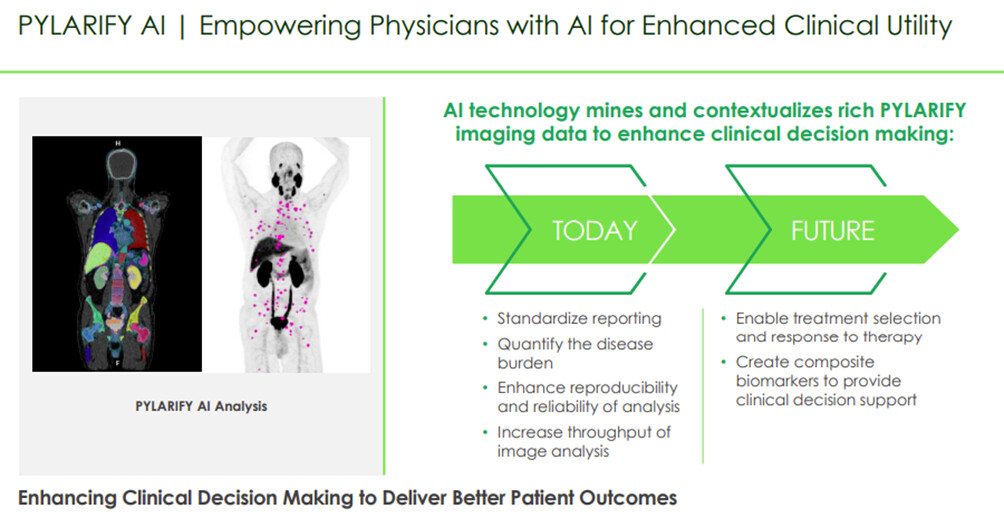
With Pylarify, certain men with prostate cancer have a better chance for PSMA-targeted PET imaging (positron emission tomography), which can help healthcare providers in evaluating prostate cancer. PET imaging improves disease localization compared to conventional imaging, thereby improving therapeutic decision-making. Pylarify AI is also available for analyzing results; it is the only FDA-cleared medical device that provides standardized quantitative and accurate reporting of PSMA PET/CT images, as well as images obtained with PYLARIFY PET/CT.
image

Here are some recent announcements regarding acquisitions and strategic collaborations with PNT and CATX:
https://lantheusholdings.gcs-web.com/news-releases/news-release-details/lantheus-acquires-nav-4694-next-generation-ss-amyloid-pet

https://lantheusholdings.gcs-web.com/news-releases/news-release-details/lantheus-acquires-global-rights-life-molecular-imagings-novel

https://lantheusholdings.gcs-web.com/news-releases/news-release-details/lantheus-expands-radiopharmaceutical-oncology-pipeline-strategic

https://lantheusholdings.gcs-web.com/news-releases/news-release-details/lantheus-and-point-biopharma-announce-strategic-collaboration

Here is one more interesting piece of news that caused the recent jump in the share price:

https://nahri.org/articles/2025-opps-proposed-rule-separate-payment-radiopharmaceuticals-new-obstetrical-cops-balance

I’ve meant to create a dedicated introduction for this company for a long time (and not just after the stock has already risen 100%), but as a father of two children under the age of 2, there hasn’t been much spare time :smiley:

28 Likes

I’ve also been following this and buying over the past couple of years, and in my opinion, it’s still not too challengingly priced, considering that PYLARIFY still has growth potential in the US and the European markets are yet to open. I can’t find the source right now, but going by memory, I recall that the demand potential for PYLARIFY compared to current levels is 2x in the US and 4x in Europe, and the market is growing because prostate cancer cases are on the rise. It should also be mentioned that this imaging-related drug development is a fairly specialized market where competition hasn’t been as intense as in the field of traditional drug development. Lantheus holds a leading market position among companies specializing in radiopharmacology. To be sure, Bayer and Novartis also have radiopharmacological products, but they are more specialized in traditional drug development. So all in all, there should still be a growth runway for years to come, and the pricing is still not particularly challenging. Looking at today’s share price, the P/E is 17.8 with the stock at $116. Historical growth over five years has been about 35% annually for both earnings and revenue. There is room in the market for the company’s revenue growth to continue at a level of 25%/year for the next 7 years. You could still potentially get a good return from this company even at these prices.

5 Likes

Lantheus Holdings (LNTH) Tops Q3 EPS by 14c; offers guidance

I wonder why the share price is -14% :thinking: :thinking:. Didn’t both revenue and EPS exceed the forecast? Although it was hard to find a release that had both the estimates and the reported figures in one place.

Edit. -18%

2 Likes

The company appears to be of good quality, and profitable growth also seems to be on the horizon. Does anyone more familiar with the company have an insight into what might be behind such a low valuation? The company’s main product accounts for ~75% of sales, of course, but I still find it reasonably priced.

1 Like

Some initial thoughts and exploration. Competition around PYLARIFY is increasing.

Lantheus’ Q1: * Revenue: $372.8 million vs analyst estimates of $378.8 million (flat year on year, 1.6% miss), of which sales of PYLARIFY were $257.7 million, a decrease of 0.5%.

Competitor Telix reported strong Q1/25 growth figures: " * $151 million from global sales of Illuccix®, up 35% over the prior year corresponding quarter (Q1 2024: $112 million) and a quarter-over-quarter increase of 9% (Q4 2024: $139 million)."

I’ve been trying to understand what’s going on. In a comparison by GPT, PYLARIFY appears superior. Is it too expensive then? PYLARIFY requires cyclotron production (apparently they have their own facility, but most is done by partners?). Lantheus’ Q1/25 GM% 63%, Telix 65% H2/2024

EDIT: apparently, a side issue with Lantheus’ 18F-based isotope is bone accumulation, which complicates diagnostics (producing false positive interpretations) https://pubmed.ncbi.nlm.nih.gov/36265908/

3 Likes