The interview somehow left me with the feeling that growth won’t be coming anytime soon, not even in the prioritized products. The company seems to be working hard, but there just doesn’t seem to be any organic demand. They are trying to patch the situation with acquisitions, which in turn increases costs, at least temporarily.
1 Like
Thank you @Frans-Mikael_Rostedt for a great and comprehensive interview! 
I have previously criticized the company’s investor communications and how, as a result, I believe the market might be misunderstanding the company and the transformation strategy it is currently executing.
So my question is: as investors, are we too anchored to the company’s past business model as a software vendor? Are we looking too much in the rearview mirror and, consequently, asking management questions that are irrelevant to the investment case?
Today’s interview reinforced my view that the company is undergoing what startup lingo calls a pivot: shifting from a traditional contact center SaaS provider toward an AI-driven customer interaction platform.
If you only follow the company through the lens of its legacy business model and the latest financial figures, this might sound like hot air. But if the company is genuinely building a new AI-driven growth engine on top of its established SaaS business, we could be looking at a significant shift in both the monetization model and long-term growth opportunities.
This could also partly explain why there are such divergent views in the market regarding the company’s future. Some investors primarily see declining ARR, weak organic growth, and integration challenges. Others see the existing customer base, infrastructure, and distribution channels more as a foundation upon which a new AI business is being built.
Naturally, a listed company might not outright announce a rapid pivot, but the company’s vision of a voice-centric AI customer interaction platform already speaks to this direction. In my view, today’s release regarding the collaboration with QuTwo and AMD further reinforces this interpretation.
The most essential question might not be when the current SaaS business’s organic growth and profitability will improve, but rather what kind of business the company aims to build over the next 3–5 years.
If this transformation succeeds, we might look back at the current figures in a few years from an entirely different perspective. If it fails, the challenges of the legacy business combined with AI investments could leave investors holding the bag.
16 Likes
Excellent thoughts. You put into words very well things that I’ve also been pondering. Here are some thoughts on the sector that I’ve been turning over in my mind recently.
In my view, this exact pivot is underway at the strategic level within the company. A significant challenge is the natural friction stemming from the existing business model and the fact that monetization is based on how many customer service agents client companies have. And as Olli also pointed out in the interview, customers want a fixed monthly sum to pay for the service. I don’t believe this will change, as pure usage-based billing is still, in my opinion, quite a difficult concept. I believe pricing will be some sort of combination of the two, and software companies must be able to prove (as before) value creation for the customer.
A very difficult question then is how to assess the value creation potential of this AI business at this stage from an investor’s perspective. Over the past roughly 10 years in the SaaS sector, many generated incredible excess returns when they were able to correctly evaluate companies’ growth potential, the unit economics that drive profitability up over time, and business competitive advantages. In the 2020s, valuations massively overshot again, and EV/S multiples across the entire sector rose to completely unsustainable levels. Amusingly, some of the most expensive companies have climbed right back to “bubble prices” because they were deservedly valued very highly. For example, CrowdStrike and Palantir, but also Datadog, Snowflake, and Shopify.
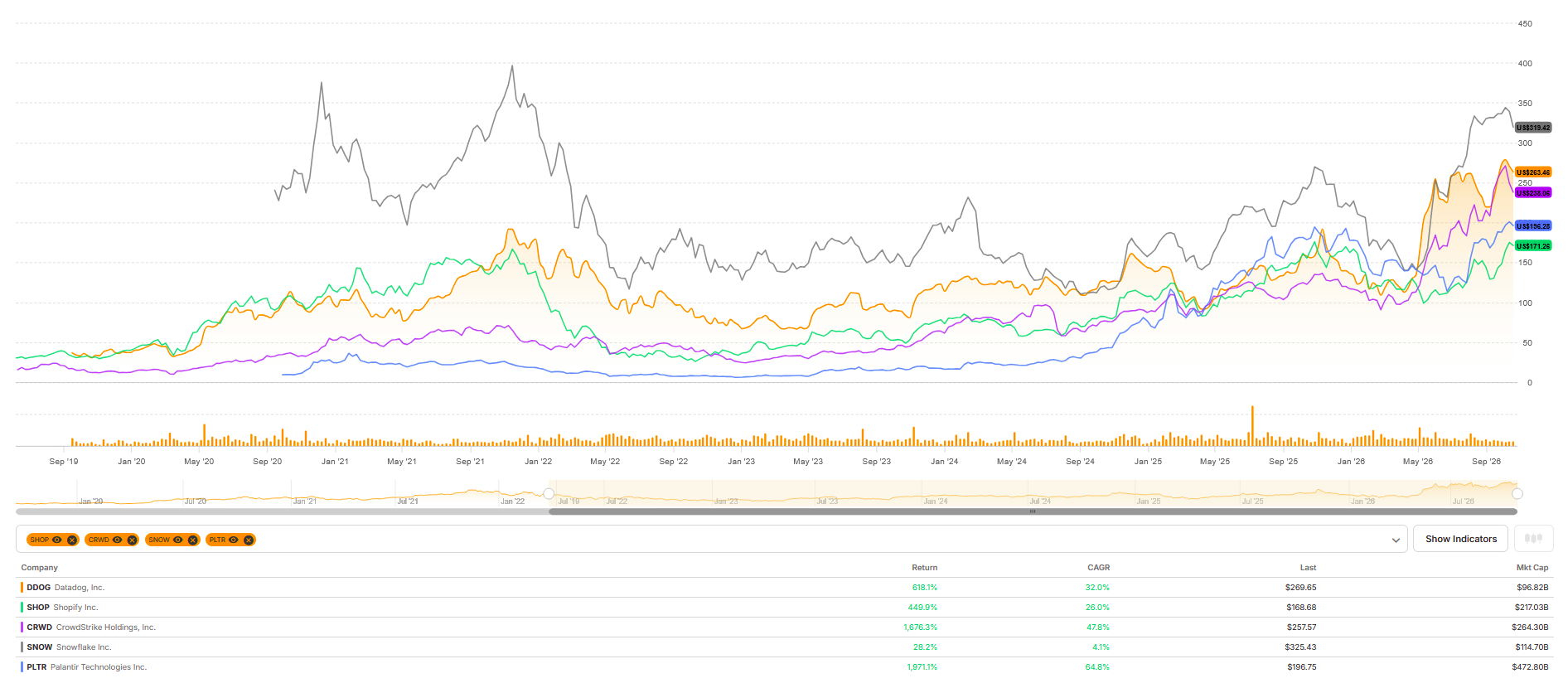
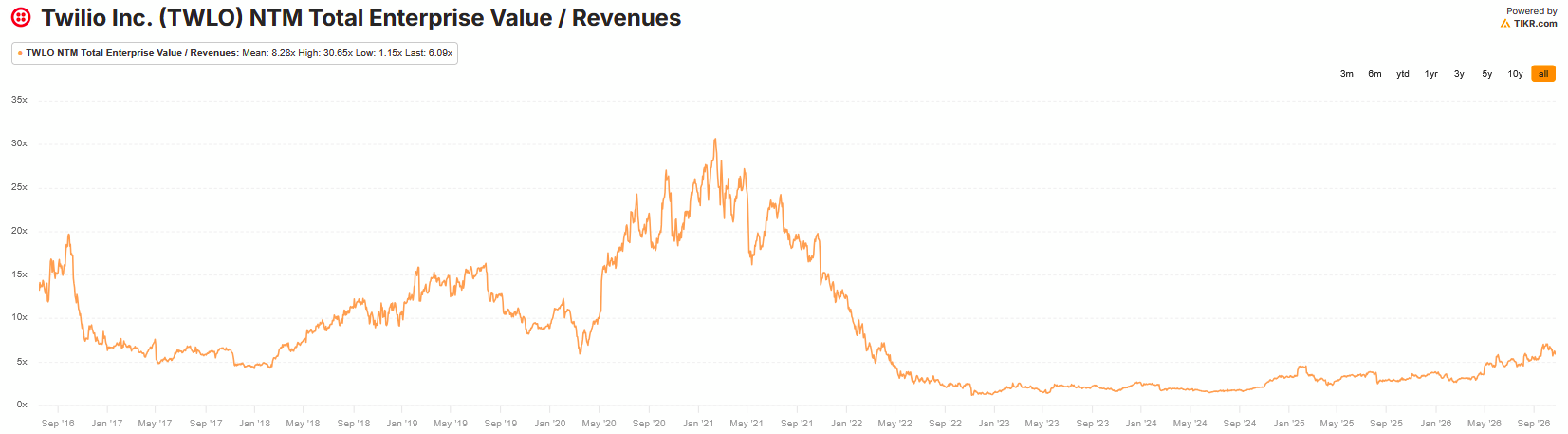
Right now, investors are demanding concrete proof through numbers of successful AI value creation in the tech sector, because a large portion of companies will not succeed in this pivot and/or will start executing it too late. In my opinion, the CCaaS sector is one of the most interesting sectors specifically in this regard, because both the potential business benefits brought by AI and the disruption it causes are easy to sketch out on paper, and the change is already arriving at full speed. For example, Twilio (whose main business is CPaaS, i.e., LeadDesk’s Telecom services) has become one of investors’ winning AI horses, and its valuation has risen high once again. Throughout its history, the company has successfully introduced AI services and other features on top of its voice and messaging infrastructure. Organic growth accelerated to 17% in Q2, and profitability has followed suit.
A few highlights from Twilio’s Q2’26 report:
- Voice traffic growth accelerated to over 20%, driven by tailwinds from Branded Calling and Conversational Intelligence.
- Self-service channel voice traffic grew by over 50% year-over-year, and AI-native customers are growing rapidly. For instance, one conversational AI customer has grown to an annualized run rate of 6 MUSD, and another vertical AI company into a 9 MUSD customer.
- Twilio positions itself as a neutral “Switzerland” that works with any language model, and introduced a new conversation layer to the market (including Conversation Memory and Relay).
- Full-year organic growth guidance was raised to 13–13.5% (previously 9.5–10.5%).
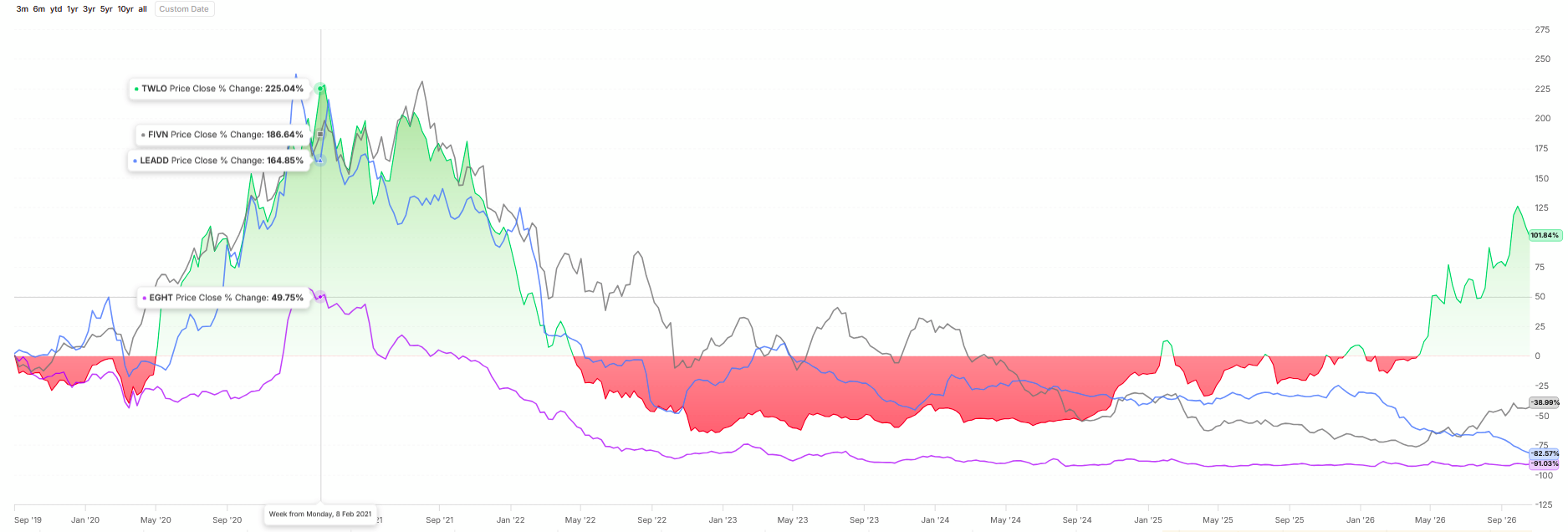
Another company that appears to have bottomed out in its share price—and a purer CCaaS player—is Five9. The company’s growth has accelerated quarter over quarter, and actual profitability has improved considerably. At its lowest, the valuation dipped to EV/S <1x. Both of these companies have also gradually reined in practices detrimental to shareholders, such as absurdly high stock-based compensation programs, and clearly are no longer pursuing growth at the expense of profitability.
An example from the other side of the spectrum, which investors currently lump into the same bucket as LeadDesk, is 8x8—one of the sector’s more traditional players and historically valued lower. At 8x8, too, the numbers seem to be developing reasonably well, but investor confidence in future earnings growth is low. In my view, LeadDesk and 8x8 have essentially slipped into becoming traditional value stocks. Valuations are low relative to revenue, and it would be easy to justify a fair value for these companies that is higher than current market levels. However, unlocking that value requires concrete action. In LeadDesk’s case, investors are demanding pure evidence of earnings growth.
Here is the stock performance of these 4 companies from pre-COVID to today:
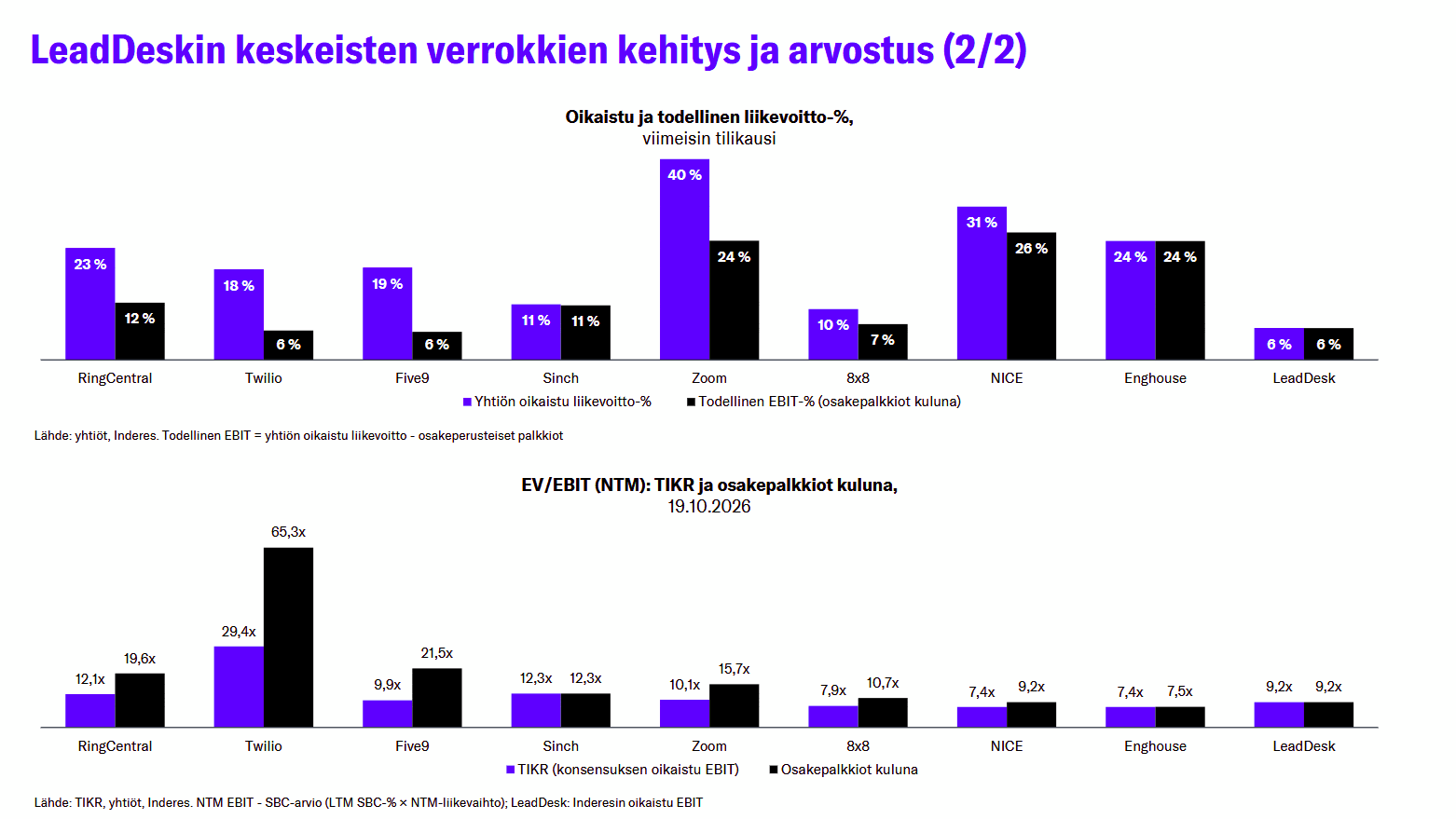
Data is so valuable in training AI models, and high-quality data is increasingly hard to find, that there has been wild speculation (anecdotal, of course) that some tech companies could be worth more “dead” compared to their current valuation if they were to sell off their existing internal and customer data. This is also a very traditional value-investing line of thought. For the companies where disruption is feared the most, EV/EBIT levels hover around 8–10x. These are modest multiples, but entirely justified if earnings growth fails to materialize. Here are the SBC-adjusted valuations I calculated for the companies from LeadDesk’s preview comment (note: LeadDesk’s level is prior to the Q3’26 report).
14 Likes
Throughout the entire interview, the most essential question lingered in the air without being addressed: what is the company’s target state that the ongoing transformation is supposed to lead to? Other than that, the CEO was a bit like a deer in the headlights, walking on eggshells and trying to answer without giving too much away. Something bigger is probably going on around the company, or else there is an internal crisis and management doesn’t know what it’s doing, or pieces are still missing (an M&A transaction / divesting a unit) from the final outcome, which is why it can’t be disclosed yet.
3 Likes
Frans and Antti have published a new company report on LeadDesk following the Q3 results. 
LeadDesk’s Q3 revenue slightly exceeded our expectations, but profitability fell well short of our forecast due to weaker-than-expected seasonality, a heavier cost structure, and M&A expenses. We significantly lowered our earnings forecasts for the coming years; the forecasts do not yet include the ACE acquisition. Short-term earnings-based valuation is tight, but revenue-based valuation has dropped to very low levels (EV/S 0.5x). Despite the elevated risks, we still see the risk-reward ratio as attractive given the significant operational leverage, valuable customer base, and the option provided by the Telia ACE transaction. We lower our target price to EUR 2.40 (previously EUR 2.50) and reiterate our Accumulate recommendation.