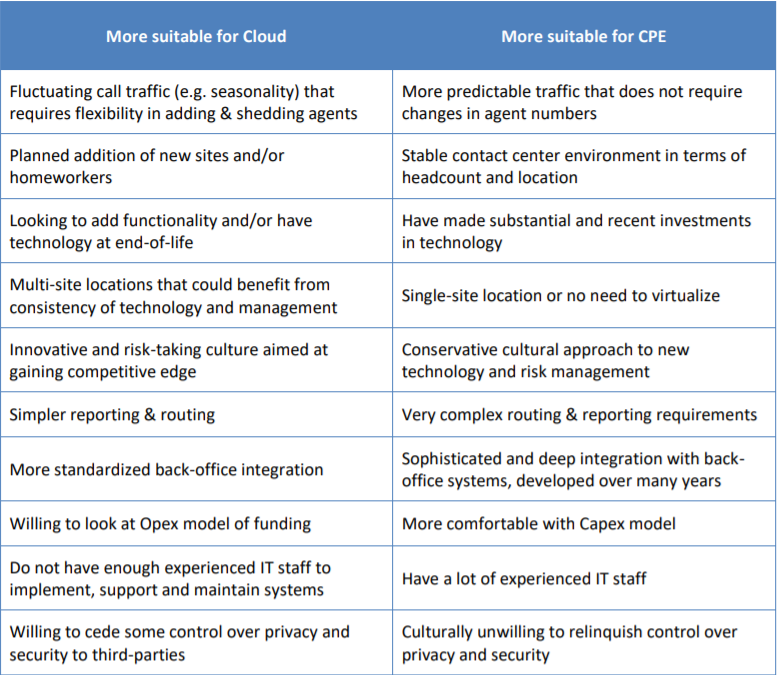
That’s a good question, and one that’s hard to answer briefly. However, here are a few arguments why SaaS is conquering the market from traditional software solutions now and in the future.
Lower initial investment
Faster implementation
Lower indirect maintenance costs (e.g., no need for in-house IT support staff and similar IT infrastructure)
SaaS services are continuously updated
Service costs scale according to usage needs
SaaS services are typically easier and more cost-effectively integrated with other services and systems than traditional solutions
…
Despite the above, it is also certainly true that for some players, it may be more sensible to acquire software with one-time licenses.
People are unlikely to be replaced immediately in the most important tasks of call centers, and the total number of call center seats is not expected to significantly decrease in the coming years.
However, customer service and contact management can already be qualitatively improved and made more efficient through automation, multichannel services, robotics, and artificial intelligence. CRM (Customer Relationship Management) vendors are believed to expand into the call center software market through acquisitions at some point.
A few risks regarding LeadDesk have already been brought up, and I thought I could summarize my own thoughts on the key risks here:
LeadDesk is a growth company, and therefore, a key risk for investors is whether the company can continue its strong growth in the future. Growth is also important for maximizing economies of scale (optimizing profitability). Predicting the growth rate is challenging, as it depends on how the company’s sales efficiency and competitiveness develop in the future and how much investment the company puts into sales.
Changes in the competitive landscape and technology can radically and unpredictably alter LeadDesk’s competitiveness.
In the SaaS business, technological and cybersecurity risks are emphasized. Failure to manage these can lead to significant costs and customer losses.
Expanding into new markets and making acquisitions always involves risks that can derail earnings growth.
The company’s size is relatively small, which means, among other things, that its resources are limited, and its ability to bear risks and invest is weaker than that of larger players.
The liquidity of the company’s stock will initially be weak, which increases its risk level. The stock’s valuation does not yet receive significant support from earnings multiples, so the valuation level will likely be very sensitive to changes in growth expectations and the valuation levels of growth companies.
What other risks would you name/consider?
/Petri
P.S. These were also discussed in yesterday’s video:
Of course, an alternative for this company would be to seek a new VC round, but the benefits of an IPO compared to VC funding are: 1) using its own stock as a tool for acquisitions (this plays an important role for them), and 2) credibility benefits when expanding internationally. I think an IPO fits the company’s chosen strategy well; the question is more whether the chosen strategy is right for this stage of development
It was mentioned somewhere, but regulatory risk is good to be aware of when dealing with personal/contact information.
In addition, I wonder how Leaddesk will fare if the general economic situation takes a bad turn. This would likely hit companies of the size of Leaddesk’s customer base the hardest, and there would be a lot of customer churn? Moreover, how many companies would dare to renew and adopt new software in a tight situation if it incurs even small additional costs?
This offering is really interesting, the SaaS model and its long-term potential are particularly appealing, and I’m also pleased that the old owners are not selling! But it feels like the more I ponder and taste it, the bigger the risks seem. Since it relies entirely on successful growth, and that’s already well-priced in, is there enough upside to bear all the risk…
Well summarized. I somehow simplify this more generally (not just concerning LeadDesk) to this: if the product is genuinely excellent and there’s a gap in the market, VC money allows for more efficient progress (from today’s news, Relex is quite a good example). If, on the other hand, expansion has to rely on acquisitions, then a listed stock can certainly be a smarter solution. As for credibility, IMHO strong references are always in a completely different league than “we are listed on a small market’s small list”.
What do LeadDesk’s balance sheet key figures look like if the offering goes through in its entirety? For example, equity ratio, net gearing, return on equity in the future, etc.?
I was reading the report, and in the first paragraph of the forecasts section, it states, “Our balance sheet, cash flow, and income forecasts presented on the next page include the assumption of a successful IPO,” but the offering funds are not included in this table?
Good point, actually it should say, “DOES NOT include capital raise funds.” A capital raise cannot really be accounted for in advance, except partially for costs, because it’s impossible to know beforehand if the raise will go through in its entirety.
Assuming the capital raise is completed, the balance sheet key figures will strengthen significantly. The company will have a net cash position of approximately EUR 4 million, equity ratio will rise significantly, etc.
The company’s board of directors will decide on or about February 13, 2019, on the implementation of the IPO, the final number of Offered Shares and their distribution between the Public Offering, the Institutional Offering, and the Personnel Offering, as well as the allocation of the Offered Shares and the full or partial acceptance of Subscription Commitments given in the IPO.
This comment by @Elina_A was originally in the Inderes failed recommendations section, but I’d prefer to reply here to keep the threads more sensible.
So, I didn’t mean that a small SaaS company couldn’t be a sensible investment. Or that they shouldn’t do early IPOs. I mostly mean that sometimes in discussions, the SaaS product itself has immediately made it acceptable that at least 20% growth will be achieved. Many other factors also influence this, such as the amount of sales work required, etc.
What always amazes me most about these situations is that if the product is a diamond and international business is easy, then companies of that size shouldn’t need an IPO; purely private funding rounds would suffice. With private funding, one can truly focus on growth, even at a loss, without having to publicly explain their actions. Or if SaaS scalability is really good, then even revenue financing can work wonders, especially when talking about a product that already exists and which (at least in theory) can be sold online with a credit card.
(Warning, an exaggerated opinion ahead. Also, this does not directly concern LeadDesk itself): A small company that wants a few million in funding only does an IPO if it can’t get that money elsewhere (or if the owners want an exit door ajar). In this situation, funding rounds have already been sought, and many have already concluded that the product is not good or credible enough. Listing on First North does not improve credibility, and no very large corporate acquisitions are made with a low-volume stock. Across the pond, SaaS services are first grown big and only then taken public, because a stock market listing does not help the company focus on the product at all; it just requires more bureaucracy.
I agree that an IPO itself is not a game-changer but, as you described, adds bureaucracy and costs. Perhaps the company’s CEO, having worked at Siili, noticed that M&A scenarios are easier when there’s an official price tag for the company’s ownership. This was once Seppo Kuula’s justification for their IPO. Valuing companies is difficult, and listing at least makes it easier to value the other party. Who knows. There could be other reasons.
One thing you didn’t cover is the visibility and recognition an IPO brings to a small company. This could be one reason for listing, instead of seeking VC funding.
True. However, listing in Finland only brings visibility within Finland, so I still don’t really see it as an international strategy. Instead, within Finland, this can be a good marketing tool. For example, Silmäasema, Altia, and Verkkokauppa certainly benefited from this. None of them, however, are SaaS companies trying to expand abroad.