Lassila & Tikanoja

Juho Toratti has also written about L&T’s demerger. :slight_smile:

Lassila & Tikanoja’s partial demerger seems like a sensible and justified strategic move. The Circular Economy business, formed at the beginning of 2025 from the company’s former Environmental Services and Industrial Services segments, is a growing and profitable entity. In contrast, the Facility Services business, formed from the Finnish and Swedish facility services, has in recent years remained stagnant or declined, driven primarily by challenges in the Swedish market.

6 Likes

This slipped my mind during the holidays, but good catch. I should have just removed that from the report. There was some manual adjustment because the historical balance sheet doesn’t correspond to reality, which messed up the sensitivity calculations. Fortunately, it should be resolved once we get the figures for the end of 2025, or at least I hope we’ll get actual balance sheets for the demerged companies at the turn of the year, but it’s not actually certain.

4 Likes

Is Lassila & Tikanoja’s purpose to remain mainly in logistics (apparently also some waste disposal operations, pallet rental, etc., etc., etc.) or does the company plan to enter the actual recycling business?

I mean something similar to what Lamor and Neste do with plastics, Betolar with mining waste, Foamit with glass, and EcoUP with insulation waste. I would also include some form of sorting in this “recycling business,” where robots sort recyclable material from mixed waste (which no listed company in Finland seems to do). Processing bio-waste into biogas is, I suppose, relatively simple, but from what I understand, it is highly competitive and the margins are probably reflective of that. Correct me if I’m wrong.

So, is the intention to invest in this type of heavier waste processing and become a true circular economy company, rather than just a logistics operator in the field (of course, they already have those previously mentioned smaller operations + some vague mentions of the possible existence of this type of activity without a more concrete description)?

In the video, Rauli mentioned that this is possible. But are there any concrete plans regarding this, beyond just the theoretical possibility? And if L&T were to go down this path, would it fundamentally be a good or bad thing? Naturally, it depends on what they would start doing and at what price.

To summarize:

  1. Does L&T have concrete plans to get more broadly involved in waste processing in addition to current logistics?
  2. Would this type of expansion be a good or bad thing? (again, depending on what and at what price)

EDIT:

A comprehensive report on the “new Tikanoja” has already been released. It states the following: “From now on, Lassila & Tikanoja’s business will consist purely of circular economy-related activities based on returning waste and side streams to circulation at the highest possible degree of processing.”

The mention above would suggest that something like this already exists, but I haven’t found what it is in concrete terms. If something already exists, I’ve completely missed it, and I can’t find any detailed descriptions of what is being done. I only found vague mentions suggesting that something like this might already be in place. Either I failed in digging up information, or L&T has failed in its communication. In their communication, the garbage trucks and waste bins are always what’s remembered.

Also, “industrial services and water treatment” make up 19% of the company’s operations according to Inderes’ comprehensive report.

Bonus questions: In the company’s case, is water treatment practically just collecting sludge from small-scale treatment plants in rural areas? Or is there some major industrial water treatment? Do they process it themselves or are they just in logistics with vacuum trucks etc.? There would be an opportunity for biogas and other things here. In Rovaniemi, sewage sludge is incinerated for energy. That’s also an interesting idea. It is, of course, a different matter whether this is an actual gold mine. At least not yet.

12 Likes

Our friend Rauli has written a new company report on L&T :slight_smile:

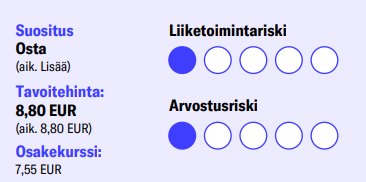
The stock market journey of the new L&T has started sluggishly, and in our opinion, the valuation is already very attractive for a defensive and stable business (adj. P/E and EV/EBIT around 10x). In addition to the low valuation, we believe the expected return is supported by earnings growth, dividend yield, and the possibility of L&T becoming an acquisition target. We are upgrading L&T’s recommendation to Buy (prev. Accumulate) while maintaining the target price at 8.8 euros. You can read more about the new L&T in the initiation of coverage report published at the turn of the year.

Quoted from the report:

In summary, we state that L&T’s expected return for the coming years consists of a steady dividend yield, moderate earnings growth, and potential for multiple expansion. The stock’s valuation level is attractive by many metrics, but a stronger rise in multiples may require a clearer outlook for revenue and earnings growth than currently seen. In our opinion, the company is also a very potential acquisition target. If realized, an acquisition would presumably raise the valuation significantly in one fell swoop.

image

13 Likes
10 Likes

Maybe these are stupid questions, but for me, Lassila & Tikanoja is now showing an acquisition cost of €0 and several thousand in profit, while Luotea shows the old Lassila price and is several thousand in the red (I assume everyone else sees this too?). Will these be corrected properly in the near future?

The second question relates to the fact that if I sell Luotea now at a loss, can that loss of several thousand be deducted for tax purposes?

The tax authorities will confirm the correct prices for both at some point whenever they get around to it. So in practice, you can’t claim a deduction. Whether the correct prices are updated will likely depend on the broker, but you should be mentally prepared to enter them yourself in due course.

2 Likes

The tax authorities will soon provide confirmation of the ratio that should be used for the companies’ acquisition costs. When it arrives, you can enter the acquisition costs for both stocks into your broker’s service based on that (unless the broker happens to do it for you).

If the ratios were, for example, 75% for the new Lassila & Tikanoja and 25% for Luotea, then look at the price you bought the old L&T for and enter the same purchase orders for both companies, multiplying the acquisition costs by 0.75 for the new L&T and by 0.25 for Luotea. (So these 75/25 figures are not the actual ratios; they will likely come from the tax office within a month or two).

2 Likes

Thank you both for the quick answers! I’ll keep the shares in my portfolio then and wait to see if they get automatically corrected in Nordnet. If not, I’ll fix them myself.

So there was no chance to get a “massive loss” for deduction here. :slight_smile:

3 Likes

Here are Rauli’s preview comments as L&T releases its Q4 results on Friday, February 27. :slight_smile:

This is the first earnings release since Lassila & Tikanoja split at the turn of the year into a company purely focused on the circular economy. We expect the company to report slight revenue growth, but we estimate that profitability has declined slightly from the comparison period, partly as a result of increased depreciation. Our attention in the report will be particularly on the 2026 guidance, the dividend proposal, and the first steps of the company’s growth strategy as an independent entity.

5 Likes

The first financial statement as a new company is out: full-year EBITA was €40.6m, while Inderes predicted €40.9m. For next year, the company is again guiding for better earnings performance than Inderes, when measured at the midpoint of the ranges.

23 Likes

Rauli’s quick comment:

Summary

  • Lassila & Tikanoja’s Q4 revenue was EUR 111 million, exceeding our expectation of EUR 109 million, and grew 5.5% year-on-year.
  • Adjusted EBITA was EUR 9.0 million, falling slightly short of our forecast of EUR 9.5 million, due to, among other things, depreciation and additional costs from a new IT system.
  • The company’s guidance for this year is steady as expected, with revenue at EUR 420-450 million and adj. EBITA at EUR 38-44 million, which is in line with our forecasts.
  • The dividend proposal is EUR 0.42 per share, slightly below our expectation of EUR 0.45, but of the expected magnitude for the new company.
15 Likes

Rauli has, to our delight, completed the L&T company report regarding the Q4 results on Sunday. :slight_smile:

L&T’s Q4 results and guidance for 2026 were largely in line with our expectations, and we only made minor fine-tuning to our forecasts. In our view, the valuation is attractive for a defensive and steady business (adj. P/E and EV/EBIT approx. 10x). In addition to the low valuation, the expected return is supported in our estimates by earnings growth, dividend yield, and the possibility of L&T becoming an acquisition target. We reiterate our Buy recommendation and target price of EUR 8.8. More information on the “new” L&T can be found in the initiation report published at the turn of the year.

13 Likes

This was a solid announcement, as the essentials are clear right from the headline: Lassila & Tikanoja Oyj:n toimitusjohtaja Eero Hautaniemi jättää tehtävänsä omasta pyynnöstään 2027 | Kauppalehti

An easygoing guy, I’ve had the opportunity to speak with him. It looks like Eero will be completing eight years as CEO. All the best!

10 Likes

Here are Rauli’s comments regarding the announcement above :slight_smile:

8 Likes

@Rauli_Juva’s new report confirms something that has likely been on our owners’ minds; however, we remain on the buy side: Lassila & Tikanoja: Dieselin hinnan noususta tilapäinen isku Q1:lle - Inderes

9 Likes

L&T: a small piece of news for today, namely the redemption of the remaining part of the old Swedish SVB acquisition. This is worth approximately EUR 6 million, but the final purchase price has already been recorded in liabilities, and L&T has, on the other hand, recorded 100% of SVB in its results until now. Thus, the only effect is that the EUR 6 million moves from one place to another in net debt and will, of course, appear in the cash flow statement.

7 Likes

Now we know this too:

Based on the aforementioned grounds, the acquisition cost of Luotea Oyj (1680140–0) shares is 24.17 percent of the original acquisition cost of Lassila & Tikanoja Oyj (1680140–0) shares before the partial demerger.

Based on the aforementioned grounds, the acquisition cost of the new Lassila & Tikanoja Oyj (3555336–9) shares is 75.83 percent of the original acquisition cost of Lassila & Tikanoja Oyj (1680140–0) shares before the partial demerger.

18 Likes

The current “cleaned up” Lassila & Tikanoja (without facility services / Luote) piques the interest of an old value investor, even though I try to avoid these kinds of cases nowadays.

Special situation (carve-out), strong market position, boring and steady business, good cash flow, under the radar…

But on the other hand, this could easily be a traditional Finnish laggard if earnings just tread water and no knight arrives to take the company private.

8 Likes

@Rauli_Juva, could you please elaborate further on: i) what the municipalization of Finnish waste management really means, ii) when it will happen, and iii) what effects it will have on Lassila & Tikanoja?

There are several very brief mentions of this “municipalization” in the long report, but it doesn’t elaborate on the background or what it concretely means for the business.

Chat GPT (I take no responsibility for the quality of the information) answers as follows below, which sounds to me more like an increase in the private sector’s role in waste management outside of households, which should be positive for L&T? What is the potential of this market segment for L&T, and is it included in your forecasts? @Rauli_Juva

In Finland, there is no “municipalization” underway in waste management – quite the opposite. The changes in 2026–2027 mean a narrowing of municipal responsibility and an increase in market-based operations, especially in certain sectors.

What happens in 2026–2027?

1) Municipal responsibility narrows (does not expand)

  • The Waste Act amendment, which comes into force at the beginning of 2026, limits municipal responsibility: Municipalities will primarily be responsible only for waste from households and holiday homes.
  • Instead, for example, the following will move away from municipal responsibility: waste from social and health care services, institutions (prisons, barracks, reception centers, etc.).

2) Big change in the social and health care sector

  • The biggest concrete change concerns social and health care.
  • Previously, the municipality often organized waste management. From 2026 onwards: operators will choose their own waste management companies.
  • This means competitive tendering, new service providers, more business for private waste companies.

3) Why was the change made?

  • Clarification of responsibilities.
  • Increased competition in the waste sector.
  • Promotion of circular economy and innovations.

4) Effects on municipalities?

  • The role of municipal waste facilities will decrease.
  • Turnover may decrease (some waste will be removed from the municipal system).
  • Municipalities will focus more on basic services: household waste.

*\For companies like Lassila & Tikanoja, the change is mainly a business opportunity, but not exclusively positive:

  1. New demand (big positive impact).\*
  • The biggest change is this: Social and health care, institutions, barracks, etc., can choose their own waste management companies. The municipal monopoly will be removed in these parts.
  • This practically means: competitive tendering, new customers for private operators, the opportunity to sell broader service packages.
  • Companies can now purchase waste management “like any other service” from the market.

2) Competition intensifies.

3) Services become “smarter.”

  • Companies will no longer purchase just emptying, but reporting (ESG, sustainability), recycling solutions, and data services.
  • The new Waste Act also increases sorting obligations and reporting for companies.
  • This favors large operators (such as L&T) that have digital services, consulting, and a national network.

4) At the same time, some business is lost

  • This is the less talked about side; household waste remains the responsibility of municipalities, and in some areas, municipalities may even take collection back to themselves.
  • Example: In Heinola, private collection ended and shifted to the municipality.
  • So: The B2B market grows, but B2C (households) may shrink in some areas.

5) Strategic change in the entire industry. In summary for private operators:

  • Winners: large national companies offering service and circular economy solutions; those who succeed in competitive tendering.
  • Losers: operators relying on a mere “garbage truck driver” model; local operators without scale.
3 Likes