After Japan’s 80s bubble burst, the country’s economy has remained stagnant in a deflationary economic environment. However, during the current year, inflation has finally risen to 3 percent. At the same time, other developed nations are struggling with 10% inflation.
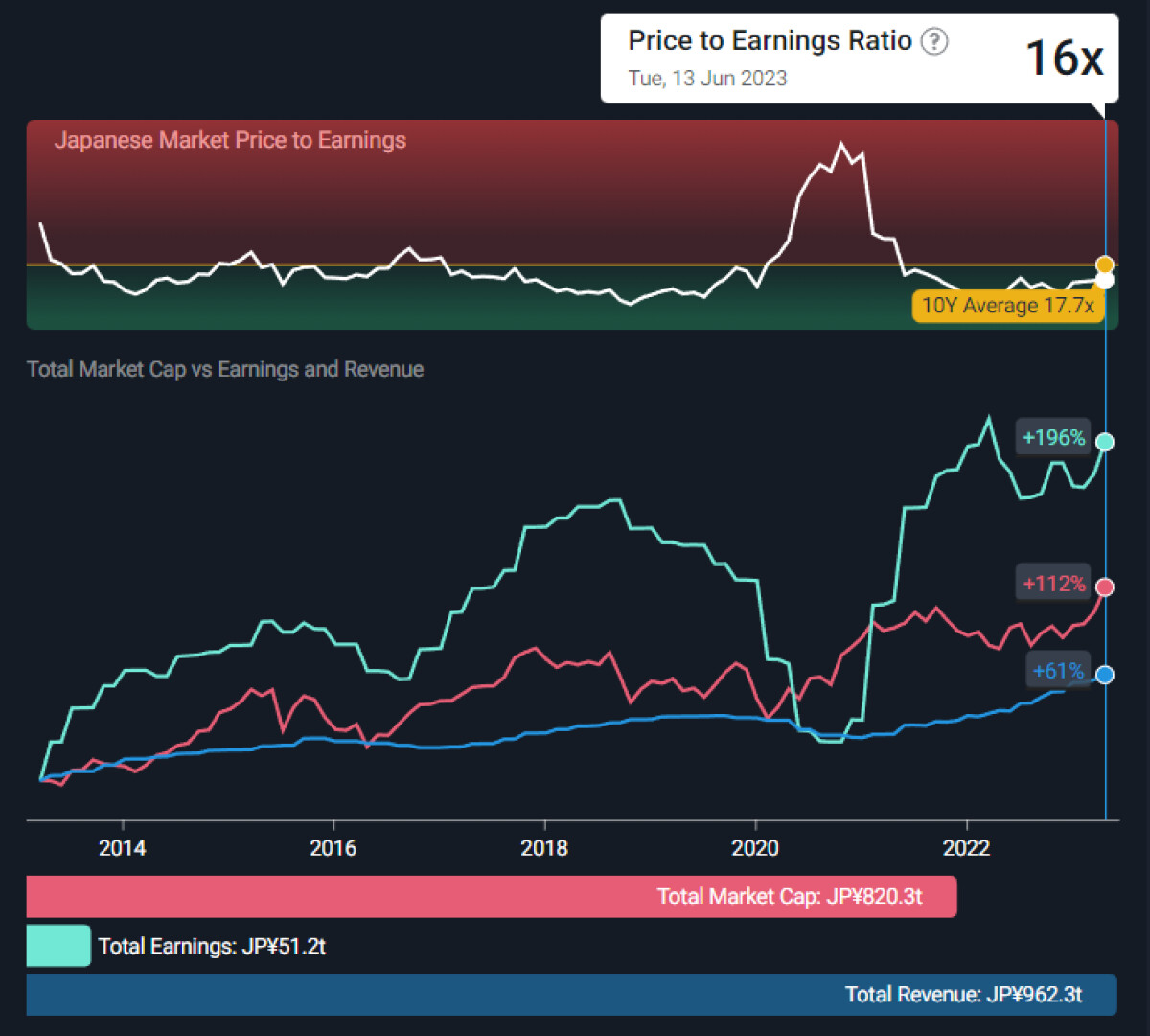
Although Japan does not seem to be a mainstream investment destination, can it serve as part of an investor’s portfolio who does not believe in a rapid decline in inflation or the sustainability of current valuation levels? The median TTM P/E of the Nikkei index is 14.25 compared to the S&P 500 P/E of 19.25.
If Japanese stocks were available through a popular broker like Nordnet, and if companies’ interim reports were available in English, then it would be interesting to follow Japanese stocks as well. Now, following the Japanese market is likely hindered by the language barrier and the lack of trading opportunities through popular brokers.
Japan is an interesting country, home to over 125 million people. It has long traditions, but has it truly changed enough over time?
Based on personal experience, Japan might be a bit too hierarchical and partly inefficient because of it. What surprised me was the poor English language proficiency. A good example of the hierarchy was that respect for older people was an obstacle to knowledge sharing, as a young employee cannot surpass their older superior in expertise. This limited the flow of information. Additionally, inefficiency manifested, for example, in the fact that if a team leader stayed late at the office, subordinates could not go home earlier, likely leading to unnecessary idleness and extended workdays. Furthermore, commuting often takes a long time despite efficient train services.
I have followed Japan’s development with interest. It is a large market, but it faces a significant challenge as its population ages. Can Japan renew itself?
While raising Japan’s 10-year policy rate by 25 basis points doesn’t sound like much, it could indicate where money will flow in the future: since the 90s, Japanese assets have flowed abroad as the Yen and Nikkei began to melt down. As an example, the Japanese are the largest net owners of US bonds, and if one starts getting decent yields from domestic bonds and the Yen strengthens, money will start finding its way back home.
It’s also worth considering whether, if the aforementioned trend begins, money will also flow into the Nikkei or mainly into bonds and bank accounts. And how will the strengthening of the Yen affect Japanese companies?
The topic is quite multifaceted, and it’s easy to create bull and bear scenarios around it. My own guess, however, is that the trend will improve the Nikkei’s expected return relative to the S&P 500. What thoughts and views do you have on this?
For those interested in the topic, I recommend reading/listening to the Macro Compass article:
Japan is stagnating due to a stubborn and conservative mentality. This mentality is particularly represented by the older generation, but new winds are already blowing, at least partially, in the minds of the youth.
What will happen when the youth eventually become the voting majority? I look forward to seeing that with interest. The wait may be a long one, though..
Sentiment has finally shifted from over 30 years of pessimism regarding Japan to at least short-term optimism; since the beginning of the year, the Nikkei index has risen by 26%.
There are, however, solid reasons for this optimism, which are covered in the video.
In summary, the drivers of the improved sentiment:
the improved and further improving return on equity (ROE) of Japanese companies, with the primary driver being a shift in corporate culture toward being more investor-friendly
the impact of the aforementioned on valuation multiples
Good observations from OP regarding the risks and opportunities in the Japanese market.
A few highlights, but it’s worth a listen:
Bank of Japan is providing stimulus
Real interest rate is significantly negative
Interest rates cannot be raised to the level required by inflation; the economy would not withstand it
Japan’s 10-year yield is pegged at 0.5%
There is a lot of debt: public debt is 225% and private debt is 185% of GDP
The central bank owns government bonds worth 130% of GDP (Fed 33%)
The video also does a good job covering currency effects and interest rate differentials.
…Jos Shinzo Aben aloittamat uudistukset jatkuvat, Japanista voi “tuuliaikakautensa jäkeen” viimeinkin tulla ns. “uusi mahdollisuuksien maa” sijoittajille…???
On Tuesday, Japan’s Nikkei 225 index crossed 33,000 for the first time since 1990.
We decided to have a look at Japan’s stock market to see what’s driving the outperformance against other global benchmarks and whether it’s sustainable:
The Nikkei 225 index is now up about 30% year-to-date compared to the S&P 500 and MSCI world indexes which are up 14% and 12% respectively. That 30% gain is a little misleading as the Nikkei is priced in Yen, but even priced in USD it’s up 20% for the year…
A years-long effort to improve corporate governance in Japan and increase shareholder value has met with limited success. However, that may all be about to change.
Foreign investors have also begun to pay attention after seeing the gains on Berkshire Hathaway’s Japanese investments.
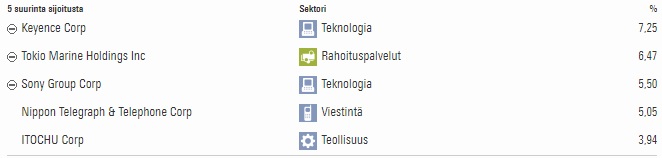
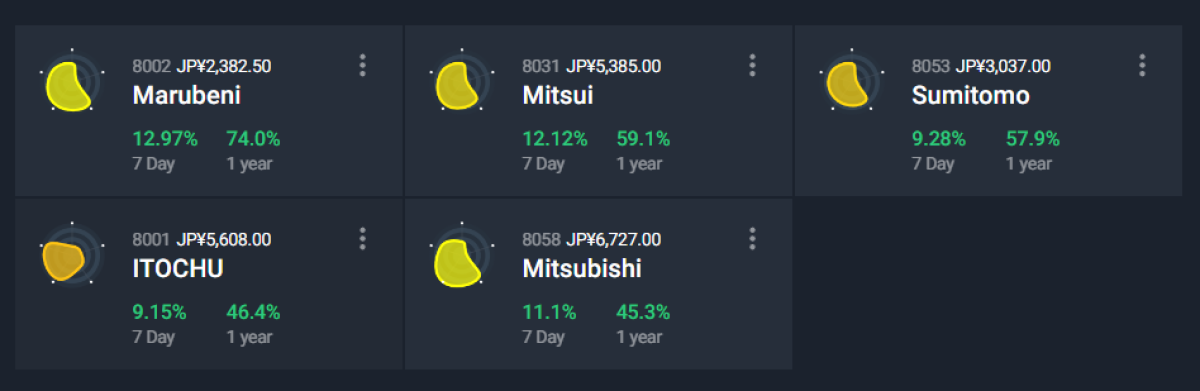
In 2020 Warren Buffett began buying shares in Japan’s five largest conglomerates (shown below), some of which are now up more than 200%.
The corporate environment and the economy could be completely transformed as companies focus on shareholder returns rather than maintaining the status quo:
Yes, the Japanese market has been interesting for investors for a long time, and the general public is now taking notice.
A weakened yen is driving exports while simultaneously offering upside potential on the currency front, at the latest once interest rate cuts begin in the US.
A significantly negative real interest rate creates the ingredients for a stock market bubble; the million-dollar question is when we can start talking about a bubble. My view is: not for a while yet.
The Nikkei’s 30% rise in six months is so vertical that we might see some consolidation along the way, which is why it’s good to keep a cool head
This is, however, just my own irresponsible speculation.
They are also likely so-called ADR stocks, which have small ongoing additional costs, e.g., on dividends. It would be cheapest to own shares bought directly from the Tokyo Stock Exchange.
I would like to buy “Itochu Corporation” on the Japanese stock exchange, which even Buffett has bought. Where could I buy it, and can I buy it through OP at all? It owns about 25% of Metsä Fibre, for example.
Here is an article by Henri Huovinen about Japan as an investment destination.
BlackRock has been right so far regarding Japan. TOPIX, one of Japan’s most followed stock indices, returned 17.8 percent during the first quarter of the year. In US dollars, the gain amounted to about 11 percent. The lower return in dollars was explained by the weakening of the Japanese yen against the world’s reserve currency.
The strong performance at the beginning of the year does not scare BlackRock. In its latest strategy update, it raised the Japanese stock market to a larger overweight and listed three reasons to invest in Japan.
Subheadings:
There are return opportunities in the European stock markets