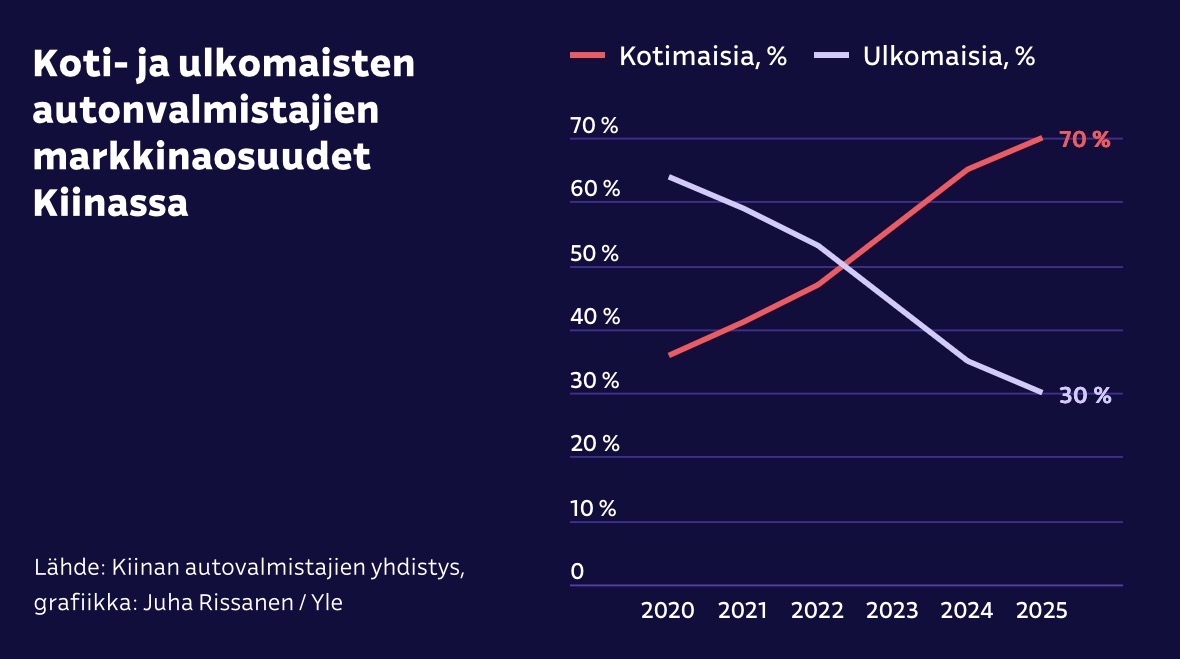
Chinese cars are conquering the market

I’m starting to get worried about how European car brands will fare. I have only ever owned European cars, and my stock portfolio includes shares of three different European car brands. But even though a Chinese car hasn’t peeked into my garage yet, one Chinese brand has already entered my stock portfolio, and it feels like the door is open for European cars to exit the portfolio if development continues as it seems now.

The 15 largest Chinese manufacturers by global sales, roughly from largest to smallest based on current total sales:

  1. SAIC Motor (MG, Maxus)
  2. Geely (e.g., Galaxy and many other brands)
  3. BYD
  4. Chery
  5. Great Wall Motor
  6. Changan
  7. FAW
  8. Dongfeng
  9. BAIC
  10. GAC
  11. Li Auto
  12. Xpeng
  13. NIO
  14. Zeekr
  15. Hongqi

The annual global car sales of the five largest manufacturers on the list are in the range of 3-5 million cars per year per manufacturer. Even the smaller ones mostly sell over half a million cars a year. Merc (M-B) sells approx. 2 million and VW 5 million cars a year.

German premium brands (e.g., M-B and Audi) have been highly regarded in China and have turned a good profit there, but sales are fading at a fast pace. Sales of Chinese cars in Germany have been very low but are growing rapidly. Visitors to Asia have surely noticed the change in the local street scene (excl. Japan); the new cars are Chinese. In Finland, too, Chinese cars are starting to appear on the roads at a fairly rapid pace.

Chinese cars have still had some difficulty getting their drivability and reliability image in order, but when you compare the technical specs to European ones and factor in the price, European prices seem expensive. The Chinese are only just setting up their sales networks in Europe, and for sure, the quality perception and drivability will be raised to a competitive level with high priority; a sufficient amount of resources are being allocated to these projects in China.

Do we try to protect ourselves with trade tariffs, or do we throw in the towel in Europe? Or how do you see the European car industry faring in this race?

8 Likes

In the same way that European mobile phones fared in the competition against Asian ones. Nokia, Ericsson, Siemens, Alcatel…
Initially, everything was made in Europe, then bit by bit production shifted to the Far East and eventually the entire manufacturing process. In the final stage, the original brands disappeared and were replaced by the manufacturing countries’ own. Huawei, Xiaomi, OnePlus…

It may be, however, that since cars are significantly larger and more difficult to transport than phones, we will remain in a stage where all the parts come from China and the largest components, such as bodies, are made in Europe. It is easier for the Chinese to bring a body and assembly plant to Europe than to freight finished cars here from China. A Volkswagen or BYD badge can then be stuck on the front of the cars rolling out the door, depending on which sales organization’s hands the car is going into.

8 Likes

European premium brands are facing ruthless price competition in China from local premium segment brands.

Mercedes’ sales volumes in Q1/2026 grew by 7% in Europe and 20% in the United States, but this was not enough to offset a 27% decline in China. Mercedes’ global sales are down 6% from last year.
https://www.reuters.com/business/autos-transportation/mercedes-reports-drop-q1-sales-during-transition-year-china-market-2026-04-09/

BMW sold 3.5 percent less globally in Q1/2026 than in Q1/2025, as weak demand in China and the United States weighed on performance. Although BMW and MINI sales grew by 3% in Europe, it was not enough to compensate for the 4.3% and 10% declines seen in the US and China.
https://www.reuters.com/business/autos-transportation/mercedes-reports-drop-q1-sales-during-transition-year-china-market-2026-04-09/

Audi’s global deliveries in Q1/2026 fell by 6.1% compared to Q1/2025. China: -12%, North America -27%, Europe +5.9%.

Sales figures for Chinese brands are not as readily or reliably available; for example, BYD has been accused of manipulating sales statistics in the past, and now its sales have stalled according to the statistics, but I don’t really know what to believe. NIO reported a 98% growth in sales for Q1/2026 vs Q1/2025.

When comparing, for instance, the specs and prices of new electric vehicle models from Bimmer and Mercedes in 2026 to models on sale last year, the development has been incredible: features are clearly better, and prices are down. It will be interesting to see how this development impacts business profitability. In EVs, the Chinese offer very high performance specs (at least on paper) at extremely competitive prices, and it clearly seems they want to offer a premium impression more affordably than European brands. At the same time, car sales are shifting to electric vehicles at such a rate that the relevant competitive arena is becoming the EV market; internal combustion engine cars are becoming a thing of the past. The Chinese are completely superior in battery technology development and mass production.

2 Likes

This topic doesn’t seem to generate much discussion, so I’ll talk to myself for now, in the hopes that someone might eventually realize the significance of the subject.

A couple of days ago, Yle reported on the Beijing Auto Show:
"When Geely and other Chinese pioneers brought their first cars to the US at the Detroit Auto Show in the mid-2000s, they were laughed at.

No one is laughing anymore.

– You can speak of a revolution. China is leading the direction and pace of innovation in the global automotive industry, Frank Sieren puts it.

China produces roughly 70 percent of the world’s electric cars.

After the COVID pandemic, the car market in China has shifted strongly into the hands of the Chinese themselves."

I get to visit China on business trips every now and then, and the change in the car fleet truly is surprisingly fast. At the same time, I believe I’ve noticed a change in Chinese attitudes compared to the pre-COVID era. Before, the Chinese seemed to value Western people and products; nowadays, it feels like they are almost emphatically nationalistic and proud—China is stronger, more efficient, more successful, and more capable than the West, and the Chinese are proud of the success they’ve built. They’d rather boast about a new, fancy Chinese car than a Western one. It’s not limited to just cars, though the observation is completely unscientific and based only on my own feelings.

China’s domestic market is so large that with this kind of market share growth and the sale of new automotive technology, the home market also provides a great development laboratory. In China, things are done on a larger scale; if they want swappable batteries for cars (a full battery in an instant to replace an empty one), they quickly build battery swapping infrastructure, etc. Such things don’t seem possible at all in Europe.

While Europe finally seems to be waking up to the competition and bringing faster-charging electric cars with longer ranges to the market, China is already a step ahead again, and prices are kept lower than those of Western competitors.

In the short term, the competition seems to serve us motorists quite nicely; new cars are developing at such a dizzying pace and competition keeps prices in check. But will it simultaneously lead to European car brands being unable to make a profit from their production? The flood of Chinese cars is actually only at Europe’s doorstep, but it’s coming with such force that it will be a revolution.

4 Likes

This article explains how the Chinese company MG Motor is building a factory in Europe, and many other Chinese automakers are doing the same.

Thanks to a factory located within the EU, MG will avoid the 45.3 percent tariff on electric cars imported to Europe from China. This is the highest tariff the EU imposes on any Chinese automaker.

The article is not behind a paywall, at least for now.

1 Like

The project is expected to create approximately 2,000 jobs in Europe.

It won’t just employ Europeans; the workers will largely come from China. They live in dormitories right next to the factory site, clothing and catering are managed from China, and the locals are left mainly with the responsibility of providing electricity and water. Furthermore, as workers are rotated between China, Europe, and South America, monitoring working hours and wages becomes completely impossible. When assembly work is also recorded in the accounting as a negligibly small share, the tax revenue for the European host country remains miserably low.

4 Likes