New US dividend RECLASSIFICATION notices have arrived for the year 2022. This time from as many as three:
NYMT (again)
Hercules Capital (HTGC)
FS KKR Capital (FSK)
The way it works is that on vero.fi, you file a claim for adjustment for the year 2022, where you add those foreign withholding tax refunds as new “dividends”.
I haven’t come across a Finnish broker through which that would be possible. I wrote here about my experiences buying those via Interactive Brokers. The typical minimum there is $1000, so you can get into them with quite small sums.
I wonder what else Nordnet has reported incorrectly to the tax authorities?
Microsoft paid a dividend of $11.78 on 11.3.2022, with $1.77 withheld in tax.
The tax return states that the dividend received was €12.04 and the tax was €1.81.
Nordnet’s annual summary shows a dividend of €10.67 and tax of €1.60.
I suspect that the USD/EUR exchange rate used for the tax return was the one from when the processing run was performed, not the one from the ex-dividend date (1€ = 0.9163$).
You can open an individual dividend payment statement from the Nordnet transactions tab, where the exchange rate is shown on the bottom line.
I personally didn’t notice any differences between what was reported to the tax authorities and the portfolio transactions. Maybe I need to look again since I have to do some adjusting anyway.
Edit: yes, there are differences. I received a dividend of 16.8d and in the NN calculation the rate is 0.90621, meaning 15.22 in euros. Nordnet reported 15.28e to the tax authorities, where the rate used was 0.90952. Looking online, the exchange rate for that day was 1 USD = 0.90730 EUR. In any case, this is a very small difference that has no significance. Your case is over 10% off, so something is wrong somewhere.
Edit2: total dividend income for 2022 according to the broker’s data is 2,952.32e and now the tax return says 2,946.8e, so the difference is only 0.19%.
I asked Nordnet in 2021 why their dividend report, annual statement, and my pre-filled tax return (as reported by Nordnet) all had different euro amounts for Intrum’s dividend, and why all of these even differed from what I would have gotten if I had entered the dividend myself according to the tax authorities’ instructions. I received this response:
When dividends are paid in a foreign currency into a currency account, the euro value reported to the tax authorities is, in a way, indicative. The investor can decide on their own exchange rate policy as long as it is consistent. Unfortunately, our reports are not completely identical in their information. We report to the tax authorities using the mid-market rate quoted by Swedish commercial banks, which is equivalent to the mid-market rate published by the Bank of Finland, but of course not exactly the same.
I interpreted the answer to mean that Nordnet’s reports live a life of their own and the euro values for foreign dividends in them are just generated using some so-called less official exchange rates. The euro value calculated using the mid-market rate quoted by Swedish commercial banks would then be the one sent to the tax authorities.
Based on my own experience, you’re in for some trouble if you have a lot of trades and haven’t started setting up the reporting work yet
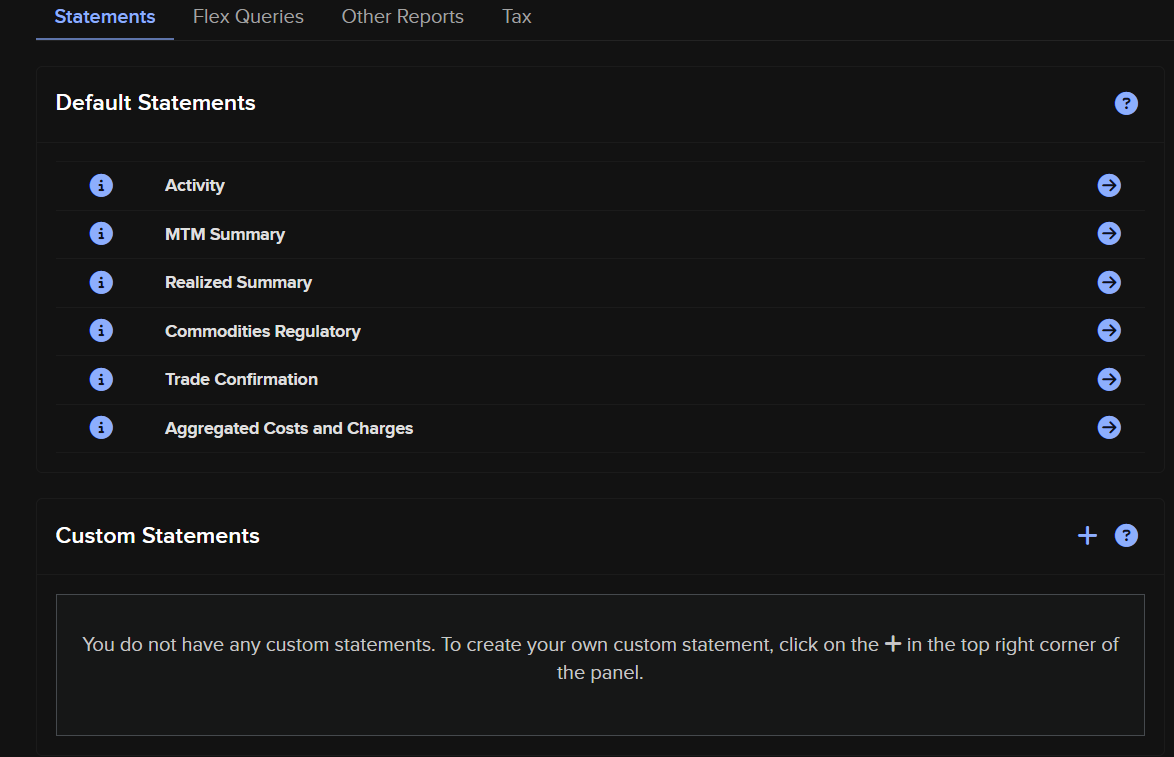
A good option is Custom statements → Trades. “Realized P/L only” trims down the unnecessary rows a bit.
Personally, I’ve submitted one of those, the activity statement, and a summary I made myself that includes all brokers + the parsing of the IBKR activity statement.
So, I import the activity statement into my own template which calculates the summary. Then I manually add Nordnet on top of that (from their 9A report).
If you only have a few trades and prefer to enter them line by line rather than attaching files, this parser might be better: https://ibkr-report-parser.appspot.com/
However, it calculates different results than the IBKR reports due to different currency conversion rates.
Apologies for the messiness, I don’t have time to give a more thorough answer. Best of luck!
Aren’t stock brokerage fees tax-deductible? In the pre-filled tax return, only the monthly ETF savings fee is showing for Nordnet Or are brokerage commissions only taken into account when the stock is potentially sold?
They are accounted for in the transaction prices. So, for example, if you buy shares for €1,000 and the fee is €10. Five years pass and you sell them for €2,000 and the fee is again €10. The broker reports the profit to the tax office as (2000-10) - (1000+10) = 980. This way, you don’t have to remember/keep them, as they are baked into the purchase prices.
The effort of maintaining and remembering information comes into play when the owner decides to transfer their book-entry account to another broker. In that situation, the acquisition prices and cost data for the shares disappear from the records and become solely the owner’s responsibility.
I still have an Equity Savings Account (OST) with Mandatum/Saxo, even though I have to correct its information for the tax authorities every year.
Today, May 19th, was the ex-dividend date for Sampo; the payment date is May 31st. However, the cash balance of the OST jumped today by the amount of the Sampo dividend. I haven’t realized or noticed that happening before. I assume that if I use the cash for a purchase now, it will be a margin transaction. Shouldn’t buying on credit be prevented on an OST?
I couldn’t find it via search, so I’ll ask here:
Are IBKR deposits handled by making a bank transfer yourself from the bank?
According to the website, the 1st deposit of the month is free; do Finnish banks charge anything for those?
What kind of fees in total do you have to pay for currency exchanges on the account?
Standard SEPA payment, meaning it’s no different from other bank transfers. Funds are usually received within half a day.
Currency exchange costs 2 USD per trade for amounts up to $100,000, provided your monthly exchange volume is under a billion. (The fee decreases after reaching a billion.) The rate is the prevailing market rate at the time of exchange.
I’ve been pondering this broker-related issue myself, and I’d be grateful if anyone reading this thread could offer a sensible perspective on the matter:
I currently own Alibaba shares (or technically NYSE-listed ADRs, I suppose) through an Equity Savings Account (osakesäästötili). Now that the company has announced plans to split into six parts, I’ve started considering whether it would be sensible to sell them from the Equity Savings Account and buy them back through a book-entry account (arvo-osuustili) with another (cheaper) broker—this way, the selling costs wouldn’t be quite so astronomical if I want to divest from some of the companies BABA is splitting into at some point.
I have accounts with both Degiro and Trade Republic. Is there any difference between these discount brokers in terms of whether these kinds of stock splits cause any unnecessary headaches?
The guy above was likely talking about the company transforming into several companies (spin-off) instead of a split, where the former BABA shareholder is given shares of the spin-off company at a certain percentage. And he would then hold two companies and want to sell the shares of one or both companies. This way, he would pay brokerage fees twice where previously he would have only had to pay once.
My response to him regarding changing brokers would be “go for it if you feel like it”.
I have no clue how relevant Alibaba’s spin-offs are, when they are coming, or whether former shareholders would also be given shares of the new company.
I also don’t know anything about Degiro or Trade Republic, but I’m sure they handle these kinds of situations quite competently. I’d say they have to if they want to stay in business
As a quick conclusion, lower brokerage costs matter if you’re dealing with small sums and you make more trades. You’ll have time to change brokers many times before the spin-off scenario you’re thinking of comes as a surprise, especially if you follow the company.
I personally use IBKR for stocks outside the Nordics, and it does save some pennies in brokerage fees.
Well yeah, that’s how it is—or rather, Alibaba plans to split into six companies, and six sets of brokerage fees on Nordnet for international shares is quite a lot. Even if the total value of the shares is several thousand, you might end up with very small lots from the smallest holdings.
But I suppose there’s no point stressing about whether this will work as it should with discount brokers. Thanks!
It will definitely work, otherwise you would be losing assets if you were SUPPOSED to receive shares of the new company in a spinoff but didn’t actually get them.

 Or are brokerage commissions only taken into account when the stock is potentially sold?
