Discussion on brokers

There hasn’t been much discussion about stockbrokers on this forum yet. For me, within the last 6 months or so, my portfolio has been with NordNet, then OP, and now finally DB. I’ve also had daily banking and loans, etc., with OP and DB. Briefly, the pros and cons of these:

NordNet:

+Best user interface (mobile and browser use)

+Funds from sales available in real-time

+Shareville community brings added value to the investor

– Unacceptably weak-seeming data security, also a key reason why I changed brokers. (Apparently, the provider is “one contract signature away” from implementing strong authentication, even though the matter has been pending for probably a year or two already.)

– Fees for domestic stocks quite high (but as an OSKL member, brokerage fee for “small trades” starting from 7e).

– Campaigns are “splashes” here and there; one never knows what campaign is coming and when. This makes systematic utilization difficult.

OP:

+Trading fees. OP joined Nordea’s price competition in autumn 2018. Small trades maximum 1%. With OSKL membership, maximum fee 5€ up to “a few thousand euros”.

+Data security: bank authentication is required. A large operator can invest in maintaining data security.

-Poor user interface: the online bank (browser-based) is really bad and confusing. Essential matters are scattered “here and there,” and the customization possibility of the user interface is insufficient.

-The online bank is constantly, literally constantly, subject to maintenance and repairs. Has it come to this, when Finland’s largest brick-and-mortar bank runs heavy machinery and digitalization is still in its infancy? Perhaps OP’s bonus system makes this (too) profitable for the bank even in 2019… phew.

-Funds from sales become available only after 2 banking days. So, not a bank for active traders. Is this also one of the gems of non-digitalization?

Danske:

-Mobile user interface is okay, but for almost every action, digging out the code list is required. A bit cumbersome compared to fingerprint authentication. On the investment side, deficiencies include missing portfolio price charts, missing backward evaluation of portfolio development (e.g., 3 months - 5 years timeline). This shouldn’t be the case in 2019. Making buy and sell orders feels clunky. If I recall correctly, offer levels are not even presented when placing an order…?

-Online bank in browser use: a reasonable experience. Information is a bit “here and there,” but still easier to find than OP’s terrible hodgepodge. On the investment side, deficiencies include missing portfolio price charts, missing backward evaluation of portfolio development (e.g., 3 months - 5 years timeline). This shouldn’t be the case in 2019.

+Trading prices: DB announced last week that it would lower trading fees for Akava members, meaning there’s a bit of competition. For Akava members, subscription fees are 5€ (at least for domestic stocks, edit: in 25 trading venues), free securities custody, free real-time service, etc. P.S. With OSKL membership, the subscription fee is 7€.

+Data security: bank authentication is required. A large operator can invest in maintaining data security.

+Hardly any maintenance breaks, cf. OP’s subpar performance. Digitalization has succeeded to some extent, and the system runs reliably.

Ratings:

  • NordNet 3/5
  • Danske 3/5
  • OP 2/5

Others, please continue from here.

9 Likes

OP does have the funds available immediately, even if they are not physically visible in the account. When placing a buy order after a sale, the funds from the sale are available. It’s stupid, though, that they don’t show up in any other way.

7 Likes

Heh, I have my own account with OP and we’ve negotiated a bit: A plus is that if you have loans with OP, you get a lot of bonuses, which you can use to cover banking fees and insurance. I haven’t paid down the apartment loan too much.

The company is with a savings bank, which is terrible (but cheap, otherwise I’d leave the bank).

I’ll probably have to get OP’s private trading software. I often use OP Mobile to follow courses while working.

3 Likes

Yeah, OP’s new pages are illogical, but even an old dog can learn new tricks over time. The new trading fees are competitive, which pleases Frugal-Masse::slight_smile:

Security with the key code list is good.

I use Nordea; costs are max. 1%, and for larger trades, 8€/0.2%.
Nordea often has campaigns (the latest was 2 days without brokerage fees on the Stockholm Stock Exchange).
Paid Kauppalehti news is free, Nordic exchange rates are real-time.
There are no custody fees if you make at least one trade per quarter.

There have rarely been any disruptions in trading, considering they are making a significant IT overhaul. People in public seem to complain, but I use the online/mobile bank daily and have no complaints.

Currency exchange fees are 0.3% - But I’m just looking now, and for a small trade, it’s still only 1% brokerage fee to the US. (E: So it’s not 1.3% - but 1% as usual - Other Nordea users, tell me if I’m blind? :D)

Nordea’s authentication app / mobile bank is, in my opinion, damn good (especially the authentication app - very handy to use, and I haven’t had any error404s).

The only thing I would wish for is a little more investment in portfolio development, e.g., comparison to an index. (Or at least I haven’t found such a feature).

6 Likes

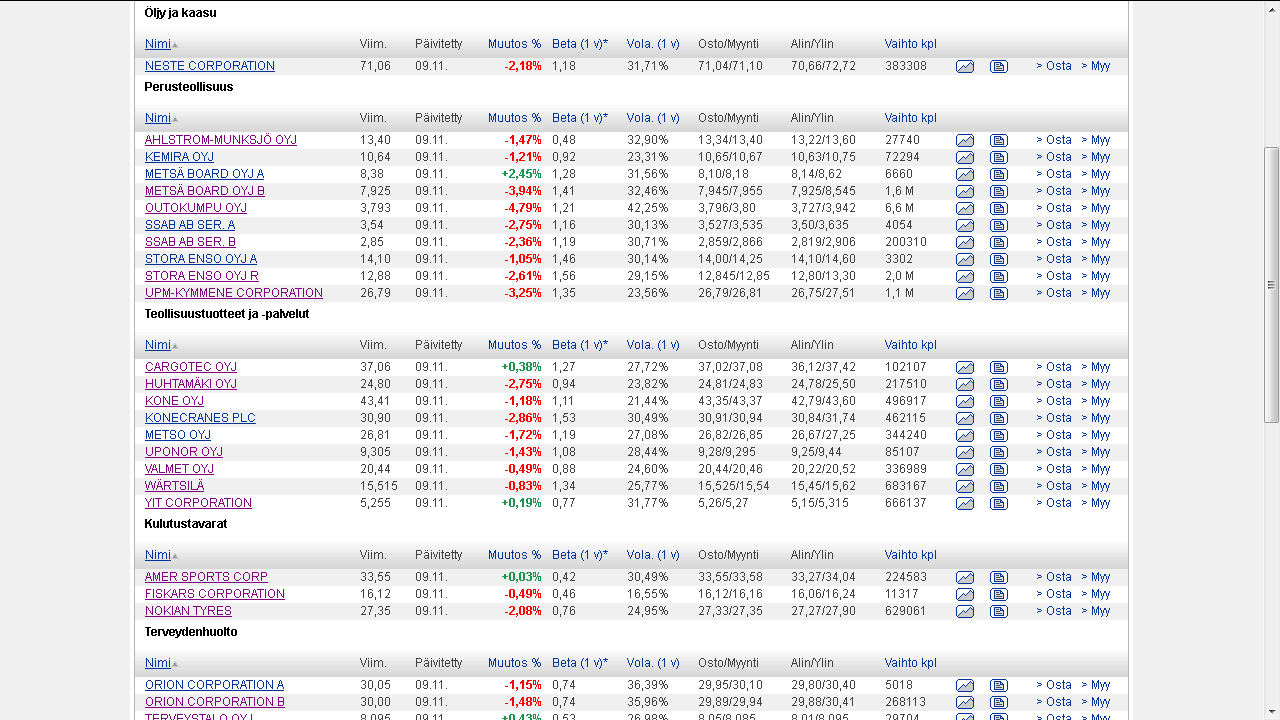
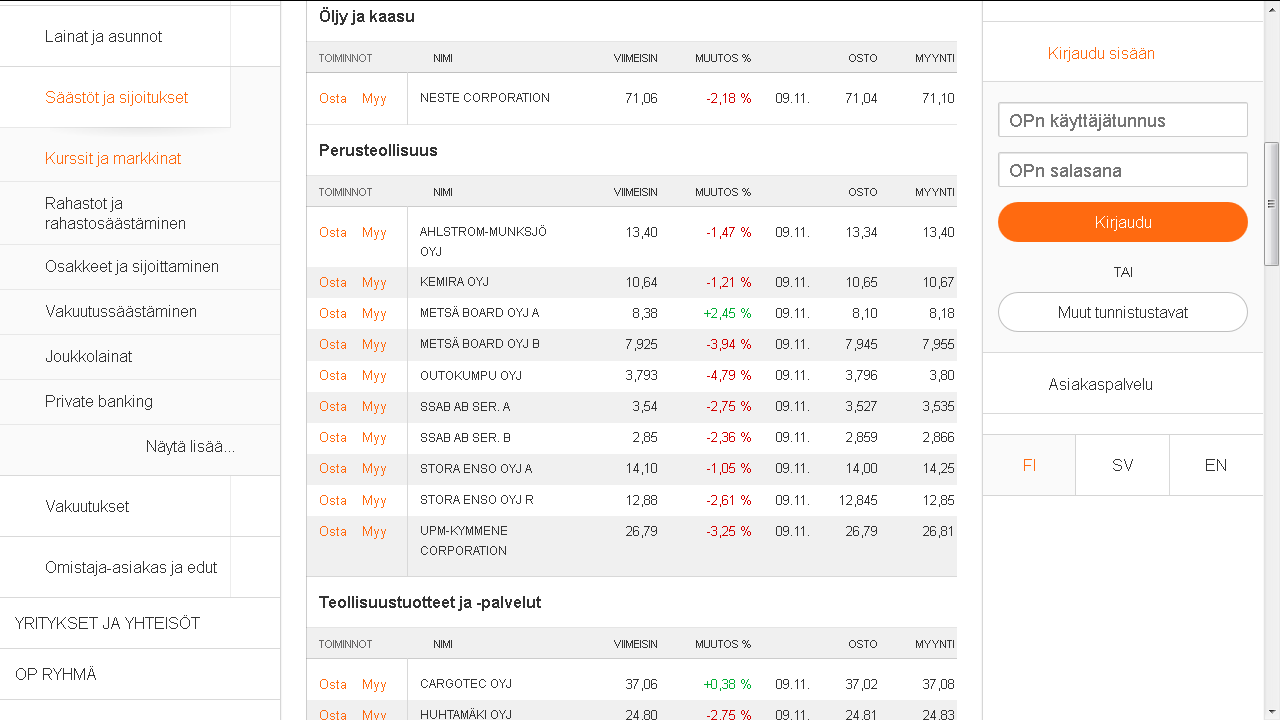
The new OP online bank has really been messed up. The upper picture is from the old site, which I at least liked to use for monitoring the stock markets. The lower picture is the unusable new site. Who approves such brick-thick bars as a permanent site element?

2 Likes

Yeah, the old Op was pretty good. You could easily set up your own watch list and add the purchase price and quantity as needed. The new one is really bad in my opinion too… If anyone at OP works there, greetings!

1 Like

I use Nordnet myself. Their new pages really don’t impress me. It’s a bit like OP’s problem. Too much whitespace and too little information.

A big problem, and the reason I haven’t made any deposits, is security. It’s absolutely incomprehensible that there’s no MFA (multi-factor authentication, or whatever it is in Finnish). Implementing that is technically trivial. So, I won’t be making any deposits until that’s implemented.

1 Like

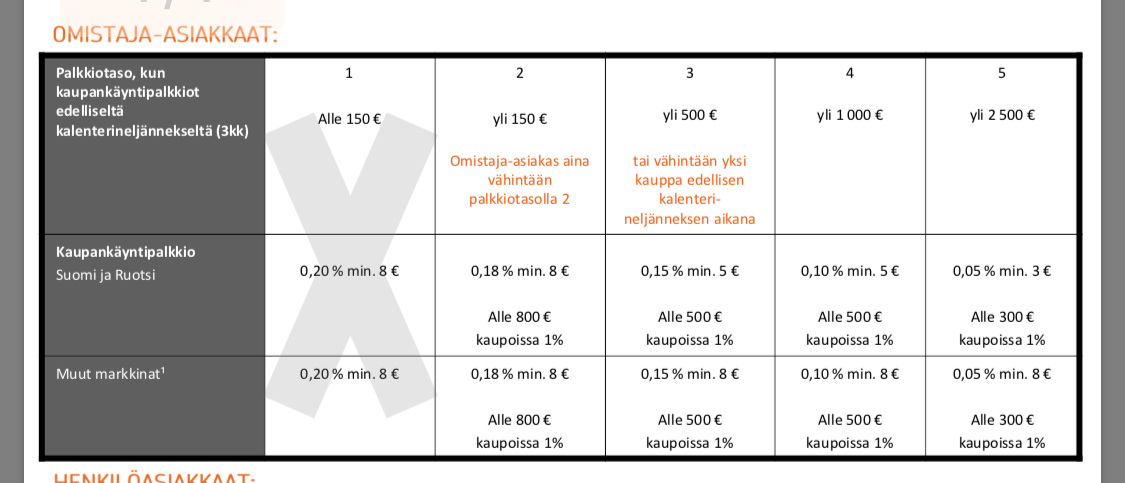
For a small investor like me, OP’s fees are truly heartwarming :hugs: I can calmly buy even small slices for my portfolio, without always having to save at least a thousand euros for one purchase. As an owner, I naturally stay in the game, and my loans + company matters are with the same bank :folded_hands:t2:

Here’s a picture of the price list if it’s unclear to anyone

5 Likes

I at least like OP-mobile. It’s a shame, though, that you can only trade in Nordic stock exchanges with it. Clearer than Nordnet and better security level. However, Nordnet’s newer mobile app is quite good.

Nordea’s browser version was completely rubbish in terms of usability, and I gave it up when they started charging too much for all unnecessary monthly fees. Maybe it would have worked if I had centralized everything there, but since there are smarter brokerage prices and other services elsewhere, there’s no greater sense in it.

Fortunately, we’ve got some competition in those price levels. 5e and 0.15% is already a pretty reasonable level, although it could always be cheaper. If only foreign stocks could be made the same price. OP charges an annual fee of 0.1 percent of the value of foreign stocks. We should definitely get rid of such ongoing costs.

If the same pace continues in the future, maybe we’ll even reach really good price levels :smiley:

2 Likes

Regarding Nordea and OP, it’s good to note the currency exchange spread in euro-denominated trades, which in my experience is 1-1.3%, meaning the actual currency exchange cost is 1.3-1.6%.

1 Like

I’ve mainly used Nordnet, but then ended up continuing my purchases on Degiro, where, for example, share purchases on the Helsinki stock exchange cost €2 + 0.038%, and on US exchanges only 50 cents + 0.004%. A recent downside I’ve noticed is that for less frequently traded stocks, the price level isn’t updated visually: so once a stock reached a level where I would have sold it (after a company name change), I couldn’t make the trade until I reported it to Degiro, and it took a few days for the update, by which time it was too late. The stock’s value had already dropped enough that I no longer sold it; now I’m more interested in buying.

1 Like

I also use OP mobile. It’s easy to do even in the middle of a meeting at work.

1 Like

Do you have experience with whether Degiro’s report is sufficient as a direct attachment for the tax authorities, or do I need to fill out separate forms? I wouldn’t acquire Finnish stocks through them for the reason Massi mentioned.

It also occurred to me, what are the actual currency exchange fees at OP when buying foreign stocks? They are exchanged directly, and I haven’t looked into it more closely, as I was told that currency exchange fees are included in the price. They are indeed included, even if the spread is whatever. Someone mentioned a spread of over 1%, which is absolutely outrageous and makes even Nordnet’s exorbitant prices seem reasonable. Has anyone looked into this?

Degiro’s breakdown was sufficient and acceptable to the tax authorities (at least for the 2018 supplementary tax return, i.e., for the 2017 tax year).

I don’t have personal experience with OP and Nordea’s currency exchange spread, but from what I’ve read, they were so high that it scared me when I read about it back then :scream: (even one percent is far too much for me).
It’s also worth checking if, for example, dollar dividends remain as dollars in the account, or if they are automatically converted to euros, incurring high exchange spreads again.
In Nordnet and Degiro, these currency matters are in order. At Degiro, US trades, in particular, are also very affordable, as mentioned earlier.

1 Like

Currencies are always automatically converted in Nordea, OP, and Danske. You can’t even open foreign currency accounts with them, apparently. It seems these traditional banks have partly figured out that they can indirectly fleece investors this way. At Nordnet, the trading fee itself is 15 euros, but after currency exchange fees, it roughly amounts to the same as with traditional banks if the spreads are indeed a little over one percent. I think I’ll make foreign purchases through Nordnet in the future, so the pricing at least remains transparent.

1 Like

Thanks, Masse, for the tip. I looked into it more closely. The authorities haven’t contacted me yet. Degiro apparently believes it’s operating correctly in compliance with the MiFID directive. Will I be fined for stupidity?

[quote=“Ville1, post:12, topic:915”]
I have mainly used Nordnet, but then I ended up continuing my purchases with Degiro
[/quote]…

@ville1, @stetson-harrison_cap, have you considered the reliability of such a relatively small and new broker? That your holdings don’t disappear into cyberspace due to internal misuse or external attacks?

I myself have experience mainly with Nordea and Handelsbanken. Both are good and trading costs are quite okay. When you don’t trade very actively or in short bursts, trading costs don’t weigh much.

Buying Nordic and other global stocks is more convenient with Nordea than with HB. I might have to look for other solutions for these, and that’s why this Degiro interests me. If you have tips on other alternatives, I’d love to hear them.

As I understand it, Mandatum will be opening some kind of trading venue early next year… am I wrong?

They’re opening something running on Saxo Bank’s platform soon. There doesn’t seem to be much more info about it anywhere yet. https://www.mandatumtrader.fi/

1 Like