In that Reuters article, the sources are statistics from ACEA (the European automobile manufacturers’ association) as well as figures from a corresponding Chinese organization. Do Chinese electric cars and Teslas, for example, show up in the European sales figures? At least they don’t belong to that European association. And the share of these non-European-based manufacturers in the EV sector is quite substantial. For instance, deliveries of Tesla’s updated Model 3 have just begun, and while waiting for them, Model 3 sales certainly took a temporary dip.
The order backlogs of European manufacturers have indeed shortened, but that is likely more about price competitiveness.
I wonder if Kempower has anything to comment on this?
In summary:
Tesla is expanding its charging infrastructure business at EG Group service stations in Europe. EG Group has 600 charging points to which Tesla will supply fast chargers. Although Kempower has a strong market position, Tesla’s brand and resources could put it in a challenging position. No comments from Kempower regarding the matter were mentioned in the press release.
Well, how electrification progresses is certainly strongly linked to Kempower’s outlook. It’s good news that energy density has been improved, yet we are still quite far compared to traditional options, at least in heavy transport. There, the battery weight is 44,000kg vs. a tank of diesel at approx. 560kg. And with those 500 kilos of diesel, you can get further than with a 44-ton battery pack. Weight limits for trucks also become an issue in many places; for example, electric trucks won’t be allowed on small bridges.
That 800V architecture raises questions about battery lifespan. I’ve often read that the slower batteries are charged, the longer they last.
In Europe, it’s still the case that electric mobility is cheaper, whereas in America, it’s largely the opposite. If the car and the ‘fuel’ itself, i.e., electricity, are more expensive than the older technology, you don’t have to guess which one will sell better.
Kempower’s competitive advantages also seem to be quite thin. At the investor event, they weren’t able to say anything at the booth. A bit stronger vision is needed on how they differentiate themselves. (see xlat’s message)
I was just wondering if I’ve ever even heard of the companies that supply gas pumps to gas stations. It’s pure B2B business, where the consumer doesn’t really know much else other than whether the pump works or it doesn’t.
This is a segue to the fact that Tesla is entering the charging market. Tesla is certainly a phenomenon as a car brand, but does that brand matter at all in the charging station business… Somehow, this charging thing is going to end up being a bit of a commodity business just like the gas pump business is now, though the customer base is broader.
A growing industry doesn’t necessarily mean profitable growth for the companies in that field. The crux of the matter is those famous competitive advantages. Different segments will likely form in the market, where companies succeed through different advantages, so there’s room for more than just a couple of massive commodity producers flooding the market with high volumes of charging stations. The charging market will be huge, but looking for the winners at this point might still be too early.
What about Chinese manufacturers from Kempower’s perspective? They have traditionally dominated these types of sectors, and transport in China has electrified rapidly. As a result, according to this article, they have more charging stations and fast-charging stations than the rest of the world combined:
At first glance, one might think that those manufacturers who have secured a significant slice of that pie would have quite a head start in terms of volume production.
Hold on now, the petrol pump markets are practically a duopoly, where both make an excellent operating profit %. The moats are as big as they get.
In Kempower’s case, I think the crux of the issue culminates in switching costs. Kempower’s product is excellent now, but it doesn’t have the kind of technological protection that would provide security on a 5+ year horizon. Therefore, I think it is extremely vital whether Kempower’s products have a high switching barrier for the customer? If Kempower grows aggressively and gains good market share (+ grows with the market growth), then they are in an excellent position IF the switching cost is high.
This is also what @Santeri_Korpinen talked about in the video linked above. As I understand it, Kempower’s product is excellent for customers because the initial investment can be small and new charging spots can be scaled extremely cost-effectively as demand grows in the coming years.
In this light, it seems logical to me that if customer X buys Kempower products now, why would they switch in 5 years when the chargers need to be renewed? Demand has likely only grown and there is rather a need to get new chargers + update the old ones. As I see it, there is some kind of barrier for customers in the business to switch to a competitor’s products, which is an excellent thing for Kempower. In addition, Kempower is already achieving excellent profitability with products that are very attractive to the customer in terms of price as well. This builds confidence that Kempower’s earnings will not collapse even years from now.
About Tesla. Tesla’s products are also extremely competitive and thus certainly an attractive option for many customers. Because of this, it’s very important for Kempower to step on the gas NOW, as market shares are being divided at a fast pace. And if switching barriers exist, then it is extremely important to capture this growth in the coming years to be among the winners later.
Good point from @Sambadi about Chinese competitors. Has @Pauli_Lohi looked into these / come across them?
EDIT: This thread didn’t have that video I referred to after all, so let’s put it here:
Nowhere, but let’s not let facts spoil a good story. Grasping the sense of scale in offhand remarks like that is sometimes difficult, but I also spent a long time wondering what kind of mass was actually intended here. That thing will soon weigh as much as a diesel locomotive.
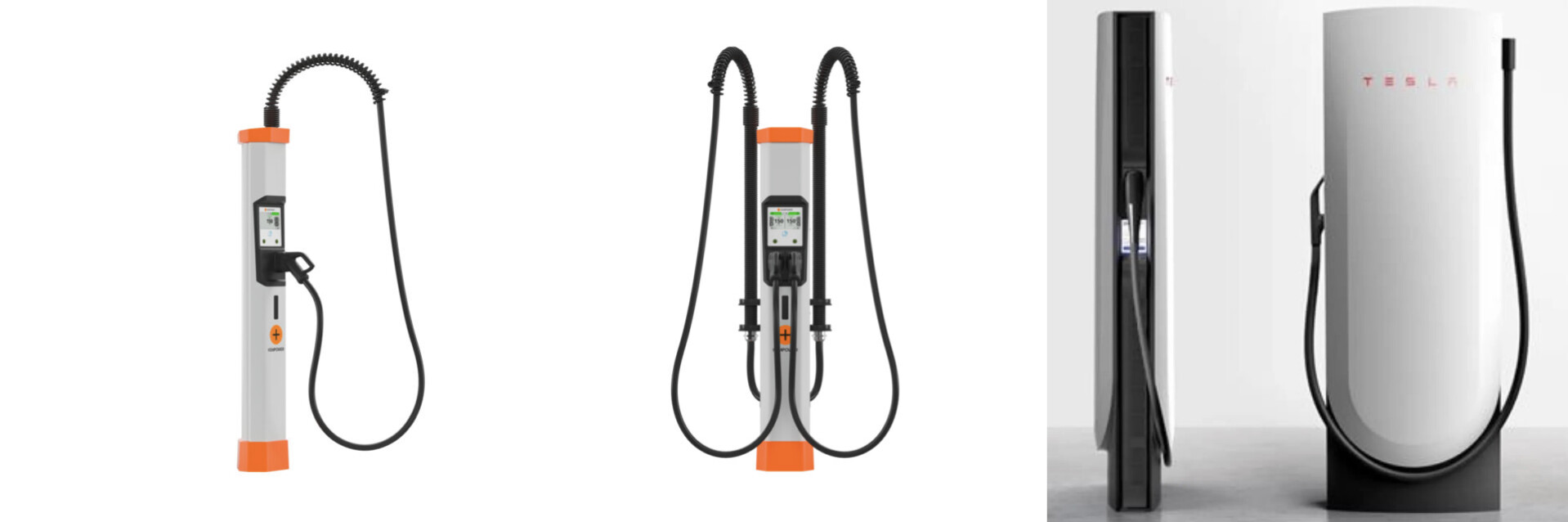
I was thinking a bit about the differences between Tesla’s and Kempower’s satellites. Here are a few thoughts:
Kempower offers both dual-cable and single-cable satellites. With the dual-cable version, two charging points are provided with one screen, payment terminal, frame, etc. This must be a cost-advantaged feature.
However, the comparison isn’t entirely fair because the power per charging point of Tesla’s satellite is higher than Kempower’s, thanks to liquid cooling.
As I understand it, Kempower only offers the liquid-cooled version as a single-cable model, meaning they compete in the same “one cable per satellite” category.
Maximum power of 350 kW is not always needed, so I see the dual-cable satellite providing cost competitiveness in many situations.
Kempower’s cable reach and cable management are indisputably better than Tesla’s satellites, even though Tesla lengthened the cable in this latest version.
For example, in dock installations for boat charging stations, meters of cable are easily required. I wonder how Tesla’s satellites would adapt to that. Is it even possible to get customized cable lengths per charging station when ordering from Tesla? And is Tesla even interested in selling “small projects” with fewer than 10 charging points?
I suspected something like this (without knowing much about it) that there are at most a few big players dominating the gas pump industry. That good profitability in that business bodes well for the charging station business too, in a way; there’s a lot of similarity in the business logic.
So, there’s a race going on in charging stations to see who can stake their claim in those locations. Switching costs are a good competitive advantage; it just really requires being able to capture the market quickly and on a large scale, because competitors have the same competitive advantage. Certain technological development can still be rapid, and more advanced technology can bypass existing systems, leading to the entire system being replaced by a new, competing product. So, one must keep up with the industry’s technological development in addition to grabbing market share.
Interesting case, this could become a successful product. (For now, I’m still watching from the sidelines; at the moment, it’s too much of a “future-oriented” company for me. In that sense, I’m commenting from a thin basis, mainly learning what the industry is about.)
China’s massive lead (at least in terms of quantity) is a threat, but it’s possible that there will be efforts to restrain it in the West. It’s not good if this important industry (as well) were dominated by the Chinese. I wouldn’t be surprised if there were tariffs and other protections in the United States.
The world’s largest electric vehicle, with a battery weight of 4.5 tons. So it’s unlikely to be ten times that in a truck. Old story, but the proportions are unlikely to be far off today.
I have heard from Kempower that Chinese companies are seen to some extent in Europe but are not particularly competitive (they are not seen at all in the USA). Some European companies also sell Chinese products under their own branding, but their technological competitiveness is not good. The Chinese have a significant market share in electric buses here, and it is common for their own chargers to be delivered with the buses.
Admittedly, one would think that the Chinese would have been able to develop good technology, as they are far ahead in the electrification of transport. On the other hand, the Chinese state likely does not support this charger segment in the same way as, for example, car manufacturing, because the market size is not strategically large enough. It must be remembered that chargers are not just hardware; software is also a significant part of the solution and can involve issues such as data privacy and system integrability.
Are there any significant names involved in the Chinese companies?
Seeing data privacy and China in the same sentence made me laugh a bit. It might be something that raises questions from buyers when selling abroad, but it’s unlikely to limit growth/subsidies in the domestic market.
Chargers will be highly critical infrastructure as all transport becomes electrified, comparable to, for example, fuel depots and fuel logistics in crisis situations. It’s hard to believe that this kind of infrastructure would be built in Europe using Chinese software and hardware. Availability of spare parts in emergency situations, security of supply, software quality, and the absence of backdoors will surely weigh more in procurement decisions than a small price difference.
This is also my thought; right now it would be very important to put A HUGE AMOUNT of resources into sales and marketing (clear, beautiful, and active visual communication) and promises of functioning customer service, maintainability, modularity / upgradeability. Anything to stand out in the market.
If I owned a site where I was ordering chargers, I would never choose a Chinese charger. Too many risks when considering customer service (fault situations), user experience, and specifically that data security… geopolitical risks etc.
Exactly. And on a side note, why wouldn’t there be enough market share for Kemppower? Is Tesla going to build the charging infrastructure for the entire planet?
To what extent has China’s charging infrastructure been built by Chinese manufacturers, or have foreign players had a significant share of the market? As I understand it, Delta at least is not a Chinese manufacturer, although it is likely a major player in China. That was perhaps another angle to this issue. However, manufacturing in China and being a Chinese manufacturer are slightly different things, so it would be interesting to break down the Chinese charging market to see who has been sharing the world’s largest piece of the pie so far.
 It might be something that raises questions from buyers when selling abroad, but it’s unlikely to limit growth/subsidies in the domestic market.