Perhaps I’ve missed a previous message, so I’m asking:
What was this survey (i.e., what was the actual question)?
Who were the respondents?
About 200 votes doesn’t seem like a very large sample without knowing what was asked and to whom? Especially since the charging station/site operator can significantly affect the user experience.
Apologies if my message wasn’t clear enough.
The poll can be found in the “Charging Network - Now!” group on Facebook and is therefore a completely unofficial poll from the group’s user base.
I summarized the question in my message because I didn’t want to copy any of the message’s content word-for-word to external sites (like this Inderes forum).
However, I thought that even such an unofficial poll from Facebook might interest other Inderes users Of course, one shouldn’t make investment decisions based on this
Thanks. I’m not in the group myself, but at least a couple of years ago, it seemed to have a more enthusiastic crowd than the average motorist, one that understood the differences between chargers. The only problem, of course, is that it’s really difficult to filter out the influence of the charging operator (Virta, Recharge, …) from those user experiences. And there’s also a bias in that, for example, Tritium’s Finnish chargers are likely a bit older compared to new Kempower chargers, which in itself makes a big difference. It’s not surprising that newer ones are better than older ones. It would be quite worrying if that weren’t the case.
And if my understanding of, for example, the age of Tritiums is wrong, please correct me.
I don’t think there’s any product development that companies of that size couldn’t “handle.” The difference between that SICHARGE D and Kempower’s product seems, at a quick glance, to be:
Power modules in the satellite. This makes the unit larger and harder to place. For DC charging of more than 2 cars, additional satellites must be acquired. In my opinion, Kempower has a significant advantage here, as utilizing existing service stations and parking lots is easier when the power modules can be placed “on the side” and the satellites kept small.
Smaller power scalability per unit. Siemens 300 kW and Kempower 600 kW. You can acquire two Siemens devices, but power cannot be shared between them.
At least Norway’s rapid market share growth proves that they have succeeded in design and technical completeness. Tesla’s own devices represent similar dynamism and scalability. Of course, there’s a long line of competitors, but indeed, in the pioneering market of Norway, the pace is accelerating, and now in Finland too.
The market size in Central Europe is of a different magnitude, and hopefully, the same development will be realized there.
And it’s worth remembering that comparing them to AC charger manufacturers might not be relevant. Fast charging and HPC (High-Power Charging) are Kempower’s forte. The success of this case depends on the successful scaling of sales in Central Europe on the sales side. And production also needs to be able to scale profitably, but it’s difficult to form an opinion on either component.
I haven’t specifically researched competitors’ chargers online, my only experience is practical experience with different chargers (I need to start researching if I participate in the IPO). I don’t think I’ve seen Siemens in Finland. The ABB chargers I’ve used are much flimsier. ABB can be found, for example, in some Lidl parking lots. The Siemens you linked is much larger than Kempower’s satellite, which only has control electronics. Kempower has long cables so they reach the back of the car, and the cables don’t lie on the ground. If Kempower is compared to a pioneer like Tesla, their usability is starting to be better, except that Teslas support automatic billing. That is, if the car is a Tesla, there is a trial underway in the Netherlands where other cars can also use Tesla chargers, and the use is more difficult.
Charging devices are selling well. What if Kempower made a hybrid model? A car charger / welding transformer. You could weld rusty car sills while charging the car at the same time.
Tesla’s limitation is its self-centered focus. Based on the above news, Kempower is a very fast-growing company. The product has a clear advantage in charge management and monitoring. This will be the next subscription and additional acquisition as soon as trading begins.
Kempower’s shares’ subscription price in the IPO (Initial Public Offering) is 5.74 euros per share. Based on the subscription price, the company’s market value would be approximately 306 million euros, which is based on the number of outstanding shares after the offering.
The subscription period for Kempower’s public offering begins tomorrow, Thursday, at 10:00 AM and is estimated to end on December 10 at 4:00 PM. In the event of oversubscription, the public offering can be suspended no earlier than December 9 at 4:00 PM.
Trading in Kempower’s shares is expected to begin on December 14.
Based on that, Kempower’s 2021 P/S is approx. 10-12 (if revenue is 25-30m)
For comparison, Zaptec’s 2021 P/S is approx. 10 based on marketscreener forecasts.
So instead of a listing discount, there’s a listing premium
For 2022 forecasts, the situation is reversed, with Zaptec’s P/S around 6 and Kempower’s 6-4 (if revenue is 50-75m, because at this point I can’t estimate whether it will grow by 100% or 400%, so I’m taking the more conservative end). Revenue should ideally grow by at least over 100%, which shouldn’t be challenging given the growth in recent years. But if it grows significantly more next year, the P/S ratio will melt away quickly.
The offering size is 87m, but anchor investors have reserved approx. 61%, meaning about 34m is available in the offerings.
In other words, it will be oversubscribed multiple times again, even though the offering size is significantly larger than Modulight or Norrhydro. So there’s a small hope that I won’t be left with less than 200e
It comes at the worst possible time, so with that valuation, the market reception might be weak. A genuinely interesting company with interesting products, but…
This is a tough decision; the stock’s valuation is quite high, yet the growth prospects are very promising and surprisingly certain. Public administration will undoubtedly support the construction of charging infrastructure in the coming years, which will surely accelerate growth. The industry is interesting, and the company has real operations. I’ll have to ponder participation until December 9th and decide based on the general market situation at that time.
Kempower’s Chairman of the Board has enough credit to participate in the offering.
Kempinvest Oy (an investment company partially owned by Antti Kemppi, Chairman of Kempower’s Board of Directors), has committed to subscribing for shares worth EUR 2.0 million.
For me, the first company presentation live stream had rather poor and grainy image quality, constantly freezing for 1 second before the stream continued. Fortunately, the audio worked without problems. Was it my own poor computer/internet connection or a more general issue? Usually, live streams haven’t been broadcast via YouTube.
The investment story and the long list of anchor investors sounded promising, though, so I’ll probably make at least the minimum subscription… still haven’t read the prospectus.
My experience, on the other hand, was that the livestream had above-average picture and sound quality. So, it’s probably not a problem affecting everyone…
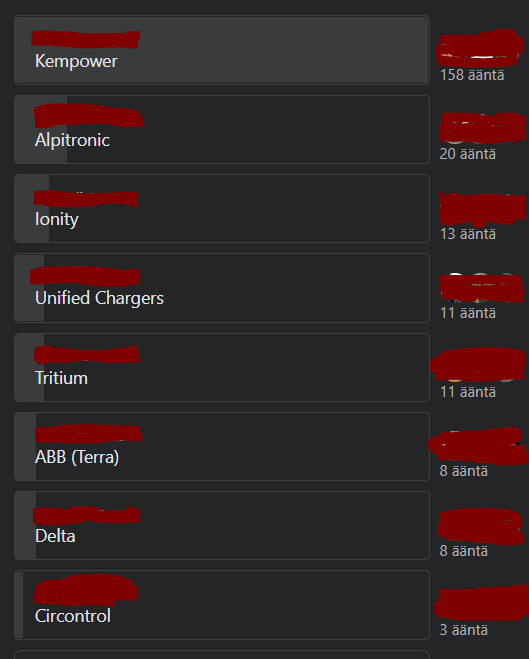
 Of course, one shouldn’t make investment decisions based on this

