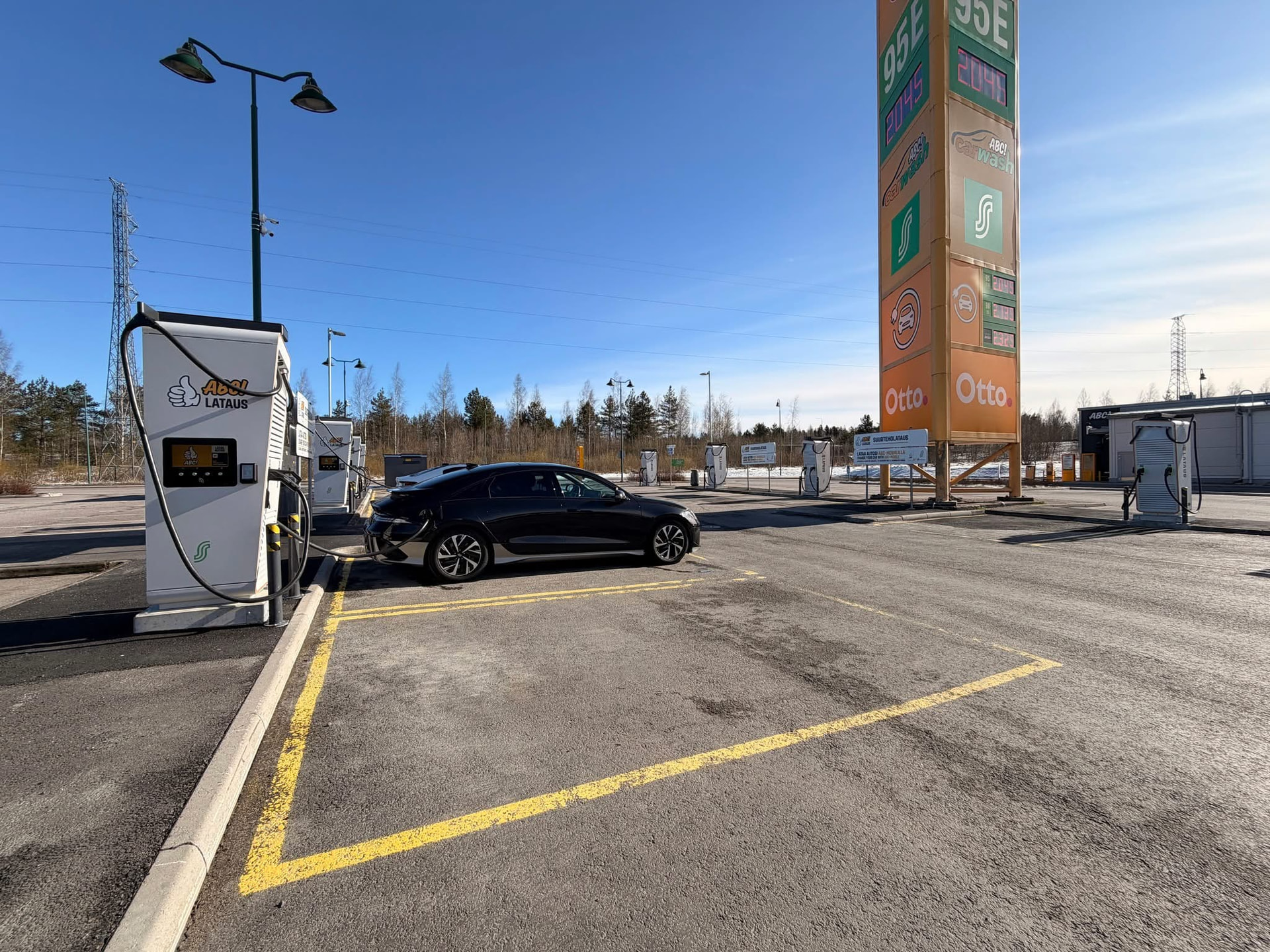
“A mega charging park with Alpitronic equipment”, 16 bays and 2 MW of (additional) total power, so one would imagine it’s the HYC1000. Regarding the earlier discussion:
Edit:
You might be right. This picture (from the Aug 27 post) shows 16 charging points with Alpitronic HYC400 cabinets.
So, no proof yet that Alpitronic has mastered satellite systems like Kempower. But if (existing) customers more broadly choose this kind of setup for new sites instead of a satellite park, that doesn’t sound good for Kempower either.
By far the most overvalued company on the Helsinki Stock Exchange.. Order intake is shrinking, margins are narrowing, and millions are being lost every quarter while the cash pile dwindles to almost nothing and the market cap is still a staggering 585 million euros..
“Mega-site with Alpitronic equipment”, 16 stalls and 2 MW (additional) total power, so one would imagine it’s the HYC1000. Related to the previous discussion:
I would personally guess that the cabinets are coming. 2 plugs per cabinet.
Now I have to ask those who are wiser and more knowledgeable: does Kempower still have any real profit-maker that makes it first and best among its peers? Or is this story almost over soon?
Kempower as a company is very young, and globally the entire industry is still in its early stages. The story has only just begun. At this stage, the most important thing is to strengthen competitiveness and market share compared to other industry players.
I view this as a very young industry and assume a fairly hard-nosed calculation, meaning:
It would be strange if the Chinese didn’t charge in hard, at the latest when chargers are selling at double the current volume. I assume raw materials like copper are more affordably available than in Europe/USA and assembly is much cheaper.
Adjustment needs in operations are a typical phenomenon for a young growth company, the mop just gets out of hand and then it gets fixed. Some experienced industrial process fixer as Production Director and things will be sorted out over time. Same thing for sales. Right now, there are “self-taught” leaders from a young industry who lack an understanding of world-class processes and management.
The whole industry should soon get rid of partner sales, conflict of interest with the manufacturer; I understand the beginning when demand exceeded the capacity of the own sales interface, but in the long run, completely unnecessary middlemen, they don’t add value, sales into own hands, installation outsourced. If these have something that needs servicing, then one should soon start considering how “Kone” does it.
The share of warranty repairs out of gross margin is very high, I consider this the most important metric alongside the order book and gross margin %.
*Addition to the China view, Maersk’s recent comment on the shift in Asian exports from consumer goods to industrial green transition products, meaning when they come in big—and apparently they are—and with traditionally strong subsidies, Westerners will be baffled again…
“What we have seen since COVID is, as the export from the Far East have boomed, it is more the industrials that are actually driving the growth. And it is anything that is related to electrification from storage, so batteries, solar panels, parts for either solar panels, windmills, turbines, grid, electricity grid, anything that has to do with electrification. Cooling units for data centers and other things. EVs. So anything that has to do around electrification and the race to build more power capacity is driving demand for industrial products whose production base is very Asia-centric and Asia-dependent.”
" And this is not only a U.S. issue. This is Europe, this is India, this is the Middle East, this is Latin America, this is Africa. We see this across the whole world, where large Asian companies are exporting more and more of these components into those geographies and those markets."
I’ve always felt that this stock has been totally over-priced, and I’ve never really had any interest in buying it, but a price below 10 euros could start to look tempting, of course. Still, there are a couple of things in the story that bother me, at least. Why will fast chargers be needed in the future if 1) they ruin your car’s battery and shouldn’t be used except in an emergency, 2) if battery technology develops as expected, the car’s range will increase so that, in practice, slow charging at home or at work is enough?
Of course, battery technology could also develop in a direction where fast charging wouldn’t ruin the battery. Still, to reduce the load on the power grid, it would be desirable that as electric cars become more common, they would be charged with slow bidirectional charging, which would actually smooth out consumption peaks by allowing electricity to be sold from the car’s batteries back to the grid during extreme consumption spikes, instead of fast charging creating those consumption spikes. For these reasons, I think fast charging is completely the wrong strategy.
Great news, though they could perhaps choose their marketing images for LinkedIn a bit more carefully in Poland even though it’s presumably about fireworks… maybe a bit off-topic…
Fast charging is needed precisely because on a trip the battery needs to be charged quickly, and that has value. And it doesn’t destroy the battery – it just wears it down more compared to slow charging.
And battery technology is constantly evolving – better cooling, better chemistry – so charging power keeps increasing and batteries last longer.
In general, battery durability is not an issue at all. Research and data show that batteries last longer than assumed / feared. Actually, there isn’t really any problem even now.
My own guess is that fast charging will still be needed in the future. High charging power (at the 500kW level) will be needed for trucks, and for cars too. Humans are so impatient that needs will always exist. That 10-minute reduction in charging time is a strong selling point.
I have been monitoring the SOC (State of Charge) values of used car batteries, and there are indeed very significant differences between cars with the exact same mileage, likely depending on how much they have been fast-charged. The battery is, after all, an electric vehicle’s most important and expensive component. If I were to buy a used EV, I certainly wouldn’t buy one that has been heavily fast-charged, because it has a bad battery. So, fast-charging definitely affects the car’s resale value and, in the long run, its lifespan.
SOC value refers to the current state of charge (State of Charge), while SOH (State of Health) indicates the battery’s current charging capacity as reported by the BMS (Battery Management System). This SOH, in turn, is very directional, varying from car to car and also according to temperatures. There are car brands that also include the battery buffers in that SOH value, and thus no drop is shown there even if there might be a drop in the general charging capacity. SOH itself therefore doesn’t tell us much, it is mostly directional.
A large portion of the SOH values in sales listings are tested, meaning they haven’t simply been read via OBD. Of course, some incompetent sellers use untested figures as well.
It is true that significant differences can be achieved for the same cars with the same mileage and age. The two main factors are the number of fast charges and how the battery is stored—meaning the battery degrades significantly faster if it is always charged to full, especially if it spends longer periods at full charge. Conversely, letting the battery drop too close to zero also causes problems.
Apologies for the typo. I might have gone a bit too far regarding the harmfulness of fast charging. It could indeed be that the results of those battery tests are just indicative. Still, the AI is of the opinion that how the car is charged matters quite a bit. If home charging degrades the battery by about 1.5% per year with average mileage, the AI estimates that with continuous, ultra-fast charging exclusively, the corresponding annual battery degradation could be around 3%. So there is a significant difference. Well, if the car is mainly charged slowly and only fast-charged on long trips, then there won’t be a problem. On the other hand, my conclusion remains that it’s never really worth fast-charging a car unless you have to. In the cars I compared, the SOH (State of Health) value in the worst ones was more than twice as poor as in some others with the same mileage. This observation is therefore the same as the estimate given by the AI. Had I had to guess, I would have ended up with the same estimate as the AI, that the battery wears out twice as fast in fast charging compared to slow charging. And for these reasons, I still question the need to increase fast-charging capacity and Kempower’s growth prospects, at least in passenger cars.
Many people do not have the possibility to charge their car at home. As electric cars become even more common, is it even sensible to provide home charging capabilities for every car? After all, the electrical grid was not built to have dozens of cars charging at the end of a single connection.
Doesn’t a larger battery always mean a heavier car? Does it make sense to increase the car’s weight if, with a more modest battery, the car would be much more energy-efficient, even if it required more frequent charging?
I personally see the potential of the DC charging market, and Kempower seems to have good technology and products. Whether they can turn those into a global success is a different question.
That weight is indeed a really good argument in favor of fast charging, especially if the automotive industry would understand to standardize batteries as swappable components. If the traction battery could be easily replaced at a reasonable cost, then you wouldn’t have to care about its wear, and then I would certainly choose a smaller, lighter battery for the car and would gladly fast charge it.
I personally see it in a way that in the future, all drivers should have the possibility for 3.5 kW slow charging at home. That doesn’t require investments in the power grid, just sufficient sockets with protections at the parking spot. For the majority of EV drivers, overnight slow charging is enough to cover daily driving needs. For longer trips, there are public fast chargers.
The problem right now seems to be that slow charging directly from a wall outlet is not recommended for long-term use because a) regular outlets don’t have sufficient residual current/thermal protections and/or b) travel chargers are not meant for continuous use. However, technical solutions to these problems already exist, and I bet that slow charging at home will become more common once people realize that at home, it doesn’t really matter whether charging takes an hour or 8 hours.
[quote="mikkojuhani, post:3736, topic:24068"]\nAnd therefore, for these reasons, I still question the need to increase fast-charging capacity and Kempower’s growth prospects, at least in passenger cars.\n\n[/quote]\n\nIf the rationale for the growth outlook flattening is that fast charging degrades the battery too much, I don’t believe that.\n\nI believe the opposite: 1) car charging power will only increase. Just 2 years ago, 200kW was a high charging power, now we are talking about 400kW and Chinese 1000kW powers. 2) Electric cars will only become more numerous. 3) Heavier vehicles will increase – vans, delivery trucks, and also heavy-duty trucks. 4) Technology is improving, and even now, battery wear is practically not a problem. The ones making the biggest fuss about it are those who don’t own an EV = they don’t know the facts.\n\nAnd yes, people charge at home whenever possible, but on trips, charging is practically fast charging. My own experience is that a 15-minute break every 2 hours is just fine, and fast charging is a great fit for that.\n\n==> all of this leads to the fact that significantly more charging power will be needed compared to today.
Can anyone tell me whether it’s the charger manufacturer’s, the charging operator’s, the car manufacturer’s, or whose problem it is that Plug & Charge or Autocharge don’t seem to be becoming more common? Nowadays, I suppose all new electric cars sold in Finland support these, but only individual chargers/operators (like Ionity?) are able to use them.
And if anyone is not familiar with it, this is about being able to just plug the car in when charging, and the car and charger handle the authentication and billing automatically (cf. current mobile apps).



 even though it’s presumably about fireworks… maybe a bit off-topic…