https://www.media.volvocars.com/global/en-gb/media/pressreleases/list
15 Likes
https://www.volvocars.com/fi/kestava-kehitys
Volvo Cars’ fundamental idea is that as a company in the automotive industry, we must be part of the solution in mitigating climate change. This is reflected in our comprehensive approach and commitment to sustainable business. We were the first traditional car manufacturer to commit entirely to electrifying its car fleet. This means that every new Volvo model launched from 2019 onwards will have an electric motor.
The Paris Agreement in 2015 defines targets for CO2 emission reductions, and electrifying the car fleet alone is not enough to achieve them. As a result, in autumn 2019, we launched one of the most ambitious climate plans in the automotive industry: we will reduce our life-cycle carbon footprint per car by 40 percent between 2018 and 2025. This is the first step towards our ambition to become a climate-neutral company by 2040. We will reduce CO2 emissions in our production network and supply chain, as well as by recycling and reusing materials.
“Being a progressive car maker means we need to address all areas of sustainability, not just CO2 emissions,” said Stuart Templar, director of global sustainability at Volvo Cars. “Responsible sourcing is an important part of that work, including respect for animal welfare. Going leather-free inside our pure electric cars is a good next step towards addressing this issue.”
“Finding products and materials that support animal welfare will be challenging, but that is no reason to avoid this important issue,” said Stuart Templar. “This is a journey worth taking. Having a truly progressive and sustainable mindset means we need to ask ourselves difficult questions and actively try and find answers.”
9 Likes
Volvo Cars announces its intention to launch an Initial Public Offering and list on Nasdaq Stockholm
Volvo Cars, which reported record growth in unit sales and revenues in the first half of 2021, today announces its intention to launch an Initial Public Offering (IPO) and to list its class B shares on Nasdaq Stockholm, offering shareholders the opportunity to invest in one of the world’s fastest growing premium automotive companies.
The proposed IPO is expected to consist of the issuance of new shares by Volvo Cars to raise gross proceeds of approximately SEK 25 billion and a potential partial sale of shares by Volvo Cars’ main shareholder. In addition, Volvo Cars’ current Swedish institutional shareholders AMF and Folksam intend to remain as shareholders following completion of the IPO.
Volvo Cars is one of the world’s fastest growing premium automotive companies in terms of both units sales and revenue, providing customers around the world with the freedom to move in a personal, sustainable and safe way. Volvo Cars believes that its unique structure and focused strategy makes it one of the fastest transformers in the global automotive industry, with mid-decade ambitions dedicated to electrification, sustainability and digitisation. This strategy aims to build on Volvo Cars’ track record as a global force for automotive safety and innovation, which has been a hallmark of the company, headquartered in Gothenburg, Sweden, since it was founded in 1927.
To support the company’s transformation and its continued growth, Volvo Cars’ Board of Directors and its main shareholder, Geely Sweden Holdings AB (Geely Sweden) have agreed to apply for a listing of the company’s shares on Nasdaq Stockholm and thereby gain access to the Swedish and international capital markets and diversify Volvo Cars ownership base.
As a listed company upon completion of the IPO, Volvo Cars will enable global institutional and retail investors to participate in the next phase of the company’s value creation. Geely Sweden – a wholly-owned subsidiary of Zhejiang Geely Holding Co Ltd. which acquired Volvo Cars in 2010 – intends to remain the company’s largest shareholder. Volvo Cars will thereby continue to benefit from cooperation within the Geely ecosystem, providing valuable scale and market synergies.
Eric Li, Chairperson of Volvo Cars’ Board of Directors and ultimate owner of the main shareholder, says: “We have supported the transformation and growth of this iconic Swedish brand during a period of unprecedented change in our industry. Over the past decade, Volvo Cars has turned itself into one of the world’s fastest-growing carmakers. We will continue to support Volvo Cars as a majority shareholder in this ongoing global success story.”
Håkan Samuelsson, CEO of Volvo Cars, says: “Today is an important milestone for our company with the announcement that we intend to list Volvo Cars on Nasdaq Stockholm. The proposed IPO marks a new chapter for Volvo Cars, and we invite Swedish and international investors to participate in our future growth and value-creation. The decision to proceed with an IPO will help strengthen our brand and accelerate our transformation strategy – towards full electrification, direct consumer relationships and the next level of safety. This will position the company to deliver continuous growing volumes, revenues and profitability.”
The institutional investors AMF and Folksam currently hold 2.2 per cent of the shares in Volvo Cars through preference shares. Following completion of the IPO, AMF and Folksam intend to remain as shareholders in Volvo Cars through listed shares .
An overview of the transaction details is included below. Full terms, conditions and instructions for the proposed IPO will be included in a prospectus to be published by the company in connection with the planned listing. The company will make a further announcement when the prospectus is available.
The listing committee of Nasdaq Stockholm has assessed that Volvo Cars meets the applicable listing requirements, provided that customary terms and conditions are satisfied, including that the distribution requirement for Volvo Cars’ common class B shares is met no later than the first day of trading in Volvo Cars’ shares on Nasdaq Stockholm and that Volvo Cars applies for the admission to trading of its shares on Nasdaq Stockholm. The first day of trading is expected to be in 2021.
Further announcements relating to the proposed IPO will be made in due course.
7 Likes
My preliminary thoughts are below (mostly on the story/business strategy level, I’ll look into the numbers later). I must say that as a very satisfied Volvo owner, I might be a bit biased here, but this is an interesting opportunity (the size of the IPO is quite massive for Sweden).
- Volvo has a clear roadmap for transitioning first to purely hybrid production and, in the longer term, completely away from internal combustion engines (by 2030) on the passenger car side. I appreciate their courage in taking such a bold stance.
- They are strongly investing in a future direct-to-consumer sales model, the effectiveness of which Tesla has, for example, already proven in the premium segment.
- Chinese investors will clearly remain the largest owners. This can also be seen as a risk, but in my opinion, it can be a plus. It might facilitate, for example, the securing of battery metals and other resources as production scales up, as the lion’s share of these comes from China.
- In my opinion, the quality of cars has also clearly improved over the last 10 years or so. The brand looks and feels premium in a completely different way than in the early 2000s, and many “teething problems” that annoyed me, such as the laxness of the steering, have been eliminated, which would suggest that customer feedback is being listened to and product development is being invested in.
- There is also other evidence of smart investments in product development and the utilization of new technologies: for example, the company heavily uses virtual reality and AR in product development, which will surely bring excellent cost-effectiveness.
13 Likes
The C40 Recharge is Volvo Cars’ second fully electric car and is the latest in a series of new pure electric cars to be launched in the coming years.
The Ghent plant, one of the company’s largest, is a trailblazer in Volvo Cars’ move towards all-out electrification. It also produces the XC40 Recharge, the fully electric version of the company’s award-winning compact SUV and Volvo Cars’ first fully electric model.
Volvo Cars is increasing electric car capacity at the Ghent facility considerably, to 135,000 cars per year, and already expects more than half of the plant’s production volume in 2022 to consist of fully electric cars.
It is also the first Volvo model to be completely leather-free.
1 Like
Has anyone found a comparison yet that compares Volvo Cars’ financials and business against other publicly listed car giants? It’s somehow really difficult to grasp what size class Volvo’s business actually is compared to other players in the industry.
3 Likes
Uh, how does Volvo Cars differ from Volvo, which has been publicly traded for a long time?
Volvo Cars is apparently co-owned by Volvo Group (under Ford) and Volvo Cars (under Chinese Geely). Nice setup? 
https://www.media.volvocars.com/global/en-gb/corporate/this-is-volvo
4 Likes
Volvo, listed on the Swedish stock exchange, has focused on heavy vehicles (trucks, buses, etc.), and this listing now encompasses Volvo’s passenger car division.
9 Likes
Ford owned passenger car Volvo (Volvo Cars) from 1999-2010. Since then, Ford has not had any role in either. The Volvo trademark is owned by Volvo Trademark Holding AB, which is owned by Volvo Cars and Volvo Group, and both are allowed to use the trademark in their products. An additional spice to the whole picture is the former Volvo tuning workshop and later sister brand Polestar, which is listing in the US: https://www.nasdaq.com/articles/ev-maker-polestar-to-go-public-at-%2420-billion-valuation-via-spac-2021-09-27
5 Likes
In practice, Polestar is a BEV (Battery Electric Vehicle) Volvo, and Volvo’s other model range will transition to BEV quickly. Despite this, they are listing as two separate entities to maximize valuation.
2 Likes
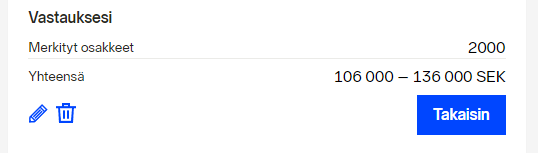
How could this be marked?
General info
(note that IF insurance company is one of the anchor investors of this IPO: perhaps interesting from Sampo owners perspective)
IPO
VOLVO CARS IPO PRICE RANGE 53-68 SEK/SHARE (NEW) (Direkt)
2021-10-18 13:56
STOCKHOLM (Nyhetsbyrån Direkt) The price range for Volvo Cars’ initial public offering has been set at 53–68 Swedish kronor per share.
This is stated in a press release.
The range corresponds to a market value of 163–200 billion Swedish kronor after the completion of the offering and after other changes in the capital structure that are being implemented.
The new issue of common shares is expected to provide Volvo Cars with gross proceeds of approximately 25 billion Swedish kronor before deduction for transaction costs.
AMF, Swedbank, If P&C Insurance (If Skadeförsäkring), Nordea, Skandia, Skandia Life Insurance Company (Livförsäkringsbolaget Skandia), and Danica Pension have committed to acquire shares corresponding to 26 percent of the gross proceeds.
Approximately 19.5-24 percent of the shares will be freely traded (so-called free float).
The application period for institutional investors is expected to run from October 19–27. For the public, it runs from October 19–26.
The first estimated day of trading is October 28.
Emil Mattsson +46 8 5191 7916
Nyhetsbyrån Direkt
6 Likes
Here’s more information in Finnish about the listing: Nyt tuli vahvistus – Volvo Cars listautuu Tukholman pörssiin, ensimmäinen kaupankäyntipäivä 28.10. | Kauppalehti
The price of one share in the IPO is approximately 5.3 - 6.8 euros, meaning the market capitalization would be around 16-20 billion euros.
More details about the IPO on Volvo’s website: https://investors.volvocars.com/en/ipo
7 Likes
Strong guess that Nordea would be involved.
There’s no need to guess when you can read the correct answer from the prospectus. In Finland, subscriptions are made through Nordnet.
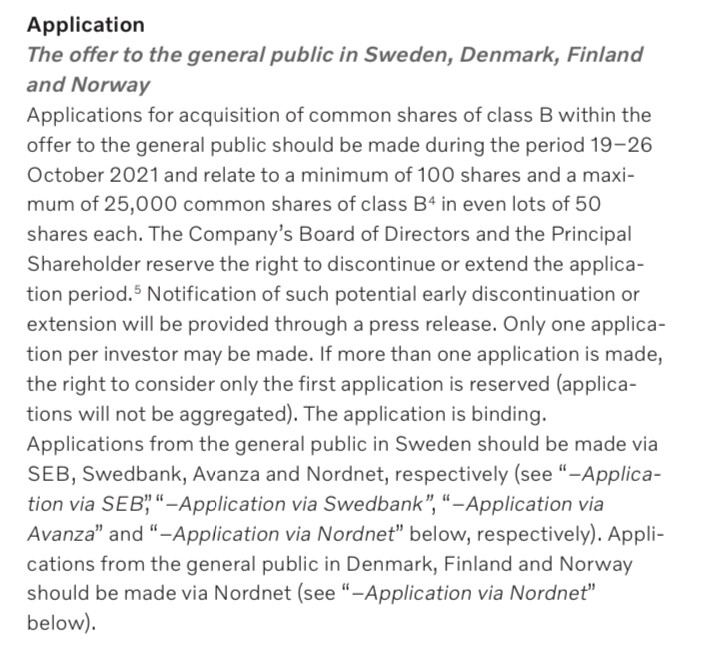
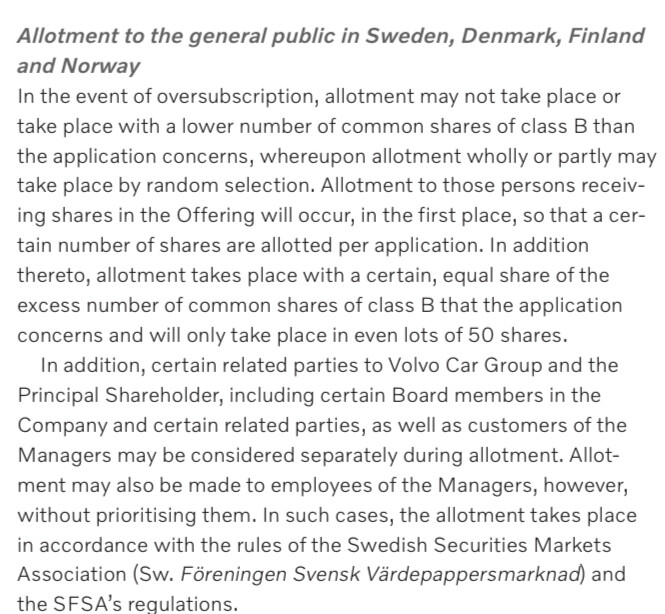
Edit: Here’s also an excerpt from the allocation terms, as I guess many will miss this again. In Sweden, it is also common to raffle the recipients of shares, meaning that in an oversubscription situation, the distribution may not follow the “something for everyone” model familiar from Finland.
10 Likes
There it was, the information, thanks. They seem to have updated the information yesterday.
Now we just wait for it to be opened on Nordnet… I didn’t find it yesterday, nor today. Or maybe I’m just too impatient this early in the morning.
3 Likes
Could someone wiser please tell me what I’m missing in the figures from the annual report?
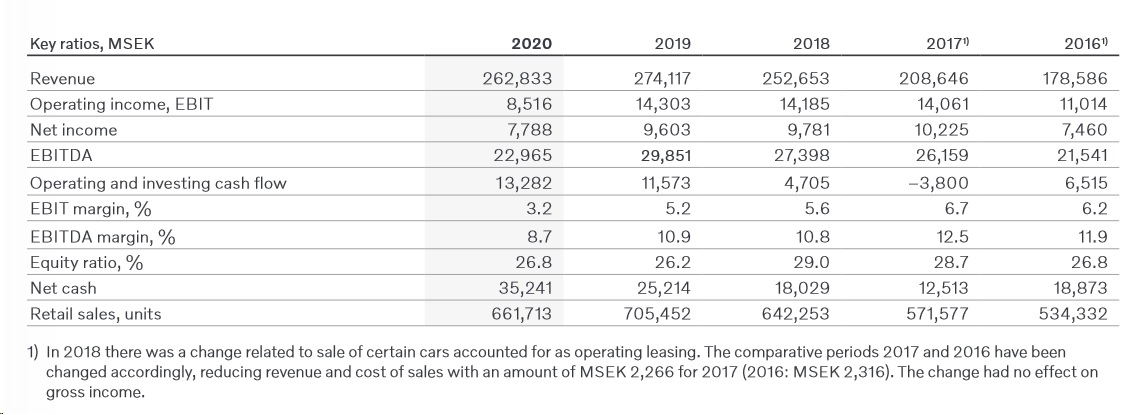
Compared to this
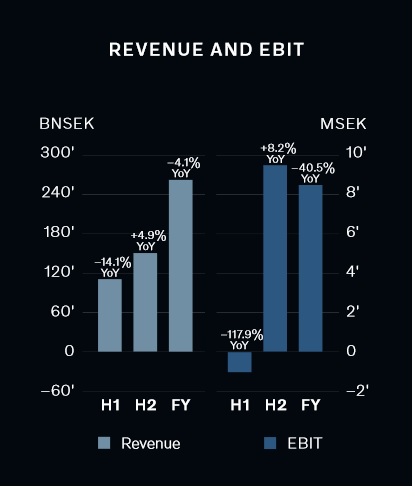
I’m missing something here, as to me the unit MSek on the right refers to EBIT?
It might just be that I’m having trouble understanding the decimal points from these figures in a Finnish context

1 Like
The labels in that graph must be wrong. So the EBIT should also be in BNSEK in my opinion, and the comma in the annual report just indicates a thousand separator. So revenue 262,833,000,000 SEK and EBIT 8,516,000,000 SEK
4 Likes
I had a moment to think that quite high valuation multiples had been set for the IPO