Now geography is spot on.  Potentially the country’s largest charging station in Sweden with nearly 200 Kempower chargers. It looks like it’s a bus depot.
28 Likes
Just a reminder that the Kempower earnings live stream is coming up again today starting at 8:25 AM! 
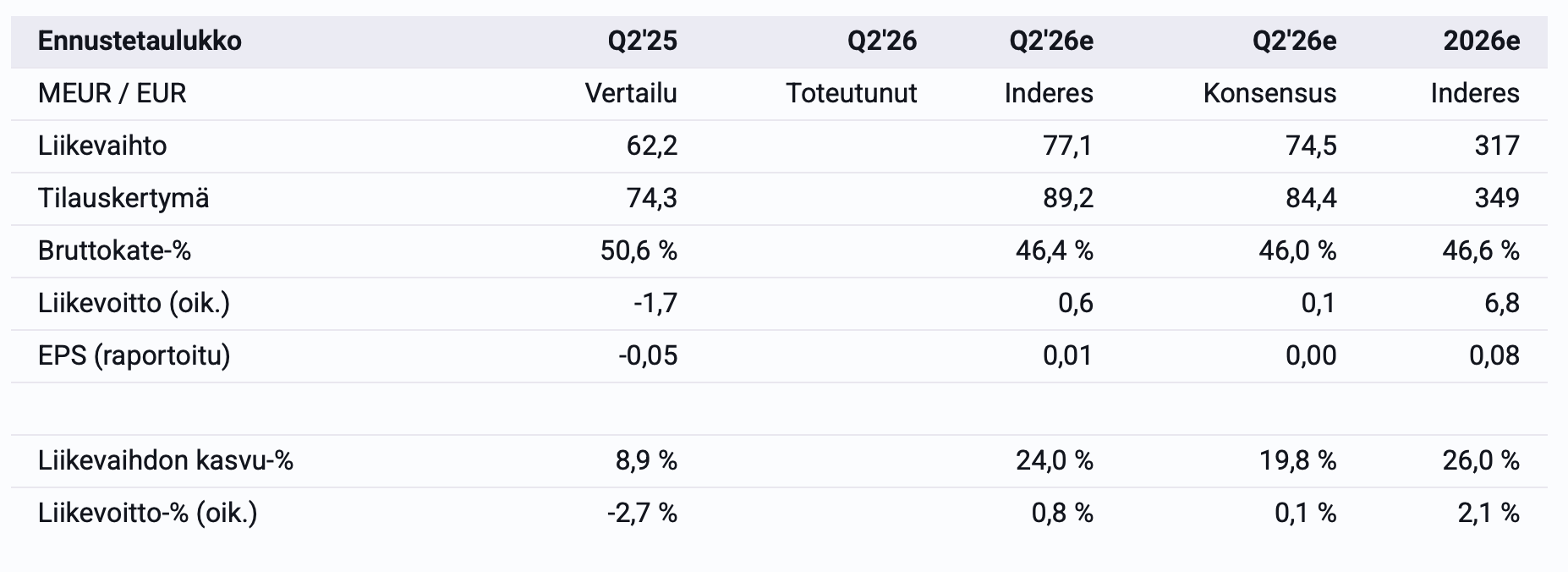
Forecasts are predicting around 24% growth; we’ll soon hear how well the chargers have been selling!
6 Likes
As a shareholder, I must say that the order intake is a huge disappointment. At first glance, it seems that the Americas segment, which showed promising development last year, has continued the stagnation that began in Q1, with orders amounting to only around 10 million. It looks like the American factory is becoming quite a burden if market demand does not pick up in the coming quarters.
13 Likes
That is certainly a soft result… But I don’t think the analysts’ forecasts were based on anything other than the company’s “promises,” were they? It missed the mark quite badly.
It’s good that a deworming (cost-cutting) program is being launched, although its scale is completely insufficient for the company to achieve its (self-imposed) targets. A major problem in the investment narrative is that management’s words and assessments of market development are in complete contradiction with Kempower’s results. The company has at least three burning platforms that have already been waiting for management’s resolution:
- The American factory
- As it stands, it’s a completely unprofitable house on the prairie. The order intake is completely insufficient to justify keeping the factory. Growth in orders is far too low.
- Product quality
- In Q2, €4.4M worth of shitty chargers were repaired. On an annual basis, that’s already almost €20M. They sold crap.
- Small market share. At the CMD (Capital Markets Day), they estimated they were in the TOP 5, and note, that is a SELF-made estimate. These are rarely estimated on the low side
 So, the reality may well be that four or even five competitors are ahead:
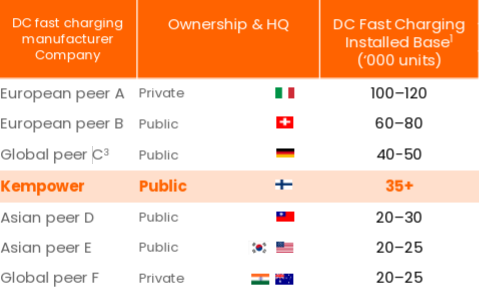
When you combine that with the fact that products are being repaired for €4.4M every quarter… then any competitive “advantage,” if it even exists at all, is completely melting away.
- Management
- Even a blind mole can see that there are far too many fixed costs. Why are the measures being initiated late, and why is their scale “Mickey Mouse” level? Why is the leadership team the size of Nokia’s? Why are new managers being hired all the time? In other words, when they should really be cutting, they end up hiring more
14 Likes
The decline was justified and could have been even greater, to be honest. It’s a shame that nothing seems to be coming of this, other than, in the best-case scenario, the company being bought out by the Chinese. Not even the recovery in electrification brought any life to this.
1 Like
I am revising my view on the stock after Q1 from “delightfully expensive” to “shockingly expensive trash.”
A €722 million market cap for a stock that is making significant losses and whose order intake is shrinking. Good luck to the shareholders! 
6 Likes
Here are Pauli’s latest comments on Kempower’s Q2 results
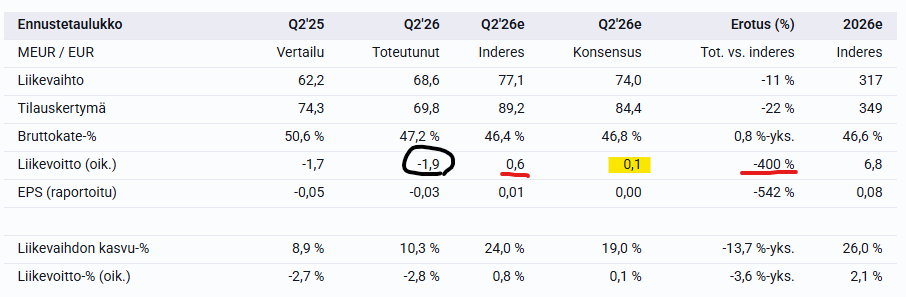
Kempower reported its Q2 results today. The earnings report was weaker than expected, with orders falling clearly short of forecasts. The gross margin, which had been under pressure in previous quarters, exceeded expectations. The upper end of the growth guidance was also slightly lowered. In the first half of the year, the company implemented savings in production and has now additionally launched a €5 million fixed cost efficiency program to adjust the organization’s structure to current demand and the focus areas of its new strategy.
1 Like
Yeah, I’m completely on the same page; we need to get real about our stance on Kempower.
This isn’t going to turn around anytime soon. As of 10:15 a.m., I still think the drop in share price has been too small—these Q2 figures are truly abysmal, and there’s no outlook for anything better.
4 Likes
I agree. The US factory is and will continue to be a real lemon of an investment. I understand well why they wanted it there, but the math behind it has been a bit too much on the “hope and pray” level. The only thing that gives a glimmer of hope is the war in Iran and the resulting rise in fuel prices. That will likely have triggered a stronger push toward the electrification of heavy transport. But even in that value chain, Kempower is so heavily at the mercy of electric truck manufacturers that I wouldn’t expect any quick silver bullet from that direction either. At the same time, there is so much “trendier” stuff in the stock market that money is flowing into, which means a pretty tough road ahead.
3 Likes
Paul had better trim that €15 target price downwards a bit after this report
3 Likes
Where did the 4.4 million euro figure for Q2 repair costs mentioned in the thread come from?
Who are the orders going to then, i.e., who is gaining market share, or is it truly the case that the charging infrastructure is simply not growing as expected?
1 Like
“According to the company, orders were weighed down by the consolidation of the charging operator customer base and a focus on improving utilization rates and profitability rather than expanding charging networks.”
In other words, buyers will have market power moving forward. Does this mean that Kempower’s strategy of purely chasing market share will not lead to better margins in the future either?
3 Likes
I have been invested in Kempower for a long time and previously trimmed my position in a controlled manner (by one-third), so I don’t want to make any rash decisions now. However, this Q2 result changed my thinking more than any previous earnings report.
My current interpretation is as follows:
- Revenue fell short of expectations.
- Order intake fell significantly short of expectations.
- Operating EBIT remained negative.
- At the same time, a new cost-saving program is being launched.
On the positive side, the gross margin remained healthy, suggesting that they are not buying market share at any cost.
However, I am primarily concerned with this question:
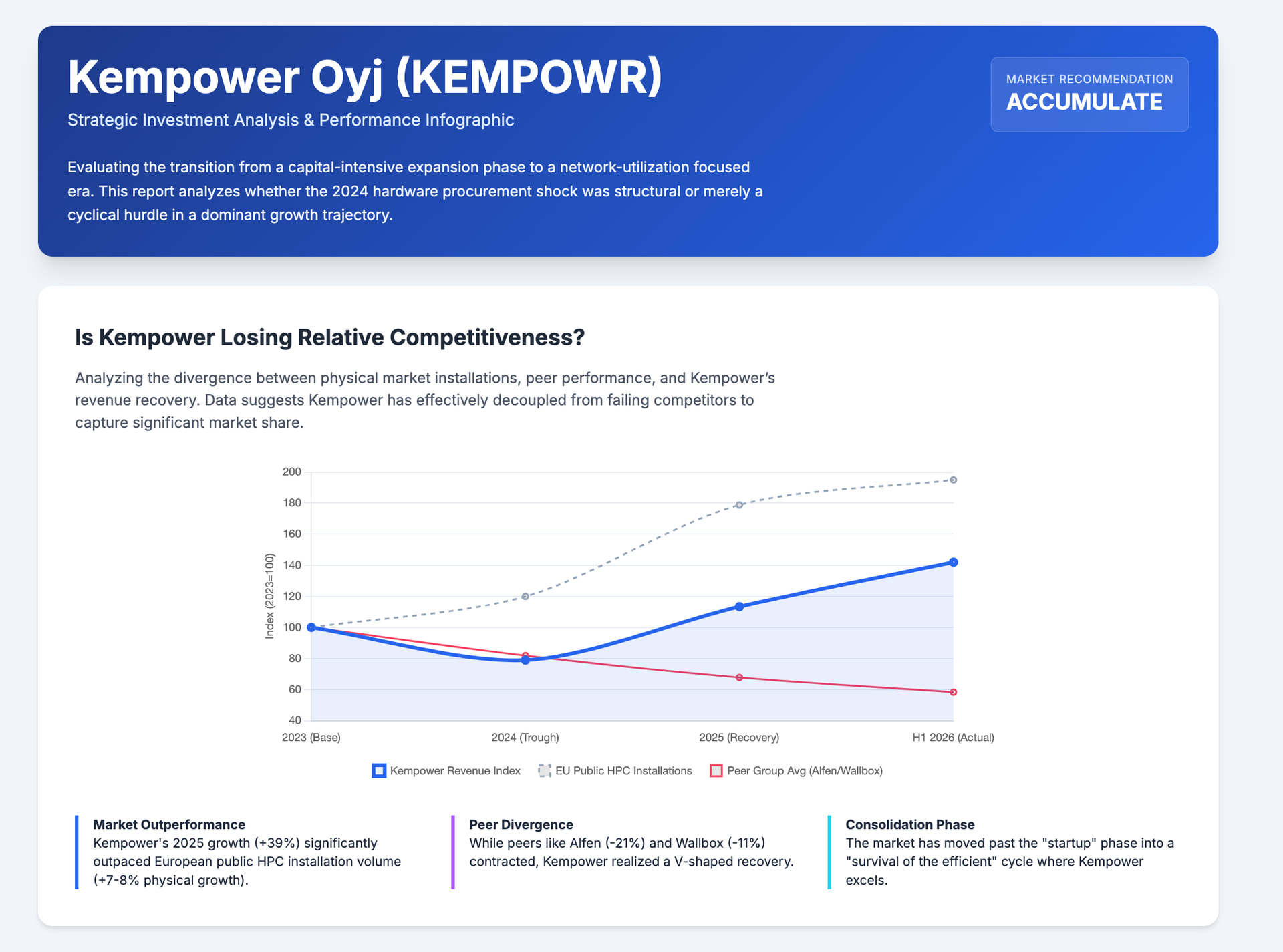
Is this a case of the entire DC fast-charging market developing more slowly than expected, or is it that Kempower is losing its relative competitiveness?
If it is about the market, the investment thesis may still be perfectly intact, and it is just a matter of the timeline extending.
If, on the other hand, competitors (ABB, Alpitronic, Siemens, ChargePoint, etc.) are reporting significantly stronger performance during the same period, then the investment thesis changes fundamentally.
So, I’m not trying to predict the stock price for next week, but rather thinking about capital allocation for the next 5–10 years.
How do you see this? Is this primarily a disappointment related to the market cycle, or are we beginning to see signs of a weakening in Kempower’s competitive position?
9 Likes

It is directly from the report (page 11):
In the second quarter of 2026, warranty costs and costs from proactive repairs outside of warranty obligations remained mainly at the previous year’s level and were 4.4 million euros (4.5 million euros).
I am not very familiar with the matter, but it has caught my eye before, and it certainly sounds a bit concerning.
Edit: this has been brought up in the thread before, but to my knowledge, the background of the issue hasn’t been examined in detail:
4 Likes
The continued loss-making was indeed a disappointment, and I may have to rethink my investment case and the weighting of Kempower in my portfolio. On the other hand, staying in the red is, as I understand it, a direct consequence of lower-than-forecast revenue. If and when that reaches the right level, the operating leverage will take care of the rest.
I for one would be interested in whether we were in the red at the EBITDA level as well, but I don’t think that is reported in Kempower’s reports. In Inderes’ quarterly estimates, it was 4.1 million in the black for Q2. Well, compared to the previous quarter (adj. EBIT −3.7 and EBITDA in Inderes’ papers -0.2), it must be clearly in the black, as the adj. EBIT is now “only” -1.9.
Bright spots: the gross margin that slightly exceeded consensus and the order intake in Europe outside the Nordics.
North American figures (MEUR and share of total):
| Q3 2025 | Q4 2025 | Q1 2026 | Q2 2026 | |
|---|---|---|---|---|
| Order intake | 16.7 (22%) | 21.3 (22%) | 11.0 (16%) | 10.9 (15%) |
| Revenue | 11.8 (16%) | 8.3 (11%) | 10.5 (16%) | 11.8 (17%) |
It looks like you are unfortunately right, at least for now.
On the other hand, there should be plenty of previously accumulated order backlog left in North America (and many, e.g., Q4’25 orders, had deliveries scheduled further into the future), so I believe it is quite possible that Q3/Q4 revenue will rise more sharply there, to a “decent” level.
But referring to the order intake (the last three quarters 21.3 → 11.0 → 10.9), some good news regarding the competitive situation in America is sorely needed. It’s a big mountain to climb, as admitted earlier in the thread.
4 Likes
I recall that some time ago, Kempower performed well in certain reliability statistics. Was it perhaps regarding charging success rates? In that light, the high level of repair costs feels quite strange. Of course, it is a different matter, but in a broader sense, it is still about quality. Now the question arises: what caused those repair costs / where have they been high? Is it due to certain specific components, or are there quality differences between production facilities? Can anyone shed some light on this? A single weak link is easier to fix than poor quality throughout.
4 Likes
Could it be related at all to the fact that in such a rapidly developing market, it makes sense to enter into agreements that guarantee the customer an exceptionally good user experience and exactly the kind of solutions that meet real needs? I don’t know if that’s realistic… what I mean is, perhaps even the customers don’t always know right away what it’s ultimately worth ordering and installing, or where.
1 Like
Is this about the DC fast-charging market as a whole developing more slowly than expected, or is Kempower losing its relative competitiveness?
Thanks @Timba79, that was an interesting question. >>
Preliminary indications suggest it’s the former.
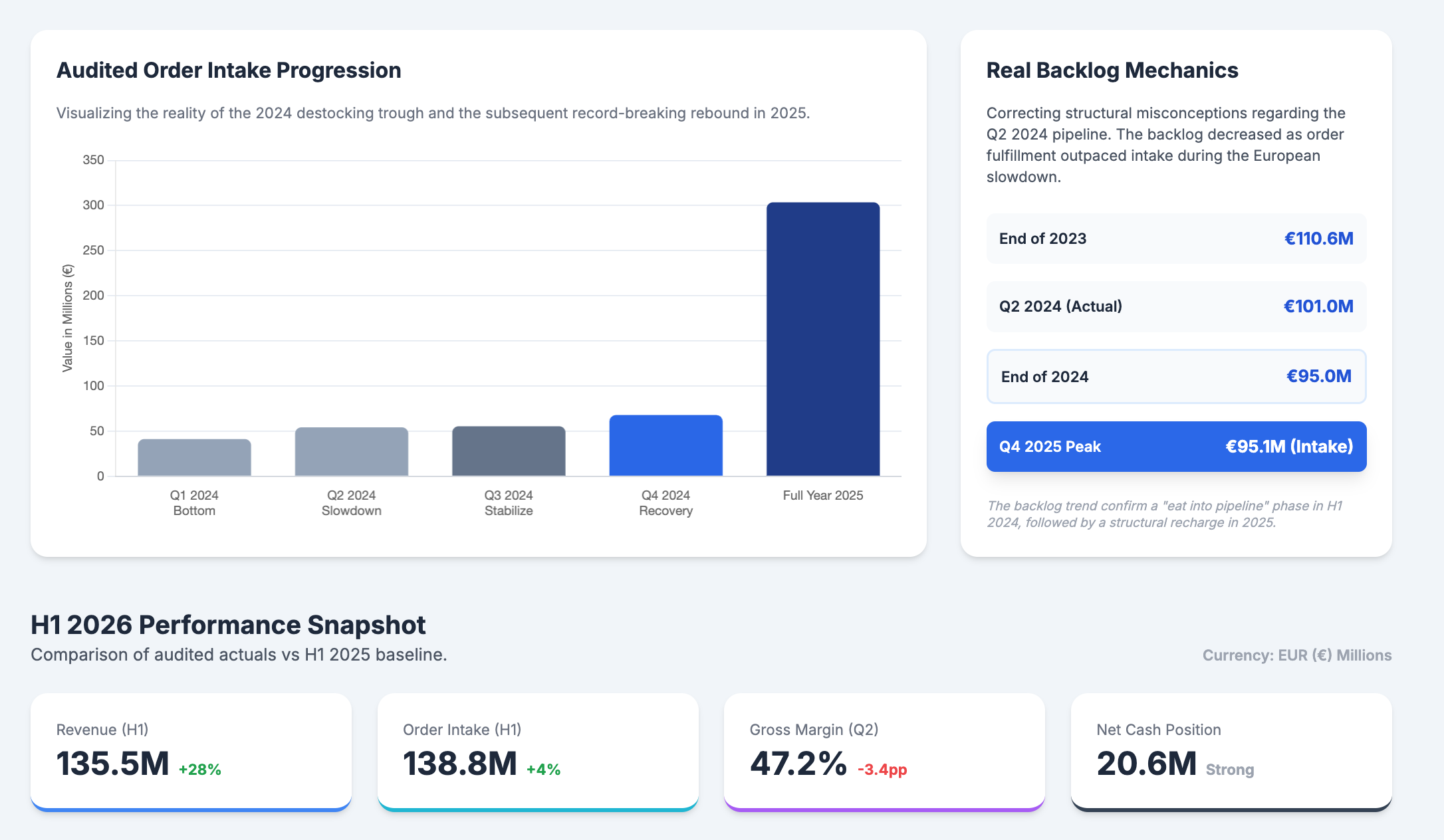
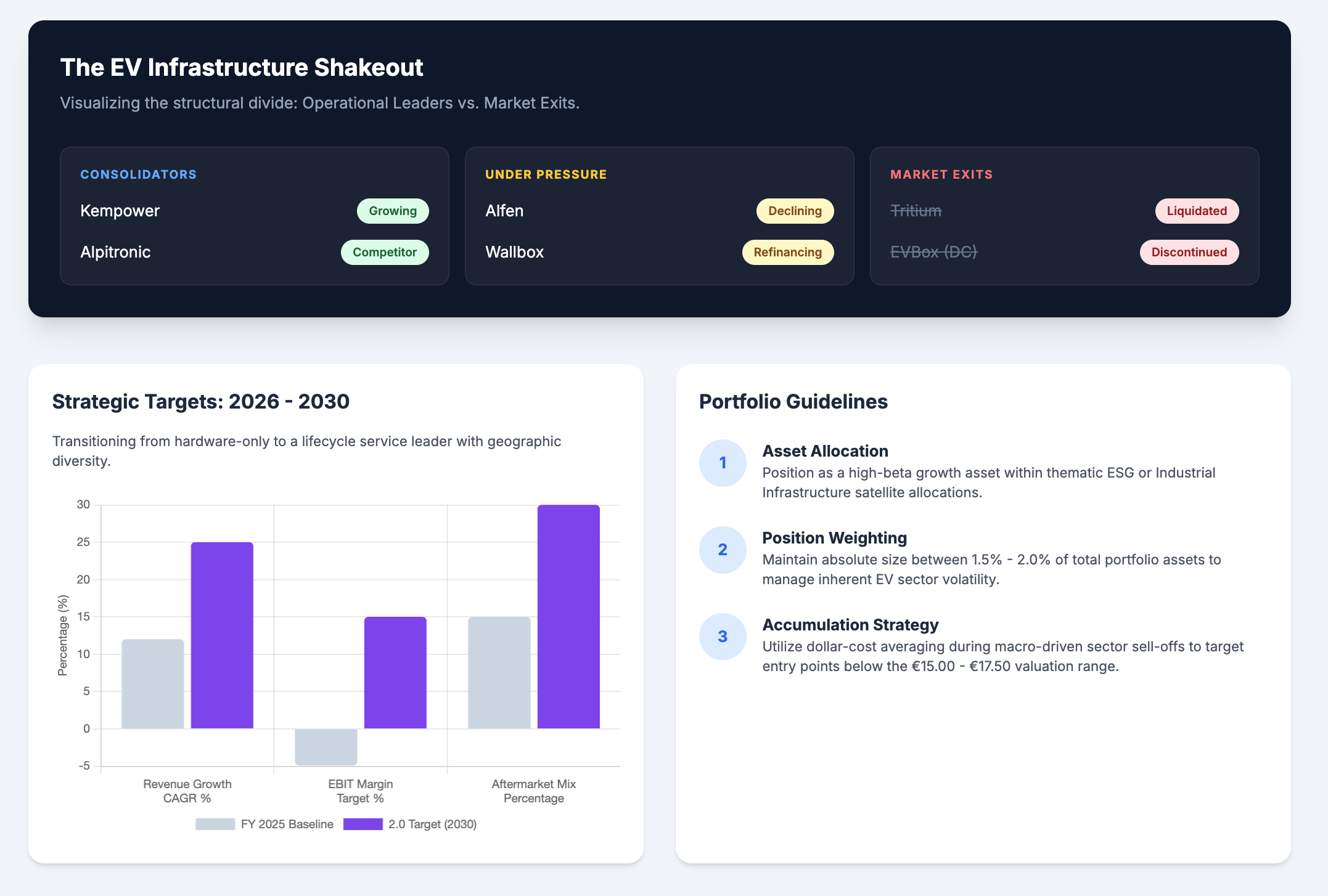
The statistical model analyst on “my desk” crunched this question for about ten minutes; searched the web for a big batch of sources, and finally said that it’s worth buying Kempower slowly when the price is favorable. And keep the position reasonably small if you are professionally managing other people’s money. (:
A bit more seriously:
From a learning perspective, it would be super interesting to compare this kind of analysis (see attached images) with the views of larger investment houses and analysts on the subject. Does it match the lens through which well-managed portfolios with a bit more capital view Kempower at all?
3 Likes
Here is the link to the webcast. It is worth listening to in its entirety if you haven’t panicked yet and are investing in Kempower for the long term.
H2 might still start showing better results little by little, even though the general market situation remains challenging. In the US, growth will likely be hindered most by Trump’s policies.
One target price and recommendation update has already come in: DNB Carnegie lowers the target price to €11, recommendation HOLD.
8 Likes