Wasn’t the message from the company’s management in the spring that the focus would be on profitability at the expense of volume? This is, of course, not really possible, as unprofitable trade-in cars would rot in storage. But it’s erratic behavior.
1 Like
Pursuing volume did not yield results, emphasizing profitability at the expense of volume did not yield results, turning Germany profitable did not yield results but it returned to a loss. Sweden has been at a loss, now with its head above water for a moment until returning to normal, changing the manager to a competent professional did not yield results, changing managers of international operations did not yield results, closing unprofitable dealerships did not yield results, a cooperation agreement with a leasing company did not yield results, updating the car fleet to match demand did not yield results, investing in ancillary services (Extended Warranty, Insurance) did not yield results, introducing ancillary products for sale did not yield results (Tires), investing in remote car sales did not yield results.
Have all possible measures already been tried, what is left, or are there any means left?
Or will we return to the starting point in implementing the measures, and repeat the same actions in the same or a different order, without results?
I think Sweden has been brought to zero by shifting more of the margin from imports to Finland there, it is of course possible to do the same for Germany, and achieve a situation where all countries are slightly in the black, but that does not change the overall picture.
5 Likes
Yes, in Q2-Q3 the focus was specifically on profitability at the expense of volume. That did improve the gross margin, but so much volume was lost that operating profit still weakened. Indeed, there have been quite a few management changes and various inventory “adjustments” made in recent years. As I wrote in the report, Kalliokoski did not, in my opinion, offer any new ways to achieve profitable growth now.
7 Likes
Now that Kamux is apparently starting to buy back its own shares today, one must be careful not to dump one’s own shares into the market when demand for the share slightly improves.
I also looked at Kamux’s Q3 materials, interviews, etc., and this is a classic case of running aground and being in a deadlock. I have encountered the exact same thing in my own professional life. That is, someone far from the customer interface decides that the margin (usually some margin percentage or unit price) will be significantly adjusted and an overly challenging target is set. The end result is that the topline suffers, and then both the margin and operating profit in euros decrease when deals are not made due to poor price competitiveness. Fixed costs continue their course, and in Kamux’s case, there are simply more of them per completed car sale.
Even in Kamux’s case, the gross margin per car had improved, but the most important thing, the bottom line, suffered badly.
Now Kalliokoski explained that Kamux needs to be steered with big movements of the wheel, well, now at least the front end crashed into the inner bank.
Pajuharju was accustomed to Harvia’s pricing power, but Kamux DOES NOT have similar.
Used car dealers sell the same products, and their prices are easy to compare.
9 Likes
The management roulette continues in Sweden. This time, however, it seems to be of the person’s own volition, and the reasons have been explained in the announcement, so there’s probably no need to worry about Sweden’s Q4 development based on this. Still, it certainly doesn’t make turning things around easier when managers change once a year. Kempas started at the beginning of this year.
22 Likes
Hedin’s Q3 figures today. Used car revenue grew by 5% and growth was seen in all markets. Profit, however, is in the red, apparently still mainly due to electric car buyback commitments and perhaps more generally due to electric car pricing.
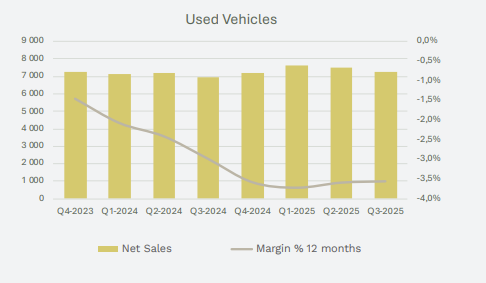
In addition, Wetteri announced new targets yesterday, aiming to double the size of its used car business in the coming years, so competition appears to remain tough (here’s Thomas’s comment)
12 Likes
Given that Chinese cars are quite popular judging by export figures, Kamux also needs to seriously consider its approach to them. BYP reportedly trades well on the market, but many used Chinese cars are a bit touch-and-go… Indeed, for some brands, the import organization and spare parts service are modest.
Trump’s anguish over the poor export success of American cars is not unfounded.

3 Likes
Now that the “earnings warning weeks” are upon us, a small recap.
Inderes expects a slight improvement from Kamux in Q4/25 vs. Q4/24.

On Saturday, I was at an evening gathering where there were also several highly knowledgeable individuals from the car industry. They claimed that Kamux in Finland is 5-10% ahead in units compared to last year’s Q4, as is also expected.
What the entire Kamux has achieved in Q4 and what profit has been made will only be seen in February. But Kamux’s Q4/25 should be well within the expected range so far. I myself do not expect an earnings warning anymore this December…
5 Likes
Well, in Q4 2024, the adjusted operating profit was €0.7M, now Inderes’ expectations are €2.8M if the €8M presented in that quote for the full year is still valid.
The company’s own guidance is very loose: “adjusted operating profit decreases from the previous year,” to achieve which, any result from the last quarter is sufficient.
2 Likes
Kamux Becomes a Small-Cap Company, One New Heavyweight to the Stock Exchange | Arvopaperi
Now free, probably a paywall soon.
Stock exchange operator Nasdaq is updating the market capitalization classifications of companies on its Nordic stock exchanges, and changes will also be seen in six Finnish companies.
Nonwoven company Suominen and used car dealer Kamux, on the other hand, will drop from the mid-cap category to small-cap.
Some funds will sell, and small-cap funds will buy.
7 Likes
A new comprehensive report on Kamux has been released. I waded through it, and I don’t quite believe that Kamux’s revenue in 2026 will be lower than in 2025… You certainly can’t accuse Rauli of excessive positivity.
After reading the report, I’m thinking that no one should even own Kamux…
There’s still time for tax-loss selling!
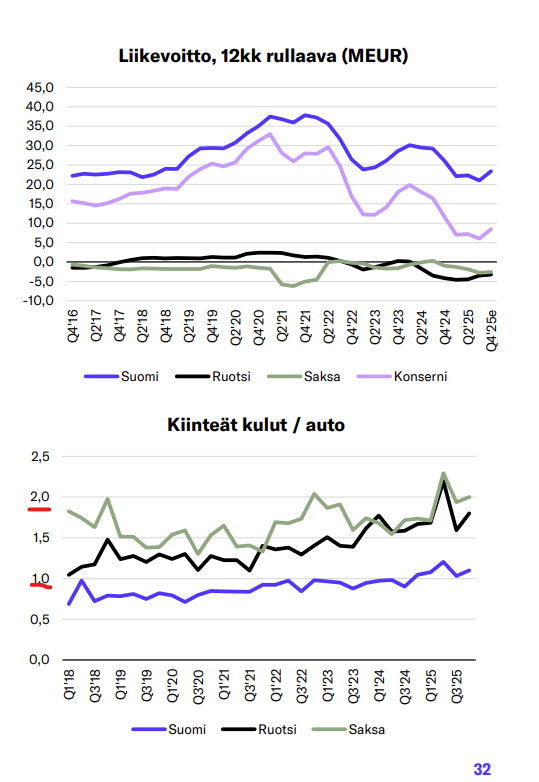
Here are the figures for FINLAND…, Germany and Sweden are just a cost drag for Kamux.

7 Likes
If the figures for Sweden and Germany materialize roughly like that, then it’s lights out.
I really don’t believe in a decline in revenue for 2026. The war in Ukraine ends in H1/26……

Rauli, in a Christmas mood, has written a new extensive report on Kamux.  Extensive reports are always accessible to everyone and have no paywalls.
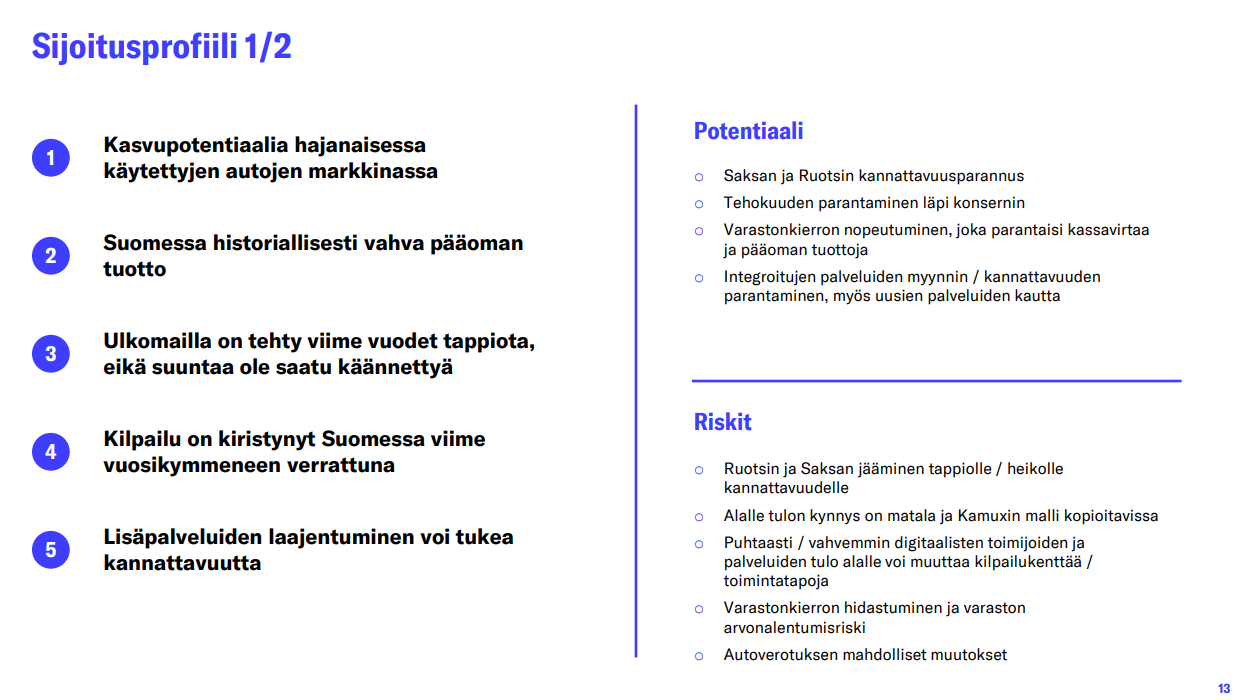
Kamux aims to turn its direction back toward profitable growth, but we do not see any major changes on the horizon. We believe earnings will improve in the coming quarters, albeit mainly due to weak comparison figures. Valuation is somewhat neutral based on next year’s forecasts, and the risk-reward ratio does not appeal to us. We reiterate our “reduce” recommendation and target price of 2.0 euros.
Quoted from the report:
Return on capital does not reach the level of value creation
Due to the weak earnings level, Kamux’s return on invested capital (ROIC) and return on equity have been below 10% for a couple of years already, and we forecast it to weaken further in 2025 as earnings decline. We expect return on invested capital figures to rise above 5% from 2026 onwards due to earnings growth and slightly improving capital turnover, but to remain below 10% in the coming years. In the longer term, we see Kamux’s returns on capital reaching roughly the level of its cost of capital (return requirement).
As previously stated, value creation has historically been good in Finland, and even at the current margin level, which is lower than historical averages, the business is value-creating. Abroad, on the other hand, the company has destroyed value throughout its entire operating history, and we expect this situation to remain the same in our forecasts going forward, even if the operating profit rises to zero or slightly positive in the medium term. When operations are unable to create value, divesting them could be a viable option from the perspective of capital allocation and shareholder value creation. The company itself has also stated that this is an option if targets abroad are not met. However, we believe the company will focus, at least in the near future, on achieving an earnings turnaround abroad, and we do not believe that divesting from Sweden or Germany is likely in, for example, the next 12 months.

3 Likes
I know you can read the report, but this is bleak, so I want to highlight it.
The Swedish and German organizations could probably use some cost-cutting.
Nothing for it but to start change negotiations and get our heads above water…

Just to highlight this point: Kamux isn’t turning a profit in Germany or Sweden because fixed costs per car are double compared to Finland. In Germany, fixed costs are €2,000 per sold car? It’s strange that they can’t get the cost side under control; I wonder what the explanation is for that?
Of course, an increase in sales volume would naturally lower the costs per car…
3 Likes
The procurement organization’s expenses are visible in Germany/Sweden, but the sales volumes of the cars they source for sale in Finland only appear in the Finnish figures?
1 Like
Rapala’s share price is at ATL levels and Inderes is piling on the negativity; apparently, the whole firm is going bankrupt and no one will buy lures in the future anymore. Someone joked (!?) that reading the analysis makes them miss Olli Vilpo’s time as an analyst.
The Kamux case is the same, but to the power of two! 
Times change, and recommendations along with them.
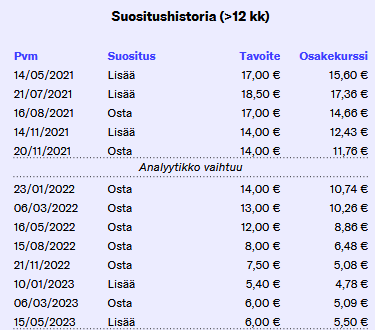
It’s nice to hear negative views on stocks, but I could ask, not even jokingly, why Kamux pays Inderes to bash the company year after year?
I own Kamux shares and I think it’s obvious that one cannot be satisfied with the performance of recent years! There have been negative surprises and kicking the can for years.
CEO Pajuharju finally had to pay for years of continuous failures, and Kalliokoski returned to the wheel.
Kalliokoski has been the CEO for a couple of months now. According to Inderes, it is already clear that:
- Foreign operations should have been abandoned. They will not turn around. Costs should have been cut by, for example, downsizing the network. It is a mistake not to cut costs and not to exit foreign markets; the CEO and the management team don’t know what they are doing.
- Kamux will not grow; even in Finland, market shares will be lost forever. Kamux’s volume-based sales and operating profit will permanently remain lower than during the “OK years,” and growth will never exceed the GDP growth rate.
- Kamux’s margins will never recover to the margins of the good times; instead, margins are permanently ridiculously low and will stay far below historical realized figures.
- Kamux, as the largest/second largest in Finland and the 4th largest player in Europe, will never reach a level where ROE > WACC

According to Inderes, it’s best to stay far away from Kamux stock. The company’s capital will never generate a return.
Founder Kalliokoski returned as CEO, and his historical track record looks like this:
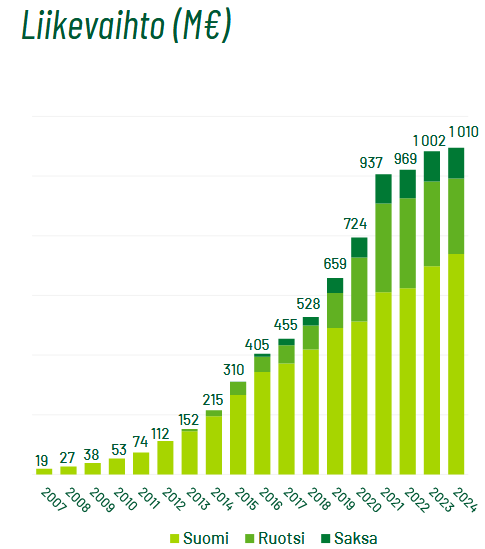
Kamux has never posted a loss for a calendar year in terms of EBIT / adjusted EBIT (EBIT oik).
Even though Kamux’s development is supposedly a perpetual downhill slide, the CEO keeps buying more shares

If we go back to those old analysts, whose job was to be investment professionals and study Kamux as their day job, I wonder what they are up to these days 


9 Likes
You are more than welcome to disagree with a justified argument, but it might be more productive to share your own thoughts on the company rather than writing sarcastically and making insinuations about our views. Furthermore, there are several incorrect claims in the message that need to be corrected:
This is indeed roughly our view, though in the last sentence, perhaps “are too optimistic” would be better than “don’t know what they are doing.” It is certainly hard to know from the outside at what price the foreign operations could be sold or shut down, but at least relative to the current results and stock price, the conclusion is relatively clear.
We expect slight growth from next year onwards and a fairly steady market share. The used car market is currently close to its peak in terms of units and is cyclical; therefore, not much market growth is forecasted for the coming years.
In the medium term, our return on equity is at the level of the required rate of return (WACC), which means that returns in Finland are above it, while abroad they are below it. Being Europe’s 4th largest is of little consolation in Sweden and Germany, where we are still far from the top of the local markets.
Juha has indeed done a great job building the company, credit to him for that. Regarding earnings, however, the curve looks quite different for the last few years.
29 Likes
There is a big risk with Kamux here. I personally have been disappointed with Kamux’s international operations for many years in a row. Growth is sluggish and profitability is miserable.
After so many disappointments, one no longer dares to trust that the direction will turn for the better. But if we consider the starting points, “better” would be achieved if:
-
The German staff wouldn’t buy non-existent cars and repeatedly fall for frauds
-
In Sweden, staff wouldn’t pocket tires bought by Kamux while selling only the cars to customers
-
Etc. There have been frauds, disappointments, and blunders for many years in a row. Are these behind us, who knows. However, almost all the problems from the last couple of years can to some extent be attributed to Pajuharju.
-
Kamux’s international operations have been a long, bitter disappointment. However, others there are doing somewhat sensible business, so I’m not ready to completely give up hope for Kamux either.
I don’t want to defend Kamux in any way or expect Kalliokoski to be a rainmaker who would lift the business to new dimensions, but if Kamux’s decades-long success story is dismissed because of a couple of years of weak (note, not negative!) profitability, then Pajuharju can at least partly be blamed:
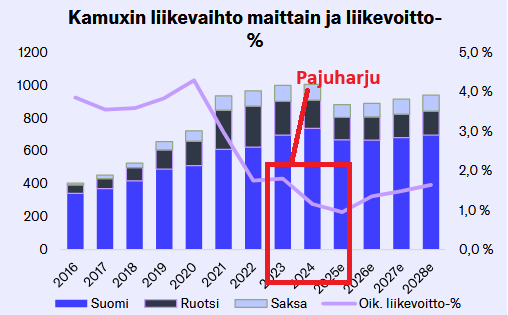
You’re right, and my own views on Kamux were minimal in my previous message.
Competition has intensified, and that doesn’t help Kamux’s position. But if we return to that previous graph of Kamux’s profitability, in Inderes’ forecast, Kamux will never reach the lowest profitability it had for over a decade straight under Kalliokoski’s leadership.
The business is moving towards “better” on its own; the comparison periods indeed include frauds by Swedish employees, purchasing frauds in Germany, failures in selection, confusion with hybrids, downsizing the network, cost reductions, and inventory health improvement. All of these should be behind us, and even if Kamux did nothing, that much improvement comes naturally.
Then we have drivers coming from the business environment:
Finland has suffered greatly from risen interest rates. Rates have been lowered, but this translates to the real world only with a 12-18 month lag. Now the Finnish economy will benefit from the fact that rates have been lowered:
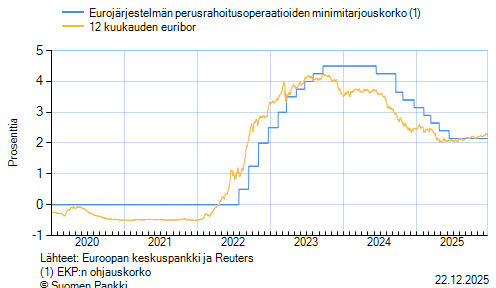
Terrible consumer confidence in Finland & Sweden, and all money has gone into services and savings; purchases of durable consumer goods have been postponed. When the economy grows slightly, cars, for example, must be replaced eventually; consumers also cannot grow their cash weight forever (assuming things don’t get even worse, e.g., escalation of the war in Ukraine or Finnish unemployment rising even higher).
Germany is loosening its fiscal policy and using debt-based stimulus. The EU economy is growing, and for example, better economic news is already coming from Southern Europe due to the positive effects of NextGenEU, among other things.
Kamux still reaches nearly a billion in annual revenue. There are Kamux Plus (Kamuxplus), insurance services, and financing services that can be utilized with the largest market position in Finland and the 4th largest market position in Europe.
Kamux’s market cap is 86 MEUR
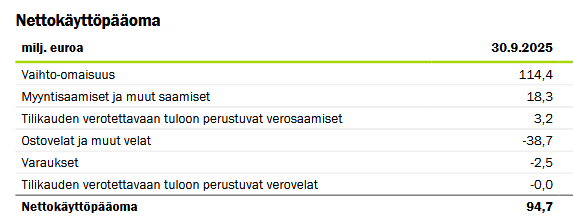
Sure, there is some debt, but there are over a hundred million euros worth of cars on the lots!
Let’s imagine that in a couple of years, Kamux generates a moderate revenue of 950 MEUR.
EBITDA% is a very low 3.2
EBIT% is a very low 1.6
Net profit would be around 10 MEUR
The company has never had a loss-making year, and with fairly weak performance, the company will have a P/E of 9 in a couple of years. With miserable margins, ROE = WACC level, and if the company cannot grow or invest sensibly, then Kamux could at least distribute an 11% dividend.
I would say that Kalliokoski’s tenure as CEO has to fail miserably if Kamux’s stock is a poor investment at the price of 2.1 euros.
21 Likes
Thanks, those were some good thoughts. I am, of course, of a different opinion on several points to some extent, but instead of debating, I’m heading off to celebrate Christmas now. Let’s get back to this later! 
18 Likes