The CEO has just bought more, as has @Yu_Gong. This makes it an interesting and potential case to follow.
It seems to offer very defensive growth at a low price.
I, Sijoittaja-Alokas, added Sijoitus-Seppo’s message to Timontti’s opening post in November 2022, which is worth reading through, especially if you are a new reader of the thread. It provides answers to many questions.
This ROAST was pretty good, even though the CEO said “Let’s put it this way” many times when answering questions XD ROAST Kamux 16.3.2018 - Inderes I’m a bit worried about the political risks of diesel cars, but the analyst’s initiation of coverage report made a good point about this:
“Thanks to its fast inventory turnover, Kamux can operate with a very low gross margin (gross margin 2016: 12.2%) and still generate very good returns on both capital employed and equity (ROI 2016: 22.5%; ROE 2016: 43.8%). Fast inventory turnover is also a positive thing for risk management, as we estimate that Kamux’s efficient inventory management would enable it to cope better than its competitors in a situation where something quickly happened to car prices due to an external shock (e.g., due to surprises related to taxation and/or diesel cars).”
Following you on Technopolis was such a good decision that I might continue with Kamux as well What do you think is the biggest threat in this investment, Yu?
I personally think that Kamux’s biggest problem will be digital disruptive services (Yu can give his own view, as he is a digital pro) and the decrease in driving due to all Uber-like operators.
The roast did a pretty good job of going through all the worries and nightmares. @Emmainen The expansion into Germany is also a risk. The worst case scenario is probably that they won’t be able to make it work the same way as in Finland and Sweden. As for digital disruption or the platform economy, those platforms already exist, Nettiauto and others, and will, in my opinion, live alongside it. Kamux utilizes them and also develops its own digital services. Perhaps the digital side is more of an opportunity for Kamux? Services like Uber can also increase the amount of driving. Uber drivers also have to get cars from somewhere Here are some articles related to the topic: https://sf.curbed.com/2018/7/27/17622178/uber-lyft-cause-traffic-streets-congestion-bruce-schaller-tnc-report
In my opinion, the roast also covered the digital “competitors” quite well.
Mainly, goods have been coming to the buy side through Enskilda Bank for quite some time, and when a stock has such low trading volume, a dump of thousands of units like that inevitably moves the price. It’s impossible to say whether those selling (that one selling) through SEB haven’t bought their Christmas presents yet or perhaps have some insider information. Most likely neither, but something in between. I don’t really believe in tax-loss selling; I doubt many have any “faith-loss cod” in their portfolio from this. Of course, not many can be in the black either when the price is wallowing at its bottom.
In these low-volume situations, there are times when one actor aggressively sells/buys, and then the price moves sharply. That offers some pretty good buying and selling opportunities if that’s what one has in mind.
Yes, that will certainly slow down sales or at least make things more difficult, although one would think that car purchases would then be pent up until this fuss is over.
I don’t know what effect this has on used car sales, but in Sweden, new car sales have plummeted by about a third due to WLTP. However, in the summer there seems to have been a real spike in sales before WLTP came into effect.
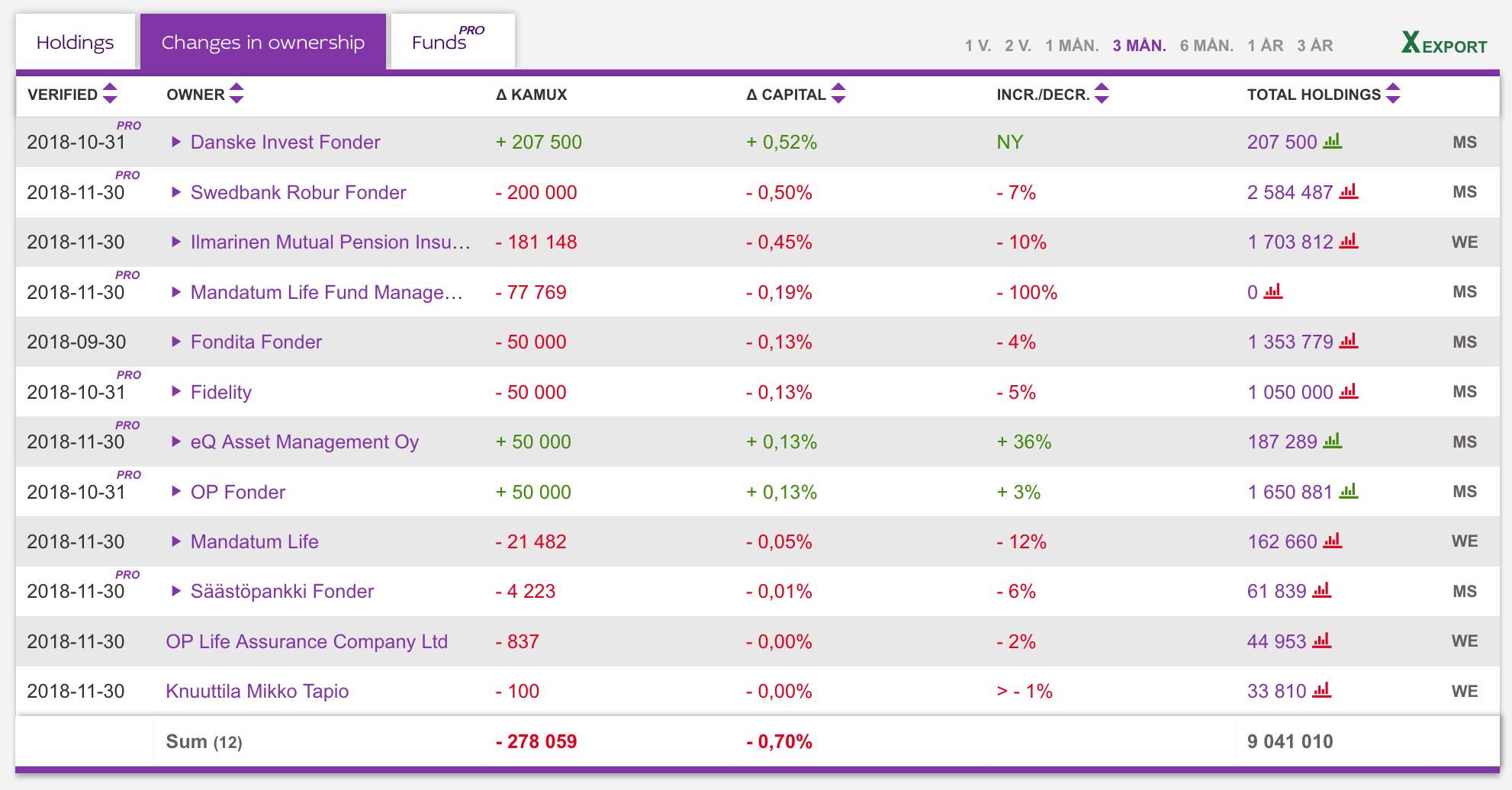
Kamux’s market capitalization is approximately EUR 220 million, and its free float is very limited. Institutions have sold a net of just under 300K shares, or less than 1% of the share capital, in the last 3 months.
Slowing new car sales mean fewer generally quite new (2-4 year old) trade-in cars available. The slowing new car sales would thus seem to be negative for Kamux as well.
Kamux is also starting to be quite cheap due to this decline, but I won’t directly comment on that.
Well, that’s how it seems, of course, as Kimmo rightly points out, many other factors also play a role here. As I understand it, historically, the used car market is very stable compared to the cyclical new car market, but certainly all the Trafi messes, diesel boogeymen, and WLTP UTLP WILTJ whatever-they-are weigh on sentiment.
I tried to find some data on this a while ago, but it seems to be very scarce. Or maybe I just don’t know how to write the search terms in the right order in Google. Recent years’ sales figures can be found in your report, but does analyst Kajaani perhaps have statistics extending back to before the financial crisis?
I talked to Kajaani about this, and he didn’t have data going back further than what has been published. We also inquired with the company, but they replied that in Finland, car dealerships/industry players have internal studies on the matter, but these have not been published.
It’s worth reading the market description in Kamux’s listing prospectus from page 52 onwards. It emphasizes the defensiveness of the industry, and since at least a legion of lawyers are behind the preparation of listing prospectuses, the claim should be true.
For lack of a better option, I found data and reports from the US. It’s a different market, but let’s take this as a guide on how the used car market has developed:
As you can see, compared to new cars, whose sales are truly ultracyclical, used car sales are very steady. Also, note that the financial crisis hit the automotive industry very hard, so this represents an extreme scenario.
Another point we discussed with Kajaani here at the office is that Kamux is growing so rapidly by opening new stores that a small dip in the industry might not significantly impact growth figures yet.
Yes, looking at the figures in the graph, used car sales dropped from about 44 million in 2007 to about 37 million in the midst of the 2009 recession. So, sales decreased by about -16% during the financial crisis.
Additionally, if the data were tested, those sales would certainly be “cointegrated” in data language, meaning they are linear combinations of each other with some coefficient.
Is this a collapse? No. Are sales cyclical? Yes. These are just my own opinions.
To me, a -16% drop in a situation where euphoria turned into hell breaking loose and the crisis hitting consumers hard, is surprisingly moderate. As Verneri noted, it was a pretty extreme situation. If the economy were to slowly slide into recession without any major shocks, the impact would be significantly smaller. So yes, the industry is not completely immune to changes in the economic situation, but it is clearly skewed towards the defensive side on the cyclical-defensive scale.
Yes, that was an extreme situation, which is why it hit especially hard in the US (many auto manufacturers went belly up and were rescued, the housing market, a pillar of middle-class wealth, collapsed, etc.). Secondly, the data is from the US, not Finland.

 What do you think is the biggest threat in this investment, Yu?
 As for digital disruption or the platform economy, those platforms already exist, Nettiauto and others, and will, in my opinion, live alongside it. Kamux utilizes them and also develops its own digital services. Perhaps the digital side is more of an opportunity for Kamux? Services like Uber can also increase the amount of driving. Uber drivers also have to get cars from somewhere
  Here are some articles related to the topic: