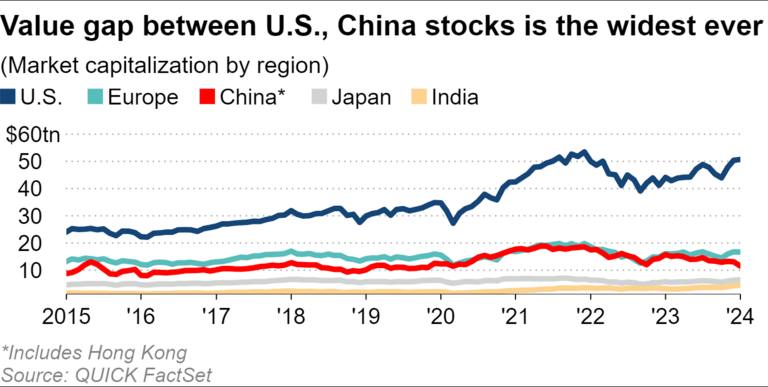
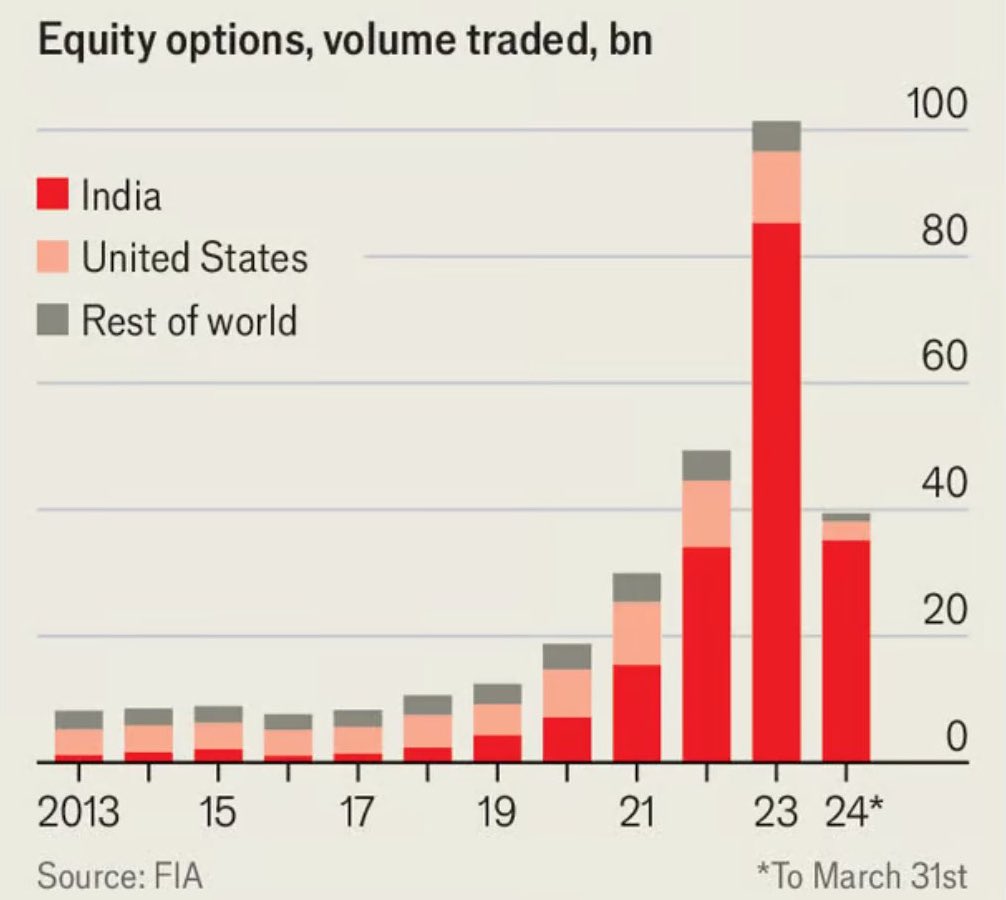
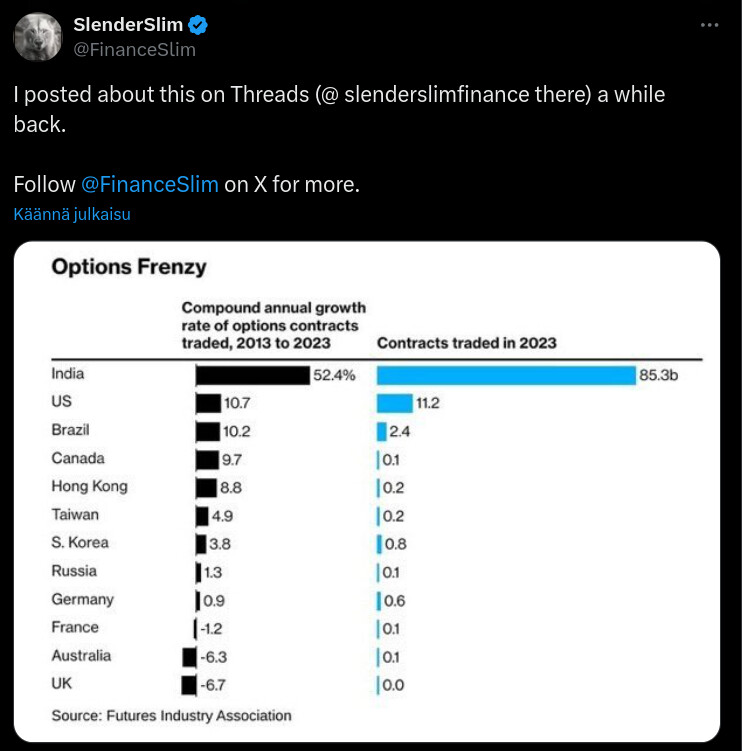
In today’s morning review, Marianne Palmu discussed the relative weight of different market areas in the stock markets.
“The key question is, will the US’s global dominance in the stock market and economy continue? Not in the long run, it is believed. For example, Goldman Sachs predicted last autumn that the United States, Europe, and other developed economies will lose a slice of the stock market pie, while emerging economies like India will correspondingly grow it.”
India is currently considered a potential and growing market, e.g., instead of China. However, I couldn’t find a thread on the forum that discusses the Indian stock markets. Would there be demand for such a thread?
I’ve been considering investing in the Indian market, and perhaps the most sensible way would be through some sort of fund. Nordnet seems to have one or two funds available in their monthly ETF savings plan, as well as a few regular funds.
Many Western companies are already in the growing Indian market even though their shares are listed on Western stock exchanges. You can therefore be involved even without “playing” directly on the Mumbai stock exchange.
The topic itself is interesting, but how specifically would one invest in India—are there any decent India funds/ETFs? Many Asia-focused funds/ETFs are quite China-heavy.
Some Sensex ETF could be an easy way to invest in India, but they didn’t seem to be available on Nordnet, at least. For example, this iShares Core S&P BSE SENSEX India - the management fee is indeed 0.4.
I personally have invested in India through the iShares MSCI India UCITS ETF (QDV5). It can be purchased at least through Interactive Brokers. The fees (0.65% p.a.) could be lower, but on the other hand, the returns have been quite satisfactory, at least so far.
I once searched the internet for stock discussion forums in different countries similar to Inderes. In India, the equivalent place seems to be https://forum.valuepickr.com/
I’ve personally invested in the Franklin FTSE India UCITS ETF through Nordnet. Ongoing charges are 0.19%.
Why India?
India has millions of highly educated young people who will generate more GDP for the country in the future. Currently, the GDP per capita is just over $2,000, while in China, for example, it is around $11,500. A lot is being invested in India right now (even by Finnish companies; for example, Incap has a relatively new factory there). Reportedly, governance in India has also improved enough that people feel confident investing there.
I wouldn’t consider it impossible for India’s GDP to multiply over the next 10–20 years. Of course, political risks could also emerge in India in the future, which could slow down economic growth.
India is definitely interesting, but so far I have only invested through the MSIC Emerging Asia ETF.
Of course, even in that one, India’s share is already approaching 20%, and I personally believe it will rise over time.
And regardless, I chose this CEBL ETF because I also want to invest in China and other emerging Asian markets.
Finnish retail investors cannot easily invest directly in Indian companies; the Mumbai Stock Exchange is not available through Nordea, Nordnet, or even Mandatum/Saxo or Degiro, even though the latter provide access to several other Asian exchanges.
I have also been interested in the Indian market, but I don’t understand what the valuation difference compared to, for example, Vietnam is based on. As an investor in PYN Elite, Vietnam is a natural point of comparison. India’s PE is 24.4 and Vietnam’s is 15.75. What is this valuation difference based on? Both are strongly growing economies. Due to a lack of understanding, my India investments have been left to emerging market funds.
I checked the PEs with a quick Google search here: https://worldperatio.com/. They seemed to be in line with my perception of the valuations of these markets.
In the relatively short term, as far as I understand, this is largely down to the valuation multiples and the performance of both stock exchanges over the last couple of years: the Indian stock market is at new ATH levels, while Vietnam has not recovered from its 2021 peaks and the subsequent drop.
The difference stems partly from the fact that the Indian stock market is more mature, vastly larger, and in a way more stable and domestic market-driven, whereas Vietnam’s economy is highly export-dependent and also susceptible to the whims of the communist government, and the stock market is a volatile frontier market. (For the time being, the Vietnamese stock market is not even part of the “emerging economies” group like India and China, but is classified as a “frontier economy” like Kazakhstan and Nigeria, for example).
Edit: PYN Elite focuses on companies operating in Vietnam’s domestic market and avoids export companies, but this only partially protects against economic cycles.
This is a Nordnet article and it advertises that specific fund, but it contains some good basics regarding investing in India. The article addresses questions such as: What factors are driving India’s growth? Has the India train already left?
India’s long-term growth is on solid ground in the eyes of investors. Compared to other emerging markets, India is considered one of the most steadily growing markets under the leadership of Prime Minister Narendra Modi. What is behind the rise of South Asia’s largest economy?
I’ve started looking into India a bit; here is a somewhat surprising analysis suggesting that the ongoing elections could be a negative “excuse” for a market decline even if Modi secures a sufficient majority. It sounds strange, but it’s a recent article published by CNBC (citing a Bernstein analyst). I’ll share it here too in case anyone is interested. https://www.cnbc.com/2024/04/25/india-election-markets-face-correction-if-modis-win-disappoints-bernstein.html
There are several funds available, at least through Nordnet, including Jupiter India, DNB Fund India, and Danske Invest India. Expenses for these are unfortunately high
1.7%.
Jupiter India seems to be the most popular, and I hold it myself as well. The fund’s 12-month return is well over +63%.