An interesting contrarian view on “AI disruption fears” that I’ve heard recently when talking to a few software company executives:
A golden age for consultants lies ahead, as clients are starting to realize they don’t have the in-house expertise to build capabilities for the AI era.
If a client has a 10 million euro budget [for software development], but now gets 5x productivity. Does the client’s IT decision-maker drop the budget to 2 million, or is the “saved” money used for growth and accelerating operations?
I’m not sure what to think of these myself. Relevant perspectives (as someone owning the sector, I’m biased toward looking for signals that give me hope ). Of course, I’ve also heard views like “short every IT consultant, everything will be disrupted.”
As a Finn, I hope our companies (the consultants’ clients) don’t just take quick EBIT improvements from productivity in a cost-cutting frenzy, because that could be a short road if competitors in the industry choose otherwise. Right now, decision-making is clearly frozen because of crises, the economy, and uncertainty about what will happen, but IT consultants’ clients cannot sit on their hands forever.
A golden age for consultants may be ahead. But as a consultant myself, I also consider the opposite scenario possible: in-house work could become more common as a single individual or two can carry out entire projects instead of a large team. At least in the analytics field where I work, we are approaching a situation where I could single-handedly execute a project that previously would have required a team of 3–4 people. This can be done in less time and at lower costs, as the so-called overhead decreases with fewer “cooks in the kitchen.” From the perspective of client companies, the threshold for recruiting one top-tier professional might be lower than for an entire team. As I understand it, Finland is an exceptional market—at least in analytics—in that there is much less in-house work here compared to the rest of the world.
On the other hand, it may also be that because AI-era projects are shorter in duration, clients still won’t see recruitment as being as sensible as paying a consultant. Replacing a key person is easier when they are already outside the company.
Why wouldn’t the boss/company use that budget to bring a team in-house to do those jobs? It’s fairly obvious that a killer in-house R&D engine is a mandatory competitive advantage for any reasonably large firm (depending on the sector). Fewer people with high productivity and building an AI-native company is a bit of a no-brainer if you just know how and are able to. You’d better know how and be able to.
This can be pondered, for example, in light of this case:
Whereas in the past world, 10 consultants from an IT firm would have billed €120/h for a couple of years, now the same job “gets done in a weekend” (and yes, I know that a fully production-ready and integrated solution isn’t born in that time, but it gives an idea of the scale and the steepness of the change).
Hourly billing has been a good taximeter for produced value in the past world. But now that taximeter has completely broken. Why would I pay exactly for the same drone alarm value-add 10 x €120/h x 7.5h x 220 d x 2 = €3,960,000, if an agent-augmented team produces the same value-add in a weekend with a few hundred euros of token consumption?
What do I need a pile of consultants for anyway, when I can, without personnel risks etc., take on new agents to fulfill the same need with lower costs?
I have written a thousand times that yes, customers will happily pay a million for solutions that generate 10 million in benefit in the future as well. But virtually no IT player in the Finnish market has answers to how this value-add is produced and justified in the post-hourly-billing world.
That’s why I see massive risks rather than a golden age – at least when speaking of current players. I am fully convinced that the IT service sector’s playing field will be completely rewritten. Not necessarily this year or next, but very quickly nonetheless. And winners will of course be found in the industry, but I’m just not at all sure they will be found among the currently listed companies, for example. Instead, we’ll be talking about outfits like Agioni that think about things in a completely new way, which have already demonstrably, with the help of agents etc., generated profit on an €/FTE metric on a completely different scale than established players.
@Mikael_Rautanen, how do you see the AI disruption as the CEO of a software company? After all, your software business accounted for 15.7% of revenue last year and seemed to be the main growth driver and a significant investment target.
You guys are hashing out the same theme here week after week =D. I can’t resist chiming in.
There are three changes happening simultaneously:
Work is becoming more efficient at a massive pace, and many tasks that previously had to be done by a human are now automated. In the short term, this looks like a rougher deal for juniors who are struggling to find their first jobs. On the other hand, I believe they will be exactly the group that benefits the most in the long run.
More and more projects that previously didn’t have a sufficient business case are now viable to implement. A couple of years ago, it wouldn’t have made any sense for me to have my own assistant managing my calendar and emails. Now I have five assistants! The number of new projects is exploding. They are much smaller than before (which is good), but the total demand for software development is growing at a very fast pace. As proof, look at the examples shared in this thread like the Taiga ALARM (HÄLYTIN) case and Agion’s growth — both tell the same story: the barrier to starting a new software project has plummeted.
The demand for senior-level talent has already increased significantly, and in many areas of expertise, there is quite frankly a talent shortage. This is because many IT projects are genuinely quite complex. While new projects are easy to start, integrating a flood of them into an existing technical setup is not at all trivial. Robust architecture and production-ready code always require skilled owners and a capable technical team.
We’re a newcomer to this IR software market, which is why I see this as a fantastic time to be building a business in the challenger role. Technological barriers have lowered significantly, and you can get an insane amount more done with the same resources. Agility and speed are emphasized over resources and muscle-flexing. Plus, there’s no legacy in organizational structures or products that would require a major reset for the AI era.
However, not all barriers to entry are solved. Sales, building networks and partnerships, brand and trust, accurate and reliable data sources, proprietary data, and so on. This requires hard work. We are, of course, in a “good” market in the sense that IR isn’t the fastest-changing category, so it’s easier to react to change. I was just in London for an industry AI conference, and the talk there was mostly about prompting. Many verticals move much slower in the short term than outsiders might expect—not due to technological challenges, but because of regulation and people.
But the significance of the software itself is becoming blurred. Value is created by the problem or process being solved for the customer, often as part of a complex setup involving existing technology and us imperfect, real people. People don’t really buy software from us; instead, the customer wants us to take a communication/legal/compliance problem off their desk. The customer doesn’t really care whether we solve it with AI, Excel, or pen and paper—as long as it’s solved reliably. AI makes it easier (when used correctly and by deep domain experts). For example, an AGM is more about the reliable execution of a relatively complex legal process than it is a software product.
I think this is the reality for quite a few software companies, but the differences are surely massive depending on the sector. I think investors are looking at the world a bit too black-and-white right now with narratives like the “SaaSapocalypse,” which is easy to get swept up in.
I’ve been wondering if we should rename our software unit some kind of “AI native boom-shakalaka platform.” A few players in our industry are already positioning themselves with this narrative (I don’t know if they’re trying to appeal to customers or to investors’ valuation multiple expectations), even though we’re all still mostly doing pretty basic things, without any major AI glamour.
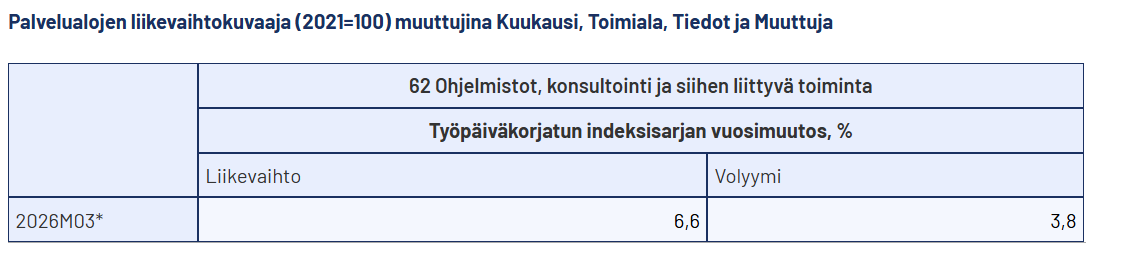
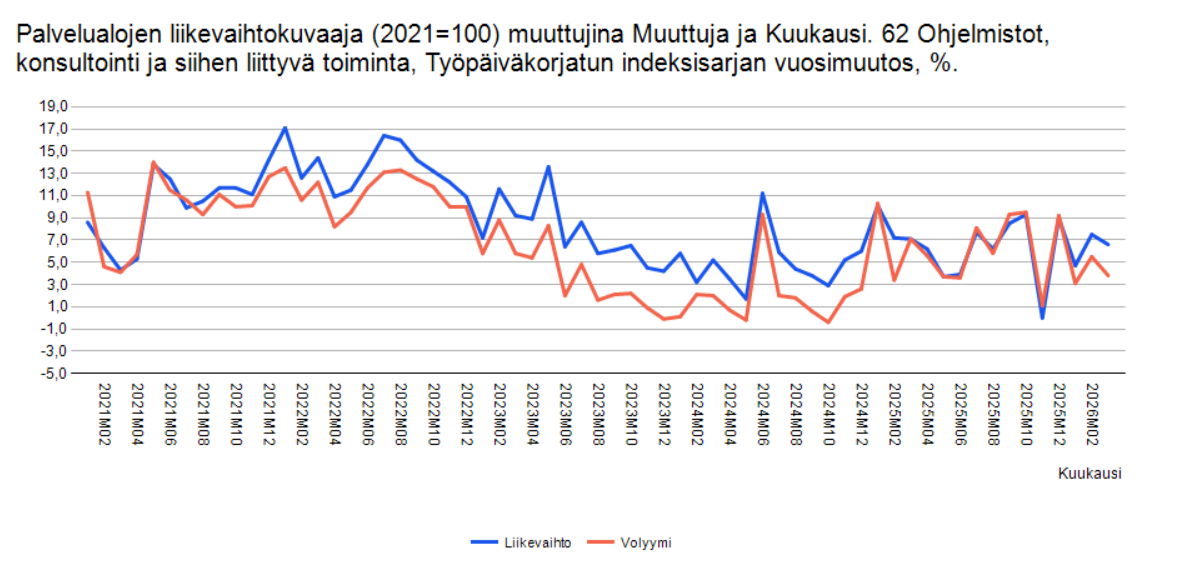
In March, this broader collection from Statistics Finland continued to grow. Not the growth of the corona years, but still at a better level than, for example, in 2024.
Netcompany once again reports strong figures, showing that even in this market, it is possible to perform well as a large company. Organic growth is particularly strong.
Q1’26
Organic revenue growth 13%
EBITA margin 13%
Rule of 40 was 26% (13% + 13%), meaning an excellent performance.
Netcompany is in many ways an interesting company when looking at its history and its major growth leaps. Also, the level of churn (“attrition rate”) that is acceptable for them; it is not a culture-led company in that sense, but it shows that you can build a good business with this formula.
Joni has written comprehensive comments on the IT service sector’s performance in Q1.
At the end of last year, we saw positive signs in the IT service sector for the first time in a long while, and organic revenue returned to growth after a long period. However, Q1’26 did not confirm this turnaround across the entire sector; instead, company-specific differences grew even further. In our view, the difficult market situation seen in recent years and the market disruption created by AI are separating the sector’s players into winners and losers more clearly than before.
Frans and Joni chatted for nearly 50 minutes about the latest trends and happenings in the IT services sector
The IT services sector’s Q1’26 results showed a clear divide, as organic revenue turned into a decline and company-specific differences grew. Analysts Frans-Mikael Rostedt and Joni Grönqvist discuss the shifts in the IT services sector on video.
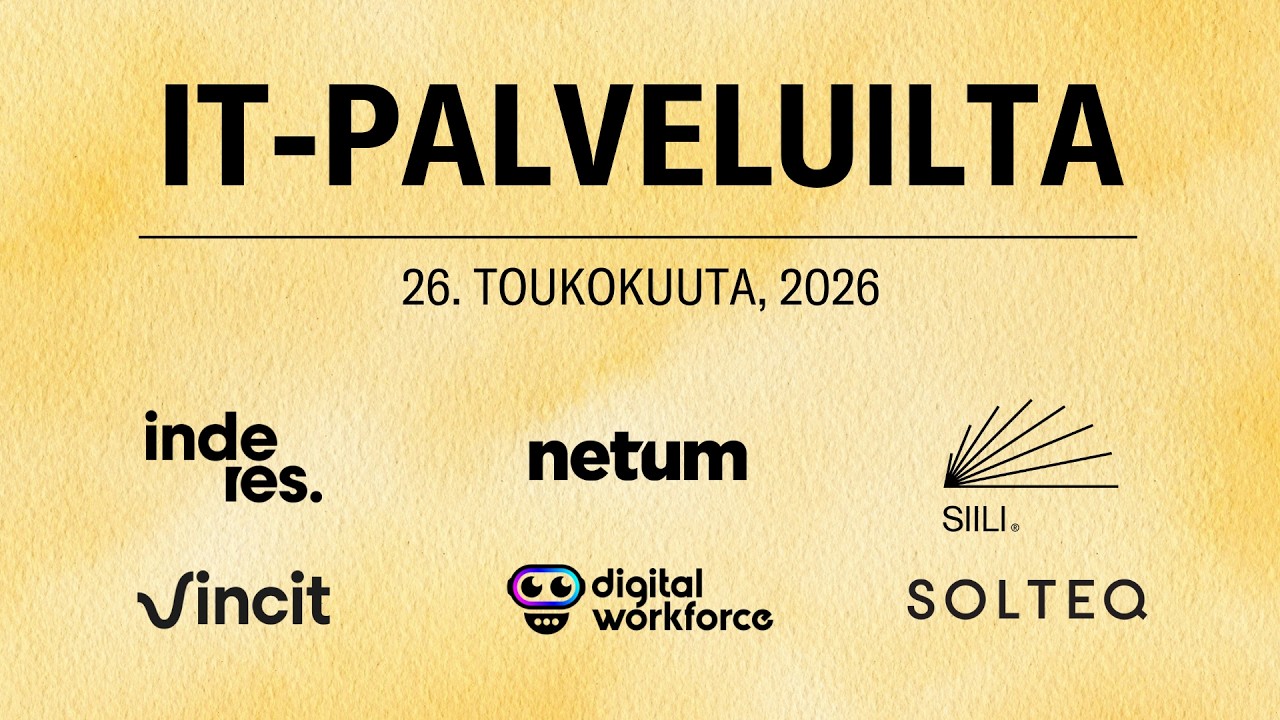
Welcome to the traditional IT Services Night. The event kicks off with a review by analyst Joni Grönqvist and proceeds to presentations by companies in the sector.
IT Services Night May 26, 2026
Inderes – Joni Grönqvist, Analyst
Netum – Repe Harmanen, CEO
Siili – Markku Savusalo, Interim CEO
Vincit – Julius Manni, CEO
Digital Workforce – Laura Viita, CFO
Solteq – Aarne Aktan, CEO
I’ve been pondering the same thing myself, but I don’t think I have enough competence. I did manage to get my “IT driving license” as a kid, but I doubt I’d even know how to play Minesweeper anymore.
At some point, the “Circle of Competence” mental model developed and popularized by Warren Buffett and Charlie Munger must have slipped my mind, as I’ve been throwing money at the IT sector head-first.
Even now, nearly 8% of my portfolio is in these “Pölhölä keyboard bashers.” (Tieto, Digia, Gofore, Vincit, and Solteq)
The current situation is that Vincit and Solteq are so far in the red that there are only pennies left in them. So, mentally, they can be completely written off. And they have been clear losers in the current market environment.
If I had to put my money into only two of all of these right now, those companies would be:
Gofore. (The highest quality IT company on the Helsinki Stock Exchange. The stock has dropped sharply because people paid high multiples for that quality, and the public sector closing its investment faucets has hit Gofore’s fingers quite hard. Previously, Gofore had a relatively large share of those public sector contracts.)
Digia. (The stock price has been stagnating (mörnimistä) for several years, but the company itself has been a surprisingly steady performer even in this quite miserable market situation. The broad offering seems to be biting quite well.)
I’ve been thinking about reducing Tieto’s weight or even selling it entirely for a few years now, but now that we finally got a change of CEO, there’s starting to be light at the end of the tunnel.
Divesting the non-core branches is a good thing in my opinion, even if they went a bit too cheap.
The new CEO seems quite competent.
Listening to the interim reports is as interesting as eating cold oatmeal.
Tieto’s reputation as a company or employer seems to be around “meh” at best.
Ending of Inderes coverage. In the future, I’d have to figure out for myself whether the company is doing well or poorly.
Let’s start a poll for those working in the IT field and those who feel they have some kind of competence in the matter.
Is AI for the IT industry…
A positive thing. (I have increased sector weighting or at least kept it the same)
A negative thing. (I have reduced sector weighting)
A neutral thing. (I have kept the weighting the same)
It depends on the company, of course, but almost all IT service companies on the Helsinki Stock Exchange do much more than just coding. Most of the work involves developing clients’ business operations, services, and organizations through technology. Clients certainly need a lot of help with things like leveraging AI. Personally, I see AI as a positive thing for the IT sector. Although it depends on the company, I see the situation for Gofore, for example, as being good.
Here is Joni’s segment from the IT services evening
Topics:
(00:00) Introduction (01:00) Challenging times in the IT services market (01:43) The market is polarized (04:16) Q1’24 earnings season in the sector (07:33) Forecasts for IT service companies (08:20) Rule of 20 (09:13) Sector valuation levels
 ). Of course, I’ve also heard views like “short every IT consultant, everything will be disrupted.”




 Listening to the interim reports is as interesting as eating cold oatmeal.