Earnings releases are behind us, though Gofore’s own is still to come. Thoughts: Although the industry is full of top-tier talent and great companies, as an investment target I currently see several critical uncertainties that favor caution:
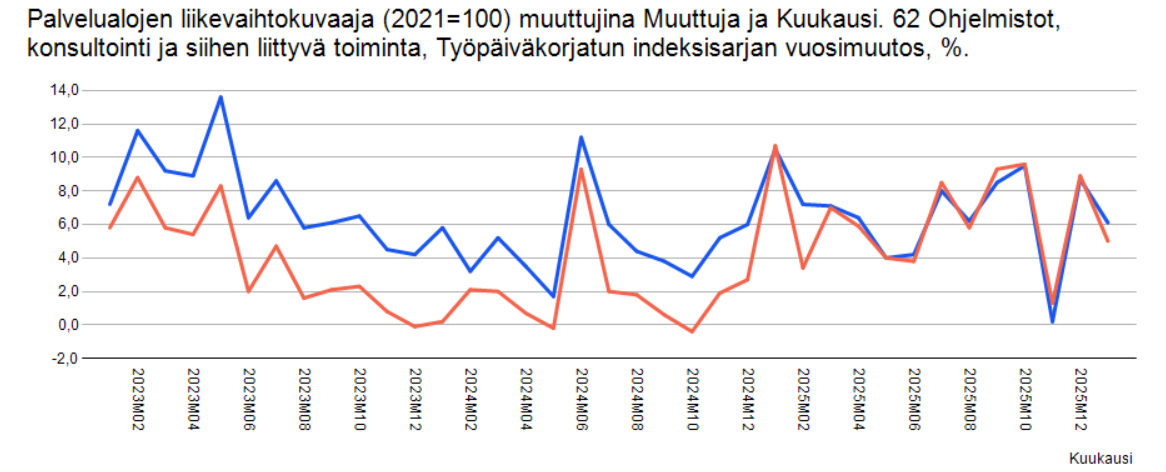
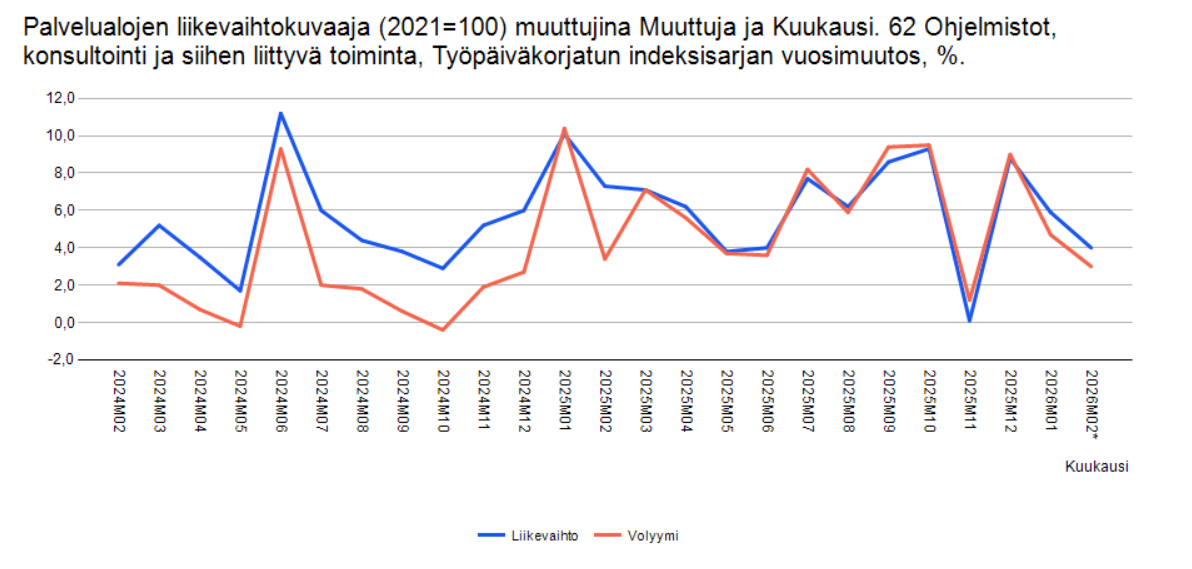
Demand pressure continues: Contrary to what might have been hoped, demand in the software development market still seems to be shrinking. Customers are prioritizing costs and project execution is being slowed down.
IPOs and valuations: For years, there have been rumors of more former big names “pushing” to list, such as Solita, Reaktor, and Futurice, or at least one of them. These are great Finnish former success stories, but in the current market sentiment, listing will be challenging.
AI paradox: The biggest question mark is AI. Everyone is talking about it, but no one knows for sure yet whether “AI business” is large enough and scales quickly enough to replace the shrinking volume of traditional software development. Efficiency increases, but does billable value grow in the same proportion?
Summary
Personally, I wouldn’t invest in current listed IT companies, nor in these newcomers, until we see clearer signs of the demand trend turning and the real impact of AI business on the bottom line.
I’m also sitting on the sidelines until one of these companies successfully shifts, at least partially, to performance-based billing. Performance-based billing benefits both the client and the provider, as both risks and rewards are shared. Currently, clients have been able to push hourly rates down to levels where you couldn’t even hire a cleaner for your home. Furthermore, consulting firms are incurring costs from learning AI and identifying viable business cases. I also believe that companies aren’t yet passing all (AI) licensing costs through to the customer, which is also weighing on profitability.
So, a small glimmer of hope is visible. If you are not in a hurry for quick returns and believe that the IT services sector will survive the AI disruption, then it might be a sensible time to invest. Many think it is worth waiting for share prices to rise before buying, but if you plan on staggering your purchases, it can be a good time to get in even during such a seemingly hopeless period. This could be a good moment for conservative investors who, in normal circumstances, would never buy tech companies due to high multiples.
Joni and Frans have once again produced an excellent IT service sector review.
The Q4 earnings season for the IT service sector brought positive signs for the first time in a long while. At the sector level, Q4 was still challenging in the big picture, but better than before. For the first time in seven quarters, organic revenue turned to slight growth. There are cautious positive signs in the market, especially in the private sector – the public sector remains challenging due to austerity measures, but it is also possible to operate there. Profitability improved slightly from previous quarters and, with the turnaround in revenue, there are now also better prospects for it to continue. We expect revenue to turn to slight growth and profitability to improve slightly in 2025. However, if the war in Iran is prolonged or expands, it will create pressure on forecasts. At the beginning of the year, several sectors, including the IT service sector, have been weighed down by the threat of AI disruption feared by investors. However, this threat has been operationally known in the big picture within the IT service sector for a couple of years already. Thus, we believe this disruption threat is partly exaggerated for the IT service sector. The share price decline has stabilized, but no major recovery has been seen yet.
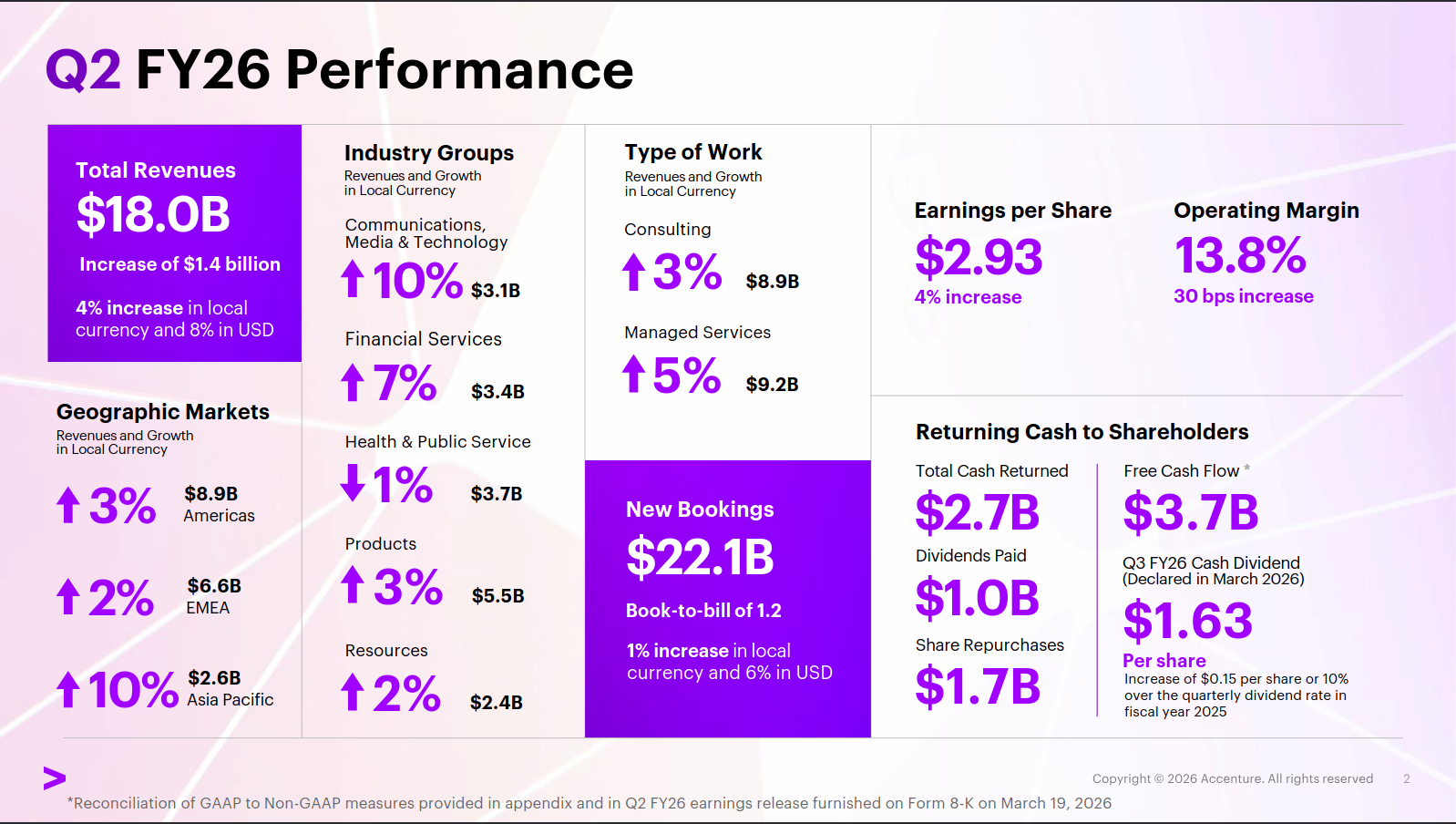
Accenture’s Q2FY26 results (December–February) were just released, and the figures exceeded consensus expectations. The company’s stock has dropped about 40% in a year as the market fears the impact of AI. There are still no real signs of doomsday in the actual figures, even though the growth rate has slowed compared to previous years. Currently, the stock is trading at a forward P/E ratio of 14.
“We delivered record second quarter bookings of $22.1 billion, including a record 41 clients with quarterly bookings greater than $100 million, with revenues at the top of our guided range, while continuing to take significant share in a competitive market. We’re accelerating our critical work with clients to scale advanced AI across their enterprise, and we’re seeing strong AI-driven growth. Our new strategic acquisitions will further strengthen our capabilities and expand our scale to help clients create value and achieve AI-based transformation. With our deep client relationships, industry and process expertise, leading and emerging ecosystem partnerships, and unmatched execution strength, we are uniquely positioned to help clients reinvent and capture the significant opportunities ahead.”
Joni has prepared a review of the Nordic IT sector
In Finland, revenue development finally turned better than in other Nordic countries at the end of the year. In other Nordic countries, organic revenue development weakened over the year. Profitability improved in the Nordic countries, led by Sweden, and was already at a relatively good level overall. For several companies, however, the decline in revenue still creates challenges in managing profitability. When examined using our launched “20-rule,” the situation in the IT services market was still challenging but improved at the end of the year. Thus, when examined by several metrics, the situation improved at the end of the year at the Nordic level. We previously published a Q4 summary of Finland’s listed IT services sector, which also looked more positive at the Finnish level.
Rule of 20 indicates a slightly better situation at the end of the year across the Nordics
The difficult market situation in 2025 is reflected in the fact that only a couple of listed IT service companies in the Nordics achieved excellent performance measured by the Rule of 20. The sector’s best performance was achieved by the consistent performer Netcompany (21%), which is an excellent performance in our long-term outlook. Only Trifork achieved good performance (16%). Bouvet, and among Finnish companies, Tieto and Digia, achieved satisfactory performance. The performance of other sector companies was weak or very weak when measured by the Rule of 20.
(the bolding of “Netcompany” in the text was done by me :))
Joni also started a thread about Netcompany in October. It seems interesting, but then again perhaps expensive, although I don’t always manage to consider the whole picture.
More SaaS than IT services sector, but Relex’s layoff news yesterday is quite bleak:
Founded in 2005, Relex employs over 900 people in Finland.
The change negotiations concern a total of 722 employees at Relex Finland. Of these, 537 work in product development and the rest in other roles. The negotiations will last six weeks.
According to the company, the reason for the change negotiations is the revolutionary impact of artificial intelligence on its software development.
The change negotiations are part of the Relex Group’s overall strategy, where the company states it will focus on high value-added expert services, while other work will be transferred to partners.
Hesari wrote more about this topic today. My interpretation is that they are increasing staff in roles that focus on optimizing customer processes, which is Relex’s core expertise. I think this is the right move, and perhaps even a necessity, because customers are now independently or with others already looking for AI solutions for these issues. Relex has a clear risk of losing market share to IT service companies.
CEO Mikko Kärkkäinen:
“The idea is to streamline operations and change the structure of operations. We will do more closer to customers and their real problems. Less than 5 percent of our business is currently in Finland.”
I really don’t see how a generic IT service provider could take business away from Relex. Even if an IT service provider were incredibly skilled at optimization and simulation, it would lack the critical customer base and the data it provides, which has been used to fine-tune the forecasting algorithm over the past 10 years.
In my eyes, this case is very clear and there’s no need to try to read between the lines. Software production has changed so that the same output can be achieved with a fraction of the previous effort (as the CEO states), and added value is provided to the customer through high-margin consulting (e.g., regarding supply chain and warehouse management) in addition to pure software offerings.
For example, SAP has a much larger customer base and the data it brings. The same situation applies to Accenture and other IT service giants. Relex has gained many SAP user organizations as customers because, for instance, SAP ERP’s own MRP is not capable enough in the area of automatic optimization of demand calculation parameters. AI is changing the dynamics of competition at this point.
It will be interesting to see if this leads to better margins for companies or lower costs for customers. If competition works, I’d bet on the latter.
This is the first major AI-related layoff bomb I’ve seen in Finland.
It’s significant in the sense that with American news, it’s hard to tell what’s their normal “10% of people out because of results” layoffs or “AI washing.” If layoffs are organized in Finland, it’s the real deal.
Apparently, the calculation related to this is massively heavy, and part of Relex’s business model seems to be related to managing the hardware needed for the calculation. The data masses to be processed also seem to be massive (in the category of “it’s not worth transferring all of one big customer’s data via cables from one data center to another” - I might have misunderstood something, those more familiar with the matter should correct me).
The aforementioned facts might also argue against customers and their ERP providers suddenly creating replacement solutions with AI. In addition to optimization, demand forecasting seems to be one of the key features in their solutions.
I suspect that a company that has grown rapidly for several years now has a good opportunity to reorganize itself in this way.
After pondering the matter for a couple of days, I might be able to express my views better.
Relex is an excellent example in that its product is a relatively small entity operating alongside or on top of enterprise resource planning (ERP) systems, compared to the ERP itself. Furthermore, Relex’s software targets fairly precisely defined process points within ERP. For example, inventory replenishment optimization is based on determining the minimum inventory level, maximum inventory level, and replenishment batch as appropriately as possible. Complexity is added by demand fluctuations, storage capacity, and what is desired to be optimized at any given time: speed, cost, or quality. Since this is a relatively well-defined problem, software for this purpose has been developed for decades. Relex has excellent software for this. I’m slowly getting to my point…
Correct me if I’m badly wrong, but my understanding is that AI is currently better suited for designing and coding small programs than large systems. It’s also easier to implement new software for small, well-defined optimization tasks, and here AI can be a very useful tool. Logistics managers and their teams can describe the challenges of inventory replenishment themselves, after which they can be discussed with consultants. A well-described problem can be given to AI, which can offer a solution model. After this, a human team can further refine the model. The result is an optimization model that specifically addresses the challenges of that particular warehouse.
From this plan, AI can already code software that can be embedded within the ERP – not on top of it or alongside it. The result can also be more efficient and better from a data security perspective than some external software. Not all of this will succeed, but Relex’s moat may not be deep enough in all respects. Competition can come from an unexpected direction.
IT service companies can play a significant role in precisely this kind of development. They can provide consultants and other experts as team members for design, code review, and testing. So this isn’t entirely new, but the changing dynamic should be recognized early rather than just observed from the sidelines. I bet many consultants have indeed recognized this but aren’t posting on forums
Will AI erode the business of SaaS companies and take jobs away from IT service company consultants? Yes, unless SaaS companies and consultants react to the situation. A SaaS company may be at risk if it fails to expand the coverage of its software or improve its fit as part of other systems. In the long run, it might even be justifiable to aim to replace a “platform” like ERP more broadly, at least in certain use cases. However, these are big strategic choices.
In IT service companies, the reaction can happen at a much more grassroots level, which makes the situation somewhat easier for them. Many consultants have already experienced a similar upheaval during the internet revolution of the 1990s, although that generation is gradually retiring.
I once saw a presentation about Relex and replenishment issues: “forecasts for each shelf location in each store, from which you get a forecast for all transportation needs to the store. Repeat the idea for each of the customer’s distribution centers, and connections to producers’ ordering systems, of course.” To this, add the observation that domestic S-Group and Kesko are probably small players among larger European and US companies.
If you estimate the number of things to forecast: the different products on each shelf location of 10,000 “Prismas,” their required distribution warehouses, and commodity flows, you get an idea of the amount of calculation per day or two. Optimization is related to the topic, of course, but they need good sales forecasts. In addition, many logistics-related optimization problems are combinatorially difficult (NP-complete), so I would almost dare to say that all operators have to perform optimization at a significantly coarser level than what the aforementioned forecasts directly enable for stores with their distribution centers. Furthermore, they have succeeded (have they?) in expanding into many other areas of retail operations, it seems.
After a long explanation, Taavetti apparently tries to say that when data masses are large enough, unique problems will arise that will require relatively deep specialization. I recall that Relex has several of its own data/computing centers on several continents doing this calculation, and each center contains relatively heavy-duty hardware.
Could that be replaced by a highly scalable ERP component that, for example, dynamically or permanently buys Amazon or MS (virtual) servers, because calculations need to be repeated frequently? Perhaps, but then is it cheaper this way, or can specialization still compete against that? I’m probably trying to suggest that one important marketable commodity for Relex is computing capacity nicely and usefully packaged. In other words, they are like Amazon/MS but more specialized in that field too.
I don’t know enough about the other components of the offering, but if they are functional, they would seem (see link above) to already be some kind of ERP functionality in themselves, excluding accounting.