That may be, but it could also be the other way around—that the owls were left on the display racks.
8 Likes
US pre-market has been running for a while and it looks just as strong as the futures indicated. Anything can happen at the open, of course, but at least things didn’t immediately head south in the pre-market.
Bears have lost their jam jar.
8 Likes
Have electric car buyers maxed out their credit limits?
10 Likes
https://twitter.com/inartecarlodoss/status/1638078071445045248?s=61&t=6ENLxAPtQSwDP-eRFLg3pA
Woe is us, the evil retail investors
15 Likes
After the latest @Verneri_Pulkkinen Vartti, it became timely again to update the investor sentiment chart I developed, which is based on my interpretation of the theories presented in Timothy Carhart’s works and is proven by research[1] to be the best way to analyze OMXH investor sentiment.
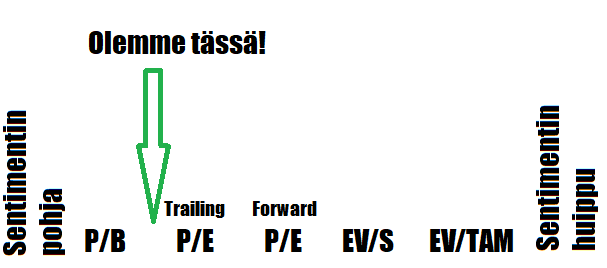
[1] Stetson-Harrison (2009) Finding Alpha: The Search for Alpha When Risk and Return Break Down
As you can see from the graph, these talks by Verneri about the P/B ratio of the Helsinki Stock Exchange suggest that we are clearly below the average in domestic investor sentiment. Although we haven’t reached the sentiment bottom yet, these levels have historically been reasonably good buying opportunities for fundamental investors and have generally indicated that growth stocks and the riskiest stocks are undervalued, as “scared money” has fled to Sampos, Nordeas, Elisas, and other safe plodders.
Could we slowly start forgetting the dividend talk and the drooling over boring companies, and finally start buying against the sentiment—filling our portfolios with tech and all sorts of loss-making hyper-growers? 
79 Likes
The caption raises the question: is this the much-talked-about Stetson method?
10 Likes
I had forward P/E in my graph, but promisingly, its use already provoked people a bit on Twitter. 
That sentiment graph is good, we should feature it on Vartti sometime.
31 Likes
Um, since the dividend payout drops the share price by the amount of the dividend, wouldn’t the price go into the negative with these ‘champs’? 
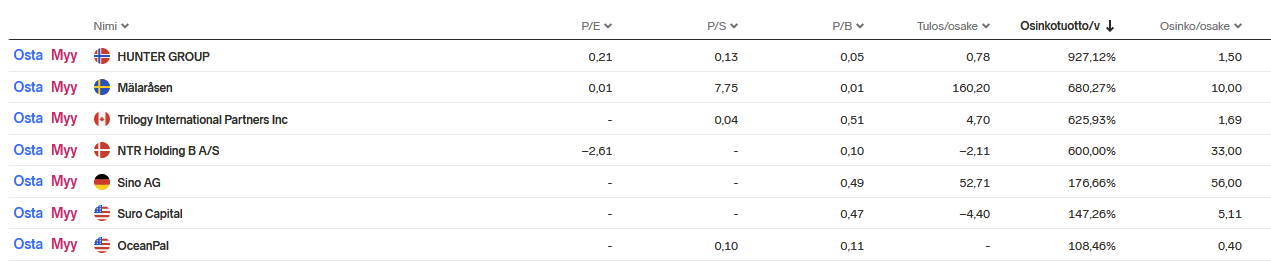
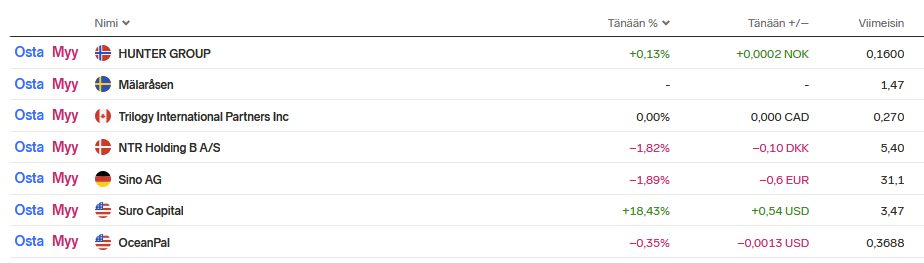
(And these probably aren’t exactly the best stocks, in case anyone is wondering )
4 Likes
Those are historical dividends that have already detached 
5 Likes
The Governor of the Bank of Finland comments:
In an uncertain situation, investors often withdraw from the riskiest assets and move funds to more stable ones. The most vulnerable actors can quickly find themselves in the eye of the storm. The best way to prepare for these risks is to ensure that banks and borrowers have sufficient risk-bearing capacity, i.e. so-called resilience.
Euro area banks have come a long way with the legacy of the previous financial crisis and debt crisis. The resolution of non-performing loans, in particular, weighed on banks’ balance sheets for a very long time.
Today, banks are much stronger at absorbing various shocks than, for example, before the global financial crisis. Buffers have been strengthened thanks to tighter regulation. Problem loans have largely been cleared from banks’ balance sheets, and capital buffers have roughly doubled (see chart below). Liquidity buffers give banks time to adjust to unexpected changes in the operating environment.
10 Likes
Is there a source where you can see how the credit default swaps of different banks are developing?
1 Like
- Nordea’s Thursday closing price 10.80 or below
- Nordea’s Thursday closing price 11.50
- Nordea’s Thursday closing price 12.00
- Nordea’s Thursday closing price 12.50 or above
0
äänestäjää
Nordea’s dividend frenzy and the correction of the oversold condition continue. Where will we end up before the ex-dividend date?
3 Likes
What. The. Actual. Heck ? What now in South Korea? Should we be worried?
https://twitter.com/Trinhnomics/status/1637980595736436736?t=ufcbflUCqXtnqFCjao4WYQ&s=19
22 Likes
After all, they’ve been building microchip factories and such at a breakneck pace in the States, so maybe they’ve anticipated the pivot?
2 Likes
Gotta appreciate this dry humor in the annual report.
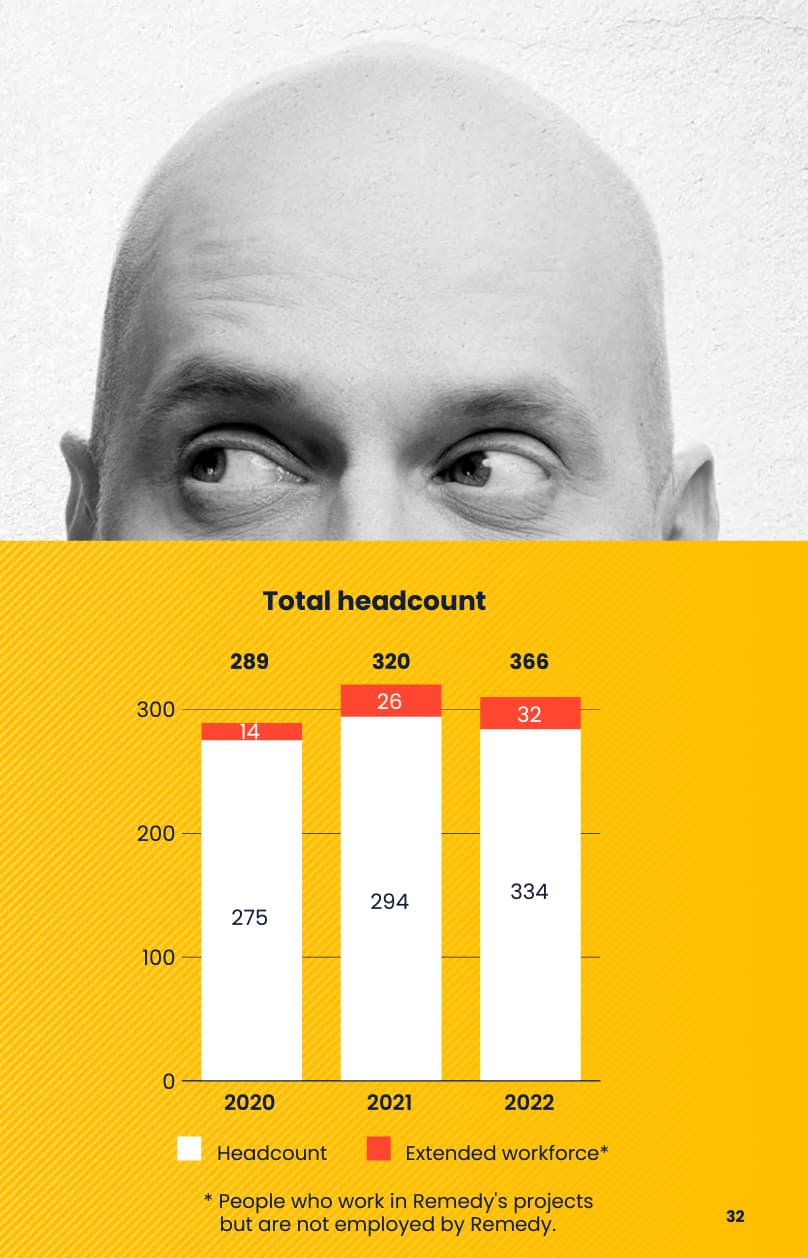
Most annual reports don’t have any humor at all.
14 Likes
It’s quite a wild situation when middle-income earners can’t afford even a used electric vehicle, let alone low-income earners, while at the same time, there is an attempt to force people to switch to EVs by raising vehicle taxes and fuel prices.
Since the car has to be bought with financing, you would need to be able to pay off a €45,000 electric car within 3 years for it to make any kind of sense. The monthly installment would be a “pleasant” €1,300, assuming a €5,000 down payment, and credit costs for this 3-year period would total around €6,000. It’s no wonder cars aren’t selling.
26 Likes
Kempower is about to surge soon, great visibility in Forbes!
11 Likes
Why should it be paid back within 3 years? I have a fixed 1.6% interest rate, and I certainly don’t intend to pay off my car even 6 years early. There was no down payment.
I doubt it. The final installment is €418, so I’m sure you can get at least that much for it. Inflation will nicely eat away even that 1.6% interest rate.
4 Likes
If the repayment period is very long, the car’s residual value may be lower than the remaining loan balance.
2 Likes
I finally managed to get it done.
8 Likes