I strongly doubt the veracity of that, but if we pretend it’s true:
What kind of interest rate should such a loan have? The probability of the borrower surviving alive, healthy, and able to work to pay off the loan is probably not very high, is it?
With the rest of the family as guarantors or the apartment as collateral, there’s no problem. Or a local payday loan company as the lender, which doesn’t really ask for reasons for the loan if the amount falls within the allowed range. Or close relatives as lenders. There are options.
1 Like
With Inderes and a few other negative reports, the discussion about guidance has increased.
The timing of negative reports is one question, but does guidance even matter in the end? I’m reading McKinsey’s valuation textbook (newest edition 2020), and it suggests that guidance doesn’t matter; instead, companies should focus on factors that create long-term value. Short-term guidance, on the other hand, consumes resources that could be used for something more sensible.
Here’s a link to an older study on the topic:
As an investor, I would probably lobby and argue most strongly for companies to focus on what’s essential instead of short-term guidance.
29 Likes
Not a very bullish scenario for Inderes, when analysts regularly appeal to the fact that forecasts are based on guidance and other information provided by the company. 
edit: So, I agree with Verneri that the focus should be on sensible long-term actions more than just the quarter. I would hope for more added value from the analysis than just small adjustments and rounding of figures provided by management.
9 Likes
In my opinion, this is precisely the psychology of investing—how a slow decline starts to affect one’s mindset. Of course, one’s thoughts are also influenced by one’s own positioning, whether the portfolio is favorably positioned for the prevailing trend or not. If there’s still cash in the portfolio when the decline seems to continue, it’s certainly easier to hold on to current holdings. If, on the other hand, one were 100% in stocks, the thought of whether to lighten up on this or that would surely creep in.
However, it’s worth remembering that if you sell at a loss, you lock in the option of permanent capital destruction related to that investment. Then, you would still need to know how to jump back in so that you at least cover that losing investment and make a profit on top of it. So, I wouldn’t sell just because of a general market downturn, unless there’s company-specific or market-related news that implies the company will be in trouble in the long run. In the long run, I am at least personally optimistic that a new bull market will come, even if it takes several more years.
8 Likes
Well, I guess that’s how it is.
In the neighboring country, they are strangely returning to the past in that matter. A rather distant past.
We all remember from history books how in the Middle Ages and before, equipment was acquired independently. The family gained privileges for equipping a horseman. I don’t think there will be any of those in Absurdistan 
2 Likes
So the analyst would have to make forecasts more blindly, but once again: guidance does not affect cash flows and fair value.
For an investor, only those matter.
3 Likes
Indeed they should:
“in the short run, the market is a voting machine but in the long run, it is a weighing machine.”
But short-sightedness is the word of the day; after all, there’s even a thread here titled about not having enough focus for books 
6 Likes
We’re getting to the point again where the Helsinki stock exchange has only yielded dividends in five years. 
8 Likes
there was a throwaway comment that guidelines don't matter, but companies should focus on factors that create long-term value.
I light-heartedly disagree, without reading the article.
The company knows its business best, and it’s important for them to constantly monitor the situation regarding demand and competitors, and adjust their strategy as needed. In other words, the work related to guidance is a core part of the company’s operations, and the same information can then be shared with investors at a very low cost. If the company cuts corners and operates in the dark, without understanding the market situation, it will eventually hit a wall.
1 Like
This is precisely the issue: only about 10% of total assets remain as investable cash, assuming one doesn’t liquidate other investments and maintains a reasonable cash buffer. However, the portfolio size is such that it probably isn’t sensible to enter the market in too many tranches due to trading fees. On the other hand, my current holdings are reasonably positioned, and there’s nothing really worth selling at these prices. The hardest part, then, is the agony of deciding when to push that remaining cash into the market. Other assets are also not particularly liquid and can only be accessed in early 2024.
2 Likes
From the writings of people wiser than myself on this forum, I’ve taken two things to heart in recent weeks: Investors’ continued holding of stocks despite extremely poor sentiment readings, and the optimism of corporate earnings forecasts. Regarding the latter (behind a paywall):
In a nutshell: according to Kaisa Kivipelto, Senior Strategist at Danske Bank, and Antti Saari from OP, who were interviewed, there is still considerable over-optimism in earnings forecasts, and they have been lowered very little.
Reasons include (direct quote):
“The weakening of economic growth has happened so quickly that analysts simply haven’t had time to cut their forecasts yet, or they want to see which companies will be hit by consumer caution, Saari estimates.”
This view is hardly news to readers of this forum, but perhaps a significant portion of “average investors” have now had this perspective presented to them very clearly.
I personally have been following forecasts from here, for example:
The report now includes Figure 4, which illustrates the historical accuracy of consensus forecasts. Similarly, the recent development of consensus forecasts (for the full year) is shown in Figure 2.
However, I can’t read or find a graph illustrating the accuracy of Yardeni’s own forecasts. I had to use the Wayback Machine to examine the differences between Yardeni’s and consensus forecasts.
For example, Yardeni’s Q3 and Q4 EPS forecasts (YoY) vs. consensus forecasts now:
Q3 -5.4% vs. 3.3% and Q4 -3.8% vs. 7.3% (full year 3.1% vs. 7.3%)
So, a good cherry (?) on top of the bear cake. On the other hand, in the spring, Yardeni was considerably more optimistic than the consensus:
Q3 16.9% vs. 10.0% and Q4 18.4% vs. 12.7% (full year 15.1% vs. 9.0%)
I’m therefore considering the source criticism for these Yardeni forecasts. It is also a commercial entity, as far as I understand. Is this differentiation from consensus forecasts a profiling done for marketing purposes? There are quite significant differences in these, however.
3 Likes
I don’t need guidance shorter than a year. Even some annual guidances, at least on the Helsinki Stock Exchange, are so vague that they don’t provide much help. Long-term or strategic period financial targets are perhaps the most appealing, as one can try to guess the company’s longer-term potential and level of ambition from them. So, it suits a long-term investor like me.
Abandoning guidance would likely benefit thorough investors. For an uninitiated small investor, the situation could be difficult, as they would have to buy even more “a pig in a poke” than they currently do. Or, they would rely even more on analysts when the company itself doesn’t provide figures, and the tomato shower for analysts would only intensify. 
10 Likes
As Howard Marks has written - there are many games being played in the markets, you have to be able to identify which one you are playing - identify who you are as an investor.

1 Like
Excerpt from Nord Stream news:
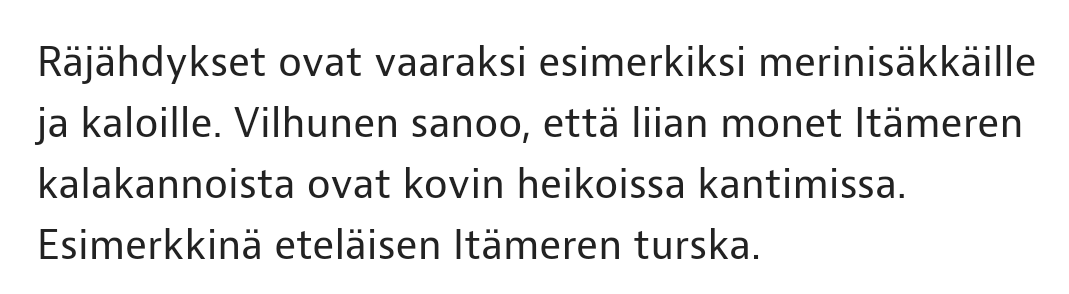
And I thought cod was doing well now. So the bottom hasn’t been seen yet.
42 Likes
I don’t know if I’m somehow abnormal, but my portfolio melting doesn’t really evoke many feelings in me. I know my investment horizon is still +20 years from now, so I’ll probably experience another big bear market in that time.
During the bull market, bear markets were eagerly awaited here too, but now that it’s a reality, it feels like some people are getting cold feet, at least partially. I guess that’s completely understandable.
25 Likes
I’m probably wrong about various things more often than the average person, if one can say that. In investing, I’m especially wrong an unusual number of times, and if I ever hit it right, it’s often due to luck or because, for example, the stock price has moved in the direction I anticipated, but for different reasons than I had thought myself.
Every day I study and follow investing matters immensely; the more I do, the more I constantly realize how little I know. It’s a positive thing that I will make fewer major mistakes in the future, although I’m sure I’ll always make some. For example, I probably won’t join a company whose operations I don’t fully understand, and perhaps I’m becoming more aware of the limited amount of knowledge I possess.
I am generally open to new ideas, meaning I don’t immediately condemn anything, and on the other hand, I have enough critical thinking not to believe everything right away. However, my limited knowledge and reasoning ability naturally restrict my investment success.
Still, despite these things, I often or at least sometimes think I’m right, but fortunately, after a moment of reflection, I often realize how wrong (again) I was. Sometimes, unfortunately, insights come with a delay of several years, often at night when I can’t sleep.
It sometimes bothers me how wrong I’ve been, especially when I haven’t realized it or admitted it. It’s comforting that, for example, even a really smart and educated scientist professor on Twitter sometimes writes completely silly things outside their area of expertise, and apparently even quite seriously. Of course, there are also those who almost always realize their limitations.
Fortunately, there’s the Forum and Inderes, which have made me perhaps a tiny bit smarter and more knowledgeable. My misunderstandings have been corrected here very often, and I am very grateful for that. I will continue to write silly things, and feel free to correct me, but please… do it kindly, as I’m too often used to being wrong.
7 Likes

18 Likes
I’ve been thinking about this Inderes guidance and profitability struggle.
Does profitability really matter in the next couple of quarters? I’d rather focus on the success of the expansion into Sweden. That has more significance for an investor than a couple of quarters of profitability. Would temporary profitability matter if Inderes wasn’t publicly listed?
Addition: The expansion into Sweden would also have a huge impact on the community.
Would you recommend that book, by the way?
7 Likes
Absolutely. I’m only on page 170 (out of about 800 total), but it’s been a full-on blast so far.
I want to emphasize that this is not an attempt to explain away Inderes’s (or other listed companies’) negative guidance blunders. I also understand the frustration with Kamux’s “6:20 PM” negative guidance. And of course, if a company were to constantly change its guidance just before earnings, it would raise questions about visibility and processes.
But generally speaking, investors’ attention should be on companies’ long-term drivers: growth, its profitability, competitiveness, market growth, market share, differentiation, etc.
If the timings bother you a lot, the criticism falls under regulation. Or the fact that companies give guidance at all. All in all, the core of investing is to find companies below their fair value. Thinking about the things mentioned above helps in understanding fair value.
5 Likes