By successfully timing the markets, it’s possible to generate significant outperformance. However, research doesn’t support how easy this is.
Heikki Keskiväli also seemed to discuss the fundamentals of acquiring positions in this week’s Trader’s Club. In the base scenario, the investment is good. Even in a bad scenario, it’s OK.
We are, metaphorically speaking, a drop in the ocean. When it comes to index levels, the direction is shown by others than small investors / households.
You would practically have to guess what others are doing. In your example, you can’t estimate what will happen, because you would spread your remaining investment capital into the market over time…yet you are now taking a view that the decline will continue. A contradiction?
Yes, there is a contradiction.
I would diversify, but for my taste, still with fairly large one-time purchases relative to my “wealth” and income level.
I already outlined the reasons for the continued decline: the sustainability of interest rates and energy prices in winter.
I personally suspect the decline will continue, but I don’t know for how long (and of course it’s possible I’m wrong about the decline continuing). I’ve allocated about 10% of my investment assets, currently in cash, to be deployed with a carpet bombing strategy over 9 months, with the idea that the bottom might be hit within that period.
Of course, in the 2000 and 2008 crashes, the downturn lasted 2-3 years. Now, at an index level, we’ve been sliding for less than a year. It’s possible I’ll carpet bomb the initial wall of the downtrend and then watch another six months of decline. Or perhaps the bottom was already in, and I’ll be buying into rising markets this whole time. The most important thing for me is not to buy everything at the peak (because I already bought the maximums for my OST there ).
Or I’ll have a change of heart and dump everything in one day; I’m not known for sticking to an investment plan.
I might have misunderstood, but if you’re 90% in stocks and 10% in cash, I don’t think there’s much benefit in diversifying such a small sum over 9 months. Unless you happen to hit the bottom with that one percent slice where the stock plummets -99% and then still rises from there
How do you know if it’s 10% of €1,000 or €10,000,000?
I probably wouldn’t bother dollar-cost averaging amounts under €10k over such a long period, as transaction costs probably can’t be pushed below 1% (excluding monthly savings ETFs?), but for sums above that, it’s always worth dollar-cost averaging a bit, unless you’re absolutely sure of your timing for some reason (please share those methods if you know them!).
I was just about to praise it myself, having just listened to it, but you took the words right out of my mouth! @Verneri_Pulkkinen, you could also put together an Inderespod (podcast) on these themes again after a long time!
It would be most fun if you could get Peppa Pig as a conversation partner there, but Juha will do too, even though it’s a goddamn rip-off market and crises.
Conversely, one could perhaps think that if there is a need to diversify when seeking security, should one then consider whether a 90% equity weighting is too much?
No, it couldn’t. Time diversification has nothing to do with allocation diversification. In the same way, I consider time diversification sensible, regardless of whether the investment target is fixed-income investments, stocks, or even real estate. The idea of time diversification is to soften the probability of hitting a locally weak buying point (and conversely, a local bottom).
Inspired by this discussion, I’ve been pondering that in investing, risks (which are the realization of unknown and unexpected events, both positive and negative) are by no means symmetrical: Negative news affecting the share price is more often surprising, which is why movements are fast and strong, whereas positive risks, when realized (perhaps with the exception of some growth company “lottery tickets”), are somewhat expected, and the result of long-term good performance, signs of which gradually emerge. Perhaps this is precisely why I consider time diversification sensible: it easily avoids buying a large pot just before a price collapse, while it’s unlikely to miss a rocket surge. Of course, this doesn’t apply to speculative stocks, but my viewpoint is quite “Grahamian” and I don’t consider buying them investing, but speculating.
Thanks for the challenge, I’ll try to explain my thinking!
I’m currently about 86% in stocks. I don’t want to sell this existing portion because it’s mainly in a brokerage account (AOT) and I’d have to pay taxes, and there’s no guarantee that the drop would be large enough to offset the taxes. However, I do want to dollar-cost average that 10 percentage point portion, because it’s more than half a year’s net salary and it would be psychologically frustrating to watch a potential decline in an all-in state. Dollar-cost averaging also costs nothing, as the fund has no subscription fees. The remaining 4% (a couple of months’ net salary) I’ll keep discretionary to put in when it feels like the bottom, mainly because this adds spice to my macro-watching hobby.
I don’t think I convinced anyone of the rationality of my actions, but perhaps I opened up the thought processes behind it
Now, don’t tease @Sijoittaja-alokas too much. Isn’t it enough that I just sold a big pile of Harvia within a week, and the results have shown yesterday and today?
Is “Alokas” (Rookie) buying Apple? Just asking for a friend… The Apple company is trying hard to stay afloat and is hovering at the Fibonacci level. The technical upside is only about 10%, but the downside is over 20%. S&P500 and the entire market are, not surprisingly, moving in the same direction.
It would probably be fairest for everyone if we just got this feared crash over with at once. Luckily, we have insider information here on the forum; we just need confirmation from “Alokas” (Rookie) on when this will start.
The Susijengi players are really smart and down-to-earth guys.
And of course, the most important question of the interview and Salin’s good reminder to everyone:
What about the cod side (turskapuoli), meaning losses during times like these?
“There have been some,” Salin confirms.
“Times are a bit difficult, but they will start to rise again sometime. No need to rush.”
As an old schoolmate of Sasu’s, I can tell you that you’d be hard-pressed to find a smarter athlete “youth.” He’s down-to-earth, always kind and polite! Not just a pretty picture
The guy radiates good vibes. I really have no information, but I watched Sasu’s interview earlier this week and thought he’s important to his team in many ways. It’s also not surprising that he knows how to handle his finances and doesn’t rush into things.
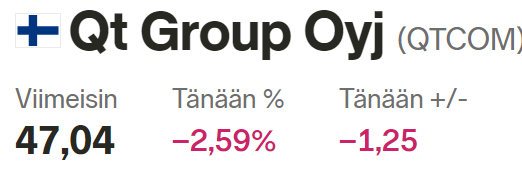
If we were on Kauppalehti’s discussion forum right now, I’d say, “QT is still ridiculously overpriced” (at €46.55) and “I’ll start buying when it drops to 12 euros.”
I wonder why the Inderes logo keeps shrinking in the button that opens the forum. Is it following my shrinking investment portfolio, or is it suffering because I press it too often? It was originally the same size as the audio software button above.
 ).