I personally don’t see any alternatives to emission reduction measures. I doubt many energy sector experts do anymore these days. It’s guaranteed that in some countries, at least temporarily, hardliners opposing reductions will come to power, and local setbacks will occur. Hydrogen will likely play a big role in energy storage and emission reduction, especially in industry and steel production, but will it in transportation? I wouldn’t bet on hydrogen being a future option in transportation. Hydrogen is certainly risky in the sense that a major hydrogen accident could increase people’s fear of hydrogen technology, even if it weren’t more dangerous than traditional technologies.
The Earth is fine. Humans and other biological organisms are screwed. A million years from now is the blink of an eye for Earth. The Earth will be very different then, whether humans are here or not.
I’m definitely not against or completely closed off to the possible widespread adoption of hydrogen. I’m critical of the “necessity” of it. I don’t know where this “necessity” comes from, but I have a gut feeling that when enough people believe in this “necessity,” it becomes the justification for the investment.
It’s somewhat amusing how cars are always blamed for emissions, even though they’re just a tiny mosquito… in the grand scheme of things.
I haven’t heard a single politician demanding a crackdown on women’s fast fashion. We could reduce emissions much more easily, lower the chemical burden, and free up cotton fields for food production. It seems it’s too commonplace, and production problems have been Nimbified to Asia, so no one knows or understands anything.
I’ll play the cynical card and bring up population growth and the number of people as one factor in climate change. Even Earth probably has some carrying capacity for Homo sapiens.
I haven’t been following closely, but my understanding is that Stone continued in the investment information’s interest rate thread and at most bought canned goods for his bunker from the bottom.
To be precise… in Glasgow, Finland and many other countries also committed regarding trucks:
Part of the plan is that by 2030, 30 percent of all newly sold trucks and buses will not emit CO2.
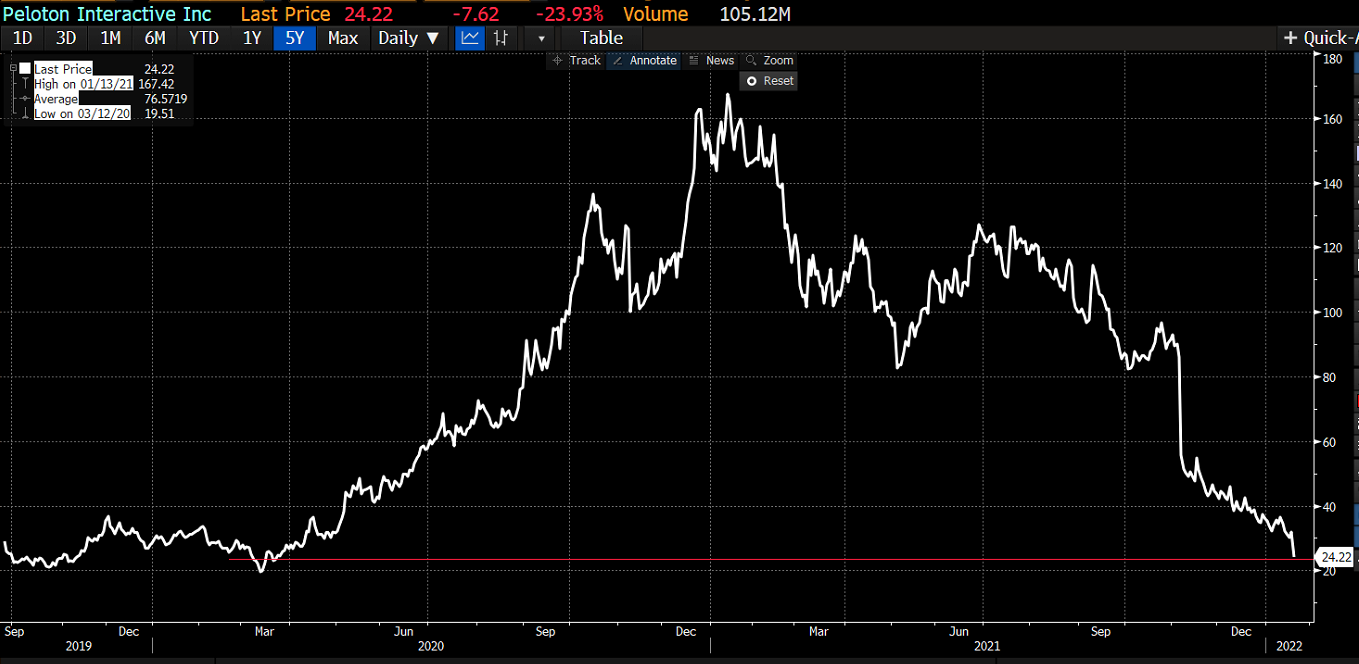
The “interactive fitness platform” Peloton, a stationary bike worth over a thousand euros with an iPad taped to it, is now just a couple of steps away from its all-time low during the COVID-19 crisis in March 2020. During the crisis, the company struggled to meet demand; now, rumors suggest production has been halted due to demand issues.
There is certainly a place for hydrogen, but don’t be too sure that its place is in gaseous form in a truck’s tank. Hydrogen can also be combined with carbon dioxide, which – ta-da – produces hydrocarbons, also known as diesel. This technology is primarily dependent on the production of clean hydrogen (quantity and cost). But hydrogen trucks also require the same production, with the difference being that hydrocarbons can be manufactured anywhere and use existing distribution routes and internal combustion engines. P.S. I own Hyzon.
Good morning @Sener!
There are tons of people here who follow, research, read, and even share genuine information related to hydrogen. So, if one wants, they can find other reasons for their investment decision than just that compulsion.
Haha, the average price will certainly be correct on paper! It was just about the portfolio’s performance graph, which I want to be in the right ballpark when I occasionally open it here.
Ahem, that OS is Android-based, and smart trainers (even those used with your own bike) are already expensive. I don’t have experience with Peloton, so I won’t comment on the company, but perhaps that price isn’t entirely absurd. Wahoo’s KICKR bike is around 3500 euros, and decent trainers that connect to a bike start at about 500 euros.
Those who train more seriously will, in all likelihood, pay the price for a premium trainer before buying a glorified exercise bike. With a trainer, you can use your own bike, which means your riding position remains the same as when cycling outdoors. This is especially true in triathlon, where getting used to (and refining) the riding position can take hours.
The problem is the market size. Peloton managed to push such a device into more mass markets that had not even considered acquiring such a device before. Then massive demand hit and manufacturing was scaled up, but it turned out that this was only a short demand spike and now inventories are full of goods and demand has been met. I predict that these inventory fillers will soon be sold Very Cheaply while Peloton takes a loss on every device. Perhaps there is a small hope that if they can be sold cheaply, the subscription service will still bring something in the long run, but it doesn’t look good. An amateur group has been scaling up manufacturing - there’s no way you can just blindly put money into the factory side without accurate forecasts for longer-term demand. Either these weren’t made, or they went way off track and it will be expensive.
And if the intention was to operate more like classic consumer electronics and thereby generate replacement demand, there should have been clear plans to make a new and better model at least every couple of years. And I’m not convinced it works with this kind of device category. At most, maybe they could have sold upgrades to the iPad part.
I also second this observation. Some, very few, seem to buy watt bikes, but traditional exercise bikes are an absolute no-no. I just bought a Wahoo turbo trainer, and it’s in a league of its own compared to anything I’ve tested before. It’s important to get your backside accustomed to your own bike’s saddle well in advance, and it’s a completely different ride than on an exercise bike. The rubber feet of the turbo trainer flex, which gives a more realistic feel as the bike can sway slightly from side to side. Your rear doesn’t go numb as easily as on a static exercise bike either. Buying that Wahoo turbo trainer has been one of the best investments I’ve made in myself. You can’t improve the feel by adding an iPad or tripling the price compared to competitors, just saying.



 It was just about the portfolio’s performance graph, which I want to be in the right ballpark when I occasionally open it here.