That summarizes it perfectly. Having seen and conducted remote learning in practice, and having listened to teachers’ opinions on its quality, I would never in a million years send my own child to a school where remote learning was a permanent practice.
20 Likes
So what’s the deal, money’s no good anymore? Just asking 
2 Likes

Are you going with a flat amount all the time?
Somehow, “Verner’s” picture in these always makes me laugh just as much. 
6 Likes
As a high school student, I really hope we can continue with in-person learning. Since the beginning of the pandemic, at least in the Helsinki metropolitan area, a significant portion of my entire high school experience has been spent in remote learning periods. For me, the sense of community with my schoolmates, which doesn’t come through the same way remotely, is really important. It would feel pretty empty if I had to finish my senior year remotely…
34 Likes

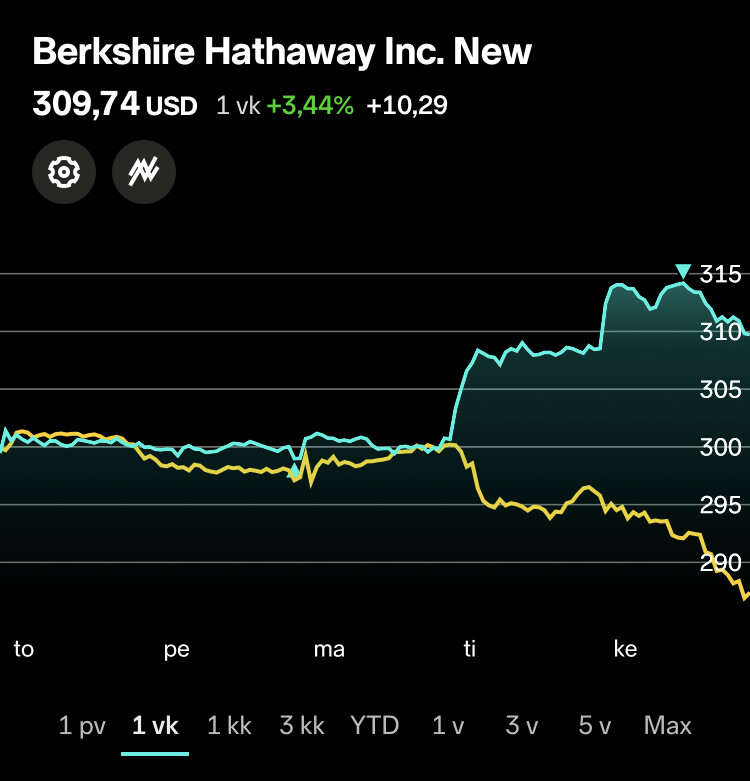
I think the sentiment (I assume) is nicely visible in the short term here.
Yellow=Nasdaq100
Thu-Mon: Was that the January rally, then?
Tue: If interest rates rise, Buffett provides at least some protection.
Wed: Now we have interest rates in black and white, what did I tell you!
12 Likes
This comment warms my heart more than you can imagine, especially as I’m now just waiting to see how we return to work next week. Thank you.
Sincerely, a special education teacher
In our municipality, these “additional resources” meant extra hours for special education teachers and school assistants. The idea is very noble, but teachers who are already somewhat overburdened might not necessarily need extra hours. Smaller class sizes and more helping hands, those are the resources that, in my experience, are needed.
24 Likes
I really feel for those who started their high school or university journey remotely. Group bonding was super important in the beginning, and I made long-term friends during those times. And it was just fun too!
9 Likes
So true, and then again, Inderes isn’t just an analysis firm… that’s where the idea came from…  Just a hypothetical question, how much would someone be willing to pay for these police officers?
 I don’t dare tag the CEO yet, because the idea is still so nascent.
Yep, someone once shared a picture of Verneri’s ancestor, the “ancient Verneri,” on Twitter a while back. It always makes me happy too. 
5 Likes
@Verneri_Pulkkinen A little tip for an extra fifteen minutes of spice 
I wonder what happened to Doomberg, as they’ve been twisting even the slightest positive news from China into negative for the past few months
1 Like
42 Likes
I would gladly take a layoff notice already. I feel like I’m a prisoner in a gilded cage. Everything is forbidden in my free time, but I have to go to very high-risk on-site work. Pandemic fatigue has long since passed the horizon. This pandemic tests everyone in such different ways.
Three doses of Pfizer in the arm, If I die, I die.
14 Likes
Hey Mitani, this is an interesting topic. It would be interesting to hear views on what exactly is involved in the idea you wrote about (the sentences I bolded) and what it could mean for the markets in practice. I posted the question here in the coffee room (mods can move it if it fits better in another thread). If you or anyone else who understands this topic would like to answer. 
4 Likes

Here’s some interesting speculation related to that topic: what if the ECB bought government bonds, after which the terms of the bonds would be changed so that they become perpetual bonds (infinite maturity) with zero interest, which would practically be equivalent to debt cancellation.
3 Likes
Mostly yes, although the savings amount has also grown somewhat over time with the salary. In retrospect, I could have taken extra from the buffers for the COVID (koronarommi) dip, but how was I to know how long we would be sliding.
1 Like
This is quite close to my own thoughts. For about a year now, I’ve been wondering what I’d do when I grow up if not my current job. Of course, I’m not in basic education.
Currently, the financial side of my household doesn’t allow me to leave my current position without immediately moving on to another job. And I would need to supplement my skills a bit to even be qualified for entirely different roles.
And among my close circle, there are many exhausted teachers, those recovering from burnout, or currently on sick leave. When you have a predominantly conscientious group of people, and suddenly an immense amount of workload, stress, and concern for students is added, their minds just can’t take it. And this is the same across different educational levels.
I summed it up with one fellow teacher that nowadays, the less conscientious you can be as a teacher, the better you’ll manage. Otherwise, everything will just pile up on you.
20 Likes
“Nowadays, the less conscientious a teacher is, the better they perform.” I’ve observed this phenomenon firsthand in my close circle, and it’s quite concerning.
8 Likes
The situation as a whole is difficult because the world’s total debt level is roughly 400% of GDP. Large debt has a bad habit of accumulating, which sooner or later will inevitably cause a widespread default. Public debt has been shown to be very damaging to a country’s economic growth when it exceeds a certain level. In short: with better economic growth (~rising interest rates), the state immediately has to cut public spending to cover debt servicing costs and, as it were, push against the economy. There are many views and even studies on what this critical level of indebtedness is. I would no longer start thinking about any ‘government debt / GDP’ magic level in today’s world, because we no longer live in an era of market-based currency policy. Central banks have more room to control interest rates, which currently gives more leeway for indebtedness.
Economic experts have long spoken of various “great reset” variations of the debt mass. The effects of a widespread reset would be truly unpredictable, so I don’t believe such a thing is realistic. As for a targeted reset, there would be a huge number of political and general fairness risks, cf. the discussion in the United States about student loan forgiveness (of course, that discussion would be about exchanging private sector debt for public debt). Resetting (at least partially) government debt, on the other hand, would fit well into many economic theoretical models. As MMT has now gained momentum, resetting government debt would fit with it in the following “solution model.”
Practical effects on the markets… A good question, for which there are no certain answers. In theory, it might even work. Public administrations would gain more room for various projects (green deals, infrastructure investments, and whatever else politicians can think of) without fear that interest costs will soon force unpleasant cuts in public finances. Central banks would indeed get a new kind of opportunity to use monetary policy in both directions and, in an ideal situation, could let the markets largely regulate interest rates again. As a result, capital would be allocated more efficiently, which in the long run is an essential factor for sustainable economic growth. The risks, of course, are human nature, especially politicians. Politicians with looser integrity would surely get a little too many spending ideas, including projects for special interest groups, basic income, increasing the civil service army, etc. And in any case, inflation might rise significantly. But if we talk about (stock) markets, any debt reset would likely be manna unless it simultaneously includes a (significant?) increase in the debt costs of “remaining” debtors.
These things can, of course, be twisted in many directions. The most essential thing for an investor is probably to grasp different future scenarios so that when they materialize, there are some thought models ready. I try to gather information from legends and structure it in a way that feels right to me. For example, Ray Dalio, Howard Marks, Jeffrey Gundlach, and Lacy Hunt are names whose latest (and longer-term) thoughts I try to keep up with.
15 Likes