HelloFresh SE - global food industry disruptor

Greetings to the forum,

I thought I’d open a thread for this German food industry player. Below is some information and my own thoughts on the company. The screenshots are from the company’s own CMD presentations. Let’s see if we can get a discussion going; if so, I can write more later, at least about the risks and competitors.

What does HelloFresh do?

HelloFresh is originally a German food industry player that sells meal kit packages to consumers as a weekly subscription service. HelloFresh customers receive 2-5 meals per week delivered to their homes. Recipes for these meals are delivered, along with pre-measured ingredients, which the customer can cook themselves at home. HelloFresh has already expanded to 17 countries, including all Nordic countries except Finland. In Finland, similar meal kits are sold by many much smaller local companies.

HelloFresh has several brands under which the service is sold. Most sales occur under the HelloFresh brand, and this brand has become almost synonymous with similar meal kits in several markets. Meals marketed under the HelloFresh brand cost, for example, about €4-5 per meal in its home market of Germany. In addition, HelloFresh has the EveryPlate brand in certain markets, which focuses on a lower price point, GreenChef, which focuses on organic and vegan portions at a higher price, and Factor, which sells ready-to-eat meals delivered to homes. Smaller brands include Chef’s Plate and the recently acquired Youfoodz.

HelloFresh can maintain higher margins compared to traditional grocery stores for three reasons. Firstly, HelloFresh buys raw ingredients directly from producers, eliminating intermediaries from the chain. Secondly, HelloFresh can optimize its processes so that food waste is only a fraction of what traditional grocery stores produce. Thirdly, HelloFresh’s production processes are refined and automated so that inventory levels are consistently very low and net working capital is negative.

HelloFresh’s customer acquisition has been optimized so that, on average, a new customer acquired for the subscription service repays the marketing costs associated with customer acquisition in about three months, thanks to strong unit economics. This is one of HelloFresh’s greatest strengths.

HelloFresh’s stock is listed on the Frankfurt Stock Exchange under the ticker HFG and was included in the DAX index last year.
Xetra
Yahoo Finance

Recent History and Future

HelloFresh turned its operations (adjusted EBITDA) profitable in 2019, just before the COVID-19 pandemic provided a significant tailwind for the company in 2020. Revenue grew from €1.8 billion in 2019 to €3.8 billion in 2020. Last year’s revenue looks set to rise to around €5.9 billion.

Adjusted EBITDA has also grown to over €500 million in 2020 and 2021 despite significant growth investments.

For the current year, HelloFresh has guided for 20-26% revenue growth, driven by new geographical openings. Margins, however, are guided for slight downward pressure due to inflation (HelloFresh has stated it will not raise prices and will instead focus on revenue growth at the expense of grocery stores) and burdened by large growth investments (developing the technology team, opening and automating new distribution centers).

Long-Term Growth Strategies

In the longer term, HelloFresh has stated its goal of achieving €10 billion in revenue and a 10-15% adjusted EBITDA margin by 2025. Of these, at least the revenue target seems easily achievable, and the company has shown it can also maintain high margins if it so desires.

Future growth will come from several sources:

  • Geographical expansion to 2-3 new markets per year. Last year, for example, services were launched in Norway, Japan, and Italy.
  • Offering additional services to existing customers, e.g., in the form of desserts, extra portions, breakfasts, and the HelloFresh Market (ordering individual ingredients outside of recipes) already trialed in the Benelux countries.
  • Bringing brands already launched in the USA to Europe and other markets. Of these, Green Chef and Factor, in particular, look promising.
  • Improved margins through automation of distribution centers and better utilization rates as the scale increases.

Competitive Advantages

HelloFresh has managed to outperform almost all competitors in many markets. Notable among these is Blue Apron, which was still the market leader in the USA market a few years ago but now only generates a fraction of HelloFresh’s sales. Nor have traditional grocery stores yet found a way to compete with a similar service, despite numerous attempts.

HelloFresh’s best competitive advantage is its brand, which in many markets is a “top-of-mind” brand when it comes to meal kit services. In many countries, this is due to a first-mover advantage, but in America, for example, the company has managed to displace strong local competitors after entering the market later.

Now that HelloFresh has grown to be clearly the largest player, economies of scale and process optimization are a big part of their competitive advantage. Smaller players cannot compete on price, and those traditional grocery stores that could drive down prices have not adapted to a similar service due to HelloFresh’s unique logistics. Data utilization is also one of HelloFresh’s strengths, and the recipe selection can be optimized for customers using data and artificial intelligence.

A weakness is the easy substitutability of the service. If a more attractive competing product appears on the market, consumers can easily switch to a new service with as little as a week’s notice. On the other hand, the evolving digital services of traditional grocery stores may close HelloFresh’s digital lead.

Valuation and Return on Capital

The stock price has fallen significantly in recent weeks and is just under €60 at the time of writing, which means a market capitalization of approximately €10.3 billion. Based on the results of the last 12 months, this means (based on my own calculations) the following multiples:

P/E = 30x
EV/EBITDA = 20x
EV/S = 1.9x (drops to 1.8x if Q4 results meet guidance)

Return on capital has been at a high level since the beginning of 2020. Below are the key figures at the time of writing based on the results of the last 12 months.

ROE = 41.4%
ROIC = 31.6%
ROA = 16.4%

Additional Material

HelloFresh IR pages
Business Breakdown podcast about the company (highly recommended for those interested)
2020 CMD slides
2021 CMD slides

79 Likes

A very interesting start, thank you for bringing this company to my attention. This one goes on the watchlist.

A couple of key figures that would be nice to calculate are perhaps the return on capital: ROA, ROI & ROE.

In addition, it would be nice to hear if anyone has personal experience using the service and, for example, the breadth of the recipe selection?

2 Likes

Thanks for the reply, I indeed forgot to include those calculations in the initial post. Capital returns have been very strong since the beginning of 2020. Below are the metrics you mentioned, calculated with the last 12-month results. I will also add them to the opening post now.

ROE = 41.4%
ROIC = 31.6%
ROA = 16.4%

I myself have been a HelloFresh customer for many years and that’s how I originally got to know the company. Customers can choose their 2-5 recipes each week from a selection of about 30-40 recipes, which covers quite a wide range of preferences and diets. You can check out an example of this week’s recipe selection for the largest market, the USA, here. My own experience in Germany has been very positive. The ingredients are high quality for the price, and apart from a few minor things, the service has worked very well.

15 Likes

I first heard about this myself now in November while on a business trip, when a foreign colleague told me his girlfriend works at HelloFresh. At the dinner table, I glanced at the stock chart, which had gone up about 5x since the Corona era, and my interest in further research stopped there :grinning_face_with_smiling_eyes:

2 Likes

On behalf of my friend, I can comment that it’s a truly popular service. I have several friends/acquaintances who have been subscribing to HelloFresh meal kits for several years now. I’ve only heard praise. I live in a London suburb, and among the producers, there are many stay-at-home mothers, as well as families with part-time and full-time working parents. They’ve praised the recipes, the portion sizes (no waste and no overeating), and overall good quality.

8 Likes

Other companies operating with a similar concept, like Blue Apron, have not succeeded, but HelloFresh has, making it a category winner with no challenger in sight. The remaining question is: what is the future of the category itself? In the short term, one might ask how the return to normalcy will affect the company’s growth. In the long term, one might ask how much growth potential there ultimately is and how long customers will remain users of the service after learning recipes.

I have owned this company, but I don’t currently. As one might guess, HelloFresh skyrocketed during the lockdowns, and the share price rose from about €20 to eventually peak at about €95, now sitting at €56.66. So, if we say the price has dropped to a more comfortable level, we can also say there was room for it to do so. If one believes in the future of meal kit delivery and that their potential is still far off, then HFG is a good target. I will not take a stand here on whether the stock is reasonably priced right now. Timing is also considerably affected by the categorical pricing of growth stocks. I also haven’t followed the performance of the latest quarters.

5 Likes

You hit the nail on the head. The company itself believes that habits learned during the pandemic will persist, although they expect the number of weekly orders to drop, for example, from five weekly meals during the pandemic to three. It remains to be seen if they are right. Having observed the habits of my acquaintances, I haven’t heard anyone returning to their old routines yet.

A large part of the growth potential will certainly come from geographical expansion, as well as bringing popular US brands to Europe, which allows for expansion beyond just dinners to lunches and breakfasts. I don’t believe these are very dependent on the continuation or end of the pandemic. Geographical expansion, of course, carries the risk, especially in countries with a strong food culture, that cultural compatibility will not be found and operations will never take off. I would see this as a particular risk when expanding to Southern Europe and Asia.

The company itself seems to believe that the stock is currently undervalued. Today, a new 250 million euro share buyback program was launched. https://ir.hellofreshgroup.com/websites/hellofresh/English/3900/news-detail.html?newsID=2184564

3 Likes

Of course, generally speaking, it can be said that learned habits persist. On the other hand, if this were completely true, it wouldn’t be possible to disrupt anything existing.

In a subscription-based business, key metrics are Cost to Acquire Customer, Customer Lifetime Value, and Customer Churn. None of these alone tells the full story of the model’s functionality. HelloFresh has also reported on all of these, albeit not always completely regularly and consistently. It also doesn’t always disclose the exact formulas it has used to calculate these key figures, or if it does, using them doesn’t always yield consistent results:

https://www.linkedin.com/pulse/curious-case-hellofreshs-retention-data-daniel-mccarthy

In the name of fairness, it should be noted that the same ailment tends to plague all internet companies. Of course, HelloFresh is considerably more transparent than, say, Alibaba, whose money gets mixed up with the Chinese Communist Party.

It would also be quite essential to understand what proportion of “new” customers are actually renewing their subscriptions. Renewing a subscription is, of course, a very good thing, but including renewing customers in the cost of acquiring new customers, on the other hand, gives an overly rosy picture of it.

7 Likes

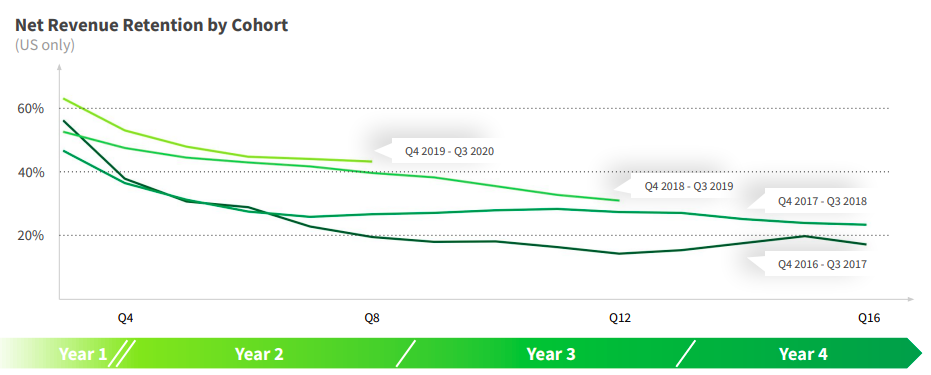
Very good point and interesting write-up, thanks for the link! I had to go through the company’s materials from recent years to see if any clarity had emerged since 2019. The only clarification I found was in last month’s CMD material, which shows data on retention in different customer cohorts.

Underneath this image, in small print, it says: “Lines represent unweighted average revenue retention for Q4–>Q3 cohorts, X Quarters after initial acquisition.” From this, one could conclude that the figures refer specifically to the acquisition of new customers. But it’s hard to say for sure even from that.

I didn’t find any more transparency myself on how these figures were arrived at. I’ll have to go through analyst calls to see if anyone has brought up the issue. Also, according to this old article, HelloFresh used to embellish numbers for potential investors in its early days, so the concern is certainly valid.

3 Likes

Thanks for the picture! Am I reading this right, that for example, in 2017, about 35% of customers who joined four quarters (one year) earlier were still active, and about 25% of customers who joined 16 quarters (four years) earlier were still active?

If so, that’s quite a significant churn compared to Finnish grocery store loyalty programs :smiley:. But I suppose the margins are also in a different league. Unlike S-Group, HelloFresh doesn’t need to entice the customer to order from them every week, because the customer has a standing order. Perhaps a better comparison would be a gym membership, meaning HelloFresh would be the Elixia of grocery shopping.

2 Likes

At least HelloFresh is good at copying the logo of a Finnish food company (Fresh Servant) :wink:


2 Likes

That’s exactly how I read it too. So, retention seems to have improved year by year, but still about 45% of new customers (or, more precisely, new revenue) who joined in early 2020 are still retained. This calculation doesn’t necessarily mean the subscription has been canceled; in some cases, the size of the weekly order could also have been reduced. In any case, during the pandemic, retention does not seem to have worsened, if the company’s data is to be trusted.

I think this is a good comparison. Except that the order can be changed or canceled from week to week with complete flexibility. The company’s CEO has also said that directly comparing them to grocery stores is wrong; he himself compared HelloFresh more to CPG (Consumer Packaged Goods) companies. In their deliveries, all packaged products are their own brand.

1 Like

Compared to gyms, one difference is that gym memberships are often very regional and cease when the area changes, even if gym attendance itself continues. I, at least, choose a gym close to work or home. If the location that was the basis for the choice changes, I easily switch to a gym near my new home when moving, for example, which may not be part of the same chain as my current one, and the distance to the nearest branch of the former chain might be too long. Not to mention if the previous gym is an independent operator. With HelloFresh, a customer can easily remain a customer even when moving, especially if moving to another part of the same city or if the service is available in the new hometown. So, at least in this sense, customer retention should be better than with gyms. Many other reasons can, however, weaken retention. As a comparison, it would be nice to know what the customer churn rate is for a gym chain.

I have been following the company for a longer time. It’s a shame that in Finland, it’s not possible to get practical experience with the company’s service. But like with another of my portfolio companies (Fodelia), this also offers the convenience of everyday life. I don’t particularly enjoy grocery shopping or want to plan groceries long-term. Nevertheless, I have to go to the store weekly, and it always wastes a family’s time. If someone did my grocery shopping for me, that would be great; it would probably save time and money. Even better if the food prepared itself. HelloFresh apparently offers that in certain areas. I would be surprised if this trend doesn’t continue in the future; one would think there’s always a certain segment of the population that wants convenience in their daily lives and a ready-made diet.

5 Likes

Thanks for this opening! By chance, I’ve also bought a small tracking position in this company (my first international investment in a while). As a former tech analyst, I liked this business model, which has some elements typical of a SaaS business model, and digitalization certainly plays a strong role here. Clear unit economics and a proven way to do profitable business with online food retail. The undisputed leader in its category, and I believe there are benefits from economies of scale in this business. Founder-driven and an excellent track record. The efficiency of logistics and the supply chain is massive compared to “traditional” online food retail because the box can be picked in an instant, and thanks to the subscription model, distribution can be optimized days in advance. On an impact level, at least, I believe this model reduces food waste and promotes eating more together as a family and healthier. On top of this, the valuation is quite low relative to growth and profitability, which makes me wonder what I’ve missed :thinking:

84 Likes

Glad to hear that even more experienced experts have found something interesting here! You bring up excellent points, and I’ll try to elaborate on a couple of them below. These same points were also discussed very well by the company’s CEO in the Business Breakdowns podcast episode I linked in the opening post.

Exactly, this has some elements of a SaaS business model. However, it cannot be considered a pure SaaS company, and you’re not claiming it is. As mentioned above, churn in this model is much higher and retention is lower due to the flexibility of subscriptions. On the other hand, there is also a much lower barrier to starting or reactivating a subscription than in many SaaS models. Perhaps it is therefore closer to a traditional subscription-based business model, but with elements from both SaaS companies and CPG companies and their consumer brands. An interesting combination in my opinion.

This efficiency is influenced not only by automated picking and good predictability but also by the small number of different products acquired during the week. HelloFresh’s weekly procurement need is approximately 300 different SKUs compared to tens of thousands of SKUs in traditional grocery stores. This massively simplifies procurement and thereby increases supply chain efficiency. Of course, the downside is that these 300 SKUs change from week to week, and the procurement quantities of individual SKUs can be very high one week and drop to zero the next. This also requires flexibility from the producer.

Once these SKUs have been acquired and arrived at the sorting center, they do not sit in a warehouse like in traditional grocery stores; instead, they are often processed on the same day and sent on to customers. This just-in-time manufacturing process enables the logistical efficiency you mentioned.

I completely agree with this; according to the company’s own data, HelloFresh’s process generates less than 1% waste, whereas in grocery stores, it can be many tens of percent. This certainly has a financial impact, but as you said, also a very positive societal impact. The downside is the relatively high amount of packaging material, which the company has, however, managed to reduce, at least in terms of plastic use.

19 Likes

I have to correct you on one thing: grocery store waste percentages are currently very low, and while “several tens” of percent might occasionally occur for a single product, the overall waste remains close to the level you described for HelloFresh.

1 Like

That was poorly phrased on my part, apologies. I meant to refer to food waste throughout the entire supply chain, not just what is directly left over from grocery stores and ends up as waste. According to a U.S. Department of Agriculture report, the amount of waste in this entire chain in America, HelloFresh’s largest market, is about 30-40% of all food produced. Individual grocery stores certainly end up with smaller amounts of waste, and I believe that in Finland, this amount is generally smaller anyway.

In the case of HelloFresh, the amount of waste is reduced in the supply chain as intermediaries have been eliminated, in production because the amount of food needed in an order-based model is easy to predict, and also on the consumer’s end when all ingredients are delivered pre-measured and nothing extra from recipes is left to spoil in the refrigerator.

6 Likes

There is a similar service in Finland called Ruokaboksi (ruokaboksi.fi).

How is the freshness of ingredients (especially perishable ones) ensured for the consumer?

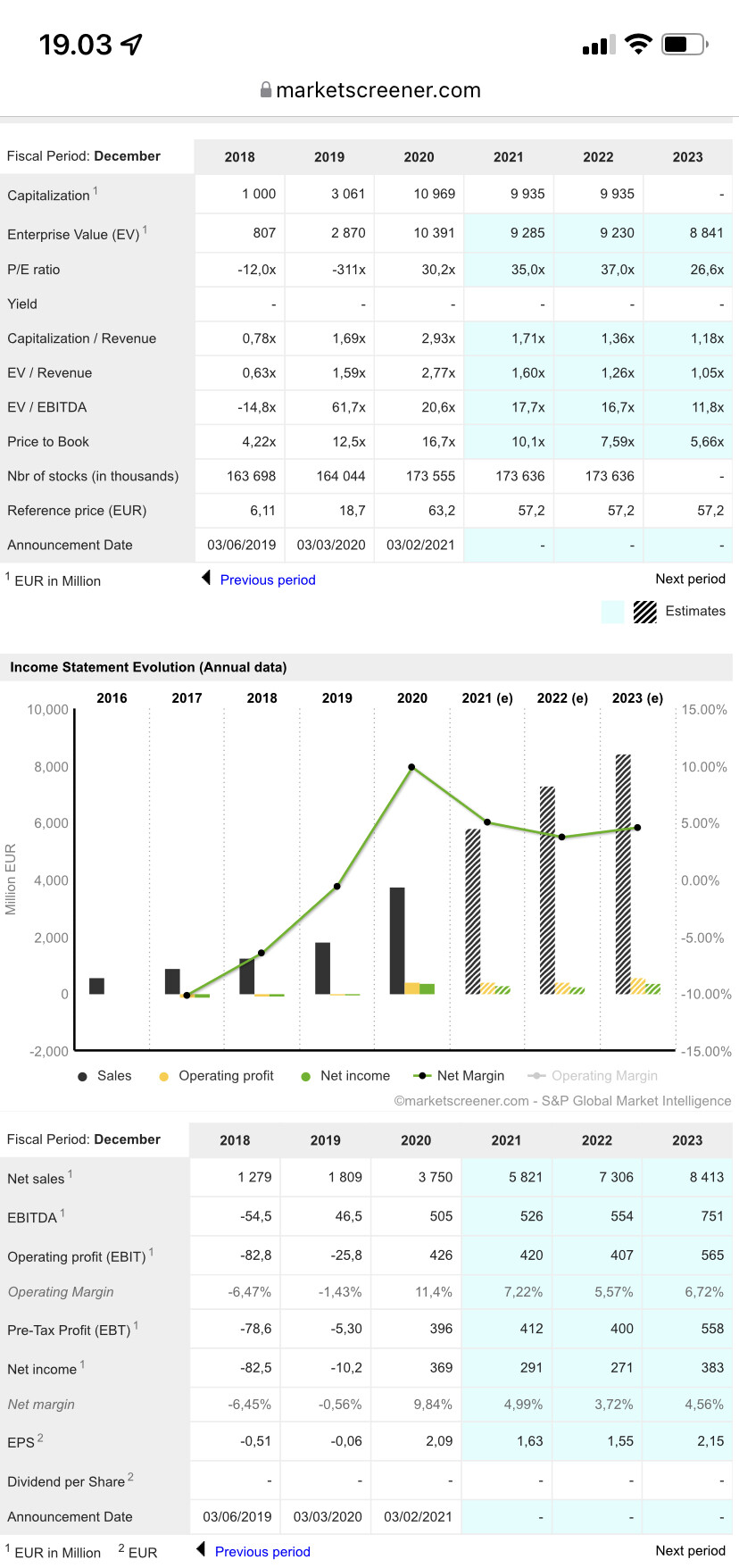
Marketscreener’s forecasts for the coming years:

1 Like

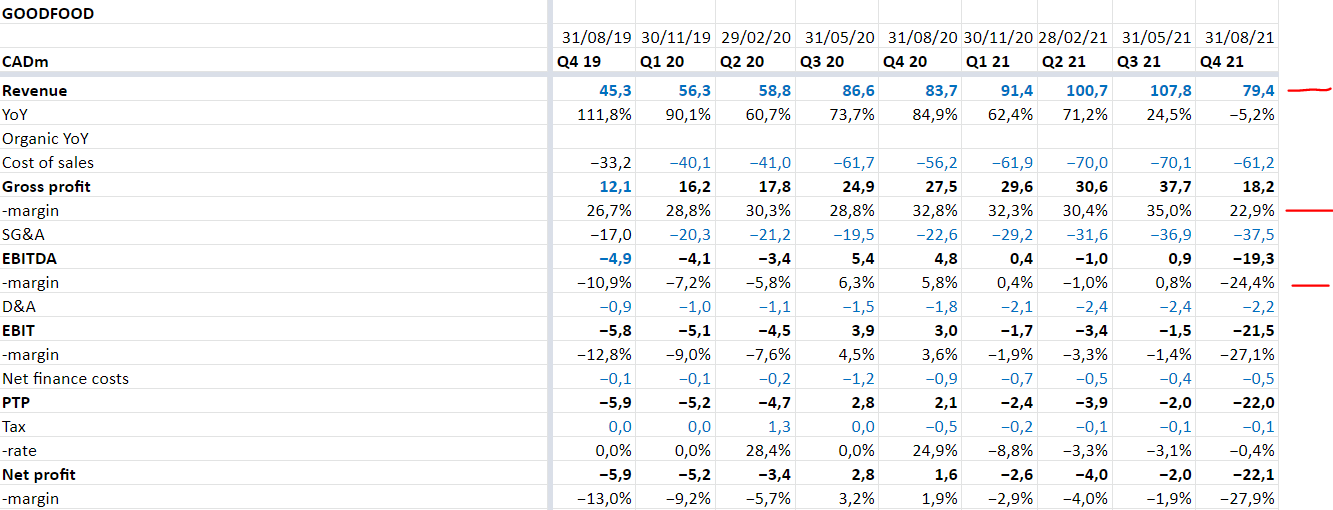
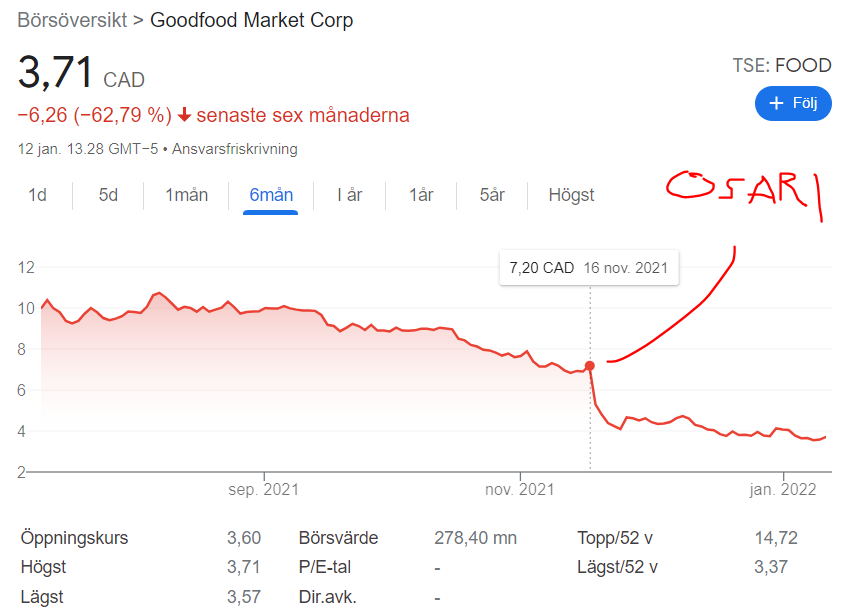
I have been following the Canadian company GoodFood for quite a long time. It is a direct competitor to HelloFresh but, of course, only in the Canadian market. I was quite surprised that inflation and the COVID impact were so severe in the previous quarter:

The gross margin simply collapsed. As did the stock price.

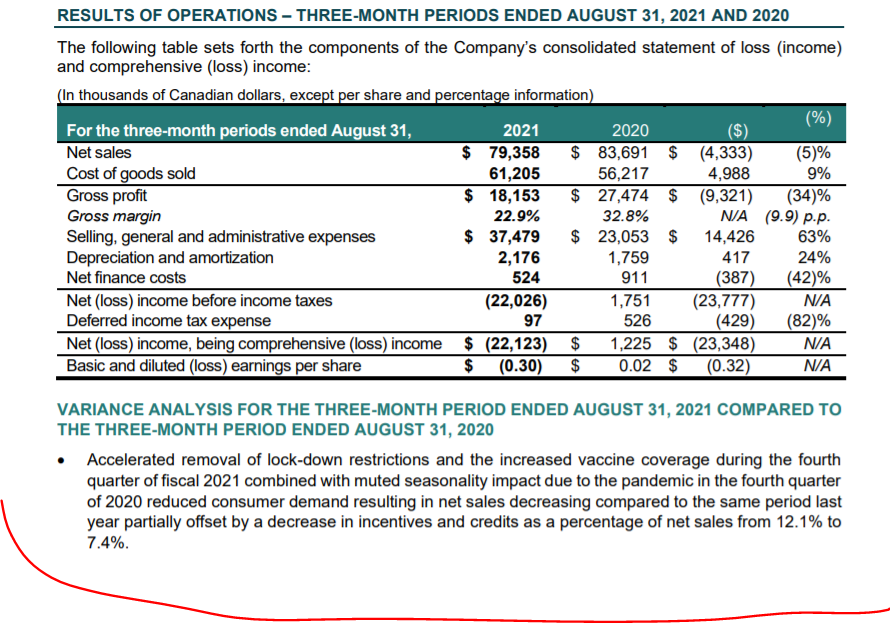
The company commented in its report as follows:

As @Mikael_Rautanen mentioned, economies of scale are certainly beneficial in this business. And GoodFood is perhaps a good example of how a leading global player in the industry can do much better business than a competitor operating in a single country. Presumably, HelloFresh can temporarily lower prices if they want to (if they enter a new country and are doing profitable business elsewhere) and thus push out competitors from the market.

22 Likes

Insiders fueled up:

https://www.marketscreener.com/quote/stock/HELLOFRESH-SE-38533857/news/HelloFresh-SE-Notification-and-public-disclosure-of-transactions-by-persons-37535460/

10 Likes