Pauli discussed with CEO Samppa Ruohtula right after H2.
Fifax successfully started salmon sales at the end of last year. The company can now gradually plan investments in new production capacity. CEO Samppa Ruohtula in an interview with analyst Pauli Lohi.
Topics:
00:00 Start
00:18 Fish deliveries were started
01:21 Fish stock development and related observations
06:32 Fish sold in smaller size than originally planned
10:57 Improvement work to ensure quality
13:26 Positive material margin
15:11 Improving efficiency
15:48 Financial situation
Lohi has prepared a company report on Fifax right after H2.
Deliveries of farmed fish started in the autumn, albeit with lower volumes than our expectations, which means that 2025 deliveries are still clearly below full capacity. The company’s reported material margin was better than our expectations, which supports expectations regarding the improvement of long-term profitability. Forecasts still involve significant uncertainty, and the financial situation remains challenging.
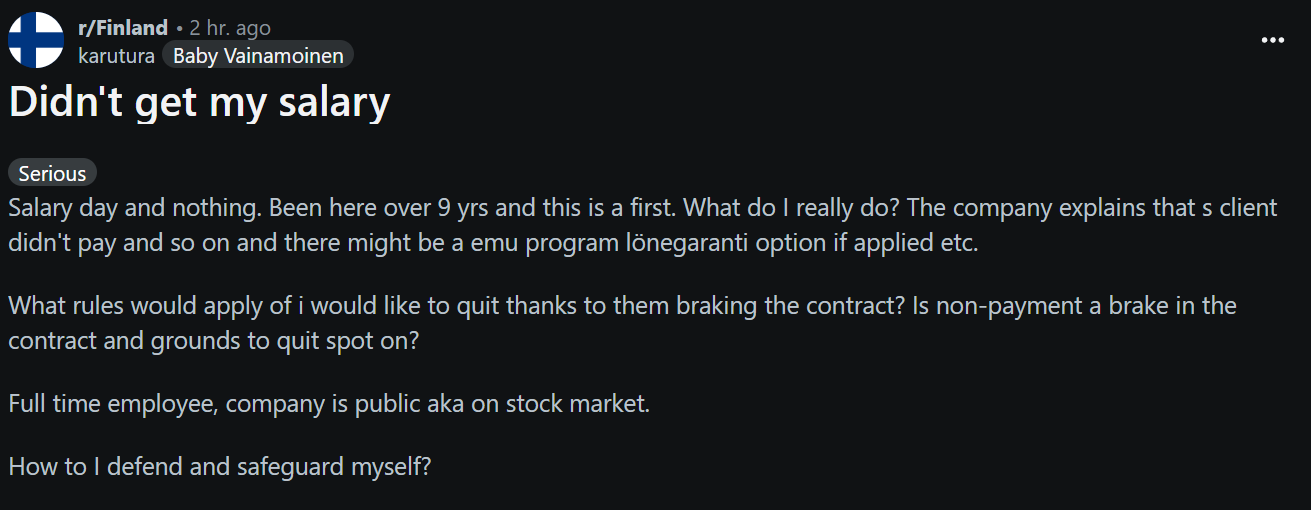
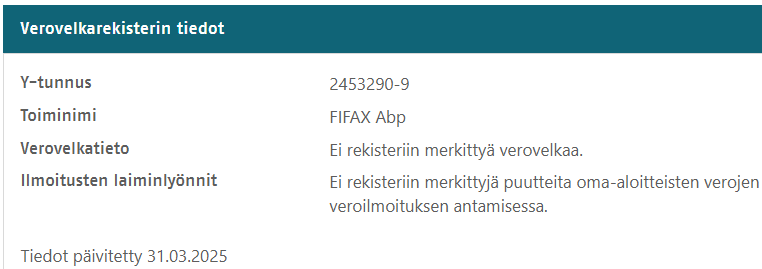
Taxes appear to be paid for now, but the April update should arrive in the coming days. You’d think that taxes would be the first to go unpaid, and employees’ salaries would be the last.
This may be due to the customer’s weak liquidity, but a reason related to the failure of Fifax’s fish deliveries (e.g., volume, size, quality) cannot be completely ruled out with certainty.
The press release is very vague and certainly doesn’t tell the whole truth. It’s also strange that the customer’s name is not mentioned, when Fifax, to my knowledge, only has one customer and its name has been published previously - fish food company Kalavapriikki.
Fifax, an Ålandic rainbow trout recirculating aquaculture system grower, and Kalavapriikki, a fish food company from Kuopio, have signed a long-term framework agreement. According to the framework agreement, Kalavapriikki commits to purchasing a significant portion of Fifax’s estimated rainbow trout production.
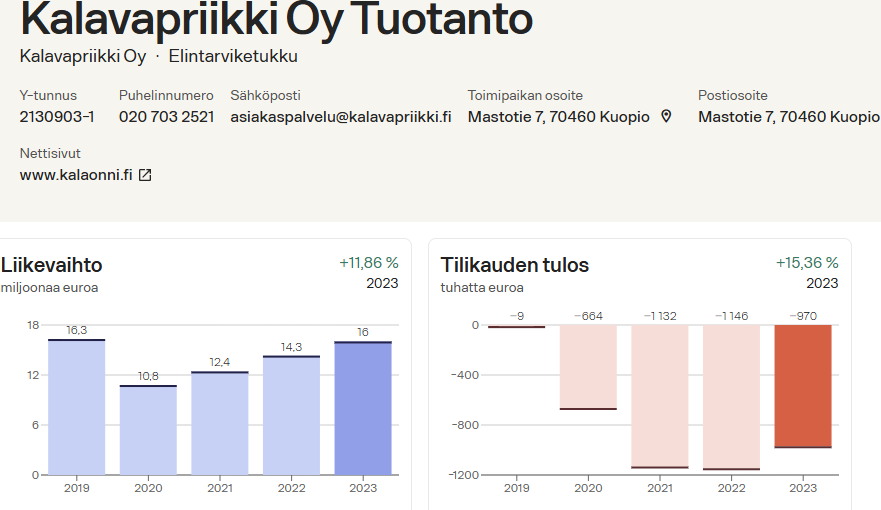
This customer’s result has been very weak in recent years, but the reason is investments.
Kalavapriikki is part of the Heino Group, so financing is unlikely to be an issue. This is the same Heino holding company that sold its Heino Tukkuri (wholesale business) to Valio a few years ago.
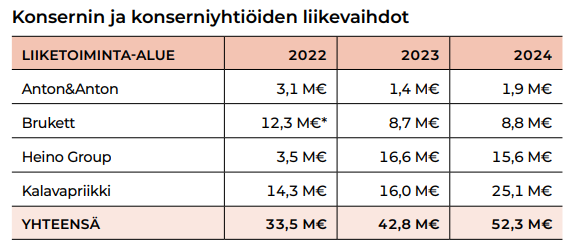
The company’s turnover grew strongly last year, no information on profit.
Heino states in its sustainability report that the company focuses on growth rather than profit.
Kalavapriikki’s investments in new production facilities and a modern filleting line have enabled significant growth and product quality development in 2024. Although large investments caused temporary challenges to profitability, in the long term they support efficiency and competitiveness.
I don’t believe Kalavapriikki would have liquidity problems; rather, the cessation of payments would point more to supply or quality issues.
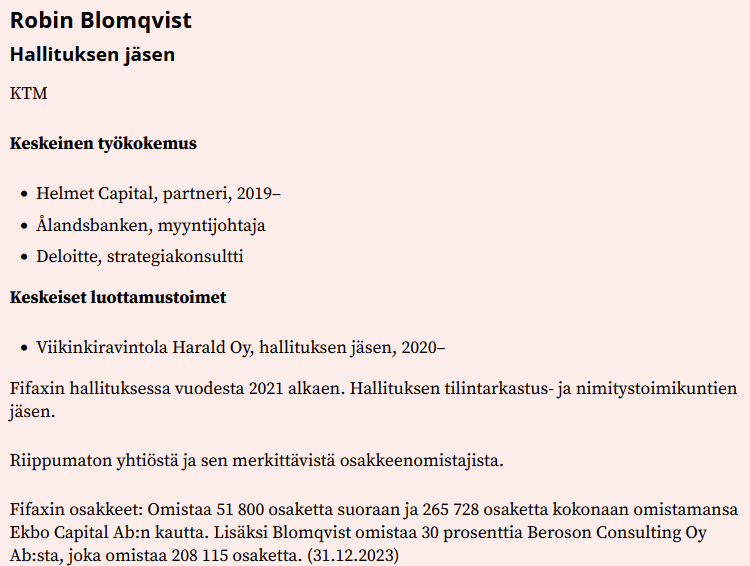
Board responsibility does not seem to be of interest. Koskenohi stayed on the board for about a year. Blomqvist, on the other hand, has been there a few years longer. Blomqvist and CEO Ruohtula are also both apparently on Helmet Capital’s lists, so Blomqvist is hardly on the outer periphery.
As an interesting coincidence, both who resigned were on the board’s audit committee.
(This information may soon disappear from the pages, so let’s save it here)
The Board of Directors of FIFAX Oyj (“Fifax” or the “Company”) has decided to apply for corporate restructuring. The application for corporate restructuring was submitted to the District Court of Åland on May 7, 2025.
As reported in connection with the 2024 financial statements, cultivation conditions during the restart have caused undesirable variations in fish growth and size distribution. This has affected the scaling of deliveries and revenue growth, which in turn increases the need for additional financing. At the same time, liquidity has rapidly deteriorated as a result of the reasons announced on April 30, 2025, leading to the decision to apply for corporate restructuring.
However, the restart of operations after the 2022 IHN virus infection is estimated to be progressing well, and the fish stock has increased to approximately 900 tons, which corresponds to the facility’s full capacity and creates a good basis for continuing operations.
Creditors, who together represent more than one-fifth of the company’s debts, support the initiation of the restructuring proceedings. The Company also continues to explore alternatives to strengthen its liquidity and financial position.
There are still people on the buy side, but getting rid of a large position certainly won’t be easy. If it were a position of about 2000€, it would most likely be possible to get rid of it today around the current price, close to 9 cents/share. Of course, it’s only in restructuring now, so it hasn’t gone bankrupt yet. I sincerely hope it doesn’t, even though I don’t have my own money at stake other than through Arvo, which has a 1M€ bridge financing for Kalavapriikki’s deliveries. I really like this environmentally sustainable approach to growing salmon. If only it could also be made economically profitable. It would be a real shame if this couldn’t be saved.
Edit: Could debt reduction in exchange for company shares be on the table? It would probably lead to quite a significant dilution, but bankruptcy would not be in anyone’s interest. Creditors would probably prefer a pile of shares with hope of success over a pile of bagged salmon from a bankruptcy estate.
On Friday, approval was received for the initiation of the restructuring process. This was expected and, as I understand it, indicates that the application was formally in order. News of interest for the company’s future and share value will only be received in the future. Such matters include, for example, the possible restructuring of current debts and obtaining new financing.
The problems are apparently mostly due to production. The size of the fish is not sufficient to meet the customer’s requirement, so they have not paid for nothing.
Here is a fresh company report on Fifax, which Pauli has naturally typed up since the last news.
Fifax has had to seek corporate restructuring due to, among other things, production challenges faced by the company and the interruption of customer payments. An acute cash crisis threatens the company’s ability to finance continued operations. In restructuring, debts could be cut or converted into shares, in connection with which the company could potentially receive new equity, for example, from current major shareholders. Raising additional financing is essential for the continuity of operations. However, there is uncertainty associated with the arrangement of the financial position, the negotiating position of the owners is unfavorable in a restructuring situation, and the most negative scenario of failed financing arrangements cannot be ruled out. For these reasons, the stock’s risk/reward ratio remains weak. Therefore, we reiterate our sell recommendation. We no longer provide a target price for the stock, as the precise valuation of the stock is exceptionally inaccurate due to the still open restructuring and additional financing terms.
Fifax’s management has taken a “hope for the best” attitude here. By forcibly trying to process “wrong” fish and indirectly blaming the customer for financial problems, the leverage has shifted to the customers in further negotiations. It couldn’t have been very surprising that with the customer who paid an advance being the only delivery point, cash flow would remain weak. Rarely do you get a joker in a single-card game.
Fish wholesalers tend to be quite short-tempered because the retail sector immediately reacts if the fish size is wrong, as it directly affects sales.
Now, trust must be re-earned.
Samppa said in an interview on March 5th that sufficient sorting could not be done due to lack of space. There was a bit of greed, and not all facilities were ready on time.
Overcrowding during cultivation causes variations in size and slows down growth, and this increases the longer the cultivation progresses, as larger fish get to eat more. These issues have been known for a long time, and a solution should have been found faster to maintain customer deliveries. @Kajuuna This development has not come as a surprise, as the fish are constantly under observation. Size can be surprising in fish growing in cages in natural waters. The magnitude of size variation might be a bit surprising. I would say that they were forced to take the risk of processing, hoping the fish would be acceptable.
For example, salmon has grown well in Norway, and 5-7% larger delivery volumes are expected from there this year than in 2024. For instance, Mowi expects to process 18% more in Q2 than in 2024. Prices have been falling in Q1, and preliminary statistics indeed indicate the same trend for salmon for the rest of the year. For domestic rainbow trout, the growing season has only just begun.
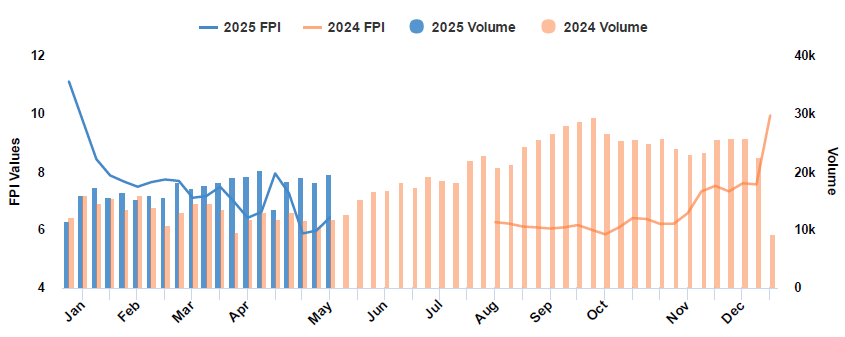
Here’s some support for the development of salmon prices and the growth of volumes.
Price information concerns 3-6 kg salmon.
Source: Fish Pool ASA
Table of price development February-May