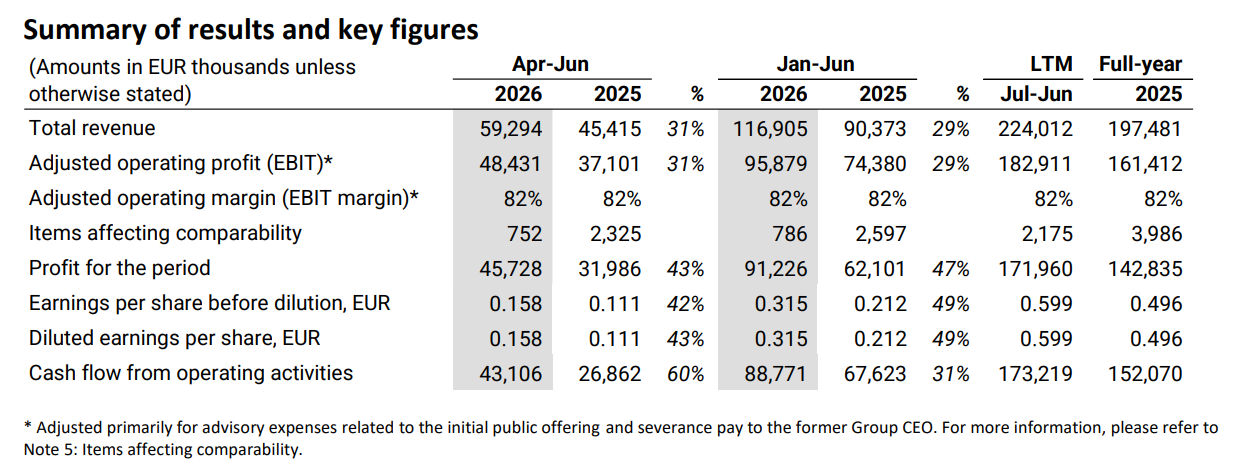
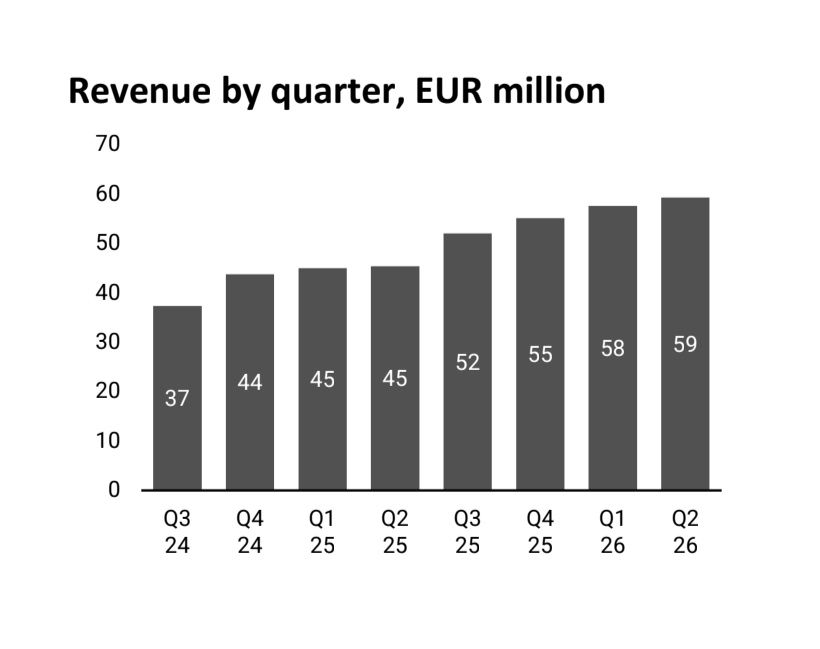
Revenue in regulated markets grew by approximately 25 million euros compared to the previous year.
Personally, it feels like we were previously punished because the share of revenue from regulated markets was too small. And now it feels like we are being punished because there is no growth from gray markets, and the revenue growth in regulated markets is not considered as important.
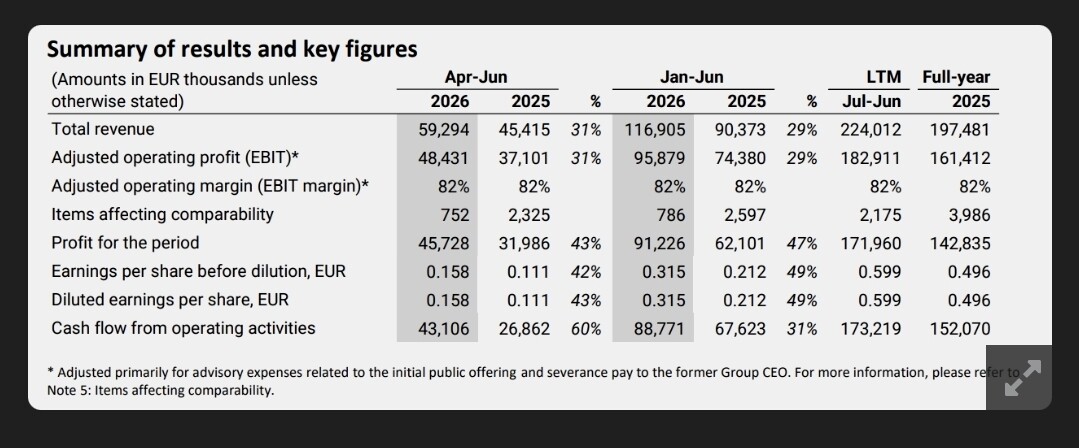
At the end of June, the number of shares traded was 194,085,085 (excluding shares held by the company as of June 30, 2026). No dividends are paid on shares held by the company. With that share count, the earnings per share (EPS) is €1.295, or roughly €1.30.
As I understand it, analyst EPS forecasts almost always use the weighted average of shares outstanding. Treasury shares (shares held by the company itself) are removed from the denominator, so they do not dilute the EPS.
EVO reports a weighted average of 197,242,652, which is not the figure that the results for June 30, 2026, would have been divided by, but apparently, this is common practice. It’s strange, given that the actual share count is known.
The consensus expectation was €1.29 per share, which was slightly exceeded when using the actual share count.
Correct me if I’m wrong, but wasn’t this result perfectly fine for those of us in the “saloon car” riding until the grave? There seems to be more trading volume than usual today, and EVO gets to scoop up shares at a favorable price today and for the next 3 months.
I’ve been sitting on the ragged seat of a luxury carriage for several years now, drinking lukewarm coffee from a dirty paper cup, but I do see the report as a good one. The stock’s reaction didn’t surprise me all that much. Since it met expectations, the reaction also settles into a flat line after an initial dip to where it was yesterday.
As long as that goal of bringing new, interesting games to the market doesn’t rely too heavily on different variations of Monopoly. Hopefully, the product development pipeline has more to offer than just different language versions of Ice Fishing. Growth in the main markets is always a good thing. At least for me, there’s no need to change seats on this train; we’re moving forward. I’m keeping my portfolio firmly in my lap and enjoying the winding tracks in peace. I would have liked some mention regarding Playtech, even if it isn’t related to the earnings report.
At a quick glance, I thought the results were weak, or actually even poor, but there were two clearly positive points in the report that explain the share price reaction—or the lack thereof. That is, the settlement with the UKGC and the possibility of unwinding the Galaxy Gaming acquisition.
Uncertainty is decreasing, and Evolution’s track record with acquisitions has been poor. Of course, share buybacks are also continuing to support the stock price.
It just occurred to me that the biggest live game releases, such as Game Night Live and that new Monopoly live game, were supposed to arrive by the end of this year, but there’s no information yet on when.
I’ve been wondering if the releases might have been delayed for some reason. I’m not too worried, because if the games weren’t quite up to EVO’s standards yet, I’d rather they polish them so that players aren’t disappointed, but does anyone have more information on this?
I would say that the product roadmap has been a little bit tilted towards the end all along, already from when we released it. And we are of course wanting it earlier, but it is a little bit tilted towards the end.
So, they’re probably somewhat making excuses now, saying that “it was very back-loaded from the start.” They likely just wanted to get big plans out there, and now it seems it wasn’t as easy to get the games released as quickly as expected. I wouldn’t be surprised if some releases slid into next year. Revenues, at least, into next year.
Yeah, I was wondering the same, especially since these games were already being showcased at trade shows earlier this year. Well, one way or another, it’s always better to fix and improve games than to release them unfinished or in a poor state.
Another thing to note, which is a bit more concerning, is that if Ice Fishing has eaten into the player base of Crazy Time, we can only be grateful that Ice Fishing is also an Evo game. If it had been a competitor’s game, the outcome would have been really ugly.
Personally, I see it as a possibility, given Playtech’s profit warning, that Evo has been losing players in traditional table games. If you can only differentiate yourself from the competition through the dealer, then from a player’s perspective, it’s probably pretty indifferent which company’s blackjack you lose your money at => Q-o-Q development is more in the hands of fate if the TAM isn’t growing enough at the same time. On one Finnish-owned site, they have reacted to this by putting all kinds of one-hit-wonder celebrities as dealers. It would be somewhat refreshing if Evo’s management would take the bull by the horns and try at least something, even if it’s not quite rap streamers or OF stars on the broadcast.
On the other hand, if you can create a recognizable and compelling game in the game show segment, the competitive advantage can be on the level of “Who Wants to Be a Millionaire” (the show, that is, not some way to get rich in a parlor car!). In those, it doesn’t matter so much whether the host is Jaajo or Antti.
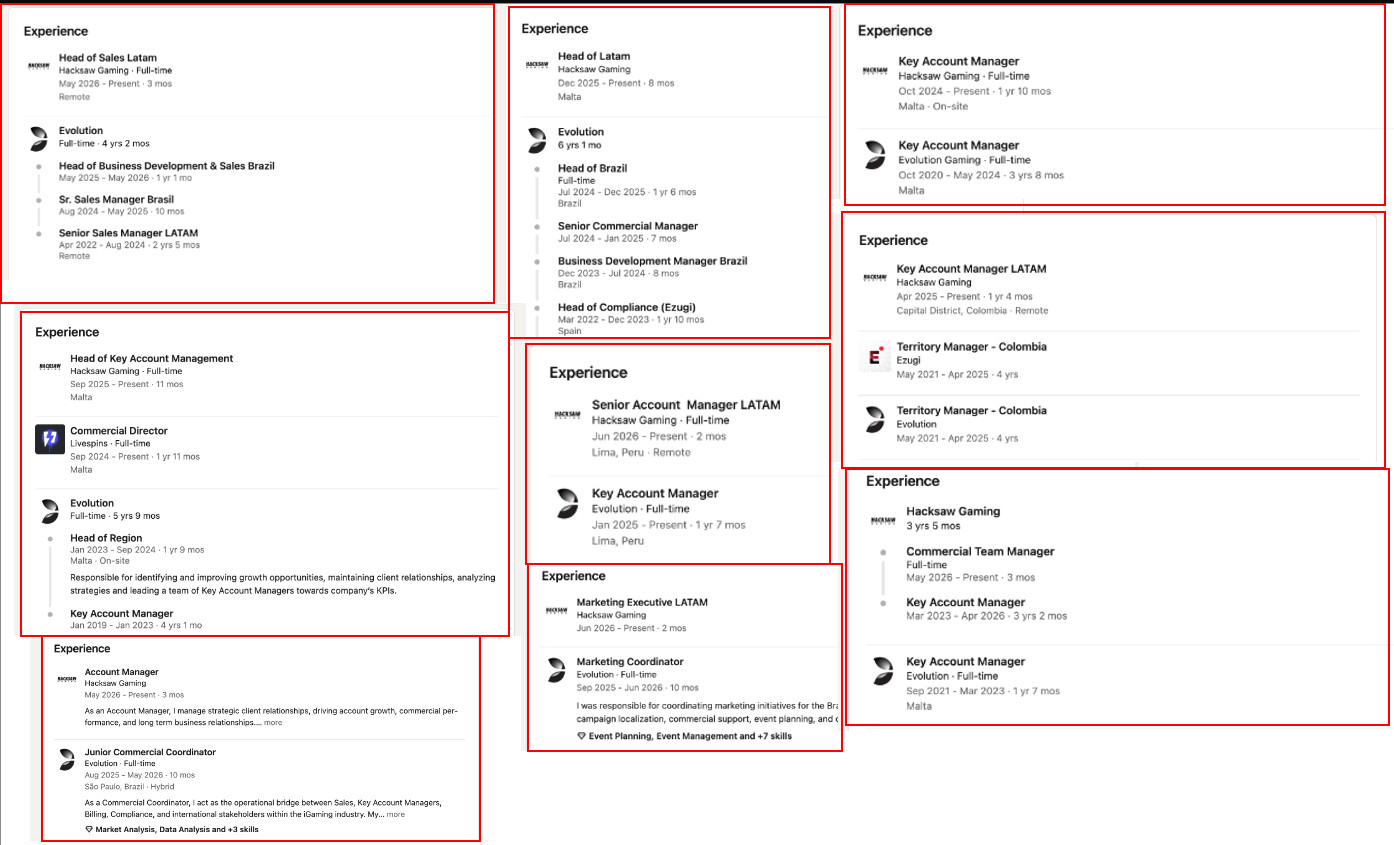
It’s no wonder there’s growth, seeing as Hacksaw has apparently been on a raiding spree in South America, poaching a lot of talent from EVO’s ranks. Surely this affects EVO’s operations too, with experienced people leaving…
You must have calculated that pretty quickly indeed. Or please, do tell me how you get higher growth figures for Evo than for Hacksaw from these numbers? According to my own math, Evo’s RNG growth is percentage-wise about half and in absolute terms about 2/3 of Hacksaw’s corresponding figures, if we compare Q2/26 vs Q2/25.
Of course, anyone can measure and evaluate things using whatever timeframes they like, but a single QoQ is inherently a very short window and contains so much variance that it’s not really suitable for measuring anything other than the development of hyperscalers.
For example, one semi-successful “Ice Fishing” game could fully explain why Evo’s entire revenue and profit appear to be showing signs of a turnaround. However, this does not mean that the downturn that has been going on for a couple of years is about to stop.
But time will tell; I personally consider the biggest hype for live casinos to be over, and I expect bigger growth from innovative RNG game developers (among whom Hacksaw, for instance, belongs).
This is interesting. A Monopoly-themed competition coming to Netflix in the fall of 2027 will certainly bring in more players and interest in Monopoly-themed live games, which are already out there, and the biggest new ones will surely arrive before that fall of 2027.
I don’t think NoLimit City falls behind Hacksaw at all when it comes to innovation, and now Tegman is in charge of Evo’s RNG side. Slots are such a competitive field that it’s hard to build a moat there like in live casino. Those basic Hacksaw mechanics are starting to get tedious when they roll out the same stuff month after month in a different skin as “new” releases. Just like Big Time’s Megaways, which have slowly faded away, even though at one point it felt like every game had them regardless of the provider. It’s not an easy industry, and that Hacksaw quarter-on-quarter trend has been on a downward slope for quite some time now. In the big US of A, there is still plenty of room for live casino, provided we just get those states to open up. The wait for regulation to open up has been long, and there’s no end in sight yet. Slow and steady wins the race Just my opinion on the matter.
I’m getting a bit of “Catman” trauma from this. I wonder if the same thing will happen here, where Kentsu offers something like 800 SEK per share, which I think is way too low, and those of us who have been on the bandwagon for a long time will be left licking our wounds.


 Just my opinion on the matter.