Surprisingly little is said about European markets, even though they are our “home markets.” I was thinking about the interruption of the long winning streak of bonds due to rising interest rates and compared European stock markets to European (government) bond markets.
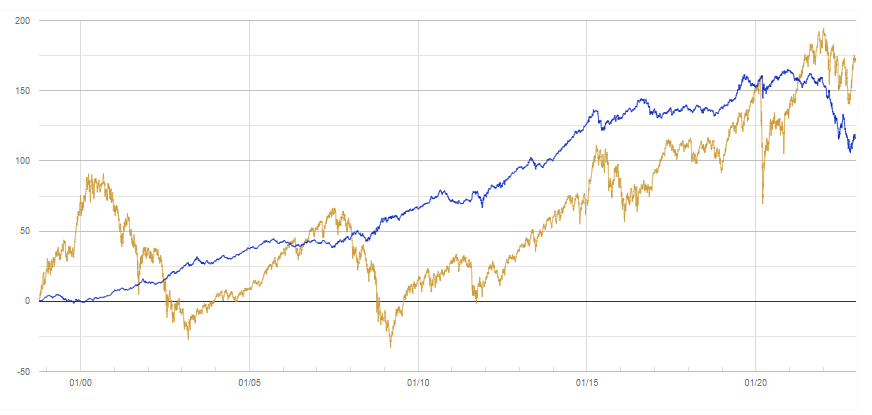
I took two funds as a point of comparison: Seligson’s Europe Index Fund and their bond fund. These have a shared history going all the way back to 1998, which is a 24-year period. That’s starting to be a truly “long time” in the markets. The result is a graph with bonds in blue and stocks in yellow:
Quite an interesting result; European stock markets have sort of stumbled from one crisis to another, while bond markets have benefited from a trend-like decline in interest rates and rose steadily with relatively low volatility until almost recently. Only the recent turn towards rising interest rates broke the bonds’ winning streak, and stocks were able to properly overtake bonds.
How have you approached European markets (both equity and fixed income) in your investment strategy? Personally, I moved away from European index investing a long time ago; I own Finnish stocks directly and some stocks from other European countries through Seligson’s Phoebus fund.
I’m increasingly of the opinion that the corporate and financial culture in Europe is just different from the United States—more bank-centric—and shareholders aren’t “valued” in quite the same way. Cultural differences change slowly, if at all, over the years. I might be completely off track with my reflections, so it would be interesting to hear your views.
Can the curves really be cumulative returns? A 2.4% annual return on stocks over 24 years? (1.75^(1/24))
As for the question, within Europe I strongly emphasize the Nordic countries, especially Finland. I admit to owning some Eurostoxx as well. I’ve been feverishly buying Eurobonds (and US bonds) lately with the idea that the drop in interest rates when something breaks could bring hefty returns, and even the interest yield alone isn’t weak compared to, for example, the dividend yield of Eurostonks.
The starting year affects the values, but overall, the performance has been weak. In twenty years, annual returns of approximately 5.6% have been achieved, which corresponds to roughly a 6% total market return (when the management fee is taken into account). In 1998, levels were somewhat higher than 20 years ago; this explains why the annual return over the 24-year period is lower.
In 1998, this was the only European index fund available to retail investors, which is why I used it as an example. The comparison provides an order of magnitude for the returns that stocks and bonds have provided to investors.
Hmm. Pretty weak performance. Barely beats inflation. DAX was at 4300 points in 1998 and is now at 13883. That’s a 222% return + dividends. The fund is 175% including dividends. Quite a big difference.
The German market has apparently performed better than the broader European market.
I’m wondering if long-term stock market returns are almost always studied using the US market (probably because data is easily available). European stock markets have been used as examples less often. Are we using the best-performing US market as our example, which might give a misleading picture of stock market returns?
Above all, I’m interested in what causes the poor returns and whether things can change for the better.
The yield difference between the US and European markets was discussed by major investors in the fall of 2018 in Talouselämä magazine, where, among others, Reima Rytsölä of Varma considered it unusual that the gap between the US and European markets had grown so large. The article contemplated the future as follows (Talouselämä 31/2018):
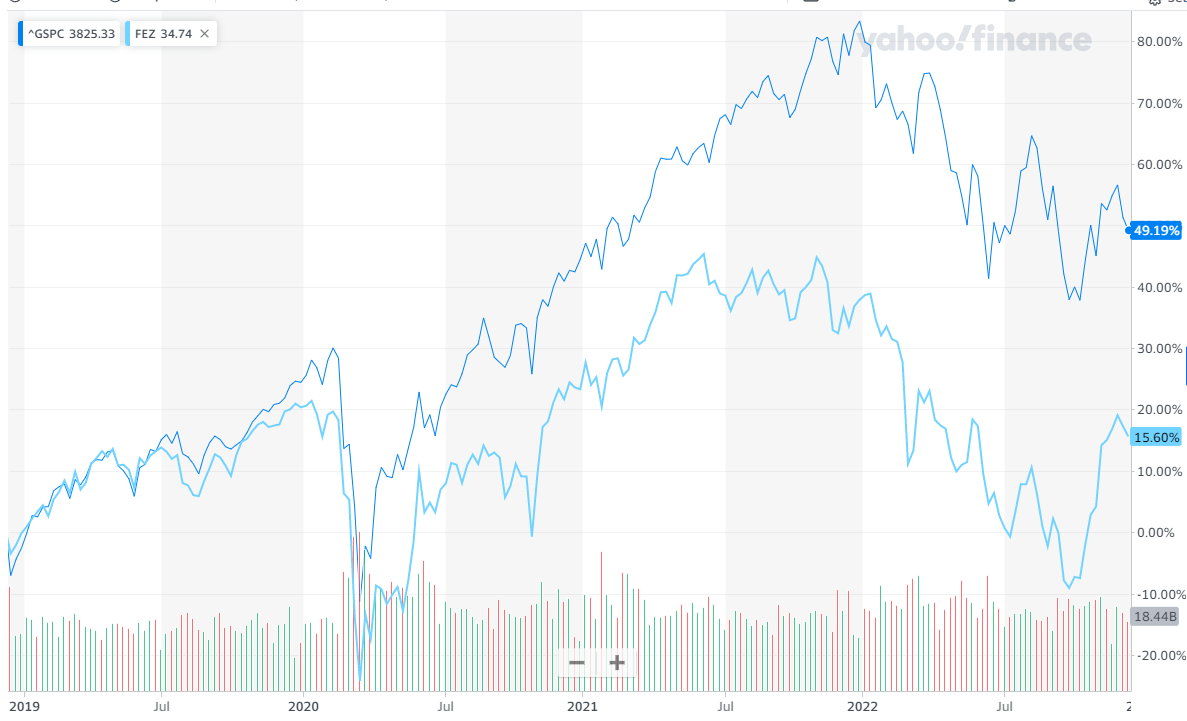
Now, four years later, we can see that at least during this period, Europe did not rise faster nor did the United States collapse relative to Europe. The S&P 500 index has returned +49%, while Europe (Euro Stoxx 50) has returned +15% (both in dollars to ensure comparability).