EHang Holdings – Future Aviation

I’m starting a thread for an interesting company called EHang (NASDAQ: EH). Below is some general information about the company and its prospects. Of course, there are risks as well, even though I didn’t include a specific heading for them in this opening post. Let’s discuss them in the thread.

About Ehang (ehang.com)

EHang(NASDAQ: EH) is a world’s leading autonomous aerial vehicle (“AAV”) technology platform company. Our mission is to make safe, autonomous and eco-friendly air mobility accessible to everyone.

EHang provides customers in various industries with AAV products and commercial solutions:

  • air mobility (including passenger transportation and logistics),
  • smart city management and
  • aerial media solutions.

Basic info

  • EHang was founded in December 2014
  • The company is located in the Cayman Islands, with its principal office in Guangzhou
  • Huazhi Hu is the current Chairman and CEO, and founded EHang’s predecessor company (Beijing Yihang Chuangshi Technology Ltd) in 2005 which specialized in aviation command and control systems.
  • The company unveiled the world’s first passenger-grade AAV in January 2016 (the EHang 184) at the (CES).
  • The major development was in March 2018 when EHang delivered the world’s first passenger-grade AAV in China for testing, training and demonstration purposes with the EHang 216 model.
  • The 216 is currently the core product, and during FY2020 the company has released specialized variations for firefighting and heavy-lifting aerial logistics.
  • Market Cap ~ 2 000 musd (16.1.2021)

Investment Case

  • With the airplane and helicopter market dominated by Western players, China sees drones as an opportunity to get a foothold in this segment of aviation.
  • EHang is strategically positioned with its passenger AAVs undergoing tests and marketing its products around the world.
  • Ehang needs to obtain regulatory approval for commercial operations. The company has commented that it will receive an airworthiness certificate for the EHang 216 AAV in 2021, and start to provide commercial services in China.
  • EHang predicts Urban Air Mobility (UAM) global logistic market could reach US$46 billion by 2023 (an estimated CAGR of 740%).
  • China is projected to be the largest regional market in the world in 2023, accounting for 45% of the global logistics UAM market.

Details on the EHang 216

  • Unlike manually controlled unmanned aerial vehicles, Ehang’s intelligent AAVs can fly and operate autonomously.
  • Cost is an estimated list price US$300,000 each
  • Designed flight time with maximum payload (220kg) is 21 minutes - so this limits travel distance and allows for little redundancy. Improved models are under development though!
  • Time to full charge is 120 minutes.
  • Dual seating.

Financials

  • During the 3rd quarter, EHang sold 23 EHang 216 passenger grade drones, with 2 of these being customized for firefighting, leading to over 100% revenue growth YOY.
  • Gross margins saw strong leverage, improving to around 59%
  • The cash position: $30 mil in cash at the end of the 3rd quarter.
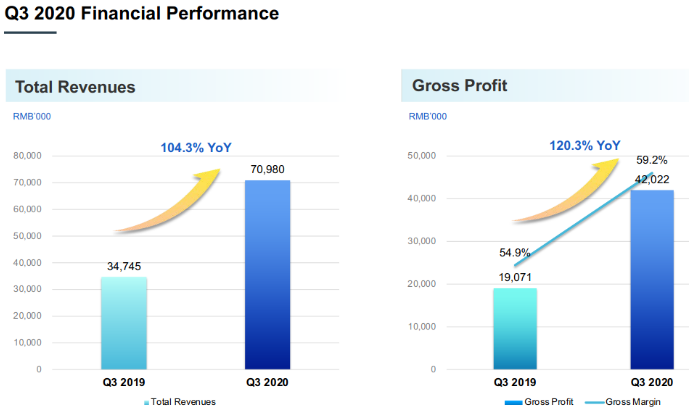
Q3/20 Earning Highligts

https://ir.ehang.com/static-files/fef9e762-d4e6-4d30-bc51-48963f624f2c

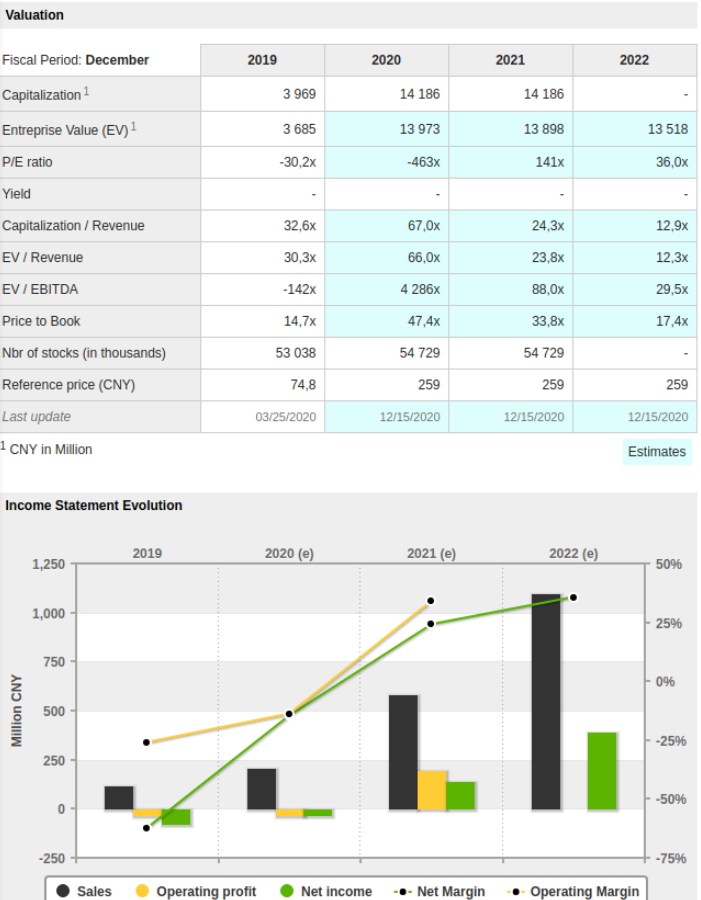
Marketscreener numbers
News Links

https://www.streetinsider.com/dr/news.php?id=17763034

Videos


@JukkaM shared his good knowledge of EHang and the industry in general in another thread. I am attaching the message below:

24 Likes

What about legislation? It’s a utopian idea that there would be several such things flying in the air anywhere other than strictly controlled test fields. Maybe sometime in 2050, after dozens of mistakes and big players have pushed this aside.

1 Like

There’s information about this in the “Investment Case” section of the initial post. The plan is to get things started in China first. The state has an interest in this, so permits should be arranged, and the company has already commented on this.

My understanding is that entering Western markets might be more challenging due to regulation (which should improve over time) and also because it’s a Chinese company, and Western countries will probably prefer local operators primarily for political reasons in the future.

3 Likes

eVTOLs are certainly the future, especially in logistics and rescue operations, and at some point definitely for people too, once flying is sufficiently regulated. Here’s a pretty good presentation introducing the eVTOL market. The company is called Blade, which offers infrastructure (platform), currently for regular helicopter trips but is positioned for the future and eVTOL aircraft. Blade is going public via EXPC SPAC during H1. ARK Autonomous Technology and Robotics made its first purchases this week.

A bit off-topic, but that presentation also has good information about the eVTOL market.

11 Likes

I initially also thought the idea was completely crazy (heh). Then I came across an article in Helsingin Sanomat about a similar device developed by GM:

I looked into the matter and apparently Ehang has been a pioneer in the field. Now tests are being conducted, for example, in Austria:

https://ir.ehang.com/news-releases/news-release-details/ehang-216-receives-long-term-trial-flight-permit-across-austria

The factory is being expanded, and capacity will increase to 600 units per year, so a quick calculation would mean a possible 200 million in revenue per year at a unit price of 300,000 dollars, making it expensive at the current valuation. On the other hand, if regulation gets in order, demand could grow quickly.

https://ir.ehang.com/news-releases/news-release-details/update-ehang-expand-production-facility-autonomous-aerial

The helicopter market size is around 50 billion, and these drones could capture some of that, in addition to creating new demand. The development is particularly advanced in Asia, where there are many megacities and regulation can be molded more quickly.

There’s also an interesting article about the company on Red Bull’s website; the CEO seems quite down-to-earth based on his speeches.

https://www.redbull.com/gb-en/theredbulletin/flying-autonomous-passenger-drone

There are many obstacles, and it will certainly take a long time until you can grab one of these drones from the street in the same way you would an electric scooter. However, the megatrend of urbanization is a good driver, and autonomous low-altitude flying itself is easy to implement because it lacks many of the challenges of autonomous driving, such as unpredictable fellow flyers (for now) and small obstacles.

PS. I don’t own any shares.

3 Likes

The opening post also contains the StreetInsider link, which states:
"the Federal Aviation Administration (FAA) decided to allow small drones to fly over people and at night in the United States.

FAA said it addressed security concerns in this space by requesting remote identification technology to allow their identification from the ground.

“The new rules make way for the further integration of drones into our airspace by addressing safety and security concerns,” FAA Administrator Steve Dickson said.

“They get us closer to the day when we will more routinely see drone operations such as the delivery of packages.”

The decision will enter into force 60 days after official publication. On the other hand, drone makers will have 18 months to start manufacturing drones with Remote ID, in addition to a year available to operators to obtain Remote ID.

As a result, drones that are not broadcasting locations may be banned by 2023. All drones weighing above 0.55 pounds (0.25kg) will be required to have their own Remote ID."

Edit. Was this in the links in the opening post?

Edit2. Has anyone looked into the legal side of this in more detail? I have a couple of layman’s questions regarding aviation. I’ve read that flight permits over people and at night would be liberalized with the “remote ID” system, but who can practically buy such a system? Can a Dubai sheikh soon buy a drone for his yacht that would fly from an anchored boat to the pier and then return to the yacht for charging? Helicopters have quite frequent mandatory maintenance intervals. How is this implemented in manned drones?

For tourist drones, I see potential in places like Disneyland. The amusement park area is simply enormous, and I can imagine the queue when people get to take a pilotless aerial tourist tour. I also don’t see how this evenly spaced, departing tour would be any more dangerous than the thrilling roller coasters where there’s always a chance of falling, yet safety concerns are few of my own worries and few dark clouds in front of massive markets. In practice, a drone experience replaces all Ferris wheels, observation towers (perhaps excluding the tallest skyscrapers), and all high-altitude amusement rides where speed and dangerous situations are not sought. An unmanned tourist flight over the Grand Canyon, for example, is pretty much the most interesting new invention I’d like to experience myself. Then one just has to consider the maintenance costs in addition to the device, and how safety and legal matters are handled.

3 Likes

Normal helicopters have pretty damn complex technology and a lot of critical components, compared to, for example, airplanes, so it’s no wonder that maintenance requirements are strict.

As far as I know, drones don’t have any transmission but simple and reliable electric motors in each propeller, and the propellers are probably fixed without any pitch adjustment or anything?

In theory, the technology is quite simple, and in the worst case, as far as I understand, a drone can land semi-normally even if one motor breaks down.

4 Likes

I didn’t notice this thread. I started a general thread Breakthrough of Electric Aircraft EVTOL AAV etc.

I’ve been following EHang myself for over a year and of course, I could have written here. However, the field is expanding rapidly, which is why I thought of a general thread. I can delete that thread if people aren’t interested.

I invested in EHang when the stock was at 8.
EHang 216 is a drone-type aircraft, but the more wing area, the less energy the aircraft consumes for the same distance.

EHang 216 can operate even if one engine fails, and there’s a video of its testing.
Many manufacturers like Airbus are aiming for larger aircraft CityAirbus
EHang took the right direction from a business perspective, developing a simple device capable of transporting people without a driver and a platform around it that enables immediate business.

The flight range of EHang 216 was 100 km in tests last autumn.

It’s completely clear that larger 6-10 passenger eVTOL devices will emerge in the coming years.
Logistics will likely be the area from which EHang will generate the most profit and revenue within a couple of years (EHang 216L).

Edit: It seems this and my own “Electric Aircraft eVTOL” threads were founded at exactly the same time :slight_smile: . Last spring, no one was interested in EHang, but now everyone is talking about it.

14 Likes

What a coincidence :slightly_smiling_face: Shall we keep two threads, a more general one and this Ehang one, whatever feels best?

1 Like

What do @Verneri_Pulkkinen and @Johannes_Sippola think?

1 Like

Currently, EHang is the stock rocket in the eVTOL area and is causing the most discussion right now.
This general thread may become necessary if and when EHang’s popularity generates general interest, e.g., in SPAC/IPO format. There are many suitable companies to list in the area, such as Lilium or Kitty Hawk. Not to mention the investment of large companies in the area (Uber, Airbus, etc.)

But let’s wait for Verneri’s answer. A general thread can be started later.

3 Likes

Flying cars don’t seem very realistic in the near future. Few ordinary people are capable of flying, and the only option is a fully autonomous flying device. However, it may still take time until all regulations and the general technology supporting it are at a level where anyone in Finland can fly anywhere fully autonomously.
For example, in autonomous vehicles, common regulations for the European area are still being developed C Roads

Instead, the electrification of small aircraft and eVTOLs (vertical take-off and landing) could be a reality within a year, at least in China, which is a pioneer in autonomous vehicles and flying devices.
Fully autonomous flying devices in closed areas and pilot-flown AirTaxis in public areas.

3 Likes

These gadgets are probably ones where hydrogen could play a relatively big role in the future, providing a significant increase in operating time with much less added weight than batteries.

The above applies especially to larger drones; the batteries for a device carrying 2-6 people are becoming so large that the whole endeavor doesn’t make sense.

The same, of course, applies to electric airplanes.

5 Likes

Since electric airplanes and vehicles share an electrical system, I would have expected these vehicles to have space for an energy source that could accommodate a fuel cell or a battery. Plug Power partly makes such things, but not generic enough for vehicles.

The Airbus Citybus is for 4 passengers, so I myself expect drone-type battery-powered vehicles for ±5 passengers to be realistic within 2-4 years.

In terms of travel distance, drone-type vehicles consume too much energy and are agile devices for less than 100 km.
Fixed-wing aircraft (which do not require upward external energy) naturally consume much less energy relative to the distance. The Eviation Alice has 9 passengers and 2 pilots. Eviation Alice

In the field of electric aviation, efforts are being made to find different types of alternatives for different purposes: drone-type, tilt-wing, fixed-wing

5 Likes

Fixed-wing aircraft require runways and thus cannot operate in cities, while tilt-rotor aircraft are likely expensive and complex (the US military’s Osprey comes to mind), so drones probably have a good handle on the city market.

Hydrogen drones have been around for a few years in mini-size, with specs at least chilling compared to battery-powered devices; I recall they can even hover for a couple of hours before refueling. One would think they scale quite easily to larger devices and that generic fuel cells could be screwed onto them?

4 Likes

There are several very promising tilt-wings that have been tested in practice.
Airbus Vahana is a fully functional tilt-wing, but Airbus decided to focus on drone-style aircraft, as they believe that market (i.e., UAM Urban Air Mobility) will take off first Airbus Vahana
Kitty Hawk is, in my opinion, the most promising tilt-wing, and I believe it will soon go public Kitty Hawk
Lilium is also a functional tilt-wing Lilium

Indeed, EHang has tested a 100 km flight range. This corresponds to 2-3 times longer distance with a fixed-wing (or a good tilt-wing). Rumors on the battery front promise rapid growth in battery energy density, and I especially expect this from CATL.

6 Likes

Any more detailed info on the Kitty Hawk listing? There’s also speculation about Lilium listing through the $ZNTE SPAC – just rumors, nothing official.

3 Likes

Discussions seem to eventually converge into one thread, but why not keep both and let time show how the discussion evolves. :smiling_face_with_sunglasses:

9 Likes

My throw is speculation. After Google’s Larry Page, as I understand it, stopped funding, the promising project needs funding. In this EHang and eVTOL craze, a SPAC could be an option. In my opinion, Kitty Hawk is very promising and they have by no means put the project on ice, as they are hiring more people, apparently with private funding.

2 Likes

I can put my general eVTOL comments in that general thread, but if people stay in this thread, then let’s just stay here.

4 Likes