EcoUp announced its application for listing on First North
This company, too, needs to be dissected with the power of the crowd!
Of course, it’s interesting to hear not only analyses but also experiences from industry professionals about EcoUp’s operations, products, and services.
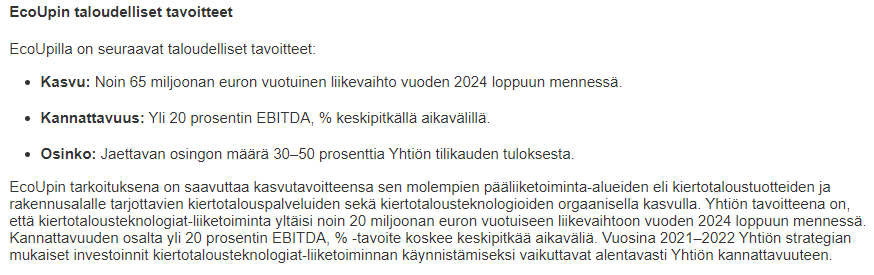
Ambitious goals, approximately 2x revenue and almost double the EBITDA%, organically at that.
EcoUp is a circular economy group that offers its customers carbon-neutral, waste-free, energy-saving, and competitive products, services, and technologies that help its customers make their operations more environmentally friendly. The products and services offered by the company include, for example, ecological insulation and fiber products, as well as circular economy services for the construction industry, such as high-power vacuuming. The company has also developed circular economy technologies and equipment that enable the recycling of mineral-based materials and their energy-efficient processing for reuse. The company has two main business areas: circular economy products and services for the construction industry, and circular economy technologies.
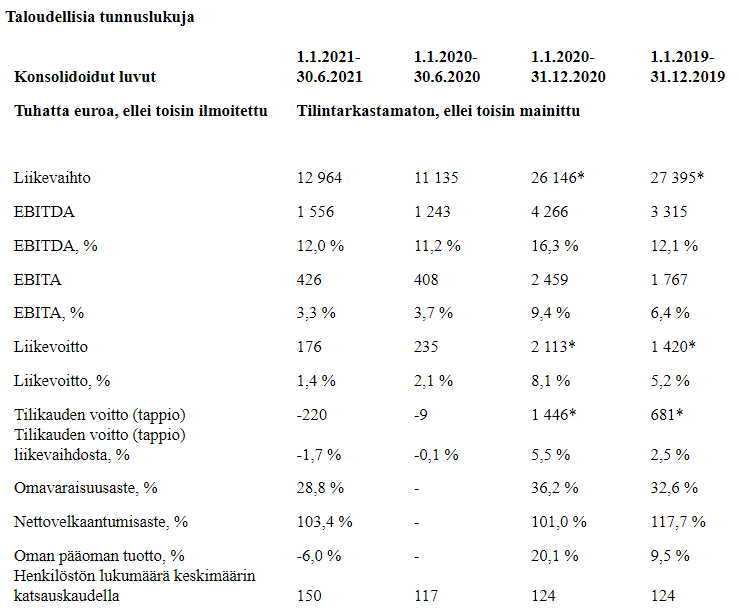
Did the company provide more details on its plans for how this growth will be achieved? After all, revenue was “only” 20.8M in 2017 and most recently 24.7M, so a clear acceleration should be expected according to the strategy.
My view on the subject is that demolition material is quite limited. Geopolymers, for example, are still in their infancy in Finland and globally. The aim of these geopolymers is to replace cement in concrete, which causes most of the emissions from concrete. There are studies on the subject that these geopolymers work for their intended purpose, but the problem is limited demolition material flows. Competition in the field is tough, so I don’t see why this particular company would be the winner.
Alternative methods have also been developed for demolition concrete, for example. There is a method by which aggregates and cement could be separated from demolition concrete. This cement can still be used in the production of new concrete, and these material flows are considerably more abundant than waste wool.
The basic business in ecowool, on the other hand, is good, but one should not be deceived by these new methods. I also don’t see how this could scale up significantly. At least I have a somewhat negative first impression.
General:
Waste recycling is an incredibly challenging task, mainly due to the complexity of waste, i.e., impurities. Construction waste recycling is virtually non-existent, but there’s a lot of buzz around it. Sustainable demolition, which allows for the recovery of different materials, is expensive and slow. On construction sites, it only works if the cost of construction waste forces it. Currently, we are far from that, and construction waste is mixed. Sorting demolition waste afterward is expensive and inefficient → the raw material is inherently costly.
The only recycling technology I would invest in is pyrolysis-based techniques, or companies that utilize large waste streams. Concrete and other aggregates are a good fraction in themselves, but their utilization in earthworks is currently easy and less bureaucratic thanks to the MARA regulation. I could imagine that elsewhere too, they mostly end up as roadbeds. Demolition wood goes to incineration. In forest-poor Europe, there might be a market for “recycled wood,” but not in Finland.
Geopolymers came to my attention, but their production is presumably precise regarding materials, and I would bet on geopolymers made from virgin materials. Geopolymers are a promising thing, and it’s absurd how they still haven’t broken through and replaced concrete and asphalt. As a material, it is much higher quality.
These products compete with virgin materials, use in earthworks, and landfilling outside the EU.
I have a very skeptical initial impression, but I need to look into it more closely.
No answer was given to the question of what percentage of the company one gets for those 15 million. Nordnet is the operator in the IPO.
Otherwise, quite an interesting case, when I listened to the press briefing.
It’s hard to see a company that has hardly grown in its history suddenly start hitting annual growth figures of approximately 25%. My guess for the course of events is: revenue has even slightly decreased from 2019-2020 due to the weak COVID year. Partly because of this, the forecasts for 2021 vs. 2020 show good growth, and this growth has then been extrapolated until 2024.
“Back in the day,” that 15 million would have bought 50-80% of the company, probably around 15% in the current IPO craze
But let’s see when more information becomes available; it doesn’t really generate any great interest beforehand.
“The reuse of demolition wool is now possible with EcoUp Oy’s innovation. Used mineral wool is transformed into new, ecologically sustainable recycled material at our production facility. The recycled materials obtained from demolition wool can replace virgin raw materials in, for example, asphalt and even brick manufacturing.”
I’m a bit pondering this neologism “ecologically sustainable” – is hiding problem fibers in other non-recyclable material sustainable in any way?
They started seeking funds from the IPO with a rather rough valuation. The current owners would sell their ownership for a total of approximately 4 million euros.
Based on the subscription price, the market value of the company’s share capital would be approximately 67.0 million euros. The market value of the share capital is based on the number of shares after the listing, assuming that the share offering is fully subscribed.
I think I’ll skip this IPO (I don’t even believe in quick profits because I think people can read) and first wait for evidence of that 20% EBITDA and rapid organic revenue growth. Not an investment recommendation…
In my opinion, EcoUp is a very interesting company, and the expected value at the IPO price is, I believe, good. This, of course, requires accelerating growth in both business areas, but there are clear steps and a strategy for this, and the green trend should provide increasing tailwind. The background and more detailed justifications can be found here.
Thanks for the report/research! Very interesting to read.
The “New consumer concept increases the reachable market, where the margin structure has the potential to be good” was mentioned as a value driver. I would also see the same point as a risk. What if the new concept doesn’t work?
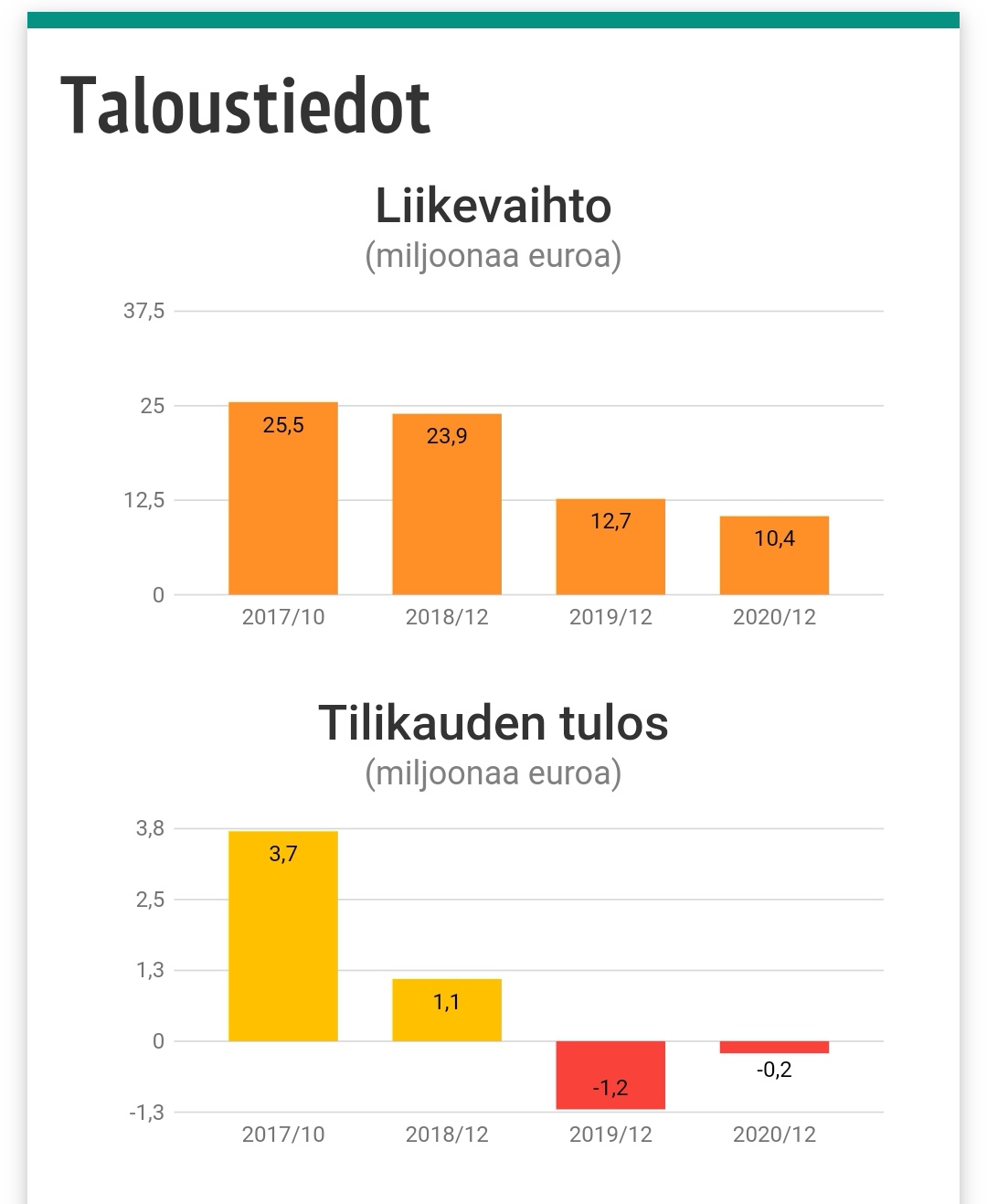
The figures for Kotisun, used as a reference, are not flattering at present, but I haven’t investigated further whether there are any underlying changes that explain these figures. Screenshot from Finder below:
When Panostaja sold KotiSun to Capman’s funds, the revenue was EUR 42 million in 2017, which doesn’t match the data from Finder. I somewhat suspect that due to KotiSun’s current group structure, it’s difficult to get fully comparable figures from Finder. Of course, I don’t have a precise understanding of KotiSun’s current condition under CapMan’s fund. And KotiSun doesn’t give any certainty one way or another about whether EcoUp will succeed with its own concept and how sustainably.
My understanding is that these types of concepts have been quite quick to accelerate, but rapid growth stabilizes in a few years as the market saturates, and after that, maintaining positions alone requires effort. Partly reflecting this and many other factors, I have not predicted EcoUp’s traditional business to grow at the rapid pace of 2021-2023 for eternity.
However, in EcoUp’s case, all eggs are not in the basket of that consumer concept, as there are other growth drivers. Additionally, investing in that concept doesn’t really require massive fixed additional investments (insulation material for the consumer concept comes from the same factories as other insulation material), but rather primarily the recruitment of management, sales, and installation teams, and certain investments in equipment. Thus, I believe it’s possible to “kill” the concept with tolerable damage if things don’t take off. This is an undeniable risk in all new businesses.
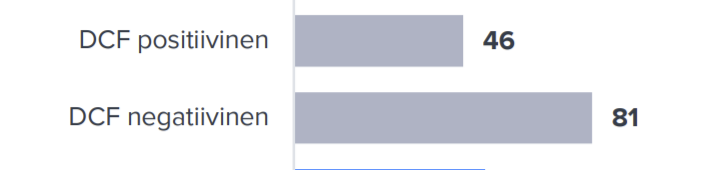
It seems @Antti_Viljakainen made a small typo in the EcoUp report, positive and negative DCF (Discounted Cash Flow) values are swapped (on page 4). Otherwise, a big plus for the comprehensive DCF figures, a DCF enthusiast like me almost gets emotional when presented with so many numbers
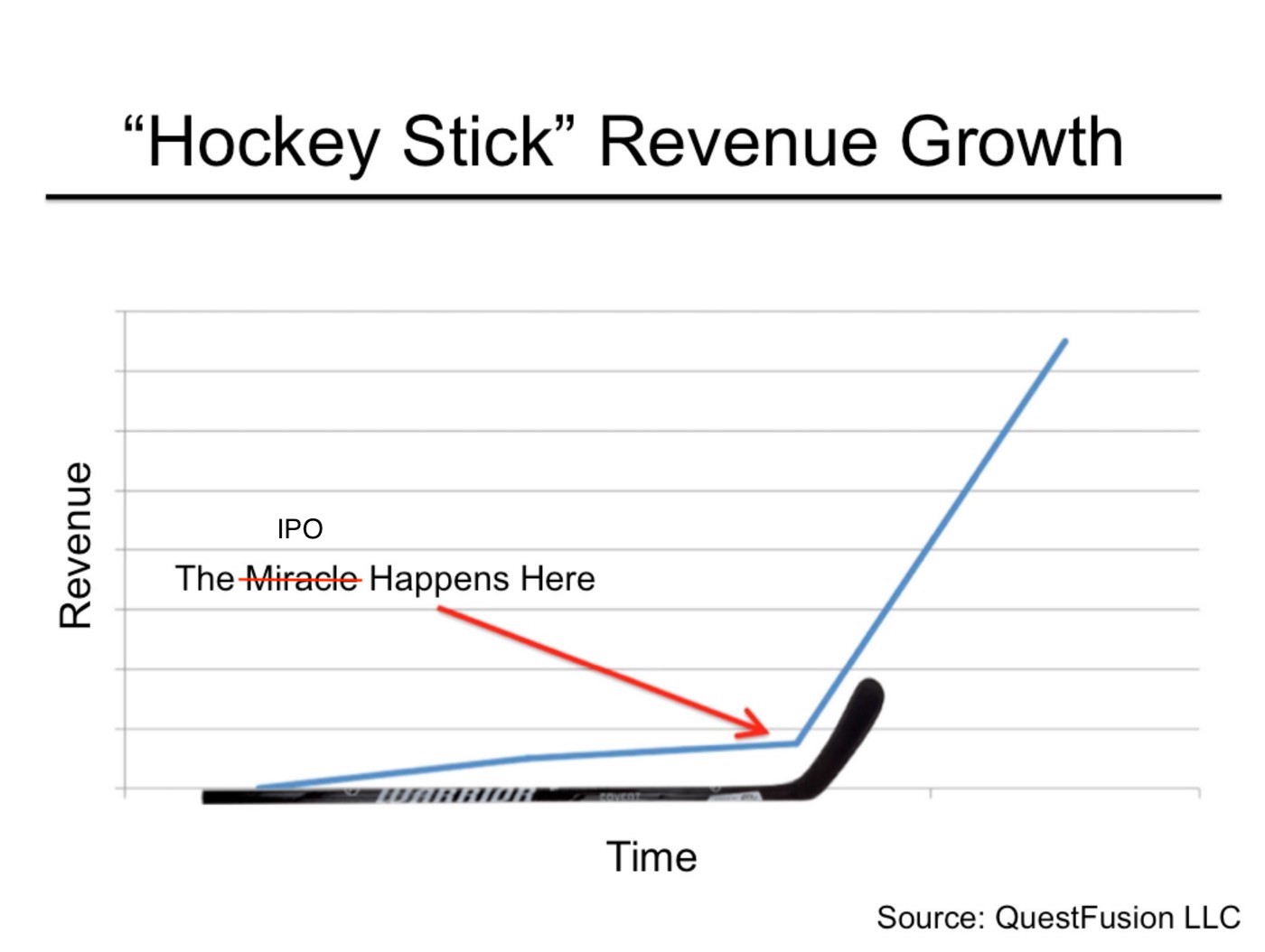
This reminds me of that picture someone posted where a hockey stick would supposedly start with an IPO, and the current owners, out of the goodness of their hearts, want to share it with us random folks
Of course, the share to be divested is apparently small, so it could also be interpreted as the owners wanting to reduce their own risk at such a point - BUT the seller always knows better than the buyer what is being sold..
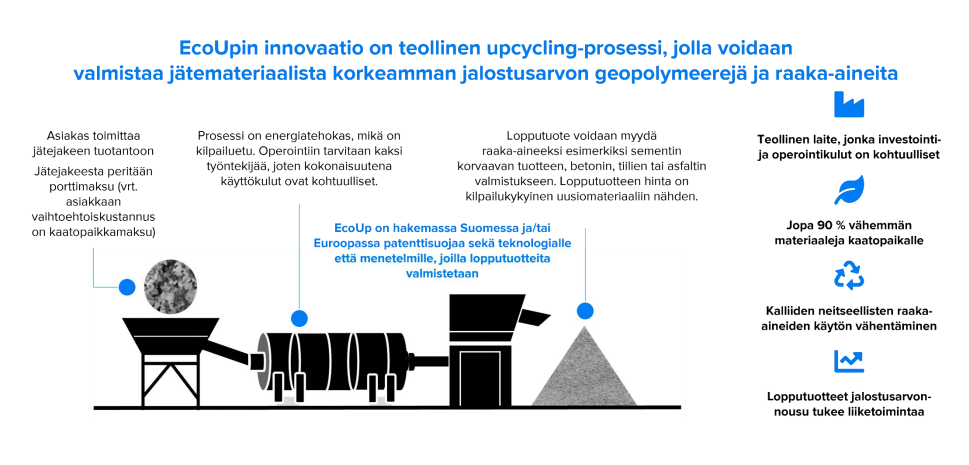
E: Hold on, the circular economy technology is based on a process where rock wool is apparently ground into a cement base, and for SoTP (Sum of the Parts), SaaS companies are used as a comparison, and near-term EV/S multiples are used as a guideline? A patent for the milling method is already pending in Finland.
A carpenter’s comment regarding eco-wool was that it supposedly smolders well in the attic if you burn e.g. trash in a barrel and lead the smoke into the flue. The analysis mentioned the exclusion of high-rise buildings as customers, which is probably the main numerical problem. A hobbyist’s opinion was that they like rock wool, and it’s also better for cold storage and, for example, cabins due to its moisture properties. EcoUp also seemed to have a rock wool solution. But this is all about the basic business’s EV/EBITDA of 8-10, which I don’t doubt so much. I’m interested in others’ thoughts on this spin-off invented to boost multiples.
The valuation is indeed outrageous based on the performance so far. This offering places a really big risk on investors as to whether performance will continue as in H1.
I might have joined with half the valuation, but at this valuation I’m just shaking my head (and I consider myself a high-risk investor, with over half of my portfolio in speculative US stocks).
From a PR perspective, this offering should have been priced at a maximum P/E of 15, which would have given it a nice start. Now there’s a risk of the stock price halving in a year.
No thick report is complete without a small somersault. Corrected. Thank you for the keen observation!
However, it’s also worth remembering that growth is free for only a very few companies. For example, in EcoUp’s case, the company’s targets and our forecasts would have to be significantly cut if the company didn’t receive capital in its cash reserves relatively quickly, at the level of the amount sought in the IPO. This is because achieving growth on the expected scale requires upfront investments, i.e., cold hard cash. This applies to all of the company’s business segments (cf. for example, plate sales won’t grow due to full capacity if factory bottlenecks aren’t opened up with equipment investments, or in Circular Economy Technology, sales won’t come if there’s no upfront recruitment of sales force, etc.).
With revenue financing, the pace would be significantly slower than targeted (cf. our cash flow forecast for this year of approximately EUR 4 million and cumulative investments of over EUR 20 million for 2021-2024), and the company’s debt capacity is, in my opinion, nearing full utilization for the time being. I don’t know the current owners’ situations and thoughts, but based on the ownership structure, I wouldn’t be surprised if a significant portion of the current owners were unable or unwilling to invest more equity in an unlisted company to the extent required by the current growth strategy. Therefore, I think it’s very natural for EcoUp to seek capital for growth from the stock exchange at this stage, even if there isn’t yet a strong track record of growth to show, and thus it will come to the listing with a higher risk profile than at a later stage (and in my opinion, also with higher upside).
Of course, growth also involves risks in EcoUp’s case, and not all growth investors succeed. The well-deserved hockey stick legend of listed companies probably stems from failures. And of course, without enough sampling, clear sales stories of fluff can also be found.
I have sought the scale for the potential valuation of the combination of growth and profitability in Circular Economy Technology from there, but the pricing does not directly follow the SaaS peer group. In my opinion, this is relevant because the business model formed by Circular Economy Technology has certain elements in common with a SaaS company (large market, high gross margin potential enabled by licensing, and upfront investments in sales and product development). There are unfortunately very few direct comparisons in the circular economy or emissions reduction sectors on the stock exchange, but in the Nordic countries, Renewcell and Spinnova can be found in the textile industry value chain. These companies also have the same elements as EcoUp’s Circular Economy Technology (new technology, potential for a scalable business model, ESG, virtually zero revenue so far). I did not, however, seek a direct benchmark for the possible valuation of Circular Economy Technology from there, as the multiples have risen to such an absolutely staggering level in relation to the expected figures for the coming years (and I am not taking a stand on whether these companies are expensive or not, as I have not analyzed them). The theme thus seems to appeal to investors, which is also a nice option in EcoUp, but of course, one should not rely on it.
The pricing of Circular Economy Technology is definitely the more demanding part in EcoUp’s case, and there will certainly be dispersion of opinions. In my opinion, this new business cannot be obtained as a zero-priced option with EcoUp’s basic business, when considering the subscription price. I also buy this, as technology has been invested in and it has been proven to work. Thus, value has already been formed, in my opinion.
I couldn’t find any mention of a market maker in the offering prospectus. Is there one at all? There’s probably no need for a market maker considering previous offerings, but it would provide a certain peace of mind.




 (and I consider myself a high-risk investor, with over half of my portfolio in speculative US stocks).