
And then, a bit more support. It took its time, but apparently the sufficiently cheap (and expected?) level has finally been reached.
10 Likes
Which Säästöpankki (Savings Bank) fund overview is this, and where can this text be found?
Säästöpankki Itämeri (Savings Bank Baltic Sea) and a brief overview can be found here:
2 Likes
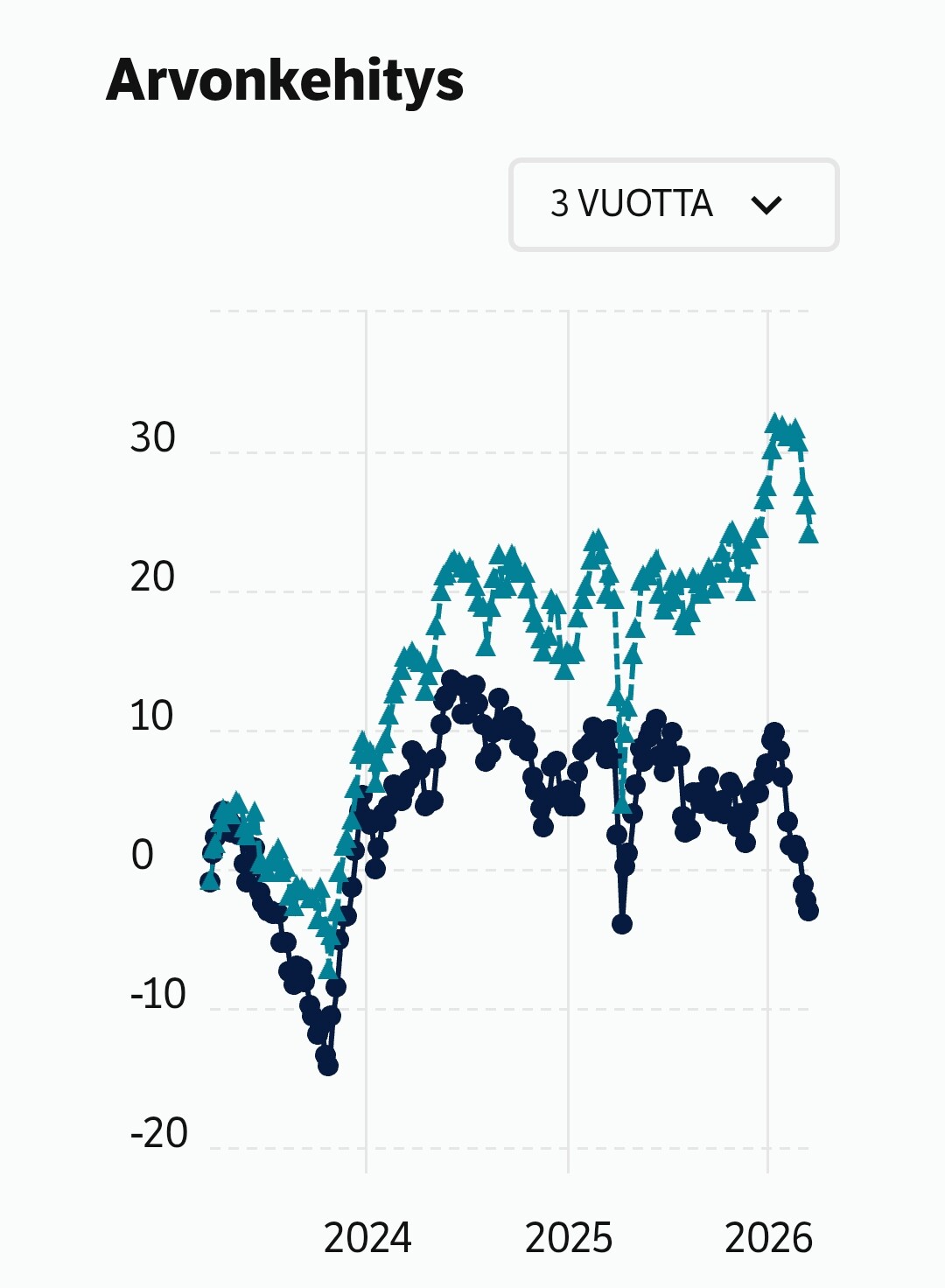
It definitely is a balancing act, we’ve fallen significantly and systematically behind the reference index. I wonder why it hasn’t been merged with another fund.
It’s a difficult situation if a major shareholder is selling off their 5% stake through the bid side, and there are no big buyers…
The stock price has nowhere to go but down if they can’t find a big block buyer, and for some reason, a large number of shares have accumulated, and they want to start mirroring themselves to the reference.
Oh darn
1 Like
Well, another Inderes analyst has left to try their wings as a portfolio manager 
Novo is the fund’s largest investment. Well, my own choice (as a risk investor) between Easor vs. Talenom is indeed Easor. I’ve added 60k shares this month and sold all my Talenom shares. In Nordnet, the acquisition cost of Easor with old shares is zero. I wonder if Nordnet will still correct the acquisition costs or if the tax authorities will eventually notice…? At least the sales of Talenom show a nice tax loss..
2 Likes
What kind of financial management software could be developed today for 5 million euros?
In the analyst’s opinion, are the €20 million in R&D costs/debts in line with the existing product?
In the big picture, it is quite impossible to give a single unequivocal answer to this. Naturally, the end result depends entirely on the size of the team, its expertise, and of course, the timeline on which the project is being pushed forward.
With 5 million, you could already put together quite a team, but if you start from scratch to build modern financial management software with all its integrations, banking APIs, and complexities, that sum can disappear surprisingly quickly. In software development, the last 10–20% of features often consume the majority of resources, especially when talking about critical systems where the margin of error is zero.
So I would say it depends entirely on whether the goal is an agile niche solution for a specific need or if the aim is to build a direct challenger to established market players. It is then a matter of its own how much AI and new development tools can streamline this process, but it is hard to promise anything “finished” without more detailed specifications.
Easor’s balance sheet interest-bearing debt does not have any actual direct link to the amount of R&D investment. It was agreed in the demerger that this €20 million slice would be transferred to Easor.
Under Talenom, much more than that has been spent on developing Easor over the years. Since 2015, Talenom’s investments in intangible assets have exceeded €80 million, the majority of which, according to our estimates, has been directed toward the development of Easor’s software. Surely, if one were to start developing a product for the next 10 years today with current tools and that amount of money, much more could be achieved. But I would see sales and customer acquisition in Easor’s market as an even bigger challenge, especially for completely new players. Customer acquisition is relatively expensive when, at the same time, the annual billing of an individual SME is in the range of hundreds or a few thousand euros.
10 Likes
It’s a good question, but I would also apply some common sense here. An equally relevant question is whether 5m EUR gets you over 15,000 customer companies or more than 60,000 software users? Customers—the ones paying the bills—are more important here as well; with what kind of investment do you acquire a customer base, references, feedback that aids development, and customer retention? How long does it take to reach those figures?
5 Likes
Now we’ve come to an interesting topic. How much of these costs have been capitalized on Talenom’s balance sheet? If and as they likely have been, is the intention to continue the same “capitalization” on the balance sheet with Easor as well?
Atte, do you think my interpretation is correct?
There is certainly “baked-in stuff” in the balance sheet.
The latest detailed carve-out breakdown shows that on 31.12.2024, Easor had EUR 2.1 million in goodwill, EUR 29.7 million in capitalized software development costs, and a small amount of other intangible rights on its balance sheet. Total intangibles + goodwill were about EUR 31.9 million, while the total balance sheet was EUR 48.2 million. So, about two-thirds of the balance sheet was intangible. Additionally, the company states that in 2025, its own software investments were still EUR 10.4 million, even though the level decreased from the previous year. The IFRS policy is the same familiar one from Talenom: development costs are capitalized if the IAS 38 criteria are somehow met.
1 Like
For the coming years, I believe Inderes predicted that capitalizations will exceed depreciation by about 1 million… both sums are certainly large. It’s a good sign that the CFO more than doubled his shareholding last month, and it didn’t happen by selling Talenom. So, could one think that both will be good investments going forward, but Easor might be slightly better?  I just had to return as a Talenom shareholder now that the share price dropped below 1.3.
The pro forma balance sheet provided in the demerger prospectus looked like this.
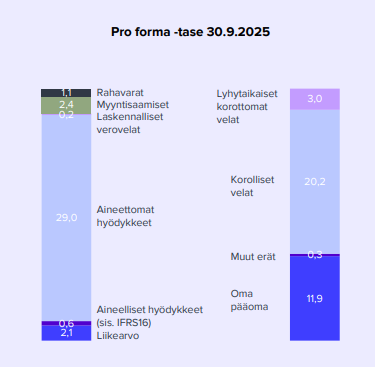
So, on the asset side of the balance sheet, there isn’t currently much else besides capitalized development expenditures. And these costs are intended to be capitalized in the future as well, but in our forecasts, the level of capitalizations/amortization will start to be close to each other going forward.
Here is a comment from the comprehensive report, which I think is most relevant regarding that balance sheet: “After the demerger, Easor’s balance sheet will thus be quite leveraged, and the situation will remain so in the coming years as the company invests its cash flow into growth in accordance with its strategy. However, as we see it, the cash flow will also be well sufficient for debt servicing costs. Regarding the financing of the growth strategy, Easor relies on internal financing and debt capital, and there is no intention to raise new equity.”
5 Likes
Just to confirm. So the practice already familiar from Talenom regarding the balance sheet continues?
@Pia_Maljanen and @Atte_Riikola talked about Easor for about fifteen minutes in English
Easor, the spin-off from Talenom, develops and provides a financial management platform for SMEs and accounting firms. If the company achieves strong international growth, the share will have significant value-creation potential. Without growth, only increased investments would remain, putting pressure on the acceptable valuation level. Analyst Atte Riikola summarizes.
Topics:
00:00 Intro 00:23 Easor in a nutshell 01:35 Spain 05:16 Competitive landscape 07:43 Investment thesis 09:40 Underlying profitability 11:30 Valuation & recommendation
This video can also be found on the Inderes Nordic channel.
Yes, product development expenses are indeed capitalized very aggressively. This issue is addressed in several places in the comprehensive report, but here is one highlight.
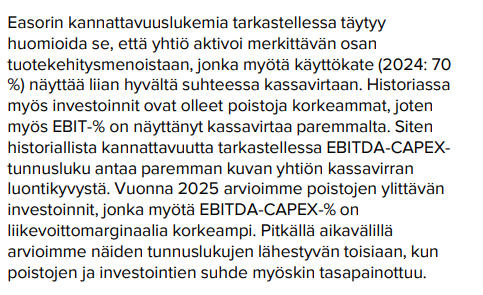
In other words, EBITDA is practically a useless earnings metric due to those capitalizations. EBIT and FCF provide a better picture of the development of profitability and cash flow, so it’s best to focus on those. The same applies to almost all companies, whether there are capitalizations or not

5 Likes
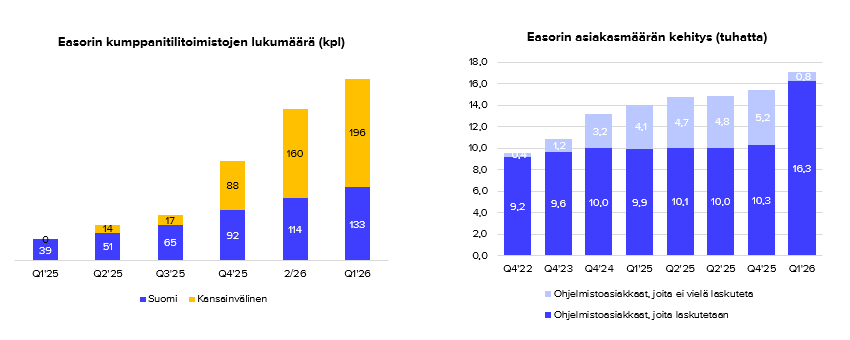
At least the partner accounting firms are growing at a rapid pace. 180 at the end of the year and already 274 in February, meaning +50% in 2 months. At the same rate, with compounding, the amount would be over 10x by the end of the year. Of course, in the fastest-growing market, Italy, the software is first distributed for free trials; however, at least in the drug trade, that is a very effective way to get customers hooked. 
3 Likes
As far as I know, Easor only has a search portal for accounting firms in Italy. Are the customers who bought themselves into the results actual clients? In itself, it’s a perfectly sensible way to gather a customer base to sell more to later.
Here are Atte’s pre-game notes as Easor reports its Q1 results next Thursday.
This is the company’s first interim report as an independent listed company following the demerger from Talenom, so historical figures for the comparison period are not available. We expect Easor’s revenue to have remained roughly stable compared to the previous quarter and operating profit to be at a low level, reflecting the administrative costs of an independent company as well as international growth investments. In the report, we are particularly monitoring the development of the number of partner accounting firms, as expanding this channel is central to achieving Easor’s medium-term growth targets.
2 Likes
Easor’s first quarterly report as an independent listed company was slightly better than our expectations:
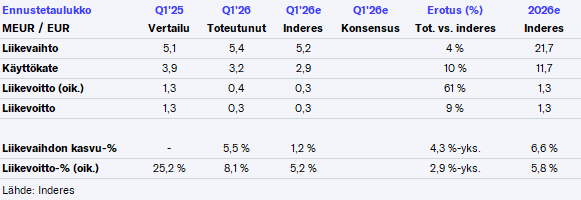
The number of both accounting firm partners and SME customers has continued to grow nicely in recent months. In Spain, a significant portion of previously non-billable customers have also been brought within the scope of billing, which was already reflected to a small extent in Q1 growth. According to the company, the average billing in Spain is still less than 10% of the Finnish level, so they have started quite cautiously in this regard.
The webcast starts at 10:00, followed by an interview with Otto-Pekka:
12 Likes
It’s surprising that despite “using all excess for growth investments,” there was an earnings per share of 0.01 in a single quarter… that makes the company look quite affordable.
It’s also good that something seems to be starting to develop organically in Italy as well.
3 Likes