Digital Workforce - Automation and Software Robotics Service Company

A queue at First North’s door, Digital Workforce announced its interest today.

Growth, recurring billing, software, robotics, intelligent automation…
However, losses are already being made at the EBITDA level.

The company is seeking 20 MEUR in gross proceeds, and old owners are selling their shares. Subscription commitments for just under 10 MEUR, if the valuation of the share capital BEFORE the offering proceeds is at most 50 MEUR.

With my math, the company’s future market value can’t yet be calculated with the above information, so anchor investors probably have more info on, e.g., the size of the offering.

LEADING INTELLIGENT AUTOMATION SERVICE COMPANY
Digital Workforce is one of the world’s leading software robotics and intelligent automation service companies measured by both revenue and number of employees. Our company offers services to a wide customer base across different industries. We focus solely on intelligent automation. Our continuous goal is to earn our leading position by being the best player in the industry.

Financial targets and dividend policy

Digital Workforce’s target is 100 million euros in annual revenue by the end of 2026. Approximately 30 million euros of the annual revenue growth is expected to come from the Nordics and 50 million euros from the USA and UK.

In addition, the Company’s goal is a clearly positive adjusted EBITDA margin%[2] by the end of 2026. In the longer term, the Company targets an adjusted EBITDA margin% of over 20 percent, but during the period 2021–2026, the Company prioritizes investing in growth over profitability.

Digital Workforce does not have a confirmed dividend policy.

The planned IPO is expected to consist of an approximately 20 million euro share issue by the company (gross proceeds) and a share sale in which certain Digital Workforce shareholders sell their shares. The proceeds from the share issue are intended to be used to support Digital Workforce’s international growth strategy by strengthening international sales and delivery resources, as well as to fund potential acquisitions. Additionally, the proceeds from the share issue are intended to be used for investments related to the adoption of new technologies and to ensure production resources and scaling.

Anchor investors, namely certain funds managed by entities owned by Aktia Bank Plc, Handelsbanken Fonder, and certain funds managed by SP-Fund Management Company Ltd, have, under certain customary terms and conditions, committed to subscribing for shares in the IPO, provided that the company’s equity valuation before the proceeds from the IPO is at most 50 million euros. The anchor investors’ commitments total 9.4 million euros.
image

https://digitalworkforce.com/fi/etusivu/
https://digitalworkforce.com/fi/listautuminen/
https://www.sttinfo.fi/embedded/announcement?publisherId=69819009&announcementId=861&widget=true

30 Likes

The press conference from the company will start soon on InderesTV at 10:00 :slight_smile: Digital Workforce tiedotustilaisuus 10.11.2021 kello 10:00 alkaen - Inderes

15 Likes

Here’s an interview with CEO Mika Vainio-Mattila: Digital Workforce suunnittelee listautumista - Inderes

18 Likes

Was it already mentioned somewhere which broker will arrange the offering?

3 Likes

In the company’s listing announcement,

“Danske Bank A/S, Finnish Branch (“Lead Manager”) has been appointed to act as the lead manager for the IPO. In addition, the Company has appointed Nordnet Bank AB as a subscription place for the Public Offering.”

9 Likes

Initial observations - this also requires closer examination:

  • A service company sells experts to set up software robots (RPA) and artificial intelligence (AI) for use, and an accompanying maintenance-like service.
  • No proprietary software. Uses RPA & AI solutions developed by others.
  • The business is claimed to be scalable. How does the RPA service scale if manpower is sold, just like other IT service companies do?
  • No precise information on market size, but “billions are swirling in discussions,” and what might be the realistic truth.
11 Likes

It will be interesting to see how expensive Digital Workforce will be on the stock exchange.

There is a lot of hype around software robotics (and for good reason, of course). Here is one study on the topic. Services will grow faster than on the system provider side, which gives direction to DF’s market and its growth. However, it should be noted that there is strong competition in the field, and even in Finland alone, there are at least a couple of handfuls of serious competitors.

7 Likes

Market growth of 32.8 percent per year, strong.

Edit: The company has nicely managed to consistently improve its profitability despite growth investments.

4 Likes

The following opinions might be a bit… critical…

I) Reflection on the credibility of the business and soft-robot technology:
As far as I understand, RPA (Robotic Process Automation) solutions are in their infancy; text and image recognition require a nearly standard, even precise and structured data presentation method, for the basic prerequisites of data processing automation to be even roughly the same as for a traditional information system. Technology will certainly develop, but it won’t replace a human in interpreting a messy financial statement yet. This leads to the basic problem: if RPA & AI only partially solve automation, why choose RPA & AI if a traditional IT solution and a human as the key user solve 100% of cases?
Well - good sales will sell…

You can spot chatbot information on the company’s website. Have you, by the way, conversed with a dumb chatbot? Yes, everyone is nodding in front of their screens, aren’t they? Bots and AI are indeed artificial intelligence (dumb ones), and again, one or more humans are needed to support bots whose customer service capability is quite weak.
Well - good sales will sell…

II) Reflection on the realism of the growth target:
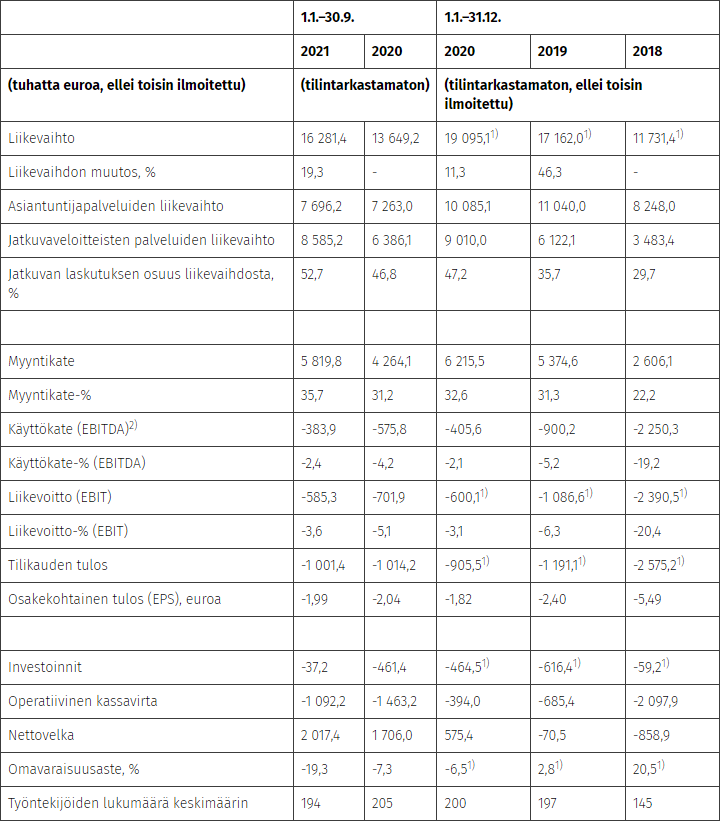
Growing revenue from a level of 19.1 million euros to 100 million euros in five years requires approximately 40% annual growth. How is this possible? In 2021, the revenue for the first nine months grew by 19.3% compared to the first nine months of 2020.
The company’s operations are unprofitable and will likely continue to be unprofitable even beyond 2026, if I interpreted correctly. Why is the gross margin only 32.6% if the company is focused on being an expert in RPA & AI services, the market is “billions,” and the market’s annual growth is around 20%? Will new share issues be required to reach the targets?
Well - a good story sells…

4 Likes

My understanding is that software robots are still in their infancy. So, if there are even small changes to the data used or the user interface of the software the robot uses (the same one a human uses with a mouse and keyboard), does that require the robot to be retrained because it no longer works, and then we’re paying the robot’s creator more money again?

Of course, current software robots are probably quite useful in larger companies and for tasks that are done very frequently and always in the same way.

Some time ago, a competitor offered these services. For someone working in a small company, the prices seemed quite high. Was it true that creating a robot would cost at least thousands, the monthly fee would probably have been hundreds per month whether you used it or not, and then you’d also pay an hourly rate for using the robot?

Software robotics is now quite well utilized in large organizations where data is in digital form and the amount of data to be processed is large. In this, the robot beats human labor hands down. I was looking for information on Digital Workforce’s customers and came across the attached webinar advertisement. I haven’t looked into it in more detail yet, as I wanted to bring it to your attention immediately. :blush: Webinaari: Miten Verohallinto hyödyntää ohjelmistorobotiikkaa muuttuvassa toimintaympäristössä?

5 Likes

RPA platforms like UiPath, BluePrism, etc., have developed significantly in recent years, and RPA is no longer in its infancy. With some older open-source tools, such as Sikuli, you might have to do things through image/text recognition or if you are automating old systems like COBOL and other legacy systems.

For example, RPA solutions are not meant to manually read Excel files, Word documents, and so on; instead, their processing is handled in the same way as in other information systems. When things are properly planned and implemented, and APIs are used where possible, even minor changes to user interfaces do not slow things down. Of course, if user interfaces change significantly, the changed parts also require modifications to the robot’s code, but generally, these are quick tasks unless the entire user interface is completely overhauled.

10 Likes

Yes, in the initial phase, human resources will be sold to develop these software robots, and at the same time, the necessary infrastructure will be established. Scalability will be achieved when (and often if) significant benefits are found in the solution for the client’s business, and much more can be automated. This way, more software robots can be created in an already established environment (where some “code” from previous solutions may also be utilized to some extent). Digital Workforce, as I understand it, provides RPA as a SaaS-style Robot as a Service, where it likely charges a monthly fee per software robot in addition to other costs (e.g., licenses + development). Typically, these customer relationships are certainly long, with an initial investment of thousands of euros, and for the customer, it becomes more cost-effective the more business processes are automated.

5 Likes

The video there explains the operation well.

8 Likes

Digital Workforce is in the right place at the right time, responding to strong market demand. RPA (Robotic Process Automation) and NLP (Natural Language Processing) are currently experiencing a good buzz in the market. So, they are growing almost effortlessly along with the rest of the market.

Based on the interview, it was not clear what their real competitive advantage is in this market, where everyone else is also using the same solutions (BluePrism, etc.).

“A broad, focused service portfolio as a competitive advantage” - what?
“The strategy is to grow by growing” - hmm
“Continuous services are produced in Poland with cheap labor and the margin is high” - No shit, Sherlock
“Profits are not being made, as recruitment, marketing, and sales efforts consume all revenue” - Is this sensible?
“Yes, we know how to grow” - This is probably true, until the money runs out, then what?
“We are already far along, but really at the beginning of the journey” - To be or not to be, that is the question

22 Likes

Every now and then, I look into where Cathie Wood’s ARK-Invest has been putting its money. She has an army of analysts at her disposal, which can lead to ready-made discoveries.

This is how UiPath came to my attention. The company remained a bit of a question mark, but a strong impression was formed that the industry and markets are expanding like dough.

There is indeed demand for Digital Workforce’s offering, and it would be a wonder if it couldn’t grow. The question is simply how much. From Verneri’s interview and the company presentation, I got the impression that the rubber band of growth targets has been stretched with both hands. Possible, but it doesn’t tolerate any potholes in the road.

Recruitment challenges are significant, and I wonder what year will see the first profit? Of course, all growth technology companies face a disruption risk, which the CEO also referred to in the video when answering a risk question from the audience.

Still, the overall picture didn’t seem bad at all. They have a track record and have found their niche. The CEO is experienced and has been around the world for a long time.

It’s a detail, but a good one, that LifeLine does not intend to sell off its holdings but plans to remain an owner. The inevitable conclusion is that Finland’s top growth company incubator considers Digital Workforce promising.

If the price is reasonable, I will put IPO participation in the “consider with interest” category.

18 Likes

How else do you grow?

5 Likes

Software robotics (ohjelmistorobotiikka) is one of the great opportunities of the future, and its potential is huge. The key question is likely getting the right people into the company, meaning top experts need to be brought in to do the work, even if it’s for a bit more money. Mediocrity in this genre is unlikely to succeed.

I myself thought about getting involved in this; of course, the risk is moderate, but then again, that’s true for everything else.

2 Likes

The fundamental question, in my opinion, is whether this business is truly profitable?

The company communicates that it is built for global growth and scalability. Operations have been built for 6 years now, and there has been growth, but it has been unprofitable. The growth target by 2026 is about 5X, and perhaps profitable. One might ask, why hasn’t the company become profitable yet, if the operating model is scalable? Why would only a multi-fold increase in business be profitable?
The share of recurring revenue in turnover had risen slightly in Q1-Q3 2021, to 52.7%. However, nearly half of the turnover is still sales of expert services, which can be low-margin and variable.
This year’s gross profit margin is 35.7%, up from 32.6% in 2020, but operating profit is sliding further into the red.
The majority of the offering will be used for sales and marketing, which is understandable in itself, but the company communicates that it is a leading player and has received recognition in its field, so why doesn’t word-of-mouth already act as a sales driver?

Has the business planning overestimated the factors of profitability and growth? For example, are the percentages of automation rate too optimistic, i.e., customers are satisfied with 20% automation, even though 80-100% potential in various functions has been calculated, which torpedoes economies of scale? Or is the competition simply so fierce that the company sells its services too cheaply to win bids, and in this way, the business remains in the red?
The solution idea of replacing humans and using existing legacy systems for automatic data entry may be a nice idea, but in my opinion, it is a limited solution principle in terms of performance scalability without additional costs for software changes.
Is a quick cheap solution with a robot just a temporary fix, and is the real efficiency for the customer a traditional IT system with integrations, which provides significantly more performance, and the system works 24/7, just like a robot?
Robots replacing hundreds of hands as temporary relief for work overloads is not sustainable and steady business, so recurring revenue may fail from this perspective, even if these stories provide good marketing material.

16 Likes

If we’re talking about user interface automation, replacing humans with robots provides the ability to work 24/7, if we exclude system maintenance breaks, etc. Another aspect is data quality. Humans are fallible and sometimes input data incorrectly. This can cause so-called error requests in customer support and subsequent manual corrections. Measuring these benefits is difficult in the short term.

Robots can be used for API solutions, and nowadays, hybrids (UI + APIs) are a common way to speed up implementation. Image recognition is done less often than people think because nowadays, the source material is primarily structured or natively digital. For example, in Windows, UI elements can be accessed 99% of the time without image recognition.

In large organizations, a robot’s lifespan is often measured in years, as many projects compete for budget funds and resources. Through mergers and acquisitions, software portfolios can acquire assets that are not desired for development but must be maintained until a larger architectural overhaul can be completed. Robots can buy time for these more important implementations.

In the public sector, organizations may be tied to certain software, as it may not be practical to replace hospital device X with a new one, or a third-party software forces the organization to operate in a certain way. Problems/limitations caused by third parties are precisely the bane of the public sector. (Okay, for example, the software expertise and processes of SMEs encountered in Germany…phew…)

The sufficiency of the 80/20 rule for customers depends on the volume of operations and peak loads. If a peak load occurs annually at the same time, even 20% robotization is a sufficient advantage, because the internal staff is in no way sufficient to handle the demand, and a solution based on using a temp agency is cumbersome with employee training and other overheads. Usually, the percentages are the opposite — 80% is done by a robot and the rest manually. This is based on my own experience.

I agree that in the long run (5+ years), robotics does not and should not replace a proper information system project. However, reality is a messy heap of constraints that dictate the pace of change. I am not taking a stance on Digital Workforce or their business here; I just wanted to bring my own perspective on what the life cycle of robotics can be like and why they defend their place as a solution option for businesses and organizations.

Final remark: I have earned my living from the field of software robotics for many years, so the above is based on hands-on experience with various clients. However, I am not employed by Digital Workforce or their client. All criticism is welcome!

42 Likes