Absolutely. If the risks were completely removed, meaning it would be a completely risk-free investment, then it would be much higher 
 the risk-free rate is close to zero currently
1 Like
Now Q1 report out: https://www.cibusnordic.com/investors/news/cibus-nordic-real-estate-ab-publ-interim-report-1-january-20-71033 the result exceeded our forecasts and also the forecasts of other analysts, although a proper consensus for this was not available now
1 Like
Yeah, so I should clarify a bit… “the biggest risks,” which you have generally taken a critical stance on, such as, for example, the vague organizational structure, the company’s young age, not super short, but not terribly long lease maturities, a large single owner who intends to dump their shares, some properties located in the middle of nowhere…
For example, Kojamo and Sato focus solely on growth centers. Hoivatilat’s lease agreements are worth almost 500 million and the lease term is 15 years. I just can’t understand why I would pay close to Hoivatilat’s key figures for this…
You don’t have to pay. Hoivatilat’s multiples are much higher, currently at a 31% premium to Q1’19 EPRA NAV. Cibus is currently valued below Q1’19 EPRA NAV.
That target price is still on top, and these can be manipulated in such a way that people want to buy out the main owner’s shares. Otherwise, the NAV should be broken down into parts to know how valid it is. Otherwise, it could end up like Ovaro, where many a cake is fair in the eye…
I wouldn’t directly compare this to care properties with NAV, as Cibus hasn’t developed anything, unlike Hoivatilat (Care Properties). (This is also a big minus for Cibus and a risk). I would rather look at the P/E, ROE, PEG, and dozens of other key figures if I were to compare it to care properties, in which case Cibus is again more expensive. Kojamo would be more valued by its balance sheet, which is also cheaper when examined by NAV, and the value of Kojamo’s properties will likely grow quite rapidly.
However, Citycon’s performance is the closest to this company in the Finnish stock exchange, and this should be valued accordingly.
I respectfully disagree here. Citycon’s operational EPS has been declining for 5 years, and in our forecasts (and consensus forecasts), it is expected to continue declining or remain stagnant in the coming years. Cibus, on the other hand, has a relatively good track record so far. For example, over the past year, the company’s cash flow-based operational earnings per share for the next 12 months have grown by 14%. Furthermore, the company has relatively credible steps to continue this growth (renegotiation of loans, new acquisitions, new organizational structure). If you compare it to NAV, Citycon’s cash flow-based ROE-% has been and is forecasted to be in the range of 6-7%, while Cibus is in the range of 10% in our forecast for the coming years. Additionally, if you look at the yield requirements at which Citycon’s properties are valued (Q1’19: 5.3%) and Cibus (5.8%), Cibus has more room for yield compression. Considering risks, Citycon is, in my opinion, much more susceptible to the threat of e-commerce than Cibus, and its business is generally more cyclical. Of course, Citycon has a regional monopoly in certain areas and other strengths, such as better property quality and lower leverage.
4 Likes
We’ll see, I don’t think there’s any hurry for the next couple of years, but I still don’t see this as a stock above €0.8 given these specs. I’d much rather invest my money in Hoivatilat or Kojamo… in fact, I already have, but I’d expect their return over a 5-year period to be significantly better than this one.
1 Like
An entertaining and well-considered text by Pyysing from Cibus.
1 Like
I can subscribe to the assessment that HPJ and the management have, so far, kept their promises excellently. Cibus has successfully implemented its strategy, and its productivity has been continuously improved. The share issue in March at a high valuation and the acquisition of Co-op’s portfolio were value-creating for shareholders.
The company’s risk profile is currently slightly elevated by the uncertainty in the financial markets and the company’s relatively high debt leverage (LTV-% around 59%). It remains to be seen whether the company’s financing costs will increase as a result and whether these will adversely affect the growth rate, as is currently predicted. Cibus’s loans are mainly secured bank loans, and the message we have received is that the availability of bank financing has generally become more difficult and its price has increased. Currently, banks’ results are under pressure due to increasing credit losses, and risk premiums have grown, and this is unlikely to pass quickly. In addition, property yield requirements only need to rise slightly for the value of collateral to decrease, and this can, in turn, increase the company’s loan margins.
1 Like
I don’t fully understand how the ECB’s liquidity increasing operations and stimulus practically trickle down to the stock and real estate markets, but this comment from Pyysing seemed realistic to me:
“But when the ECB semi-forcibly pushes money with negative interest rates onto banks, and it would be in their interest to lend it to companies that are still standing, I don’t see the yield requirements for permanently rented properties with good tenants rising once the smoke clears.”
In any case, the current cash flow alone brings at least a sufficient return for me, which is why I have been buying this. Even if the dividend were to decrease slightly due to increased financing costs, it would still be at the level of the stock market’s long-term average. Of course, at the moment, there are stocks available in the market where the expected return is likely significantly higher, but here the risk is much easier to understand/assess
The current disturbance in the financial markets is such that it is estimated to affect property yield requirements in the short term. In the longer term, the impact is likely to be small or non-existent. I agree with your assessment.
2 Likes
EVLI raises recommendation to Buy, target 150SEK, previously Hold and 155SEK:
https://pankki.evli.com/hubfs/ERP/Raportit/cibus/Cibus%20200512%20Company%20Report.pdf
https://www.evli.com/equity-research/companies/cibus-nordic
I was supposed to buy another batch around 110SEK, but it seems I didn’t.
Waiting for Q2, hoping to get some more at a slightly lower price 
And dividends will apparently be distributed monthly in the future, awaiting an official decision
3 Likes
2020/Q1 Report Published
Quick glance:
- Revenue growth apparently mainly from the acquisition of Coop properties
- Negative currency effects
- Corona has little impact, income mainly from grocery store properties, which are open normally
- New properties possibly coming from both Sweden and Norway
- Dividends to be paid monthly in the future once decisions and operating models are in place
2 Likes
@Jesse_Kinnunen How do you see online grocery stores fitting into Cibus? Online grocery stores are undoubtedly becoming more common as a result of this corona pandemic.
Here are Jesse’s comments on the Q1 results:
E: SEB’s report
An interesting point in Cibus’s own report:
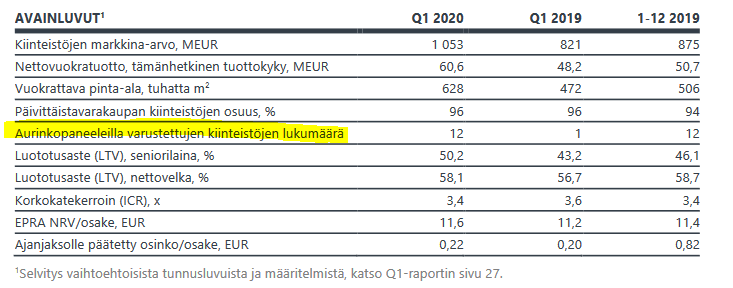
Akiki is also strongly advocating for Cibus:
Can one see where Cibus’s properties are located more precisely in Finland and Sweden? I need to do more research before adding it to my portfolio  . Of course, the price shouldn’t get too far from the current level anymore.
1 Like
I don’t know, but I would assume that the existing stores are still probably the best way to handle online shopping at the moment. Picking is easier than from a warehouse. The layout is actually very good for picking. If the popularity of online shopping increases, then a building similar to a current grocery store + an interior layout will probably be placed somewhere that is logistically easy to pick up and transport to the serviced area. Someone will surely have to rent/own that too. But would this reduce the need for commercial properties? Warehouse-style online shopping still seems far-fetched, unless they are placed at least 1 per city. However, the products should still be displayed there, not in cardboard boxes, so the current store display would certainly be optimal there too. I guess that such a thing is certainly perhaps a reality someday. It would require online shopping to become an everyday thing for many. In that case, the need for brick-and-mortar stores would certainly decrease somewhat.
3 Likes
A recent observation from the grassroots; this morning I was wondering why there were panel workers on the roof of a Cibus property and the company’s cars in the yard  so at least +1 in the Q2 column.
3 Likes
For at least a few years now, Kesko and S-Ryhmä have been boasting about which one will become the largest solar power producer in Finland. They’ve been building/having built solar panels on the roofs of grocery stores at a frantic pace.
1 Like
Pareto Securities (18.05.2020) lowers recommendation to SEK 150.00 (previously SEK 154) and Buy
https://www.avanza.se/placera/telegram/2020/05/18/cibus-pareto-securities-sanker-riktkursen-for-cibus-till-150-kronor-154-upprepar-kop.html
Updated Cibus report from Evli today, recommendation still SEK 150 and buy.
https://pankki.evli.com/hubfs/ERP/Raportit/cibus/Cibus%20200518%20Company%20update.pdf
2 Likes
These bank analyses are such a barrel of wishes that you can’t read them with a straight face.
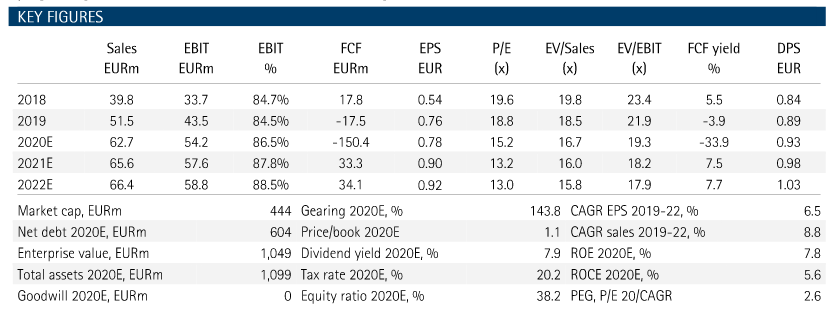
So Cibus pays out more in dividends than it earns, while sales grow explosively, margins strengthen, free cash flows improve, the balance sheet strengthens, and even earnings per share grow. All this thanks to share issues made at a P/B of 1.1. In other words, the analyst has figured out something obvious about business development that even the company’s insiders don’t see.
1 Like
Could the panel investments in stores be related to them having large roof surfaces for installation and also high electricity consumption year-round (refrigeration systems, other electrical appliances, lighting…)? And they probably feed what they don’t need into the grid.
And of course, it’s also a boost to their image 
1 Like