CapMan and cost efficiency, a familiar theme ever since I started following the company in 2013! 
In the big picture, I can agree with what some have criticized here; historically, CapMan has constantly struggled with its cost levels, and the fee profit level has been modest.
Let’s first look at that Q4 & 2025 development. That 34% increase in personnel costs in Q4 is a really ugly number, there’s no way around it. However, with CapMan, I would rather look at the full-year figures, as there can be significant fluctuation between quarters, especially due to bonus provisions. For the full year, personnel costs rose by 17% or 5.6 MEUR—large numbers, for sure. This figure includes three things that drive up costs. 1) ~1 MEUR in bonuses related to carried interest (voitonjako-osuustuotto) was recorded for Q4. Usually, these don’t show up on CapMan’s income statement, but in some older funds, these items run through CapMan’s income statement. This is genuinely a one-off item. 2) CAERUS came on board in August, which added about 1 MEUR in personnel costs by my estimate. There’s good visibility into this number. 3) The Midstar transaction in February increased personnel costs by over 1 MEUR according to our calculations. Visibility into this number is quite poor. When these three items are adjusted, that 5.6 MEUR growth turns into a comparable growth of 2.5 MEUR, or a bit over 7% growth. I assume CapMan itself will further adjust some of those one-off costs affecting comparability (page 22 of the report). I’m not terribly keen on adjusting these myself, as corporate restructurings are part of the company’s strategy. Well, is +7% per year a lot or a little? CapMan is seeking strong growth, and part of this growth is certainly explained by growth investments (headcount has risen more in a year than the number of people brought in through M&A). On the other hand, the underlying personnel costs have risen since last year (around ~3-5%), which is still clear growth.
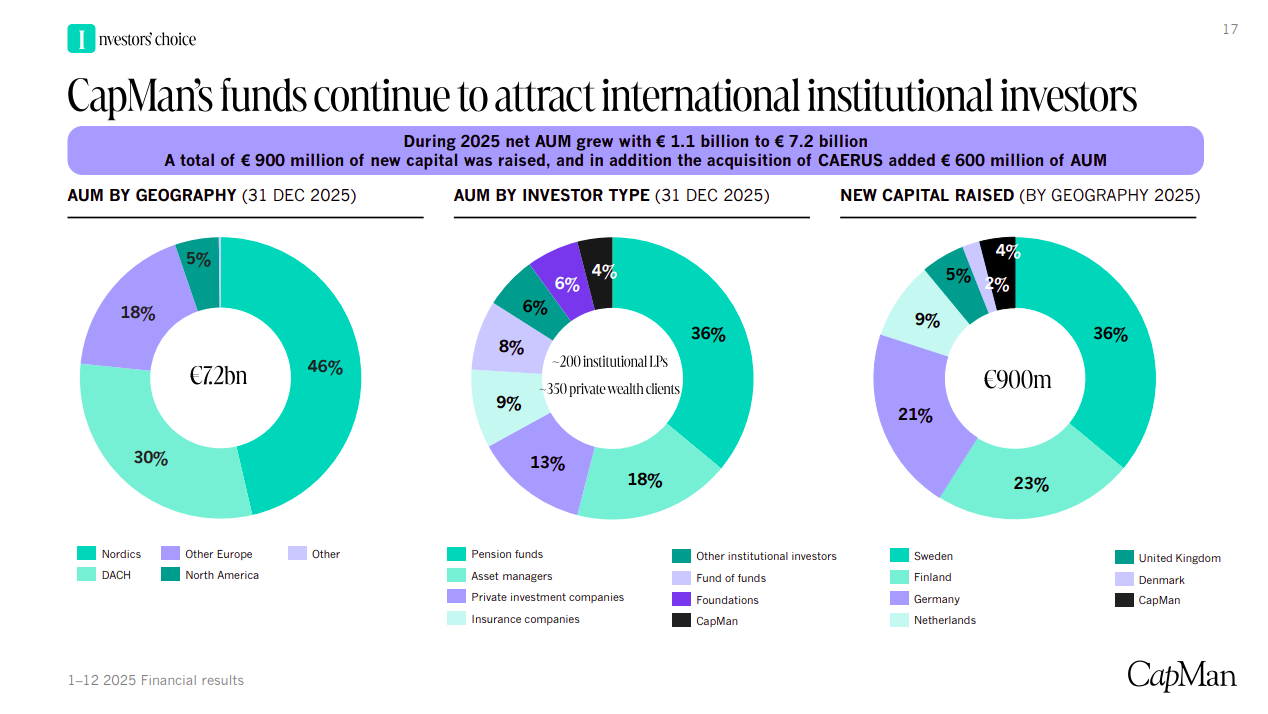
Then, if we look at the big picture regarding profitability, it’s easy to say it’s not where it should be, and it never has been. “Fee profit” was just under 12% for 2025, or 7.4 MEUR, which is a weak level, both absolutely and relatively. CapMan’s fee profit turned from a loss to positive between 2018–2022 (before 2017, CapMan’s management operations were indeed systematically loss-making or at break-even  ). The driver for this improvement was the company’s strong growth (AUM roughly doubled during this period). Additionally, for the first time in history, the company started taking an interest in fee profit. After this, Dasos boosted the fee profit somewhat, but organically we’ve been running in place. The reason for this, of course, is that CapMan’s organic growth has been slow for the last couple of years, and fundraising has been difficult (recent years’ growth has largely come from acquisitions).
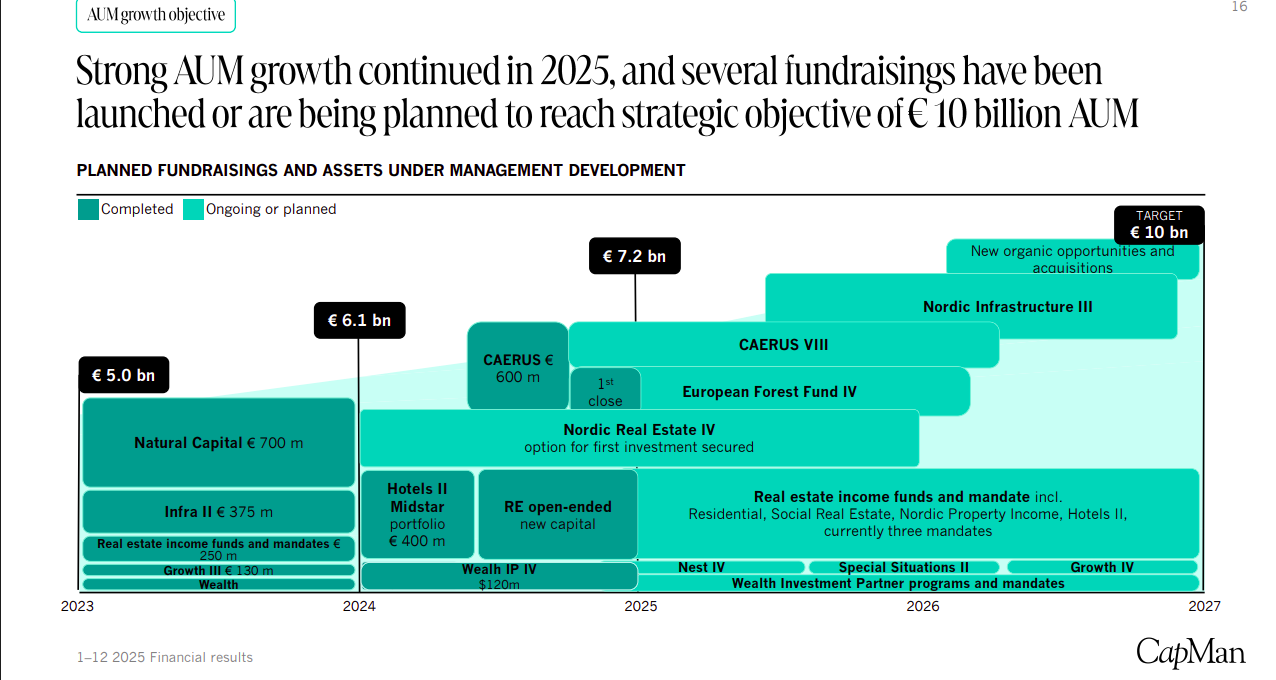
2026 should finally be the year when CapMan grows strongly organically again, and by all logic, this growth should scale efficiently into the fee profit. Growth investments have been made for this, and now the market is finally starting to be in a better position. Since the company is raising the largest ever vintage for all its funds, scaling is practically a given, as long as fundraising is successful. The slope of the scaling is then a question mark. CapMan’s historical track record here isn’t very good, and I do see a scenario where scalability falls well below 50% for various reasons. Conversely, the company should have every prerequisite to get well over 50% of this growth to the bottom line if costs are kept in check. In our forecasts, the fee profit rises to around ~20%, i.e., at most to a reasonable level. I find it hard to see that with the current structure, fee profit would reach levels of +30%, as that would require growth to flow to the bottom line at a massive rate, and the company’s track record for this is thin. This is also reflected in CapMan’s valuation, because if the market trusted that the fee profit would rise to, say, 30%, the stock would be laughably cheap. 
Summa summarum, the criticism regarding costs is quite deserved in my opinion, and 2026 will be the company’s moment of truth. If fundraising succeeds and the fee profit doesn’t scale properly for one reason or another, the bottom would fall out of the case. Conversely, if the fee profit can be scaled to the next level, the case will look much better again. 
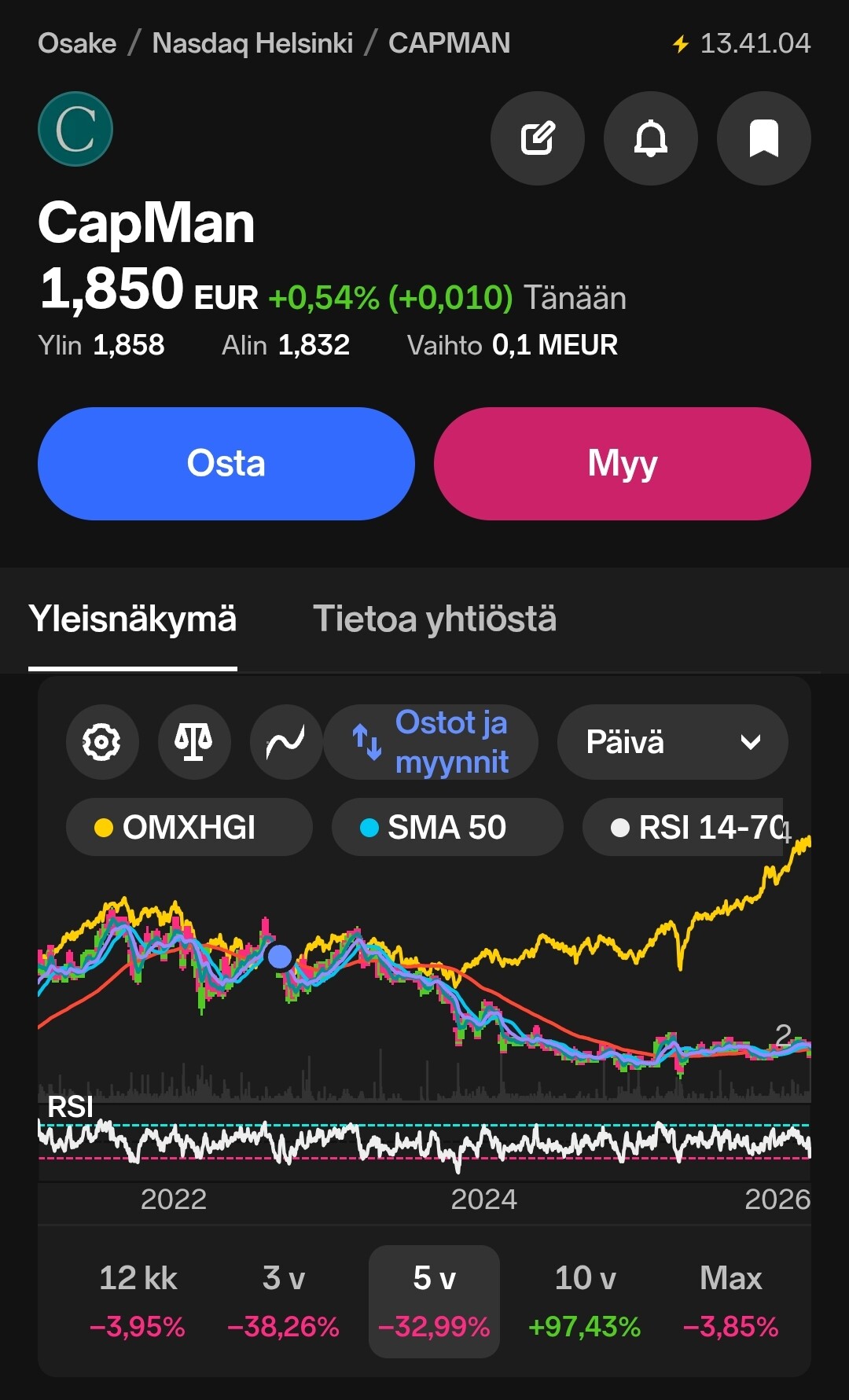
@Osinkoseilaaja is quite right that the recommendation hasn’t gone according to plan  . Although, of course, a strong dividend stream has luckily prevented this from being a total disaster investment. In my opinion, the clearest mistake relates to the last 2-3 year period. Until 2022, the story was progressing very nicely on track as the results improved along with strong growth. However, the rise in interest rates also cut those festivities short, and the last couple of years have been difficult, as growth has been hard to come by. I should have better understood how severely rising interest rates hit CapMan too, and especially the fundraising market. Here I have been too optimistic about growth materializing, and for this period, it would have been best to stay on the sidelines.