CapMan - Private Market Pioneer in the Nordics

I don’t have any data on this, and the company doesn’t report the detailed success of individual exits. At a high level, the development of these individual assets can (and should) be monitored through the funds’ performance fees. In this business, the rules of the game are quite brutal. You have to generate good returns for investors, or else it is difficult to raise new capital. Therefore, the funds should, on average, reach performance fee levels, because otherwise, the equation doesn’t work. An example is the Buyout situation mentioned by @Hagking above, where a couple of weaker vintages led to a situation where new ones could no longer be raised.

Of course, there will always be weaker vintages from time to time, but for every bad vintage, a manager should be able to show several good ones. In CapMan’s case, the results will be properly measured in the coming years as the exit market recovers and the company exits several flagship funds. These must yield significant performance fees, or something is wrong. The most important individual products are NRE2 and Infra1.

And yes, the majority of CapMan’s value comes from management fees. However, without performance fees, there won’t be any management fees in the long run either :slight_smile:

20 Likes

CapMan, together with CAERUS, is expanding its Real Asset Debt investment area into infrastructure debt. CapMan established its Real Asset Debt investment area, which focuses on real asset debt, upon acquiring a majority stake in CAERUS Debt Investments in June 2025.

The new infrastructure debt strategy will be led by René Kassis, who has over 30 years of experience in building and developing infrastructure debt investment strategies. During his career, Kassis built a European real estate and infrastructure debt platform for the international investment firm LBP AM, with assets under management exceeding EUR 6 billion. Previously, he developed Dexia’s infrastructure business into one of the world’s three largest infrastructure banks.

The expansion enables CapMan and CAERUS to operate in a rapidly growing market segment. According to recent market reports, the financing needs for infrastructure investments in Europe are growing significantly, particularly in projects that strengthen operational reliability and self-sufficiency and promote the transition toward a low-carbon economy. At the same time, CapMan and CAERUS are strengthening their presence in Western Europe by opening an office in Paris under Kassis’s leadership.

17 Likes

Here are Sale’s comments regarding the recent CapMan announcement above. :slight_smile:

7 Likes

CEO’s review of yesterday’s AGM! :sun:

12 Likes

CapMan Growth Equity Fund III has signed an agreement to invest in Finnish exergaming company CSE Simulation, known for its high-quality, movement-activating game solutions. The investment supports the company’s growth strategy and strengthens its position as one of the international pioneers in the field.

CSE Simulation develops digital, movement-based games that make physical activity fun and accessible for all ages. The company’s products are widely used in entertainment and leisure venues, schools, and sports and exercise centers around the world. The majority of the company’s revenue comes from international markets, reflecting the strong demand for solutions that combine meaningful movement and a high-quality digital gaming experience.

This is the seventh investment for the CapMan Growth Equity Fund III.

9 Likes

CapMan Q1 next Wednesday. In terms of numbers, the quarter should be quite “boring”, and major surprises are unlikely to be on offer. Regarding fundraising, we have to wait for major steps forward, as the company has not reported any fund closings. The big picture remains unchanged: if fundraising succeeds, the stock is very cheap; if it falls short, the stock is roughly correctly priced. :balance_scale:

18 Likes

Here are Sale’s pre-earnings thoughts as Capman releases its Q1 results next week. :slight_smile:

7 Likes

Capman has always pulled some factor out of their sleeve to explain high costs. I believe this time it will be the opening of the Paris office. Personally, I’ve already prepared myself for disappointment, but there’s always a small spark of hope for those much-discussed economies of scale. Will they finally start to show? :crossed_fingers:

9 Likes

CapMan Dasos European Forest Fund IV, a forest fund managed by CapMan Natural Capital, has acquired a forest portfolio of approximately 6,500 hectares in Finland from a forest fund managed by S-Bank. The acquired forests are located in the regions of Kainuu and North Karelia.

The acquired forest portfolio is an excellent fit for the investment strategy of the new CapMan Dasos European Forest Fund IV in terms of both its location and characteristics. The fund’s objective is long-term value creation by managing European forest resources in an active and sustainable manner, while simultaneously generating measurable climate and nature benefits.

The investment is the first for the CapMan Dasos European Forest Fund IV. The fund’s first closing took place in December 2025, and the fund continues to actively engage in both fundraising and investment activities.

16 Likes

CapMan Infra has agreed to acquire a majority stake in HeliAir Sweden, a leading Nordic helicopter operator and lessor. The company provides society-critical aviation services, particularly for firefighting, energy and power grids, and the defense sector.

HeliAir has built a strong position in the Nordic market and serves a diverse customer base in both the public and private sectors. The company provides critical helicopter services, such as aerial firefighting, power grid inspections, vegetation management, military training support services, and other specialized operations. HeliAir’s service offering is based on the company’s own, comprehensively produced services and its internal expertise in maintenance, refueling, and training.

11 Likes

CapMan posted a very solid set of numbers for Q1 for a change. In my opinion, the most important takeaway was that the company is now talking about months, not quarters, regarding fundraising. The tone in their commentary, especially regarding NRE4, is also clearly more positive. Generally speaking, fundraising hasn’t become significantly more difficult despite the war in Iran. Today’s share price reaction is well-deserved. Attached is an interview where, in addition to the usual themes, we finally discussed the development of an individual portfolio company (Valokuituinen). I don’t recall ever covering a single investment target during my 10 years of CapMan interviews, but this was a great opportunity! :detective:

29 Likes

CapMan update fresh out of the oven. The big picture remains unchanged; the stock is cheap if fundraising succeeds and the fee result scales. A step forward in fundraising was taken in the early part of the year, and the company expects fund closures in the coming months. This is likely to remove uncertainty regarding the success of fundraising. One could certainly justify a bolder view here, but personally, I want to see concrete progress in fundraising first. :balance_scale:

37 Likes

CapMan’s Sustainability Report covering investment portfolio for 2025 has been published

Report highlights for the period 1 January–31 December 2025

Science-based climate action

  • Over half of CapMan Real Estate’s investment assets are EU Taxonomy-aligned: the share of taxonomy-aligned assets increased to 54% in 2025 (36% in 2024). Additionally, the share of assets covered by environmental certifications for buildings rose to 70% (68% in 2024).

  • Net-zero targets for operational greenhouse gas emissions from real estate investments, validated by the Science Based Targets initiative (SBTi), are progressing as planned towards the 2035 goal. Investments in geothermal energy, the transition to renewable energy, and energy efficiency measures have reduced operational emission intensity by 65% compared to 2021.

  • CapMan Infra’s portfolio company Skarta Energy is EU Taxonomy-aligned.

  • The total carbon sequestration of forests managed by Natural Capital funds was 462,000 tCO₂e in 2025. This corresponds to the carbon footprint of approximately 45,000 Finns or an average of approximately 1.3 million long-haul flights.

Operations respecting nature and planetary boundaries

  • The share of FSC- and/or PEFC-certified forests in the Natural Capital funds’ forest assets is 97%.

  • A total of 13% of our forest assets are protected, which is at or above the level of national or certification criteria.

  • The recycling rate for real estate investments rose to 52% in 2025, advancing the goal of reaching 60% in 2026.

Diverse, equitable, and inclusive business operations providing meaningful work

  • The share of women appointed by CapMan to the boards and management (independent) of infrastructure and private equity portfolio companies was 38% in 2025, in line with the target.

  • 86% of infrastructure and private equity portfolio companies follow DEI principles (diversity, equity, and inclusion).

Realization of human rights throughout the value chain

  • 96% of infrastructure and private equity portfolio companies follow human rights principles.

  • 83% of infrastructure and private equity portfolio companies follow supplier codes of conduct that also take human rights into account.

Responsibility and transparency

  • In 2025, we improved our GRESB scores at both the fund and asset level. Six CapMan Real Estate funds participated in the assessment, four of which achieved the full five stars in the Standing Investments benchmark, and the other two achieved a four-star rating. Additionally, the CapMan Residential Fund was recognized as a Global Sector Leader in the residential real estate category. CapMan Infra achieved the highest five-star rating in the assessment of assets under development for the CapMan Nordic Infrastructure II fund and improved its results across all its portfolio companies.

  • 71% of infrastructure and private equity portfolio companies have linked management remuneration to sustainability targets.

12 Likes

Is CapMan an investor in the Lifeline funds that hold Oura? If so, the €35m “external VC investments” pot could contain significant upside, impacting the bottom line directly. Does anyone have info on this or know where it could be found?

3 Likes

Extensive report on CapMan:

From Sauli’s pen: “Without clear growth in fee income, there is no upside in the stock, and should our forecasts materialize, the stock is cheap.”

10 Likes

CapMan’s extensive report is finally out! :closed_mailbox_with_raised_flag: It’s been quite a while since my previous extensive report, as if I recall correctly, I updated the last one in '22, and then Kasper updated the extensive report in '24 during my sabbatical. True to its name, the report became quite extensive as I got excited about writing and covering things very broadly. I don’t remember spending this many hours on an extensive report in a while, as I went through the industry comprehensively again. :man_scientist:

I didn’t touch the forecasts in the report because I practically already made the changes in connection with the Q1’24 report. I couldn’t find reasons for changes in the big picture either, no matter how much I went through this. The company will be raising capital for practically all its strategies during 2026-2027, and if successful, AUM (Assets Under Management) should grow significantly. Although the fundraising market remains difficult, the situation is gradually easing, and additionally, the company has made significant investments in its own sales organization. There will be big differences in fundraising between product groups. In Infra, this should be a so-called “slam dunk,” while in real estate (Nordic Real Estate IV), fundraising will continue to be challenging. :currency_exchange:

If the company succeeds in fundraising according to our expectations, revenue will grow briskly. This growth should reflect strongly in the fee result (= operating profit based on recurring fees). The fee result is still at a very modest level and should leap to the next level from here. Given the highly scalable nature of the industry, that scaling shouldn’t be “rocket science” (Amerikan temppu), even though CapMan has undeniably had challenges with its cost efficiency in the past. In our forecasts, the scaling doesn’t happen at any crazy ratio, and if the company were to make cost adjustments at the same time (which I don’t think they will do by any means), the upward leverage could be significantly larger than our forecasts. :bar_chart:

The valuation picture is exceptionally two-sided. With the current fee result, the value of the Management Business remains low, and the sum-of-the-parts actually falls below the current share price. On the other hand, if that growth materializes and the earnings scale, the sum-of-the-parts is easily above the current price. :balance_scale:

Regarding the balance sheet, it is important for investors to understand that CapMan will start releasing significant amounts of capital from the balance sheet in the coming years. This is due to large investment commitments made previously and a slowed-down exit market. According to my calculations, CapMan will easily recoup EUR 100 million from its EUR 180 million portfolio by the end of the decade, and the company won’t invest nearly that much into its new funds. Consequently, cash flow will certainly be higher than earnings. In my opinion, downsizing the investment portfolio is more than justified anyway, as CapMan’s value currently relies heavily on the investment portfolio. In an optimal situation, the value rests mainly on the Management Business, and the investment portfolio is a supporting component. :money_bag:

What will CapMan do with this excess cash flow? Most likely, they will at least pay down some debt, but the rest will be distributed to shareholders and/or used for growth investments (practically M&A). In my opinion, it is a good assumption that from 2027 onwards at the latest, CapMan will distribute at least its entire result as dividends. :money_with_wings:

Why am I not at a BUY rating when next year’s P/E is 10x? :thinking: Do I not believe in my own forecasts? The stock is undeniably cheap if the forecasts come through, and this would make a good Buy case. However, what rubs me the wrong way is that there is still very little concrete evidence available regarding those fundraisings. A moderately sized first closing was made for the forest fund, and a seed investment has been secured for NRE4. That is all the concrete evidence so far. If we had, for example, a strong first closing for Infra III (around 300m or so) and a reasonable first closing for NRE4 (even 150m) on the table, it would be easier to take an anticipatory stance. The fact remains, however, that if those fundraisings fall short and schedules are extended, it will flatten the growth curve and essentially weaken the scalability. :neutral_face:

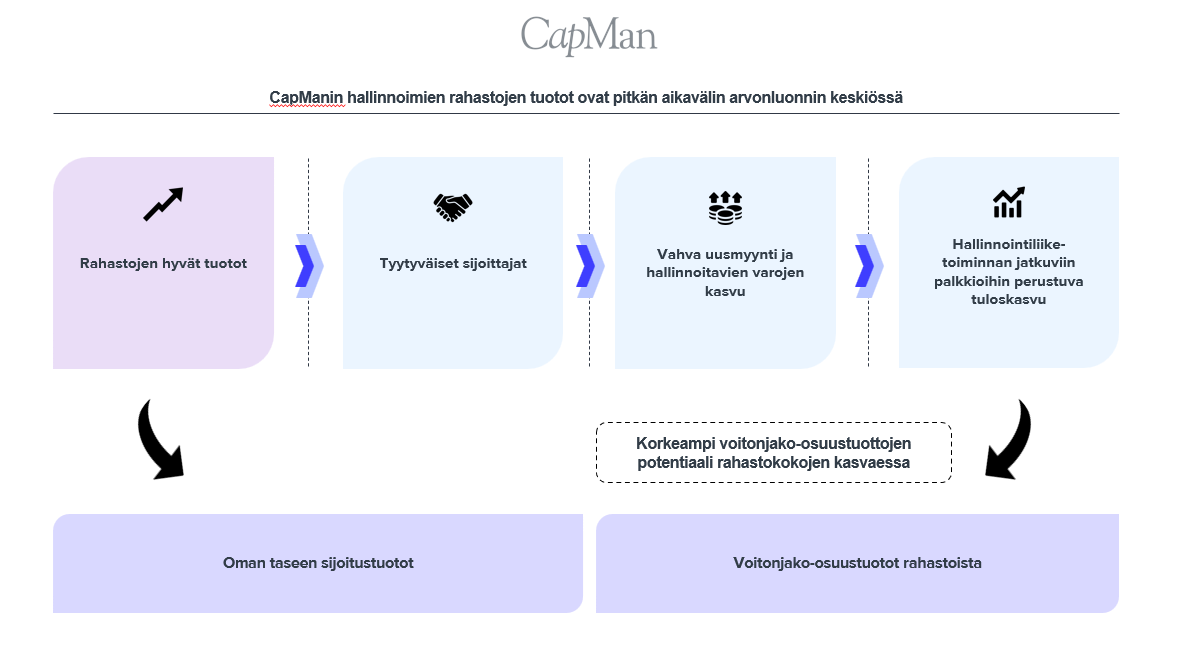
Finally, a reminder about CapMan’s business model and the fact that the whole thing ultimately rests on the good returns of the funds. If your products perform well, the other components will work too. Conversely, if the funds do not succeed, everything else becomes difficult. Fund performance is very hard to track from the outside, and the best metric for investors is carried interest income. If you don’t get carried interest, it unfortunately indicates that the underlying funds are staying below the hurdle rate. In a single vintage, this can be okay if the vintage has been terrible and you outperform peers. For example, in real estate vintages raised just before interest rates rose, you don’t need to expect carried interest, but being “at the top of the pile of corpses” is a decent performance. However, in the long run, the hurdle rate should be reached systematically. Here too, CapMan has a clear point to prove, as several large funds should move into the carry phase over the next two years. :bullseye:

47 Likes

I don’t have the facts on this, but my understanding is that those VC funds are international funds, not Finnish ones. Furthermore, even if there were some Lifeline funds involved, that Oura jackpot would have already largely been reflected as valuation increases. Oura has been steadily raising capital at higher and higher valuations, and typically in these cases, VCs book the values based on the most recent funding round. Therefore, in Oura’s case for example, the value appreciation from zero to 10 billion is already on the books, and “only” the valuation jump occurring at the IPO (10-50%) would remain.

15 Likes

Looking a bit at Capman’s PE investments, with the current investment policy, Capman will likely continue to steer well clear of companies like Oura, not to mention quantum stocks. Perhaps it’s better this way, but one almost falls asleep trying to find any original investment target that Capman is involved in. Furthermore, since they operate across a million different industries with several different business models, this truly is an interesting department store of various goods.

8 Likes

Here are Sauli’s thoughts on CapMan in video format as well. :movie_camera:

Sauli mentioned that CapMan is not primarily a dividend play, but I still ruthlessly exploited the 7% dividend yield for the video title and thumbnail. :smiley:

20 Likes

CapMan Growth exits Silmäasema – Terveystalo to acquire the company’s entire share capital

The CapMan Growth Equity II fund, together with other shareholders of Silmäasema Oy, has signed an agreement to sell all shares in the company to Terveystalo Plc and its subsidiary, Terveystalo Healthcare Oy. The arrangement strengthens the position of the combined Terveystalo and Silmäasema entity in the growing eye health market and enables an even better range of services and care for customers.

Silmäasema is Finland’s leading eye health company in both private eye health and optical retail. CapMan Growth invested in Silmäasema from the Growth Equity II fund in 2023 as part of an approximately EUR 40 million investment round. In connection with this, CapMan Growth exited Coronaria Oy, which has served as Silmäasema’s largest owner and will become Terveystalo’s largest shareholder upon completion of the arrangement. CapMan Growth’s Managing Partner, Antti Kummu, has served as Chairman of the Board of Silmäasema since 2019.

Silmäasema’s revenue has grown steadily and faster than the market at an average annual rate of 16 percent during CapMan Growth’s ownership period between 2020 and 2025. The company’s revenue has more than doubled to EUR 267 million and EBITDA (IFRS) has quadrupled to over EUR 55 million (2025). During this time, Silmäasema has also become the market leader in its field in Finland. A key part of Silmäasema’s strong growth and high profitability has been its unique integrated operating model, which covers all eye health services.

The completion of the arrangement is subject to approval by the Finnish Competition and Consumer Authority and the decision of Terveystalo’s Extraordinary General Meeting to authorize Terveystalo’s Board of Directors to issue Consideration Shares.

The exit is CapMan Growth’s tenth and the Growth Equity II fund’s second.

17 Likes