Off the top of my head and simplified: momentum. First, there was a strong upward spiral that attracted shareholders who just wanted to join the rally. Then, once the direction reversed after some degree of overshooting, those same people exit as the share price drops. Ultimately, markets are a balance of supply and demand, and more sellers were found at the peak, after which the pressure has continued. First, there was strong positive momentum, and now there is strong negative momentum, and both are hard to reverse. It will be interesting to see the changes in ownership at the turn of the month.
I wonder if this actually came from Buffett: “Short-term, the market is a popularity contest, while long-term it acts as a “weighing machine” that recognizes true company value.” In other words, fundamentals rule in the long run, while the short run is more of a popularity contest—and that popularity is largely proportional to the share price development.
There was nothing wrong with the results. The guidance was lackluster compared to our expectations, but in the big picture, the outlook remains excellent. It’s just that no one knows the timing of potential new contracts.
If I may follow up, do you think it’s just thousands of “retail investors” dumping their positions en masse, or is there a larger player, such as SEB’s large-scale investors, making some strategic moves?
How do you view your current recommendation of €34 and “Reduce”? We are already €8 below that. If your recommendation was based on current information and outlook, nothing has changed with the company itself; the share price has just plummeted. Is this stock starting to become attractive, and should the recommendation be changed to “Accumulate/Buy”?
Momentum certainly played a part, as the end of the year was such a blast in terms of deals. Thousands of new people / retail investors surely jumped on board.
But wasn’t that rise mainly driven by SEB, which accumulated nearly 1.5 million shares in a couple of months? And the shares went into a nominee register. Of course, at the same time, hundreds (or even thousands?) of new small investors also joined.
However, I don’t know if this kind of activity is ultimately quite normal—that for a company of Bitti’s size, and on the Helsinki Stock Exchange (sarcasm) of all places, such a quantity of shares (worth tens of millions) is bought just because of momentum? And I’m talking about SEB’s purchases now. And then they want to stay hidden?
It seems SEB was buying quite a lot even when the share price was over €40.
SEB has also sold occasionally, then bought again, but in recent days they have demonstrably sold more; you can see it in the share price as well.
So, did some deep pocket just see good momentum here, grab tens of millions worth of shares, and then quickly decide “to hell with it” and is now dumping them?
There are certainly those hundreds and/or thousands of disappointed retail investors selling, probably some domestic funds too, but the volumes are such that SEB seems to be playing both sides—right now they’re just hitting the sell button a bit more. The total ownership hasn’t dropped particularly much from the peaks, though (unless there’s been a radical drop in the very last few days).
I’m interested in that setup: what’s the logic, and who or what is behind it, as SEB itself is now clearly Bitti’s largest owner, despite the recent selling. Of course, there could be any number of different parties, funds, or whatever behind it, but why would everyone use SEB’s services specifically?
Several parties must have been accumulating ownership there, since there haven’t been any flagging notifications (liputus).
Juha, what are your guesses regarding this situation?
Bittium was previously a grossly overpriced bubble stock and remains expensive even after this drop, even if you take the upper end of the guidance: EBIT of €32 million vs. the current market cap of ~€930 million..
I didn’t say anything about “retail investors,” but let’s clarify that international investors were likely the biggest reason behind the rise. As I said then, the supply/demand balance is distorted when private investors hold or buy while international investors and foreign interest have joined in. And domestic institutions can also be quick in their moves, especially around the turn of the year when they can act quite irrationally—because who would want to show that they completely missed out on last year’s biggest gainer. So demand > supply, the price adjusts upwards.
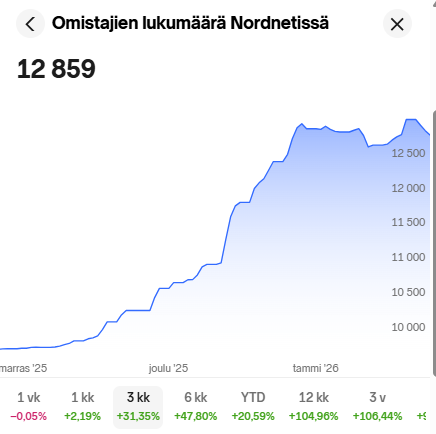
At some point, large sellers appeared in January. The largest were apparently Jtel Oy (−224,519 in January), Aktia fund (−150,000), and Varma (−130,000). That’s when the needs of even a larger buyer start to be satisfied. Private investors seem to have stopped buying and have lightened their positions as sentiment has soured along with the share price. So there hasn’t been buying pressure from there either, but nothing points to an actual collapse. Looking at the change in sentiment, I’m even a little surprised that the number of owners on Nordnet hasn’t decreased—a threat or an opportunity for the coming weeks?
Then that dynamic changes, meaning supply > demand and the price adjusts downwards. This is, of course, a simplification, but perhaps it’s sometimes necessary to return to basics rather than over-analyzing everything.
First, it must be noted that behind SEB’s nominee register, there must be many different parties who seem to behave in different ways. Therefore, it’s difficult to assess this SEB situation one way or the other. Why must there be many different parties? Because SEB had a 6.76% ownership stake at the end of January, yet no 5% flagging notification (disclosure notice) has been made. You already knew this, of course.
In other words, there could be, for example, a large international investor who believes in Bittium in the long term but wants to keep themselves “hidden” by owning 4.99%. Of course, if they are truly a long-term owner, it will surely come to light at some point. Additionally, there could be short-term speculators who jumped on the momentum and left once it died down. Globally, there are even momentum funds whose strategy is based specifically on exploiting this phenomenon. I’m not saying this is the case, but there isn’t necessarily any greater wisdom out there internationally one way or the other.
I don’t really believe that pondering this with current information will provide any greater insight, but it is interesting to follow. SEB can be used by many different parties without any specific reason; it might just be that SEB has had connections to large sellers and thus something to offer buyers. And again, different players can have completely different motives. SEB is strong in Sweden, which could be a logical place for international investors interested in Bittium.
For clarity, I will state that I am not criticizing anyone’s buying or selling here—everyone does as they please, as long as laws are followed. I try to focus on the fundamentals and assess their development to the best of my ability.
We do not comment on any possible or impossible changes in advance. I can say that not even a week has passed since the previous report. If you look at Inderes’ operating model, we don’t usually update our view weekly, at least not without news about the company.
Again, for full transparency, I can state that I still indirectly own 2,000 Bittium shares. By the time our blackout period was over (Tuesday, Feb 24), Bittium’s share price had already fallen sharply (>15%) below our target price. Even though I could have theoretically reduced my holding with a “reduce” recommendation, that discrepancy with the target price was already so large that permission for transactions would not, in principle, have been granted. So here I am, riding the decline just as I was the rise earlier. Someone will probably get upset again because “I haven’t followed my own recommendation,” so this is the background to that. Or I don’t know, maybe it doesn’t bother anyone since this time the direction is bad for me
If I had been able to act above the target price, I would have gladly followed it at least enough to come below the 50k disclosure limit. But since in our operating model investors come first, here we go—perhaps the limit will be reached through the share price decline. Values aren’t really values if they don’t cost anything. And there’s nothing dramatic in this for me; the sum is still not significant for me, and I have much bigger problems than the fall of Bittium’s share price. Let’s see how this plays out in peace.
On the KL forum, people have been visiting or calling Euroclear.
The amount of SEB’s nominee-registered holdings reached nearly 3 million shares in mid-February and has now slid down to the late January level of 2.4 million shares.
Whatever the ultimate reason behind it may be, there were over 1 million older shares held there. Perhaps one party in the nominee register started buying, and as the price rose, another started selling, and the balance has shifted to net selling.
Also, below is apparently the data retrieval date and the corresponding Euroclear data. I wonder if it shows holdings from a couple of days ago if the settlement time is (T+2).
The extensive report estimated that the 2026 EV/EBIT for Bittium’s defense & security segment was 28, while for BAE, Thales, Motorola, and L3Harris it was around 20, and for Elbit as high as 36. Following the share price drop, Bittium’s multiple is likely now close to the cheaper peers. Or actually below most of them, as the share prices of many have risen by over 20% since the start of the year. Elbit is in a league of its own despite the loss of Indra.
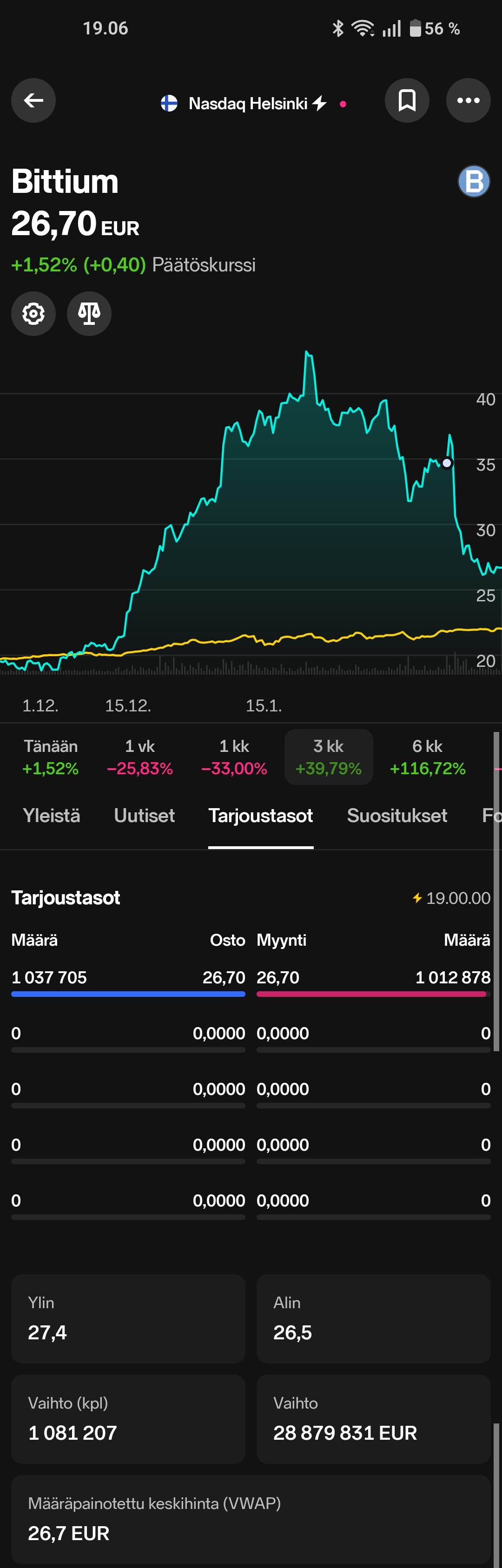
First, 68k shares are traded back and forth during the day,
Then the closing auction and 1,012k shares.
1 million shares and 27 MEUR turnover is already nearly 3% of the total shares outstanding. Churning could, of course, have occurred between funds of the same owner, etc.
the trading price of 26.7 EUR seems to be quite close to the average of the day’s other trades and generally the level that prevailed before the auction