There’s a lot of market headwind right now. I still believe that for a long-term investor, there’s a really juicy opportunity here. A few things that come to mind, somewhat poorly structured:
The e-commerce market is extremely interesting when you delve into the dynamics of e-commerce in different categories. E-commerce is too often discussed as a single online blob, assuming they behave the same way in the market, and listed e-commerce companies, among others, all drop simultaneously on the stock exchange when some player lowers forecasts. This was concretely seen when fashion e-commerce company Boozt lowered its outlook last week, causing both BHG and CDON to drop at the same time, even though their product categories are completely different. There are really big differences between product categories in e-commerce, for example, when looking at marketing costs or return rates (e.g., in fashion, marketing costs, return rates, and the proportion of products sold at a discount are all high compared to other consumer goods e-commerce categories). So, the category mix is very important when comparing these as investments. Some product categories are also very local businesses, surprisingly, for example, the furniture market and partly home decor, where local category management and a local supply chain are key. In many home appliances, installation services and their functionality are definitely a competitive advantage. Also, the average order value (AOV), which for BHG is approximately just under 300 euros and for Boozt, for example, around 90 euros, affects operational profitability. One could talk at length about the different categories of e-commerce and their dynamics, but the point is to look deep into the product category mix and the supply chain, not just the demand drivers and the e-commerce company’s ability to sell products. The spontaneous brand awareness of an e-commerce company also has a big impact, bringing organic visibility; similarly, the breadth and quality of built customer bases, as regulation related to customer registers is constantly tightening.
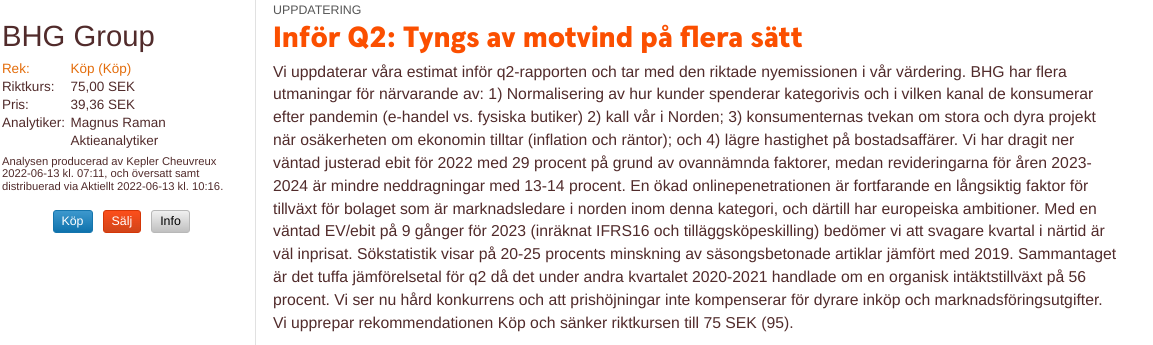
When we look at the near-term outlook, for BHG, the comparison period (spring 2021) was very good, which means that relative growth will certainly be low, and the market might be alarmed by that when the Q2 report comes out. This spring has also been cool, which will surely be reflected in the sales of very profitable outdoor furniture during Q2, and last year people also bought a lot of them, which means a 1-2 year purchase hangover. The DIY boom was also at its peak during the corona pandemic, so many have already bought hardware store products a year ago, filling their cabinets. Similarly, discretionary spending is under pressure, and fewer home sales are apparently taking place, which is reflected in the sales of Netrauta and Taloon.com-type e-commerce stores. So, there is headwind, and that certainly explains a lot why the stock price is at such a low level.
But then, if you think about when a long-term investor should pick such companies for their portfolio, I personally think that now is a better time than, for example, at the peak of e-commerce demand boosted by the corona pandemic. In the Nordic region, the total market for BHG’s product categories is about 30 billion euros, and online penetration is still low (about 10-13%) in both main segments. Digitalization is unlikely to stop, and the clear competitive advantages of e-commerce companies will not disappear, even with headwinds. These products will continue to be sold in the future, and the industry is also very fragmented in Europe, and BHG (largely thanks to anchor owner EQT) is in a clear position as a market consolidator. Someone previously referred to the increase in the number of shares; the background to this is that acquisitions have been partly financed with own shares, i.e., a targeted issue has been made to the seller, which I consider a good thing for the success of integration = a common interest in creating shareholder value.
It’s also worth looking at what kind of players have been acquired into BHG’s portfolio. There are truly category-leading e-commerce companies, such as NordicNest, which sells Scandinavian design to 70 countries. These acquisitions in Finland have also been high quality, including Netrauta. Expansion into Germany also began last year with the acquisition of AH-Trading. So, there is indeed value within, and synergies for many of last year’s closed acquisitions are still being built, and integration is partly ongoing. In my experience, the benefits of these industry integrations are fully realized only within 1-3 years, once systems have been merged (and duplicate costs eliminated), product management harmonized, accounting and part of administration centralized, supplier synergies analyzed, and cross-selling initiated, etc.
As valuations have fallen, I’ve personally speculated that, in addition to European expansion, a larger consolidation move in the Nordics could also be possible. The image below is from an investor event where BHG presented the acquisition of AH-Trading, and towards the end of the presentation, there was this telling visualization of BHG’s growth directions, with the title “everything for the home.” They haven’t communicated this before, and it seems clear that BHG will not remain in its two current main segments but will expand into new verticals. E-commerce valuations have now fallen significantly, which can be a big opportunity and bring a nice overnight surprise in the form of a corporate arrangement. In the Nordics, CDON or Boozt are listed options, and there is also one larger listed player here in Finland with over 500 million euros in revenue  The Hobbyhall e-commerce store would also fit very well, as they operate in exactly the same product categories, so there would be synergistic acquisitions in the market. Investment company Ferd AS, by the way, is the 3rd largest owner in BHG (6%) and the second largest in Boozt (12.5%)… EQT, as BHG’s main owner, has certainly conducted a thorough due diligence of the market and its consolidation potential, so I am quite sure that there are several recipes in the cookbook for successful value creation.
But we will follow with interest  !
!