Soon €80/t CO2, though I don’t know how many free emission allowances cement producers have.
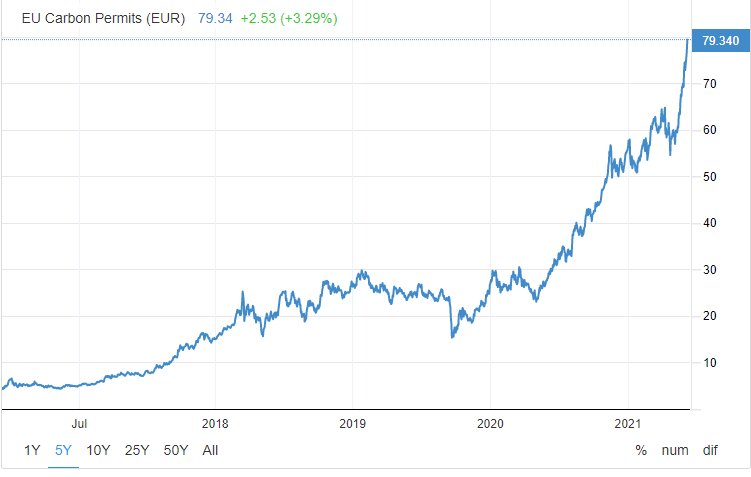
If I remember correctly, there was a question from the audience about this during the company presentation, specifically whether cement producers are subject to emissions trading, and the answer was that they currently receive a lot of free emission allowances.
This is how I see it. It’s not just about the binder, but for example, changes in the aggregate’s grain size or shape can affect the end result. Additionally, in winter, a very cold aggregate can significantly impact the initial bonding. In practice, these factors are likely measurable per batch, but it would undoubtedly require significant investments for many stations to install various meters, as well as operational costs for calibrations and maintenance. Homogenization is certainly possible, though it can be very expensive, and I’m not sure if there’s existing technology for it. I haven’t, however, delved very deeply into the manufacturing of cement, its admixtures, or geopolymers, so I can’t say more precisely about that.
Of course, very precise fine-tuning isn’t always necessary; often, a coarser level suffices. The fact that Betolar doesn’t get all recipes right at once doesn’t mean it can’t succeed.
While a computer program can certainly create recipes for many typical “easy” mixes with a few iterations, an experienced concrete mixer or lab technician can also do this, so a program designed for this wouldn’t be beneficial then.
Still, regarding those emission fees: From a large hardware chain’s online store, you can buy Finsement’s plus cement in 25-kilogram bags for 0.27 cents per kilo, and this includes the hardware store’s margin and taxes. In practice, one can conclude that for large buyers, the price is likely much less than €100/ton. If carbon emissions cost €80/ton, which is about €40/cement ton, this portion could be truly significant for the cost of concrete, considering that cement accounts for a very significant part of material costs in normal concrete. Currently, it’s understandable that the concrete industry receives these emission allowances for free, because otherwise, construction costs would further swell. However, when reasonably low-carbon alternatives become available on the market at some point, I believe it’s to be expected that free emission allowances will start to be reduced.
5 Likes
It seems the offering didn’t close early after all. So, demand for the shares was poor or at best moderate.
This reminded me of an earlier news headline about an expansion wing being built at Turku University Hospital. After the groundwork was completed to a certain point, it was discovered that the concrete had serious quality problems. Luckily, it was noticed at this stage. Everything already built was demolished and started over.
If waste streams are mixed for construction site use, one must be very careful to ensure that quality problems do not arise even years later.
4 Likes
Hi @Betis and thank you for your insightful post.
I was absolutely sure I would subscribe to Betolar because I thought the question was about adding atmospheric carbon dioxide to concrete. I understand that this kind of technology has at least been researched, if not already available. Also, adding carbon dioxide to concrete improves the strength of the concrete and additionally binds carbon dioxide into the structure, which makes concrete construction more carbon neutral.
Do you, @Betis, have any insight into this process and whether this type of activity exists here in the Nordics?
1 Like
I’ve also read about that sometime. As I understand it, in that method, carbon dioxide is captured from another factory’s chimney before it reaches the sky, and then somehow injected into concrete. However, I don’t know if this is done anywhere on a significant scale. As far as I know, it also has nothing to do with Betolar.
Normal concrete naturally absorbs carbon dioxide from the air. This phenomenon is called carbonation. Carbonation slightly increases the strength of concrete, and at the same time lowers the pH value of the concrete enough to allow steel corrosion, so most of the time it is a very bad thing. I can’t say if some cement-replacing material can affect this process. If it could, it would certainly also be a huge goldmine. However, these speculations don’t seem to me to be very relevant to the topic of the thread, so it’s better to leave it at that.
3 Likes
I haven’t heard of any large quantities either, but you can find some in Britain:
Wasn’t this technology what was talked about in the offering (or was it in Verneri’s interview)? It was supposedly an investment of millions that would take a couple of years to implement, if I remember correctly.
How I myself have interpreted (read: speculated about) this AI matter is that they use some kind of simulating AI model (or aim to develop one) that tries to produce continuously better simulations based on data accumulated from measurements, ultimately feeding itself. This way, the machine learning model can eventually generate its own data for simulations when recipes are applied to new combinations/waste streams. An interesting tidbit on how this works is a “generative adversarial network”, which is not related to this in any way but merely illustrates how AI can also train itself. Often, the AI idea is based on the company possessing an exceptionally large amount of well-described data that can be used to feed a machine learning algorithm. Sure, those algorithms are also being tweaked around the world with millions in annual salaries, but the amount of high-quality data is probably the key thing without which even a mediocre algorithm cannot be made. A more accurate term than AI is machine learning, which is practically just an exercise in mathematical optimization that, thanks to modern circuits, can be performed so fast that results can be obtained in a reasonable time.
This AI matter has not been described in any way, nor has it been explained why Betolar would be ahead of others in it, which is why everything discussed above is strong speculation. Because it has not been described in any way, the question arises as to how advanced the work can be. There are many researchers/people with research backgrounds in R&D, but there are no actual machine learning experts there. My own interpretation is that the AI part of this recipe is ultimately quite trivial from a competitive advantage perspective (=that part would be easy to copy), but the others are not.
1 Like
Concrete proportioning mainly consists of measurable discrete variables. Thus, a neural network can be trained to produce desired outcomes if a good outcome is known. This has been done, even in Finland; for example, if you type “Abhay Bulsari” into Google, you’ll find Finnish content online, such as this article:
A very meritorious review of the basics, Betis. I think you meant to say that concrete proportioning is an incredibly complex phenomenon and cannot be solved with just cement paste or binder. Instead, it requires in-depth expertise in the aggregates used, their particle size distribution, the fillers used, etc. And as I previously asked myself, does Betolar have any high-caliber concrete technology veterans on its payroll?
Another thing that astonished me was whether they have actually even mixed aggregates into their geopolymer paste yet?
1 Like
What does the adoption of this new binder really mean? It’s a very long process before the necessary official approvals are obtained and the required tests are completed. It certainly doesn’t work by finding some side stream, then typing on a computer, and after that, starting to pour concrete for an apartment building or a bridge.
Machine learning and other buzzwords are of no use when it comes to obtaining those official approvals.
4 Likes
You are absolutely right that this deployment cannot happen very quickly. I’m not particularly familiar with those regulatory issues, but I do have some information about them. Once it has reached the stage where someone offers a new binder to a concrete manufacturer, the binder has presumably already been CE marked. I can’t say how the binders are marked, especially if the substance in question does not clearly belong to any existing standard, but is indeed a new product.
If I have understood correctly, Betolar’s biggest advantage would arise in the next stage, where recipes are developed with the new binder. It is very difficult to say how long this stage usually lasts, because with a new binder, existing additives may not work as expected, and their properties may also have to be adjusted. If sufficient changes have to be made to existing additives, their approval is also pending. The most typical test almost always done with concrete is the 28-day compressive strength, so both the masses and all materials will take at least that month of waiting for testing. Of course, it may be possible to do things at the same time.
Thus, if Betolar can at this point only take samples of the offered binder and existing aggregates, and the computer tells what kind of recipe is needed, and what kind of additives are needed, the implementation can be shortened a lot, as it is possible to directly manufacture the additive, start its approval, and at the same time start the concrete approval process. Another option is to first perform tests with the binder paste, then add the additives and modify them. After that, stones would be mixed in, and finally, cubes would be compressed and probably started from scratch, because there are inexplicable differences in strengths. So if this stage can be condensed directly into concrete testing, and these test rounds can be reduced, there is a clear competitive advantage.
After this stage, the final product still needs to be approved, which will take at least another month, while waiting for the concrete to reach its review age. At this point, it must be mentioned that my own knowledge focuses largely on the practical stage, where the first concretes are mixed in the lab, and we wonder why nothing works again. When going to the concrete plant, most of the problems have usually already been solved in the lab. As I understand it, Betolar’s work would aim to bypass this lab phase with artificial intelligence that can anticipate these things, and they would move directly to fine-tuning the mix at the factory. I wouldn’t be sorry at all if this lab fiddling were reduced, because unpleasantly often it feels almost like guesswork.
@Takahuhti You understood correctly. I know from experience that adjusting a concrete recipe can be very challenging. Sometimes it succeeds at once, but more often, unexpected things come up in testing, and very extensive expertise is needed to solve these surprises. One reason for this, in my opinion, is that we still know the properties of concrete relatively poorly. Of course, many things are well known, but there are also many things that have not been studied much yet. As our knowledge increases, the time will surely come at some point when this Betolar system works. As an investment case at the moment, I don’t think we are there yet. I hope I’m wrong, because the benefits would be enormous.
One additional question that would probably require a chemist familiar with the subject to answer is the customization of those additives per factory. For example, plasticizers are typically used in modern concrete at 0.5-2% by weight of cement, meaning in practice a good guess for averages could be 2-4 kilograms per cubic meter. A chemist would be needed to answer how much concrete one plant needs to produce for it to be profitable to manufacture its own additive, or does Betolar have a partner or method that allows relatively small quantities of different additives to be made, or is there a certain minimum capacity for customers, below which smaller operators cannot become customers? Plasticizers are perhaps the easiest example of this topic, because they are used the most. At the other extreme are air entraining agents, whose consumption can be <0.1% by weight of cement. In Finland, for example, all concrete left outdoors must be air-entrained, so the product cannot be bypassed, but must be available. However, it is difficult to see that its customization could be profitable, because the quantities are so small. With both mentioned substances, their function is based on their action specifically with cement and water, so with another binder, they may be useless.
At the moment, the problem described above is largely handled by the fact that the raw materials are reasonably well known, and the recipes can be modified to work with current additives. Of course, additives are also continuously developed and new ones are tested, but known raw materials significantly facilitate this. In Betolar’s model, where each plant can have a different binder, it is by no means set in stone that the same plasticizer will work at all at two different plants. Of course, if two plants use slag, even if the slag comes from different places, it can be assumed that the additives also have a lot in common, but a slag plant and a completely different geopolymer plant may not be able to combine their chemicals effectively in any way.
As a general observation, it may also be good to consider the source of the slag. Nowadays, almost all steel is produced with coal, but the first hydrogen-reduced steels have already been introduced to the market. I am not very familiar with the steel industry, but my strong guess is that hydrogen steel slag is chemically quite different from coal-reduced steel slag.
At this point, however, it must be noted that Betolar largely states that they have solved all these problems. If that is true, this consideration is unnecessary, and one of the best things for the environment in a long time is coming to the stock market.
Edit. Typo correction
15 Likes
“Betolar Plc’s (“the Company”) initial public offering for private individuals and institutions in Finland (“Public Offering”) has been oversubscribed multiple times.”
12 Likes
Regarding plasticizers, at the construction site, a “drink glass” worth of plasticizer needs to be added to one 8 m3 load, and the mass changes significantly. According to my own estimates, a customized plasticizer for a concrete plant would never be economically viable. However, plasticizer is a bulk commodity.
There are also huge financial risks associated with these concrete admixtures. If the mix fails, it incurs enormous costs. Admixtures also need to obtain regulatory approvals. In practice, such risks are completely unsustainable for the concrete supplier.
5 Likes
Even institutions liked the startup, at least the oversubscription.
4 Likes
There were just over 4,300 new shareholders:
Commitments made in the public offering will be fully accepted up to 50 shares offered, and for the amount exceeding this, approximately 6 percent of the subscription commitments made.
10 Likes
Betolar’s Geoprime (Geoprime) is going to be tested in residential construction.
6 Likes
Karo Hämäläinen’s article on Betolar doesn’t seem very bullish. Especially if, in some timeframe, blast furnace steel production and coal-fired energy production decline towards their end.
3 Likes
Can Betolar be shorted somewhere?
2 Likes
That’s an interesting question, how much they actually profit from licensing fees. However, I believe this is their primary means of generating profit, at least in the short and medium term. I tried to estimate those licensing fees myself during the IPO, but found it difficult. Admittedly, at least with the numbers in that article, the financial targets might be set a tad optimistically.
Reselling chemicals will probably boost revenue, but that business is unlikely to yield very good margins. This also raises the question of how many of those chemicals are needed per ton of concrete when talking about material produced from side streams. I don’t remember seeing any numbers on this anywhere, but it’s possible I missed them. If anyone knows, please share 
As for the revenues from the recipe AI platform, I don’t think we can say anything at all with this information, so for now, we’re just going along with the story 
1 Like
Betolar Plc: Betolar and JA-KO Betoni sign 10-year Geoprime® license and supply agreements
7 Likes