A thread for BDC companies.
Unlike CEFs, these can generally all be purchased normally (excluding, for example, some misclassified ones, such as Morgan Stanley’s very interesting MSDL, which Nordnet has misclassified and still hasn’t corrected despite numerous requests).
A business development company (BDC) is an organization that invests in small- and medium-sized companies as well as distressed companies. A BDC helps these firms grow in the initial stages of their development. With distressed businesses, the BDC helps the companies regain sound financial footing.
Similar to closed-end investment funds, many BDCs are public companies whose shares trade on major stock exchanges, such as the American Stock Exchange (AMEX), Nasdaq, and others. As investments, they are high-risk but offer higher rewards.
I personally have (perhaps) an overly large weight in these because I want a high cash flow (=dividends) to be able to continuously buy more of the investments I am following at any given time and to take my share of the growth of (mainly) US small and medium-sized UNLISTED companies.
Typically, BDCs have dozens or even thousands of companies as clients, so good diversification is naturally achieved here.
BDCs can be found ranging from giants (e.g., ARCC) to companies under $100m (early-stage). Many massive financial sector companies also have a BDC (such as BlackRock, Blackstone, Blue Owl, Goldman Sachs, and the already mentioned Ares).
One of the most well-known among Finns is likely MAIN, which is one of the rarer internally managed companies and which, year after year, trades at a very high premium relative to its NAV.
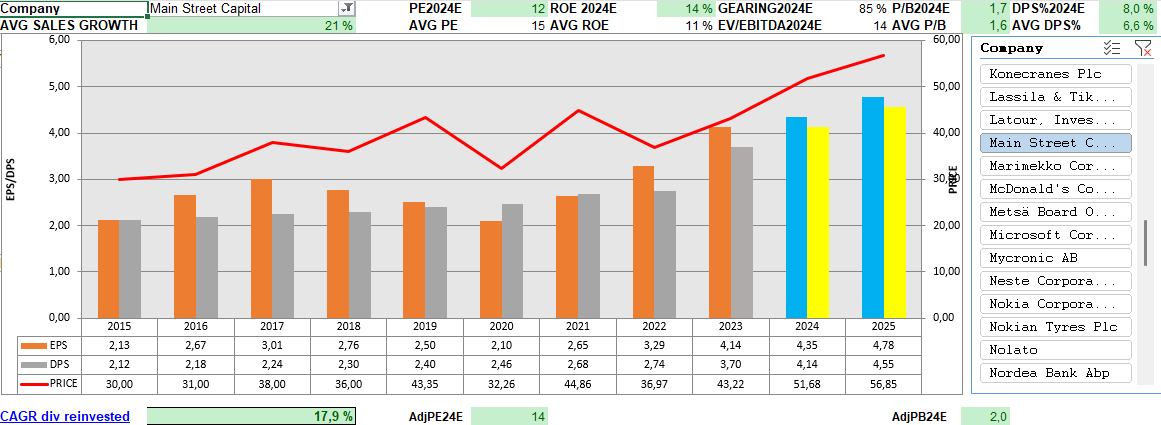
My favorite of these is Main Street Capital, which pays a fairly good dividend yield every month and additionally a few extra ones a year. It has also been delivering good results for a long time now.
Some you can, some you can’t. Based on some reasoning of their own, they classified some BDCs as closed-end funds, which cannot be purchased under EU legislation.
They are currently looking into the matter. It’s a shame if they can’t get it fixed. For example, the MAIN I mentioned is classified as a closed-end fund, which I don’t think it is.
MAIN is definitely not a CEF, so have those spineless folks at Nordnet now blocked the purchase of MAIN too?
For example, the word “fund” appears in the definition of MSDL, and it feels like some summer intern at Nordnet has categorized it as a CEF based on that, even though I linked directly to the MSDL website, which states clearly that it’s a BDC.
This is starting to be the last straw (the list is long… the worst being the non-compliance with the Finland-US tax treaty) from Nordnet before switching brokers.
According to the U.S. Securities and Exchange Commission (SEC), BDCs are all by definition CEF funds:
" BDCs are a type of closed-end investment fund. They are a way for retail investors to invest money in small and medium-sized private companies and, to a lesser extent, other investments, including public companies. BDCs are complex and have certain unique risks. This Investor Bulletin discusses BDCs whose shares can be bought and sold on national securities exchanges, or “publicly traded” BDCs.
This doesn’t quite belong in this thread, but I’ll ask anyway, since I hold FSK among those BDCs.
I personally haven’t noticed that dividends from the USA weren’t taxed “correctly” at NN.
What is the problem with NN’s actions regarding taxes?
I personally have had a quite diverse collection of different BDCs (including FSK, which you mentioned) as well as other US-headquartered dividend payers since the start of 2021, and at least so far, none of them have had taxes withheld incorrectly at Nordnet (nor at OP). It’s always the 15% that stays in the US and the rest is then handled through Finnish taxes.
I have a position in PSEC, i.e., Prospect Capital. What’s interesting about this company is that management owns a significant portion of the company (I think it was around 25%) and thus shares the risk with their own capital.
The dividend yield is 13-14%, and they have a broadly diversified portfolio and even their own real estate REIT company among their holdings. It seems to be the longest-running BDC company, according to their own words, for over 20 years.
I’m in this purely for the dividends, and they’ve been coming in nicely. I had a position earlier, around 2016 or so, and held it long enough then that it paid out dividends equal to the principal, i.e., the original investment. My feeling is that I can stay invested with peace of mind; the company is not one of the smallest BDCs.
I don’t have any other BDCs at the moment as I don’t really have enough time to follow them, though it would be good to track them to stay on top of things.
BDCs have been on my radar for quite some time. They seem to be very competitive as investment targets compared to, for example, fixed-income instruments, as one could leverage the compound interest effect with a general return of about 10%. At the same time, you are diversely exposed to the development of the US economy.
Despite 2-3 years of monitoring, I still don’t have any Business Development Companies in my portfolio. There are reasons for this:
How will BDC returns develop as US interest rates edge downwards?
An additional risk related to the above is Donald Trump’s intention to harness interest rates under “presidential guidance.”
How will BDCs fare if the US enters difficult economic times? The multi-year US economic boom is partly built on reckless borrowing, and this party cannot last forever.
So, I want to see the presidential elections first, and especially DT’s rise to power with trade wars etc. could bring about all sorts of scenarios. Secondly, I would preferably time my potential purchases for a cooldown in the US economy. This would allow me to see a) how BDCs generally withstand a brittle economy, and b) if company-specific differences emerge between the US Business Development Companies. In other words, how the industry and its different companies weather the storm.
For example, one of the most popular BDCs among Swedish investors is New Mountain Finance, whose performance and share price have slipped recently. If we set aside the enlightened investors of the Inderes Forum, BDCs haven’t been very visible in Finland, with the exception of the article below.
Lower Borrowing Costs: BDCs often finance their investments with debt. A decline in interest rates can lower borrowing costs, which improves profit margins.
Increased Investment Activity: Lower interest rates can stimulate economic growth, increasing the demand for loans and investments. This can improve BDC portfolio performance.
Higher Valuations: As interest rates fall, the present value of future cash flows increases, which can boost the market valuations of BDCs.
Improved Portfolio Performance: Many BDCs invest in companies that can benefit from low interest rates, leading to better performance and lower default risks.
Potential Concerns
Contraction of Interest Margins: If BDCs cannot lower their investment yields as quickly as their borrowing costs, their net interest margins may narrow.
Dividend Pressures: BDCs are often required to distribute a significant portion of their profits as dividends. If lower interest rates lead to a decline in income, maintaining dividends can be challenging.
Market Sentiment: Investors often react to interest rate changes with emotional and market shifts, which can lead to volatility in BDC share prices.
Potential Impacts
Political Influence: The president’s ability to adjust interest rates could lead to political decisions influencing economic policy. This could increase economic instability, especially during election cycles when decisions might be made for populist reasons or short-term gains.
Erosion of Confidence: Mistrust may arise among financial markets and international investors if interest rates are determined by political decisions. This could lead to rising interest rates and economic uncertainty.
Inflation: If the president sought to keep interest rates low to support economic growth, it could lead to accelerating inflation, which in turn could affect the cost of living and purchasing power.
Monetary Policy Instability: A weakening of central bank independence could lead to instability in financial policy. This could make economic forecasting and planning more difficult for both businesses and households.
Investment Strategies: If the market fears political direction in interest rates, investors may change their strategies, which can affect the stock and bond markets.
Impacts of a Recession on BDCs
Increase in Defaults: With a recession, many companies in which BDCs have invested may face financial challenges. This can lead to an increase in defaults and thus a decline in the value of BDC investments.
Lower Returns: A recession can weaken companies’ ability to pay interest and dividends, which in turn can affect BDC income and dividend payment capacity.
Decision-making and Investment Tactics: BDCs may change their investment strategies, focusing more on stable and less risky investments, which could affect their growth potential.
Market Sentiment: A recession can cause fear and uncertainty in the markets, which can lead to a decline in the value of BDC shares and general volatility.
Impacts of Debt Exceeding Sustainability
Deterioration of Credit Ratings: If US debt exceeds sustainable levels, it could lead to credit rating downgrades. This can raise financing costs for both the government and BDCs, affecting their profitability.
Acceleration of Inflation: High debt can lead to inflationary pressures, which can affect interest rate levels and thus BDC borrowing costs. Lower rates might initially benefit BDCs, but accelerating inflation can later increase financing costs.
Weakening Investment Demand: If the economy is in an unstable state due to high debt, companies may reduce their investments, which could narrow BDC business opportunities.
Risks and Opportunities: Higher debt can create uncertainty, but it can also provide opportunities for BDCs that are able to identify undervalued investment targets during times of crisis.
Prospect Capital (PSEC) cut its November–January dividend from $0.06 to $0.045.
Link to an old story about the Q4/24 earnings call (held in August) (and a bit of other stuff). The Q&A was quite different to listen to compared to what I’m used to.
This month’s Q1/25 Q&A then went in a more pleasant atmosphere.
I tried in Nordnet which BDCs go through and which don’t. Not a comprehensive list, but perhaps the bigger point is how arbitrary Nordnet’s handling of these is when over 50% of BDCs can still be bought