Assa Abloy: key to the locking industry and access control solutions markets

Ehkäpä yksi aikamme ikonisimmista ja kaikkien aikojen innovatiivisimmista yhtiöistä mielenkiintoisella ja tarpeellisella alalla ansaitsee oman ketjunsa, mikä on meille jokaiselle hyvin tuttu ja minkä tuotteita jokainen meistä käyttää päivittäin.
Assa Abloy (ASSA) on 1994 perustettu globaalisti toimiva johtava kulunhallintaratkaisujen toimittaja (access solutions), jonka kotipaikka on Tukholma, Ruotsi, ja jonka osakkeet on noteerattu Tukholman pörsissä. Yhtiön ehkäpä tunnetuimman tuotteen eli tavallisen lukon siemen sekä lähde on Suomessa keksitty, tänäkin päivänä lukoissa ympäri maailman käytössä oleva innovatiivinen lukitusmekanismi ja sen ympärille rakennettu yritys Abloy, josta kohta lisää. Yhtiöllä on 48000 työntekijää 70 maassa. Vuonna 2020 yhtiö teki n.88mrd SEK liikevaihtoa (-7%), operatiivista tulosta n.12mrd SEK (-20%) ja nettotulosta n.9,2mrd SEK (-18%). Pandemiavuotena romahti liikevaihto ja tulos jonkinverran, mutta nyt yhtiö on taas päässyt kasvuvauhtiin: Ensimmäinen puolivuotis eli H1 liikevaihto oli n.45,5mrd SEK (+8%), operatiivinen tulos n.6,8mrd SEK (+40%) ja nettotulos n.5,5mrd SEK (+67%). Yhtiö on kasvanut tasaisesti orgaanisesti ja yritysostoin pirstaleisella ja fragmentoituneella alalla, ja yhtiö tavoittelee tulevaisuudessa 5% orgaanista kasvua ja 5% epäorgaanista, joten konsolidaatiota tulemme todennäköisesti näkemään myös jatkossa.


HUOM: Lukitus, kulunhallinta- ja turvajärjestelmäala on kaikenkaikkiaan hyvin laaja, monipuolinen, meitä jokaista koskeva, nopeasti kehittyvä, suuren digi- ja älyaskeleen ottanut ala, jossa alan jätti ASSA on todella vahvasti mukana markkinoiden ykkösenä, ellei jopa dominoivana osapuolena, niin tässä ketjussa voidaan keskustella yhtiön lisäksi alasta ja markkinasta yleisestikin sekä tietenkin ASSAn kilpailijoista, eli kaikesta alaan liittyvästä. :+1:


  • Assa Abloy on markkinajohtaja 100mrd usd kokoisella markkinalla
  • markkina-arvo 291mrd sek (n.34mrd usd)
  • nettovelkaa Q2 28,5mrd sek
  • oma pääoma (2020) n.59mrd sek
  • rullaava 12k p/s 3,2x
  • rullaava 12kk p/e 29x

→ 9000 patenttia
→ yli 300 yritysostoa
→ 138% liikevaihdon kasvu 10 vuodessa
→ 107% tuloksen kasvu 10 vuodessa
→ 2800 työntekijää tuotekehityksessä
→ 190 brändiä tai tuotetta portfoliossa
→ yksi maailman sadasta innovatiivisimmista yrityksistä

Tuoteryhmät

  • Mekaaniset lukot
  • Sähkömekaaniset ja sähkölukot
  • Riippulukot
  • Kulunvalvontajärjestelmät
  • Mobiililukot
  • Automaattiovet
  • Ovensulkimet
  • Hätäuloskäynnit
  • Hotellilukot
  • Turvaovet
  • Älykaapit
  • Avainhallintajärjestelmät


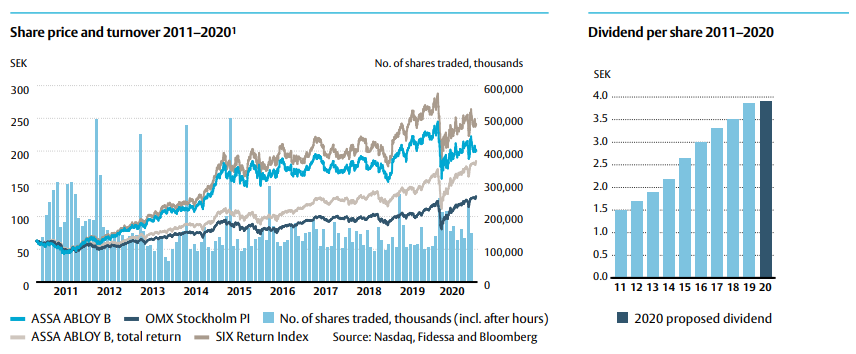
Kurssigraafi ja osinko
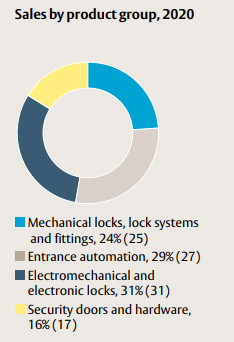
myynnin jakautuminen
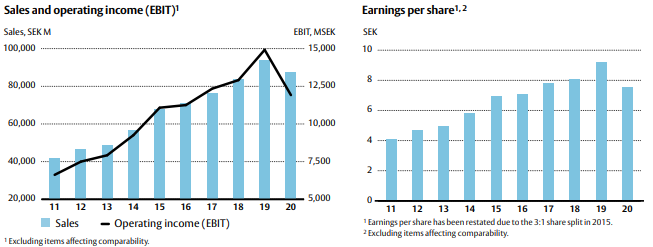
Liikevaihto, operatiivinen tulos ja osakekohtainen tulos kehitys
Lukitusalan ja menestyksen takana suomalainen keksintö

Yhtiön toisen puolen historia on ainutlaatuinen vaikkakin hieman sekava, joten siitä sananen. Yhtiön tunnettavuudesta ja menestyksestä, sekä nykyisestä olemassaolostaan lienee ainakin osittain kiittäminen juuri itsenäistyneessä Suomessa 1918 perustettua Abloyta, joka rakennettiin yhtiön perustajan Emil Henrikssonin 1907 keksimän kiekkohaittasylinterillä toimivan lukon ympärille. Konttorikonemekaanikkona työskennellyt Henriksson sai idean kassakoneen pyörivistä kiekoista keksiä lukon jonka toiminta perustuisi haittoina pyöriviin kiekkoihin. Se toimisi ilman ylimääräisiä jousia tehden siitä varmasti toimivan ja sen tiirikoiminen on ällistyttävän vaikeaa. Mekanismia on lisäksi helppo kehittää jatkuvasti. Syntyi Abloy-lukko, joka oli avain mullistamaan koko lukitusteollisuuden ja joka olisi 1900-luvun innovatiivisimmista ja käytännöllisimmistä keksinnöistä, ja jonka mekanismiin perustuu jokaisen Abloyn lukon toimintaperiaate myös tänä päivänä ympäri maailman.

Keksintö patentoitiin vuonna 1919 nimellä Henrikssonin Patentti Lukko. Lukkojen teollista tuotantoa varten perustettiin Helsingissä Ab Låsfabriken - Lukkotehdas Oy. Myöhemmin yhtiön nimi lyheni muotoon Ab Lukko Oy. Samoihin aikoihin rekisteröitiin yrityksen nimestä juontava tavaramerkki ABLOY.

Loistavasta tuotteesta huolimatta yhtiö ajautui kriisiin 1921 ja muutti nimen hetkeksi Ab Omega Oy:ksi. 1923 Kone- ja siltarakennus Oy ostaa Abloyn (tai Ab Lukko Oyn). Sittemmin 1935 Abloy päätyi Wärtsilän alaisuuteen Wärtsilän ostettua Kone- ja siltarakennuksen. Wärtsilä ostaa 1989 saksalaisen IKON-lukkosylinteriyrityksen, joka ei ollut kannattava toisin kuin Abloy ja tämä tuli olemaan Abloylle kohtalokasta. Myöhemmin monialayhtiö Metra otti Abloyn haltuun, joka jatkoi Wärtsilän toimintaa. Metran tullessa ruoriin päätettiin, että lukkoala ei kuulunut yhtiön ydinbisnekseen. Piti löytää sopiva kumppani, jonka kanssa Abloy voisi jatkaa kasvua. Semmoinen oli ruotsalainen Assa, Securitas-konserin omistama Abloyn kova kilpakumppani, joka oli aluksi keskittynyt saranoiden valmistukseen mutta lähtenyt lukitusalaan yritysostoin 1900-luvulla. Assaa oltiin lähestytty jo Wärtsilän ajoista lähtien useamman kerran yritysosto mielessä, mutta Assa ei kertaakaan suostunut järjestelyihin. Lopulta molemmat yhtiöt, Metra ja Securitas olivat halukkaita yhdistämään nämä kaksi yhtiötä. Kaavailtiin 60/40 omistusjakaumaa, mutta molemmat tähtäsivät 60 prosenttiin. Abloy oli Assaa suurempi liikevaihdolla mitattuna, mutta ilmeisesti Ikon-yritysoston ja sitä seuranneiden raskaiden tappioiden vuoksi Assalla oli vahvemmat talousluvut. Lopulta päädyttiin ratkaisuun, jossa Metra sai 55% uudesta yhtiöstä ja Securitas 45%, mutta Metran pitäisi pienentää omistus 40 prosenttiin vuoteen 95 mennessä. Vuonna 1995, syntyi Assa Abloy AB ja sen pääkonttori nousi Ruotsiin, ja yhtiö vietiin Tukholman pörssiin jo samana vuonna. Nykyään suomalaisten omistus yhtiöstä on hyvin vähäinen, ja Wärtsilä on luopunut kauan sitten Assan osakkeista.
(Lähde: arvopaperi, lukkokeskus, Abloyn kotisivut, wikipedia Suomi)

Markkinat

Yhtiön mukaan kulunratkaisumarkkinoiden koko on 100 miljardia dollaria, joka on kasvanut tasaisesti, kehittyy jatkuvasti ja joka on hyvin pirstaloitunut varsinkin kehittyvillä markkinoilla. Yhtiö sanoo suoraan, että heidän markkinaosuus on matala pirstautuneisuuden vuoksi ja yhtiöllä on merkittävää potentiaalia kasvaa markkinoilla.

Markkinoita ohjaavat trendit:
→ kaupungistuminen
→ turvallisuuden kysyntä
→ kestävä kehitys
→ uusi teknologia
→ paikalliset regulaatiot
(Lähde: annual report 2020)

Strategia
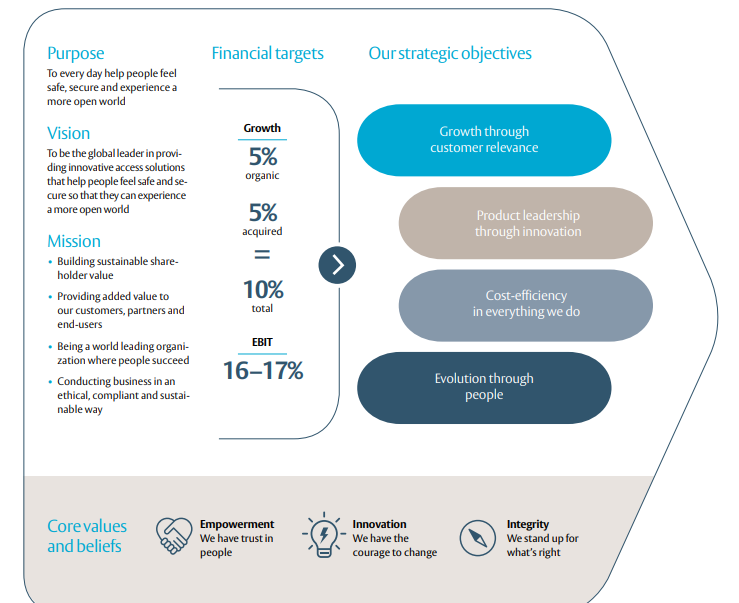
Yhtiöllä on kolme alueellista jakoa;
EMEA (Eurooppa, Lähi-itä, Afrikka)
Americas (Pohjois- ja Etelä-Amerikka)
Asia Pacific (Aasia ja Tyynimeri)

Globaalit jakaumat;
Global Technologies
Entrance Systems

Miksi sijoittaa Assa Abloyhyn

Lähde
→ Hyvä teollisuus olla mukana
Yhtiöön kohdistuvat vahvat megatrendit, jotka tukevat tuotteiden kasvua ja kysyntää. Näitä ovat lisääntynyt turvallisuus- ja kestävien rakennusten kysyntä, kaupungistuminen, digitalisaatio, koodien muuttaminen ja paikallisten markkinoiden sääntelyn jatkuvat muutokset. Asiakastarjonta on linjassa perustavanlaatuisten kasvutrendien kanssa ja yleensä vakaat jälkimarkkinat tekevät yhtiöstä vähemmän alttiin monien muiden toimialojen suhdannekysynnälle.

→ Kannattava kasvu
Pitkä kokemus kannattavasta kasvusta. Liikevaihto on kasvanut yli 9% vuodessa viimeisen kymmenen vuoden aikana, ja oikaistu liikevoittomarginaali on pysynyt vakaana yli 16 prosentissa, lukuun ottamatta pandemian vuotta. Siirtyminen sähkömekaanisiin tuotteisiin antaa mahdollisuutta jatkaa kannattavaa kasvua pitkällä aikavälillä.

→ Johtava markkina-asema
Syvä osaaminen alalla, jota ylläpidetään ja päivitetään jatkuvasti uusilla ratkaisuilla. Kaksi kolmasosaa tuloista syntyy jälkimarkkinoilta, mikä tarjoaa vakaan tulovirran.

→ Investoinnit innovaatioihin
Yhtiö investoi noin 4% liikevaihdosta tuotekehitykseen, joka saattaa antaa kilpailuetua sekä lyhyellä että pitkällä aikavälillä.

→ Konsolidaatio
yhtiö on ostanut yli 300 yritystä maailmanlaajuisesti sen jälkeen, kun Assa Abloy perustettiin vuonna 1994. Yritykset ovat monissa tapauksissa johtavia palveluntarjoajia omilla markkinoillaan vakiintuneilla asiakaskunnilla ja tuotemerkeillä. Synergioiden saavuttamisen jälkeen on aikomus kasvattaa yrityksiä ja niiden kannattavuutta. Tämä strategia on osoittautunut yhtiön mukaan onnistuneeksi, ja ostetut yritykset ovat integroinnin jälkeen luoneet merkittävää arvoa yhtiön mukaan.

→ Vahva brändi ja laaja tuoteportfolio
→ tehostettu toiminta
→ Aktiiviset kestävän kehityksen aloitteet
Noin kolmasosa tuloista syntyy tuotteista, joilla on elinkaariarviointiin perustuva ympäristötuotedeklarointi (EPD). Vastuullisuus saattaa parantaa kilpailukykyä ja tarjoaa järkeviä yritystuotannon ja tuotekehityksen kannustimia. Yhtiöllä on uusissa tuotteissa tavoitteena minimoida niiden ympäristövaikutukset ja hiilijalanjälki, maksimoimalla samalla kestävyysominaisuudet, kuten energiatehokkuus, tuotteiden elinkaaren pituus ja kierrättää tuotteita käyttöikänsä lopussa.

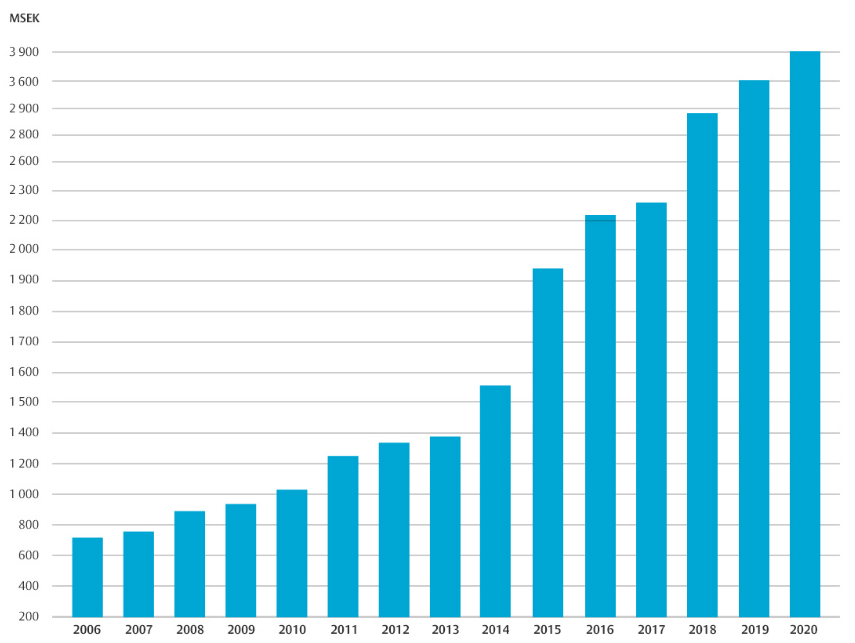
Tuotekehityksen kulut
Riskit

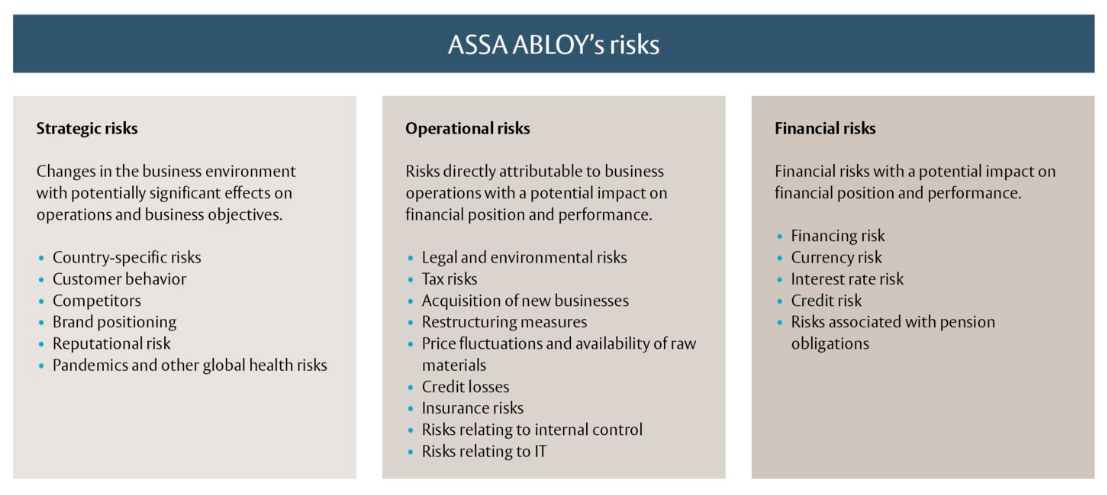
“Osakenanalyysi” tai yhtiön tarkastelu ei ole mitään, jos ei tarkastella riskejä. Yhtiö on luetellut merkittävimmät riskinsä sijoittajasivuillaan.
Yhtiön merkittävimmät kilpailijat ovat:
Ingersoll-Rand (Yhdysvallat), Stanley Black & Decker, Dorma (Saksa), Kaba (Sveitsi) ja Hörmann (Saksa) sekä lukuisia pienempiä kilpailijoita. Valitettavasti en ehdi analysoida tai tarkastella juuri nyt kilpailijoita, yritän niistäkin koota jotain tänne, sillä kilpailijoidenkin tarkastelu on hyvin olennaista yhtiön ja markkinoiden tarkastelun kannalta.

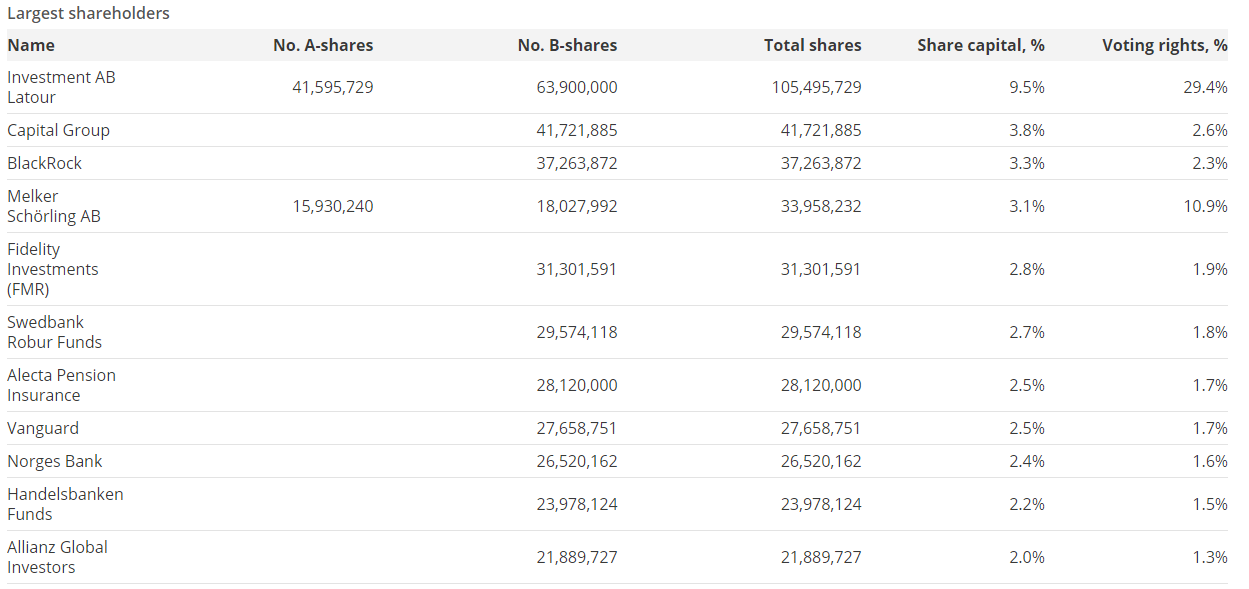
Isoimmat osakkeenomistajat

Merkittävimmät lähteet: Annual report 2020, Assa Abloyn sijoitajasivut, Assa Abloyn kvartaaliraportit, Abloyn omat sivut, arvopaperi, Wikipedia Suomi.


Oma kommentti:

Sanotaan heti kättelyssä että mihinkään hype-lokeroon tämä yhtiö ei mene. Pikemminkin tämä yhtiö edustaa hyvällä tavalla melko tylsääkin ja (kirjaimellisesti) turvallista toimialaa. Yhtiö ja toimiala vaikuttaa todellakin kiintoisalta, ja oli ilo tutustua tähän yhtiöön ja kaivaa tietoja (käyttäen tähän parin päivän kaikki vapaa-ajat), oppien paljon uutta yhtiöstä ja koko toimialasta. Annan kyllä propsit analyytikoille ja jokaiselle sijoittajalle, jotka jaksaa tonkia itse tietoja yhtiöistä, ja tämäkin oli vasta yhtiön tietojen todella, todella pintapuolista perkaamista eli kaukana mistään syväanalyysistä eikä sisällä edes omia ennusteita tai tulevaisuuden kassavirtojen pyörittelyä. Niin tai näin, olisi kiva kuulla onko foorumilaisilla positiota yhtiöstä ja mitä mieltä olette yhtiöstä, alasta ja kaikesta siihen liittyvästä ylipäätänsä. Oma mielikuva yhtiöstä on, että yhtiö on hyvin laadukas, ehkä laadukkaimpia yhtiöitä Tukholman pörssistä, kuka tietää, ja varmasti myös sijoittajien silmissä laatuleiman saanut, joka tietenkin näkyy osakkeen tämänhetkisessä arvostuksessa. Yhtiön tuotteet ja historia on ainutlaatuisia ja yhtiö on vallannut todella tukevan jalansijan hitaasti kasvavalla, jatkuvan disruption omaavalla ja hyvin voivalla markkinalla. Ei liene epäilystä etteikö yhtiöllä olisi vahvoja vallihautoja. Varmasti mielenkiintoinen sijoituskohde jos hyvällä hinnalla saisi. Tuskin osake mitään tuplia tekee suuntaan tai toiseen kauhean nopeasti, pikemminkin uskon tämän olevan vakaa ja riskiprofiililtaan vähäriskinen sijoituskohde.

Disclaimer: Tekstin kirjoittaja ei ota vastuuta tekstin paikkansapitävyydestä. Lukija on itse vastuussa lukemastaan. Ei sisällä sijoitussuosituksia. Tekstin kirjoittaja ei omista yhtiön osakkeita kirjoituksen julkaisuhetkellä.
72 Likes

Thanks for starting this thread. I don’t own the company, and I’m not buying it. In Finland, they really dominate the market; in stores, their padlocks are expensive compared to competitors, but the quality is also in a different league, from a consumer’s perspective. With Abloy, I’ve mostly been thinking about the disruption in electronic locks. If/when more competitors enter this category, how will Abloy’s story develop? Big tech companies could develop their own electronic locks if they wanted to, perhaps with biometric identification. Abloy’s relatively new Pulse series and Iloq’s equivalent (a Finnish competitor) are also interesting, as these electronic locks get their energy from the key’s turning motion.

A few years ago, Abloy closed one factory in Finland, so I think the one in Joensuu might be the only one left? I’ll be following the discussion with interest.

4 Likes

A defensive stock in every way. How about customers like the armed forces and other big clients?

2 Likes

To my knowledge, they have major public sector clients such as the police and defense forces. The following news, although old, is relevant when considering the disruption coming to locking systems in electronic locking.

https://www.abloy.com/fi/uutiset-ja-media/tiedotteita/uutiset-2020/uutiskategoria-2020/parempaa-asumismukavuutta-joensuun-opiskelijoille/

Yale’s Doorman is also becoming more common; I haven’t had a chance to try it myself, but you can use disposable tags with it, for example. It’s also handy in student housing as you can discard a tag and the lock doesn’t need to be re-keyed.

4 Likes

Yale belongs to the Abloy (Abloy) group, as does the access control system Flexim, for example.

4 Likes

As I understand it, there are major customers: military installations, agencies, schools, hospitals, banks, critical infrastructure protection, etc. ASSA also claims to be the market leader in securing public areas. Not all customers are served under the ASSA brand; for example, Ceco, which belongs to ASSA, is a leading manufacturer of steel doors with all the quality standard bells and whistles. Customers and sites include government agencies, armies, and other military operations, or anything else like hotels and health centers. In Finland, Certego’s customers included public entities, but ASSA recently sold Certego :S but that was just one example.

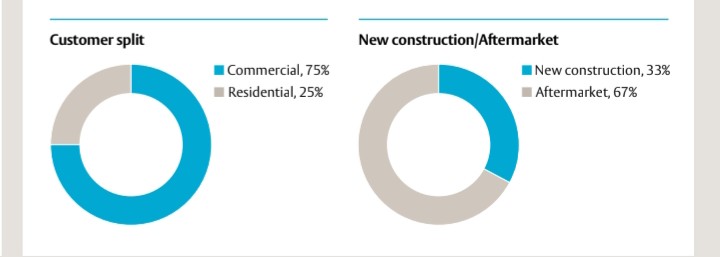
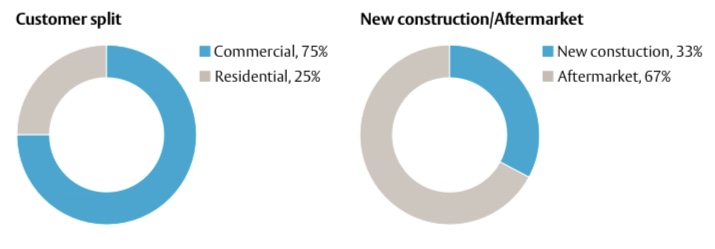
Here’s a breakdown of customers to give you an idea:

Private customers account for only 25% of sales.

Aftermarket sales account for 67% of sales, btw… :thinking:

5 Likes

ASSA indeed recently sold Certego to Nalka Invest ASSA ABLOY sells its Nordic locksmith business CERTEGO to Nalka Invest | ASSA ABLOY

Certego provides comprehensive security technology solutions and is the leading security solutions provider in the Nordics with over 200 million euros in revenue. ASSA probably originally branded this as Certego. Certego acquired the aforementioned Flexim in 2016, which ASSA has extensively developed with its technology and expertise, and it now seems to be branded as Abloy Flexim. How will things be handled there? Will Abloy Flexim remain with ASSA, and Certego only retain selling rights, or will the product’s name change? I don’t know. No idea at all.

2 Likes

The Abloy Pulse mentioned here is indeed a clever locking system, although it has been around for a few years already. It’s a system where a door is opened with a normal-looking key, but the key and the lock cylinder are programmed to communicate with each other. The pushing motion of the key provides the necessary electrical energy, so no separate power source, such as batteries, is needed. The keys of the system are identical, so the master keying is entirely digital, meaning any key can be programmed to any lock. If a key is lost, the lost key just needs to be deactivated, and there’s no need to re-key the entire building. The system is run through the Accentra cloud service, with the company billing for its use as a SaaS service, and the information system is protected by the company’s own patented SEOS technology.

Of course, when evaluating a company of this size, market movements and product impacts must be quite significant to be reflected in the stock price. By the way, the Finnish company iLOQ was the first in the world to introduce a system in 2007 where lock cylinders get the necessary energy from the key’s pushing motion. So, this isn’t entirely new. Primarily, this gives some indication of where the locking industry is constantly heading – products are becoming more practical, scalable, and bringing added value and savings to all parties. And it seems SaaS is also making its way into the locking industry :grinning_face_with_smiling_eyes: When thinking about the Pulse system, it is incredibly convenient, especially in student housing where residents change frequently and someone loses a key once a week.

And it’s ecological. With sustainability being preached everywhere anyway, this is at least concretely a sustainable development product, as energy is generated by the key’s movement, there’s no need to redo the entire building’s locking if a key is lost, and it’s generally a long-lifecycle system.

3 Likes

A few questions about the Pulse key.

Is there a battery/accumulator/chip inside the key?
The brochure gives the impression that it also works with a card reader.
The card reader definitely runs on electricity/battery.
What about the lock case?

The lock cylinder is a separate matter.

Good questions @Tauno_Kataja. So, there are no batteries or any power source inside the key either. I understand there is some chip inside where data is stored and which communicates with the lock cylinder, which also operates digitally and has electronic rekeying, so there must be some kind of circuit there. Likewise, the cylinder also gets energy from the key’s pushing motion, meaning no batteries. The card reader you mentioned is a different matter. You can also install this Pulse cylinder in the lock case, so if you want to upgrade a door to Pulse, just attach the new key cylinder, and that’s it.

I have never dealt with Pulse, so it’s not worth asking me too technical questions :smiley: if anyone knows better, feel free to speak up. I try to talk about ASSA here in general, as in terms of investment. I also try to share information about the industry and markets in general sometimes if I find something interesting and if it affects ASSA. I do not aim to focus on the in-depth functioning of products unless it has a significant connection to ASSA’s investment case, e.g., in terms of investment, it might be more essential to understand, research, or evaluate Pulse’s general operation and the opportunities and changes it brings to the industry, and the system’s cybersecurity to ensure it is foolproof.

3 Likes

This month, the company made a couple more acquisitions, each in the range of 110-150 MSEK. I’ve been thinking a bit superficially about the company’s direction, especially its acquisition strategy and related challenges.

Let’s quickly go through the numbers. While the pandemic year clearly devastated sales and profit, both quarters this year have clearly reached pre-pandemic levels in sales and profit. Therefore, I think it’s relevant to compare this year’s quarters to 2019, as last year’s comparative figures are very weak (making this year’s growth look incredibly strong). Let’s compare (figures in parentheses are 2019 comparables):

Q2’21
net profit 3,212 (2,562) billion SEK
operating profit 3,589 (3,733) billion SEK
sales 23.6 (23.5) billion SEK

Q1’21
net profit 2,253 (2,218) billion SEK
operating profit 3,187 (3,246) billion SEK
sales 21,805 (21.5) billion SEK

So, sales are slightly higher than in 2019, but net profit is more or less a bit more robust, while operating profit is slightly weaker. I don’t know the exact reasons, but we could assume the company will achieve roughly the same net profit this year as in 2019, i.e., just over 10 billion SEK, and sales of 94 billion SEK.

The company has made 7 acquisitions this year, as far as I understand (acquisitions page), and their size has varied around 200 MSEK. If the company aims for 5% inorganic growth per year, that would mean approximately 4.5 billion SEK in sales growth through acquisitions. In this case, at least 20 acquisitions per year would be needed, preferably more, to reach the inorganic growth target, assuming the deal sizes remain around 200 MSEK. The company has not achieved 5% inorganic growth in 2019, 2020, or in the first half of this year.

There’s a fear here that the company might force acquisitions to meet its targets. When corporate arrangements are carried out on an assembly line, it’s almost guaranteed that some arrangements will occasionally go wrong. Not every deal can be good, and not every deal can yield the desired synergies. Then, that acquired company has to be integrated into this giant corporation, and so on. Additionally, maintaining this 5% growth becomes increasingly challenging each year :smiley: So, this growth through acquisitions, maintaining growth while adhering to value creation, and the company’s large size are, in my opinion, one risk. It’s comforting, however, that there are plenty of acquisition targets in the market, so I don’t think they’ll run out of candidates immediately, I presume.

ASSA is a huge giant anyway, and that’s not always a good thing. Still, the valuation from a market cap perspective (28 billion EUR vs. a market size of approx. 90 billion EUR or 100 billion USD) is not alarming. And this year’s P/E is only about 27x with these assumptions, and for next year, it’s already around 26x. P/B of 4x, however, sounds quite high for a company generating approximately 16% return on equity. But at first glance, the price is not outrageous.

6 Likes


I want to wake this up! :smiley:

Here is Salkunrakentaja’s article about Abloy.

The Swedish company appears to be in a good position to continue its profitable growth, assesses Danske Bank analyst Olof Larshammer.

”We see potential for margin growth in 2023 due to declining costs and believe that the acquisition of HHI is a strategically correct choice despite the high price level,” Larshammer states.

12 Likes

Thanks, Alokas, for bumping the thread and linking the news! I’ve occasionally regretted that I never had the time or energy to continue looking into the company, and especially its numbers. It would be fun to crunch this company’s numbers and look at the valuation, or at least read some analyses. Hopefully, this will be added to Inderes’ coverage!

3 Likes

Reviving this thread again. Based on the article by Timo Heikkilä from Sijoittaja.fi, Assa Abloy seems like an interesting company. :slight_smile:

When comparing Assa Abloy to other Nordic industrial quality stocks, it is observed that Assa Abloy is currently the lowest valued in the group. The 2023 P/E ratio is 18, while for KONE, for example, it is 25.8. Historically, Assa Abloy has traded at a P/E ratio of 25-30.

Assa Abloy is one of the best quality stocks in the Nordic industrial sector, if not the best. The company’s business is recession-resilient, and megatrends such as urbanization and demographic changes support medium-term growth. The stock is attractively valued relative to its own history and other high-quality industrial stocks.

8 Likes

Earnings release tomorrow. This seems to be so boring (no hype, and no daily swings of tens of percent) that it doesn’t spark much discussion. It has risen quite a bit already this year and was fairly defensive in 2021. It’s also worth noting the weakness of the SEK against the euro, which should provide some extra gains once the SEK eventually strengthens again. Personally, I’ll be watching the earnings report with a small slice in my portfolio.

2 Likes

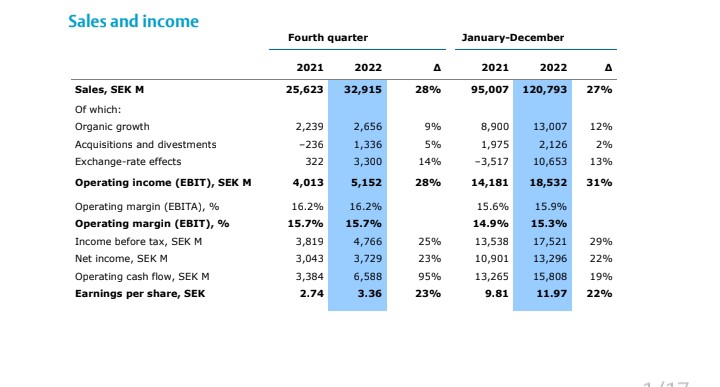
Revenue is growing and (full-year) relative profitability is improving…

21 acquisitions for the full year, of which 10 were in the last quarter. Total sales from acquisitions reached 7 billion kronor. Active pace, but that’s what the pace needs to be, and even more intense in the future if the company intends to keep inorganic growth at 5%.

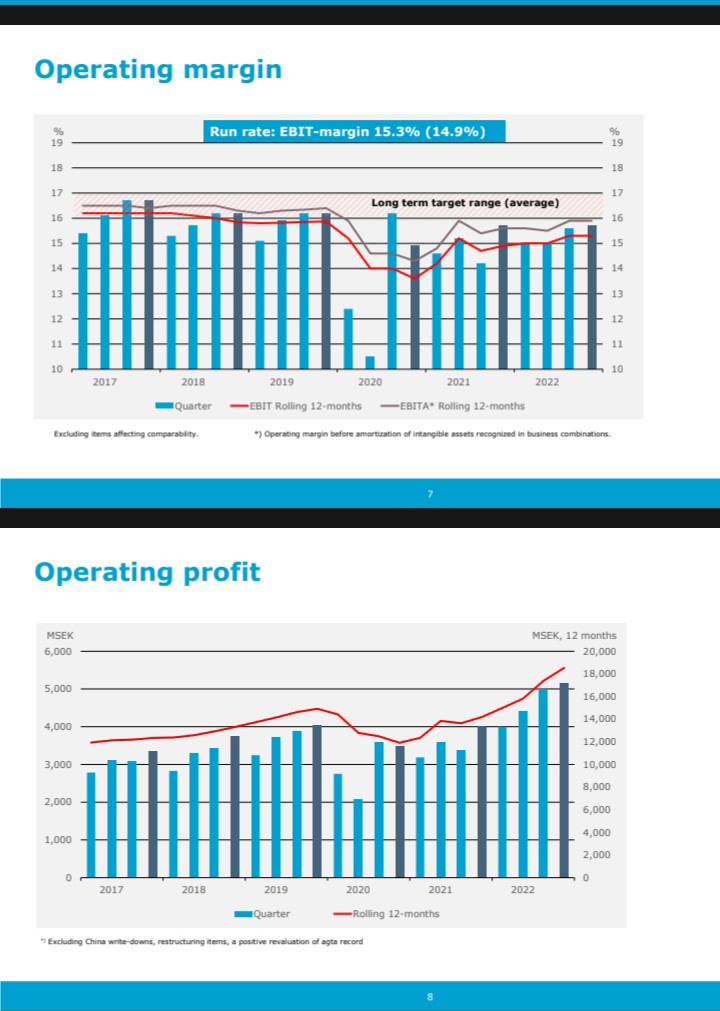
Relative profitability is well-depicted there quarterly and on a rolling basis (above) and the absolute development of operating profit (below). There was quite a dip back in 2020 :smiley:

8 Likes

Great, I should have added more. Well, there’s still time, it’s just that my cash is already in the market. A steady performer, and it’s really worth keeping that exchange rate in mind as well. Good for the long-term investor, bad for the day trader.

1 Like

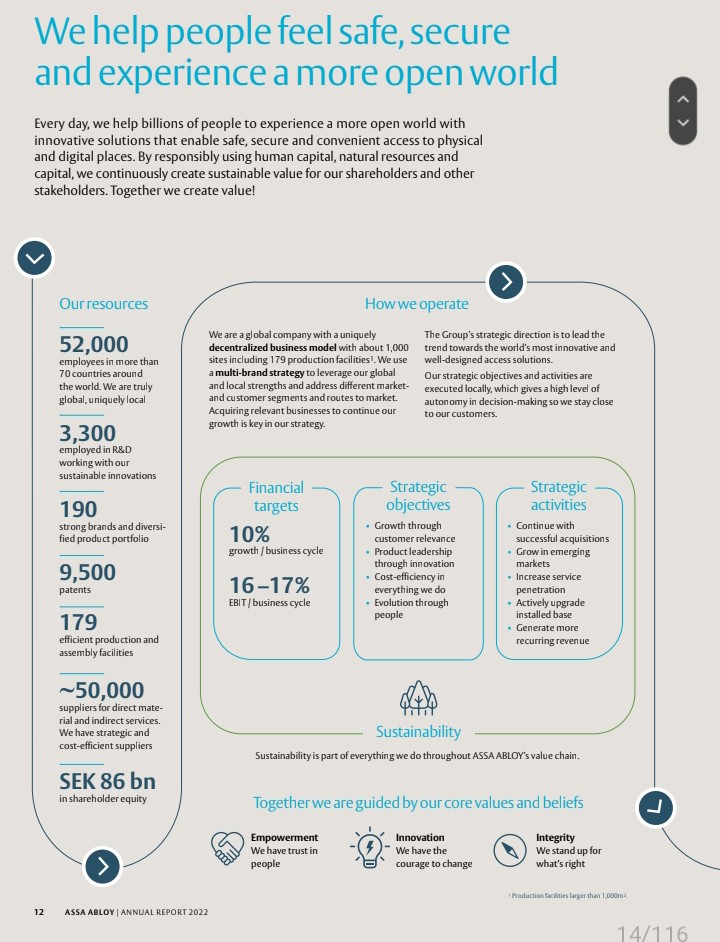
Assa’s latest annual report has been published. These are pure gold in terms of content…

Most of the customers are public and the business is mainly aftermarket… this hasn’t changed at all since last year, though.

Interesting that R&D spending has also stayed at 6%, but the number of employees has increased relative to the total number from last year. (51,000 vs 2,800 → 53,000 vs 3,300). Who knows if that’s just splitting hairs.

And patents, ah 9,500 pcs (same as last year). Apparently, 149 patents were registered during the past year; I don’t know if it was rounded to that 9,500, presumably. One must remember that the company may have who knows how many applications pending; they are usually approved with a several-year delay. I don’t think that number 149 refers to the number of patent applications.

The company raves about how they set money aside for product development, and then patents come out once you shovel enough money in and apply pressure. I wonder if it was Abloy’s Sento where they changed like one disc, which was a pretty flimsy update and otherwise vague, citing a need for renewal, and someone even wrote online that the international patent application (for Sento) had actually failed. But I don’t know the details, and honestly, I don’t even really care.

It’s perhaps good to remember that the purpose of a patent is not primarily to bring cash flow to the company, but rather to specifically prevent a competitor from entering the market. I’ve heard quite absurd stories that many firms (not Abloy specifically) just feverishly crank out new patents as fast as they can, not because they ever expect them to yield anything, but so that a competitor doesn’t accidentally invent the same thing and benefit from it financially. It’s a rough game, especially with all sorts of patent trolls who create patents just to sue companies for patent infringement. Interesting stuff, @Antti_Jarvenpaa could make some kind of video about this patent business.

And here’s the sustainability report, good stuff…

9 Likes

Assa has apparently experienced some country risk between the USA and Mexico.

Today, ASSA ABLOY has received clearance from the Mexican competition authority to acquire Spectrum Brands’ Hardware and Home Improvement division (“HHI”).

Following the clearance from the Mexican competition authority, the HHI acquisition remains subject to customary closing conditions. Closing of the transaction is expected by the end of June 2023.

Background

On September 8, 2021, ASSA ABLOY announced it had signed an agreement to acquire the HHI division of Spectrum Brands (NYSE:SPB) for a purchase price of MUSD 4,300 on a cash and debt free basis. On September 15, 2022, the U.S. Department of Justice (“DOJ”) announced that it will seek to block the proposed acquisition of HHI. On December 1, 2022, ASSA ABLOY announced that it had entered into binding agreements with Fortune Brands for the divestment of Emtek and the Smart Residential business in the U.S. and Canada to fully resolve all the alleged competitive concerns surrounding the proposed acquisition of HHI. On May 6, 2023, ASSA ABLOY announced that it had reached a settlement agreement with the DOJ regarding the HHI acquisition and that it will proceed with the divestment of Emtek and the Smart Residential business in the U.S. and Canada to Fortune Brands.

So Assa bought this HHI business from Spectrum Brands about two years ago; it’s a specific brand portfolio of smart locking solutions including, among others, SmartKey technology and patents, and later the U.S. Department of Justice announced it would block this acquisition for some reason. Today, the Mexican competition authority has given its approval for the deal, and the company announced at the same time that it had reached a settlement with the Department of Justice—on the condition that some businesses in the U.S. and Canada are sold off to resolve all the alleged competitive concerns. I don’t know, it’s quite a mess.

The purchase price was thus “pocket change” at 4.3 MUSD, or roughly 2.5x revenue. However, some legal news stated the purchase price was 4.3 billion dollars. Hardly that much, surely, but at least the inorganic growth target would have been checked off for a while.

And it’s also true that the company manages to capture patents well through these deals. But yeah.

3 Likes

The original purchase price was indeed 4.3 billion USD, making it significant for Assa, which had a revenue of 120 billion SEK last year. However, they are required to sell business segments worth about 800 million USD related to the HHI acquisition. The original HHI revenue at the time of acquisition was approximately 1.4B USD, of which 350M USD must be sold as a condition for the deal’s approval. In North America, there were two business segments where Assa would have gained too strong a competitive position through the deal, and they are forced to divest these. This is a very significant acquisition for Assa, adding roughly 10% more highly profitable revenue and important patents; the purchase price paid indicates that expectations are high.

7 Likes