I missed Monday’s press release from Andfjord.
First, there was info about the sale of “post-smolt” fish, i.e., further-grown juveniles, to others for further farming. The buyer is Eidsfjord Sjøfarm for the years 2026 and 2027, meaning Andfjord acts as an “intermediate grower,” and Eidsfjord gets larger juveniles into its tanks, speeding up the sales cycle. Holmøy Havbruk, on the other hand, processes the fish and sells the juveniles. As I understand it, Eidsfjord Sjøfarm is part of the Holmøy Group.
Andfjord benefits financially from the overstocking of the tanks during the juvenile stage and receives cash flow at times other than just from the sale of adult-stage fish. It is, of course, a trade secret as to which party the deal is more profitable for.
During the autumn of 2025, approximately 1.1 million juveniles were placed into two tanks. “Post-smolt” thinning will be done twice, and eventually, about 100,000 fish will remain in the tank to grow to their final dimensions.
It was more unpleasant to read about the new 330 MNOK directed share issue, which corresponds to about 10% of the market value. Part of it goes toward accelerating construction work and development work, and part toward preparing for damages related to the previous contractor’s alleged overbilling and negligence.
In the presentation, Andfjord underlines that the amount of money used for the construction of the entire harbor is subject to a legal dispute, in addition to the previous 1,000 MNOK. Andfjord claims the previous contractor misreported the completion rate, which led to additional work and thus extra costs. In Andfjord’s opinion, there are measurement errors in the tunnels between the tanks, for which an additional 5 MNOK is being claimed. The total claim in the lawsuit is thus a staggering 1,155 MNOK, if I added it up correctly. We are not at Olkiluoto 3 claim levels, but in the field of fish farming, it is likely the largest of its kind.
Development relates to feeding and tank cleaning. According to Andfjord’s announcement, robots can replace 1 FTE (Full-time equivalent) per tank just for cleaning. A small thing now, but as the scale increases, the change sounds sensible.
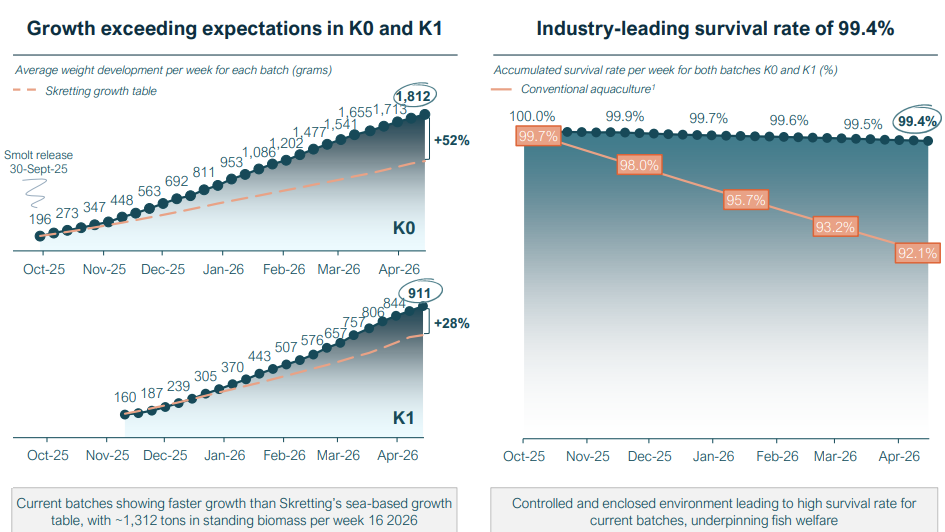
The share price did not budge from the news of the share issue, and the biological outperformance of the fish farming is certainly the reason for this. Both the growth rate of the fish and the low mortality are at an excellent level and a testament to the functionality of the flow-through technology.
The first tank will now be emptied of fish in Q3, as stated, meaning the duration of the growth cycle is at the lower end of or below the previously communicated (12–15 months). The timing is likely in August–September, in which case the cycle duration would be less than 12 months.
An interestingly twofold investment case. In the long run, the process and its scaling to other sites (Andfjord’s additional tanks, doubling capacity + Breivik and Fiskenes as completely new ones) is ultimately perhaps even more valuable than these early-stage exercises. If there is enough faith that the quality of Norwegian construction (or the client’s expertise, a matter of perspective) will no longer stumble, the outlook for the 2030s is lucrative, based on a rule-of-thumb estimate.