General Study Thread

Does anyone have insights into studying economic information or studying in general? Business studies is probably the most common route concerning economics, although it might even be easier to advance through information technology and mathematical fields.

The entrance exam for business studies, in its current form, has also been so accessible that I find it to be a fascinating reasoning test. When you have to think at the level of four multiple-choice statements, and not just memorize the content of books, which is the more common entrance exam format in Finland. Below are examples of recent years’ entrance exams and a website where you can find a keyword search summary of high school economics course books.

kauppis.pages.dev

As a disclaimer, I could clarify that I made the latter website myself as part of a trilogy of free study utility websites. The first one, http://helpotnopat.fi/, concerned the easiest study credits.
But as was discussed on the website, it might be that in the business studies entrance exam, which is more about economic information than economic models, an applicant benefits more from, for example, reading the “Pörssien suunta” (Stock Market Direction) thread and following “Vernerin Vartti” (Verneri’s Quarter) on YouTube than, for instance, Matti Pohjola’s Economics Textbook or Econ Core’s Talous. Since the entrance exam also asks for understanding of what has been read, but does not necessarily delve into economic models and theory before the basic course in economics. So, one can also study by expanding their general knowledge.
8 Likes

One would have expected a wide range of comments to accumulate following this opening, but although that hasn’t happened, a few thoughts arose.

Studying financial information is perhaps too broad a topic for a single discussion thread, but I would think this forum has many “experts by experience” regarding economy-focused degrees alone. University degree programs that come to mind, besides the obvious business studies (business administration), are economics, statistics, and industrial engineering and management (M.Sc. Tech.). One could certainly make a long list of lower-level degrees (BBA, vocational business qualifications, etc.) as well, but I am not familiar with those.

The mention of the current format of the business studies entrance exam is interesting. We have come a long way from the days when getting into business school required studying entrance exam books (written by university professors) from cover to cover and memorizing every bit of trivia. I don’t have a business degree myself, but I remember well the struggles my friends who applied to the field twenty years ago had with the entrance exams. Now that the entrance exam material is based on high school subjects (history, social studies, and certain mathematics courses), the exam truly seems to focus heavily on general knowledge and reasoning skills.

5 Likes

Even at the risk of this thread remaining a monologue or at most a dialogue, I will continue on the topic.

During the days between Christmas and New Year, I did all the business school entrance exams from 2018–2022 by myself and for my own enjoyment. It required a bit of tinkering to remove the bolding from the correct answers in the published exam questions before reading them, but that was done quickly enough. This time wasn’t wasted either, as quite a few terms familiar from the news (employment rate, unemployment rate, etc.) and their precise definitions were only checked by me after this.

I did some of the exams more deliberately, while in others I preferred making wild guesses, even though I knew that wrong answers would penalize the overall score. The end result suggested that with zero preparation, a study place could be secured at least at the University of Eastern Finland. In a real exam situation, nerves, limited time, and many other factors would naturally make the performance more difficult.

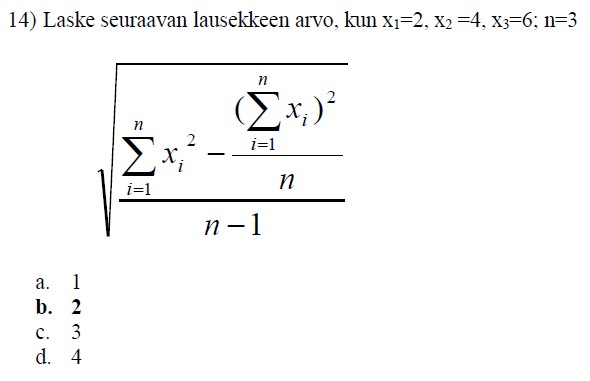
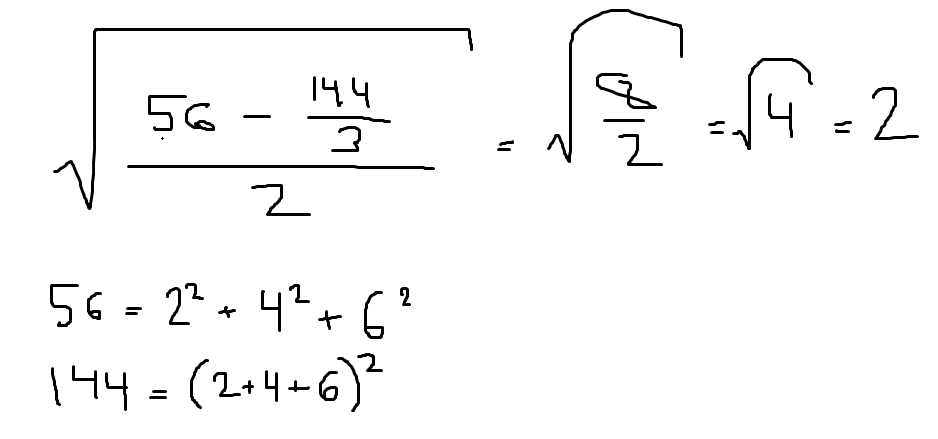
A tantalizing thought remained in the back of my mind that I could start studying business as a hobby alongside work (in a completely different field) if a spot happened to open up at some regional university. Regarding the entrance exams, the math section would require the most practice, because even though I graduated with an “M” (magna cum laude approbatur) in advanced mathematics twenty years ago, I don’t remember much about the subject. Would someone with a better memory mind explaining what the image below is about, how to calculate it, and what terms I should use to search for similar math exercises?

2 Likes

I’m not a mathematician but… it’s a sum (sigma).

2 Likes

Thanks! I had to think for a moment (or I could have just opened the link) about where those 56 and 144 actually came from, but it’s clear now.

It’s funny how they still look like complete hieroglyphics to me. It seems to be such a simple task at its core that this is probably intended. I don’t think many will get it wrong (unless they forget to take the square root of four at the end); the task is either a total piece of cake or it’s simply skipped.

2 Likes

Greetings

Do you have any experience with UAS (AMK) studies in open university or blended learning?
My situation is that I want to take certain courses, but daytime studies aren’t an option.
I’m currently taking courses, but it’s too challenging since I can’t attend the classes. I’m an HVAC technician by training and I’m interested in Building Services Engineering. I’ve been in touch with Metropolia, and it seems that the blended learning program for Building Services Engineering is the only option, so I’ll have to take the entrance exams. It feels a bit pointless because the first year would be redundant for me. The courses I want to take don’t come until later.

Do you have any experience with blended learning? Or any tips to share?

3 Likes

I completed my BBA (tradenomi) through blended learning at a University of Applied Sciences between 2013-2015. I can recommend it; at least at Laurea, it worked very well. You can balance work and school, though there is also a risk that school takes a back seat because the studying was quite flexible. Certain courses like law, accounting, and mathematics were completed during on-campus contact days. Then, practically all projects, group work, etc., where a teacher wasn’t needed and you could conduct research independently using remote connections, were done remotely. The first year was more intensive, with more contact days, and I earned 96 ECTS credits; about half of the students dropped out. In my opinion, this mode of study is suitable if you have the self-discipline for home study and still prioritize school over work so you don’t get too overwhelmed.

4 Likes
  1. Entrance exams are not mandatory; you can get in with your matriculation examination results without taking the entrance exams if your points are sufficient.

  2. If you have already completed first-year studies elsewhere, you can get them credited. Teachers will approve previous studies equivalent to their own subjects once you can demonstrate that you have completed them at a sufficient level.

  3. I have experience with Metropolia’s multimodal learning, although not in building services engineering. You have to do a significant amount of schoolwork when studying alongside work, but if you have enough energy and interest, it definitely works. In multimodal learning, there are fewer contact hours than for full-time students, meaning there is a bit more personal responsibility for completing the studies with respectable grades.

I have liked multimodal studying; almost everything is handled through distance learning, and if you want, you can also participate in daytime students’ courses, whereas daytime students are not allowed to join the evening courses for multimodal studies. In our case, lectures have mostly been organized Mon–Thu from 5:00 PM to 8:30 PM, and mainly lab work, a few rare exams, and language studies have required coming to the campus. On-site visits have averaged roughly once every two weeks or even less often.

3 Likes

I’ve noticed that BBA studies are easier to arrange. My sister is studying for a BBA as a full-time student and goes to campus maybe once every two weeks. At first, when I contacted the school, I was completely confused by the options. It perhaps wasn’t as simple as I had imagined.

1 Like

After a break of a few years, it’s time to invest more significantly in studies again. Does anyone have experience with these Master’s (YAMK) degree programs? I would love to hear your comments!

Strategic Management - Master’s Degree (YAMK) - Laurea University of Applied Sciences
Strategy Work in Organizations, Master of Business Administration (YAMK) | Haaga-Helia
Degree Program in Business Renewal and Management, Master of Business Administration (YAMK) | Haaga-Helia

1 Like

I don’t have experience, but I’d be interested to know why one would choose a YAMK degree over a Master’s degree? From a UAS (AMK) degree, you can continue to a Master’s just as well as to a YAMK degree; I find it hard to understand why someone would choose YAMK?

1 Like

Probably primarily because YAMK degrees are, in their own way, designed to be completed while working. There are usually few contact days, a few a month, and they focus on the end of the week, even Saturdays. With that BBA (tradenomi) background, it seems to be 90 ECTS, in engineering it’s probably 60 ECTS, which also favors YAMK, since a university Master’s degree is 120 ECTS.

Additionally, based on my own experience, things I’ve heard, and work I’ve read/browsed, I’d say that writing a thesis for a YAMK degree is slightly less demanding regarding source requirements, for instance, than a university Master’s thesis (gradu/diplomityö)—feel free to disagree on this. As an example, I’ll mention that in these theses, you often see entire paragraphs referenced to a single source. However, this varies by field and by what the supervisors require, etc.

Here, by the way, is a 2017 dissertation titled: MASTER’S DEGREES FROM UNIVERSITIES OF APPLIED SCIENCES IN THE LABOR MARKET AND THE HIGHER EDUCATION SYSTEM

The abstract states, among other things:

Compared to Master’s degrees, the competitiveness of the YAMK degree was weakened by the low appreciation and poor recognition of the degree, as well as the fact that in recruitment, employers largely prefer applicants matching their own educational background.
Employers also had reservations about the expertise and competitiveness produced by a YAMK degree and did not see the degree as equivalent to a university Master’s degree.

Of course, so much water has flowed under the bridge since that dissertation that a new survey would probably be needed. :man_shrugging:

Additionally, from what I’ve heard, starting YAMK studies is more of a formality and just expressing your interest, whereas getting into the Master’s stage can be harder, requiring academic success in a previous degree and potentially studies from the Open University, etc. I won’t speculate on this further, as the requirements can be found on the institutions’ websites, and most probably publish statistics on applicant numbers too.

TLDR: A YAMK degree is potentially easier to complete alongside full-time work compared to a university Master’s degree.

3 Likes

Thanks, good answer. That doctoral research sounds interesting, I’ll have to look into it, thanks for that too.

At least on the M.Sc. (Tech) side, there are degree programs specifically designed to be completed alongside work for those with a UAS background, and likely in other fields too. Undoubtedly, they are harder to get into than UAS Master’s programs, and you probably have to work harder in them. On the other hand, I also think that if you start “upgrading” your degree, why wouldn’t you want the thesis to be a bit more comprehensive and the level of expertise to be a bit higher. I think a UAS degree is a UAS degree, and if for some reason I want a higher-level degree, then it’s a Master’s/M.Sc. (Tech) from the research university side.

2 Likes

That’s right, at least in Lappeenranta these have been created, I completely forgot, good point:

https://www.lut.fi/fi/opiskelu/maisteriohjelmat-tyon-ohessa

There are technology and business studies available. There are still 8 days left in the application period, so those interested should apply! These seem to use this Master’s UAS (YAMK) style teaching schedule:

scheduled instruction is mainly organized on Fridays from 3:00 PM to 8:00 PM and Saturdays from 9:00 AM to 4:00 PM, with exams on Fridays from 11:30 AM to 2:30 PM. The academic year’s teaching begins in mid-August and ends at the end of April. The scheduled instruction timetable takes into account the autumn and winter holiday seasons, during which no teaching is organized.

It is then also largely a matter of taste and whether you see a concrete benefit for future career plans from a postgraduate degree. If you want to complete a Master’s program alongside full-time work, I recommend monitoring your own well-being and resources very closely; even if it is scheduled for Friday evenings and Saturdays, the workload is still significant during so-called free time.

3 Likes

It was already mentioned that it is better suited for doing alongside work and has a smaller workload. For me, it’s not about upgrading my degree, either. I have a Master’s degree in another field from 15 years ago, so this would be a completely separate entity.

2 Likes

I would say to Kuikelo that if you master the content of even one YH2 high school economics textbook (about 180 quite densely written pages) and have a rough idea of what other book series cover, then mathematical proficiency will be the deciding factor in the selection.

Compared to many other multiple-choice exams, the business school entrance exam (kauppis) has a rather tricky framing in its questions. And there is relatively little time—3 hours—of which the calculations take up a portion. If you make a wrong deduction between the options, even a single incorrect answer results in a significant point penalty. This requires a systematic approach to always understand where they are trying to mislead you.

Regarding the history questions, the information itself is easy. The problem is simply that the economic history exam syllabus covers practically everything that has happened in the last 10,000 years. This means you need to have a broad knowledge of basic facts from different eras, in addition to the fact that the books may contain specific claims that serve as the basis for questions—for example, from the books’ theme pages.

In the last couple of exams, they have also consciously mixed questions from all the different subjects together. This means it is no longer possible to choose to leave, for example, the history-themed questions unanswered.

But on the other hand, it is a nice and rare exam because it tests real-world general knowledge, some of which can be picked up just by following online discussions.

4 Likes

Thanks. I got a good feel for the exam content and question topics while going through those past papers from previous years. I’ll have to think about how much I’m motivated to put effort into it over the spring, but I’ll likely take the entrance exams just for the sake of it. The tight response time and trick questions are what worry me the most.

1 Like

I was looking at those university entrance exam questions from previous years, and this one in particular looks like total gibberish from a nonsense generator to me:

A business analyst has developed a model based on which they predict companies going bankrupt using financial statement data. According to the data collected by the analyst, 1% of companies go bankrupt within 5 years. Based on the model, the analyst is able to predict as many as 95% of those companies that actually go bankrupt during the next 5 years. Of those companies that do not go bankrupt, the model correctly predicts 90%. If the model predicts that company X will go bankrupt, what is the probability, based on the above information, that the company will go bankrupt?

From the options below, A is correct:

a) 8.8%
b) 9.5%
c) 77.4%
d) 95.0%

Could someone explain the logic behind both the formulation of the question and its calculation?

In my opinion, for a model that claims company X will go bankrupt (in what timeframe? A year, 5 years, or sometime during its entire existence?), an 8.8% chance of the company actually going bankrupt seems quite low for the model to be considered even as good as that famous dart-throwing monkey. :face_with_spiral_eyes:

1 Like

Let’s assume you have 10,000 companies. One percent of these, or 100 companies, will go bust within five years, and 9,900 companies will not go bankrupt in the same period.

Out of the hundred companies that actually go bankrupt, the model identifies 95 (95%). Of the 9,900 surviving companies, the model incorrectly predicts 990 bankruptcies (100% - 90% = 10%). Thus, according to the model’s prediction, 95 + 990 = 1,085 out of 10,000 companies will go bankrupt. This means that when the model predicts bankruptcy for a company, it belongs to the group of 95 that actually go bust 8.7 percent of the time, while the rest of the time it is a false positive result.

As for the wording of the question, it could certainly be clearer. The question should state more explicitly that it is asking for the probability of bankruptcy within the next five years—a more pedantic but enlightened candidate could draw a bearded gentleman in an Inderes shirt on the answer sheet and state that all companies are headed toward inevitable bankruptcy.

10 Likes

This doesn’t relate to studying economics, but let me just state, with a solid week of experience in University of Applied Sciences (AMK) studies, that if anyone else has spent 20 years on a factory floor wondering if they should still head back to school, then…

The only thought spinning in my head right now is why on earth I didn’t go to school sooner. :man_facepalming:

For me at least, compared to my old 6 am - 2 pm work schedule, the freedoms/responsibilities of remote learning suit me perfectly. If I feel like going to play some badminton in the morning, I go; schoolwork can be handled whenever it fits my own schedule. I don’t mind at all extending the school day into weekday evenings or the weekend when it’s entirely my own choice, and I can rhythm the rest of my life so that I don’t have to be at place X at time Y every single week, every single day. :smiling_face_with_three_hearts:

10 Likes