Witted’s trailing 12-month adjusted EBITA margin is now 3.6%, the highest since the IPO. Extrapolating with a ruler, it would be almost 7% by the end of next year. That probably won’t happen, as there are always surprises =D. Still, I believe in reaching seven; it’ll just take a bit longer.
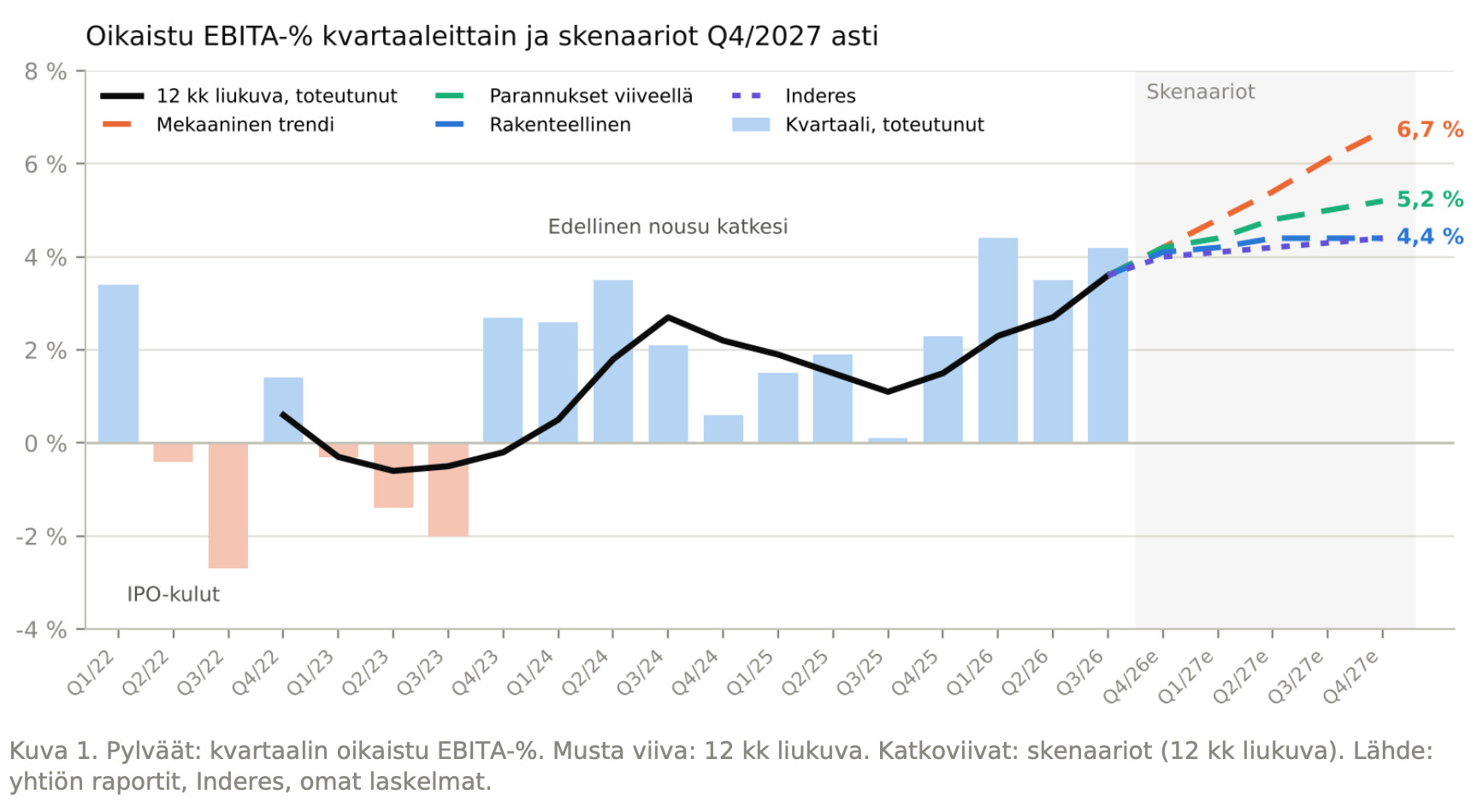
A year ago, the figure was 1.1%. We saw the same rise back in 2024, when it hit 2.7% and then dropped back within a year. I calculated four scenarios for 2027:
-
Mechanical trend, 6.7%. The margin continues at last year’s pace, where the 12-month rolling figure rose by an average of 0.6 percentage points per quarter. It looks good on paper, but the segments would need to generate around a 10% margin. Finland did 7.9% in Q3 and International did 7.3%, and Finland’s best-ever quarter has never exceeded 8.6%.
-
Delayed improvements, 5.2%. This is my so-called cautious case. Segment margin increases by about 0.25 percentage points per quarter, meaning from 7.8% to about 9% by the end of 2027. Administration still costs about €0.5M per quarter. The engine here is gross margin, which rose to 36.4% in Q3 (33.2%) as direct customer accounts increased and low-margin subcontracting projects ended. According to the CEO, ending subcontracting assignments affects revenue more than earnings, so part of the improvement isn’t visible in the numbers yet.
-
Structural, 4.4%. Segment margins and administrative expenses remain at Q3 levels, with nothing new happening. Revenue matches Inderes’ forecast of €54.6M. The company can reach this with current measures alone, provided nothing deteriorates.
-
Inderes forecast, 4.4%. Inderes’ 2027e adjusted EBITA is €2.38M. The analyst expects profitability to improve slightly from this year’s ~4%, but revenue to decline by 0.5%. The pessimism is therefore in the growth, not the margin. I consider this a good baseline that needs to be beaten.
Where did the improvement come from?
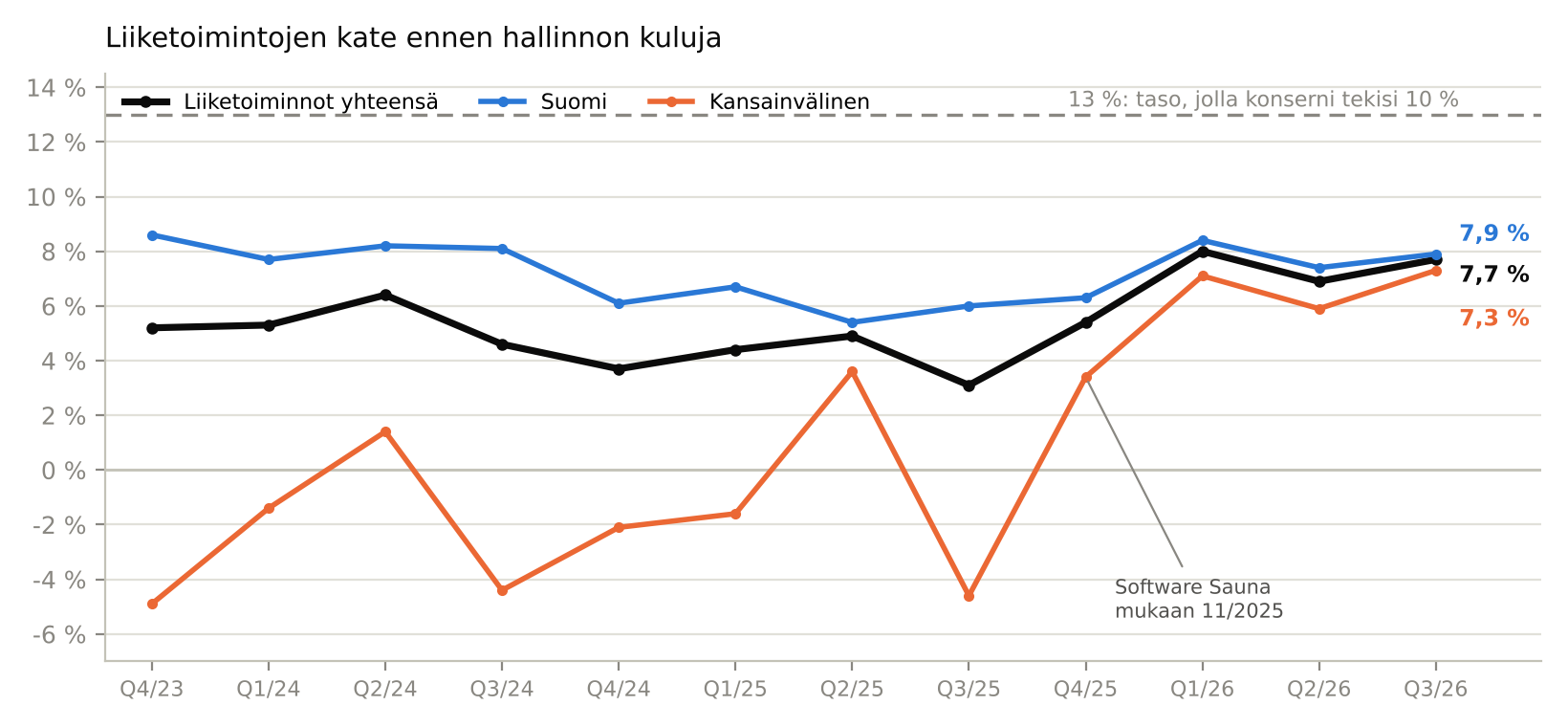
The improvement came almost entirely from the international side. A year ago in Q3 it was at -4.6%, and now it’s at 7.3%. Software Sauna has been onboard since November 2025, and Norway now has its own direct accounts. Finland delivered 7.9%, but its peak quarter remains 8.6% from late 2023.
How to get from seven to ten?
10% would be a good target level for Witted. With roughly €55M in revenue, that means €5.5M in earnings.
Administration costs around €2M annually. Therefore, Finland and the international business together would need to generate €7.5M, or about 13% of revenue. Currently, they are doing 7.8%.
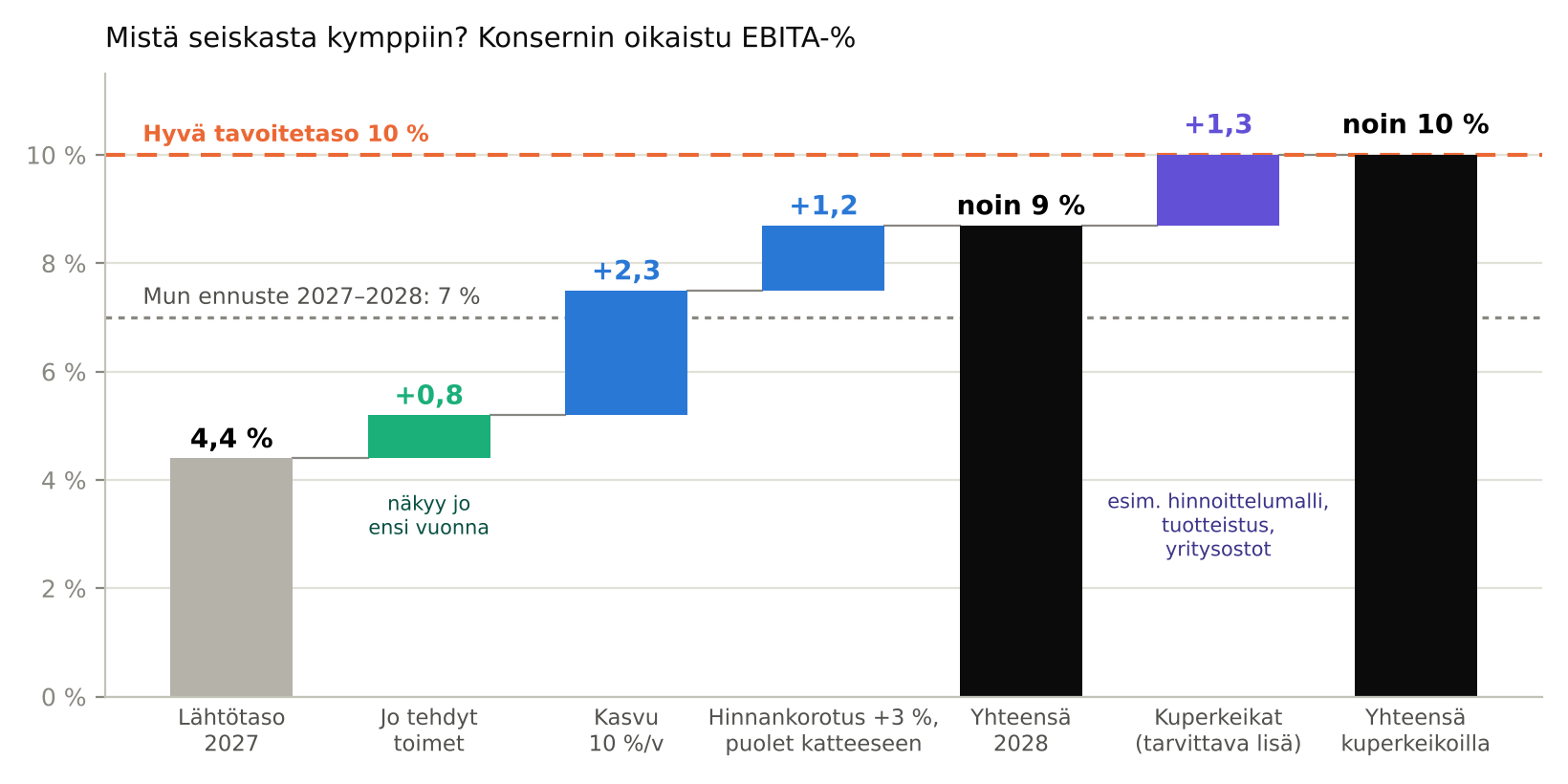
Starting from the structural 4.4%, I believe the measures already taken will show up next year and lift the level to 5.2%. After that, there are three levers:
-
Growth. When the business grows by 10% per year and new revenue incurs costs only in terms of consultant salaries and subcontracting, two years of growth adds around €2M to earnings. The margin improves by about 2.3 percentage points because administration and other fixed costs are spread over a larger revenue base.
-
Price increases. A +3% increase in pricing brings in around €2M more on higher revenue, assuming costs don’t rise at all. Some of this trickles down to subcontractors and salaries, but with client accounts increasingly in their own hands, at least half drops to the margin. The margin improves by about 1.2 percentage points.
With these, we are near 9% in 2028 if everything goes smoothly. Still, two years of 10% organic growth is a big assumption when organic growth in Q3 was -2.5%.
- Game-changers. The final ~1.3 percentage points won’t come from growth or price hikes. It requires changes in how things are done and sold: productizing services, moving away from pure hourly pricing, and capitalizing on cross-country price arbitrage. M&A is another option, as demonstrated by Software Sauna. Everything has its price tag, since productization and acquisitions require upfront investments before paying off.
My conclusion
I believe Witted’s profitability will reach the 7% level in 2027–2028. The market is better than in 2022–2024, and Norway stands on a much firmer footing thanks to direct customer accounts. If organic growth really takes off, nearly 9% is feasible as early as 2028. Reaching a full ten, however, will require brand-new game-changers.
The calculations are my own and based on the company’s public reports. Assumptions: around 18% margin remains from new revenue after salaries and subcontracting, and half of the price increases drop to the bottom line.