Life is certainly gloomy for the car dealer from Savo. Things look really miserable through the Patron’s eyes. Let’s let the new management show their mettle now with the new strategy. Life is always ahead, and the past is behind. It’s good to look forward; you can’t see the future in the rearview mirror. Bitterness is life’s worst enemy.
Here are Thomas’s pre-comments as Wetteri releases its Q4 report on Thursday, March 12 
We expect Wetteri’s revenue to have turned to slight growth and the adjusted operating profit to have improved clearly from the weak level of the comparison period. The Wetteri Power business, sold at the start of 2025, was recorded as a discontinued operation in the comparison period, so its divestment no longer weighs on group-level performance as it did in previous quarters. In Wetteri’s investment story, positive profitability development and the guidance pointing towards it for 2026 play a key role in the report to strengthen the credibility of the earnings turnaround.
Familiar optimism regarding Wetteri’s direction has once again been seen on the forum, but the facts tell a harsher story.
Under Parikka’s lead, Wetteri sold off Wetteri-Power – effectively the most profitable part of the business – and yet management seems satisfied with the chosen path. Parikka’s track record doesn’t exactly inspire confidence: previous actions have mostly produced mega-losses rather than growth.
The change negotiations are promised to be reflected in payroll costs, but realism forces the question of how quickly, as severance packages and training eat into the benefits right from the start. Downsizing through spreadsheets doesn’t grow a company – quite the opposite. Evidence of this already exists.
Particularly concerning is management’s indifference toward customer relationships built over the years. They aren’t created in an office – they grow from trust and familiarity between the salesperson and the client. When long-time employees are pushed out, customers leave with them. History has shown this time and again – including within Wetteri’s own history.
For those who remained, a title change was implemented, which as a side effect lowered salaries. This is a surefire recipe for the top talent to start looking for the exit – and as people leave, more customers and tacit knowledge vanish.
The industry will certainly get a boost as the tax ambiguities surrounding imported cars begin to clear up. However, we have likely only seen the tip of the iceberg. It hasn’t been legally possible for the hammer price of the same car in a Swedish auction to be higher than the asking price in Finland. Investigating this will continue to significantly shake up the industry.
With its current actions, Wetteri is unlikely to be the company that experiences the industry’s growth.
1 Like
Thomas discussed the Q4 results with Wetteri’s CEO Pietu Parikka.
Topics:
00:00 Introduction
00:11 Year-end highlights
01:00 Passenger car segment
02:55 VAT on imported cars
06:16 Maintenance service sales
08:18 Heavy equipment development
09:43 Guidance
11:26 New strategy and financial targets
Here is a company report on Wetteri from Thomas regarding the Q4 results
Wetteri’s Q4 report was weaker than our expectations, which was mainly due to a heavy loss in passenger car sales. Balance sheet restructuring measures should be behind them, but the company must show signs of clear progress in its earnings turnaround for the stock to be attractive at the current valuation level. We reiterate our reduce recommendation and lower our target price to EUR 0.16 (prev. 0.18).
Where does @Thomas_Westerholm find the belief that Wetteri could reach a 2% operating margin level in the coming years, which is actually a fairly good margin level in the industry right now? Wetteri is a downright miserable company right now, and in my opinion, there is no evidence of anything better.
3 Likes
I would summarize this into two points: the company’s actions to streamline operations and the potential for market recovery.
Starting with the first, Wetteri has an ongoing program aimed at 4 MEUR in cost savings, and in addition, another program aimed at an 8 MEUR improvement in results. These programs have caused various costs, which is why Wetteri’s current earnings performance does not reflect its normalized level.
Admittedly, estimating the normalized level is very challenging when the performance level in recent years has been what it has been, and profitability will increasingly rely on the used car business (where the company’s public track record is generally weak) instead of the sold Wetteri Power business. On an Excel sheet, the profitability improvement broken down by the company works very straightforwardly, but unfortunately, various programs easily overlook real-life multiplier effects, such as the resulting changes in organizational operating models and employee motivation.
You are absolutely right that a 2% EBIT margin would be a high level in the industry right now. The profitability level of the industry is generally weak at the moment, and I am inclined to believe there is room for it to recover along with the Finnish economy. Attached are the relative EBIT margins of key competitors in recent years.
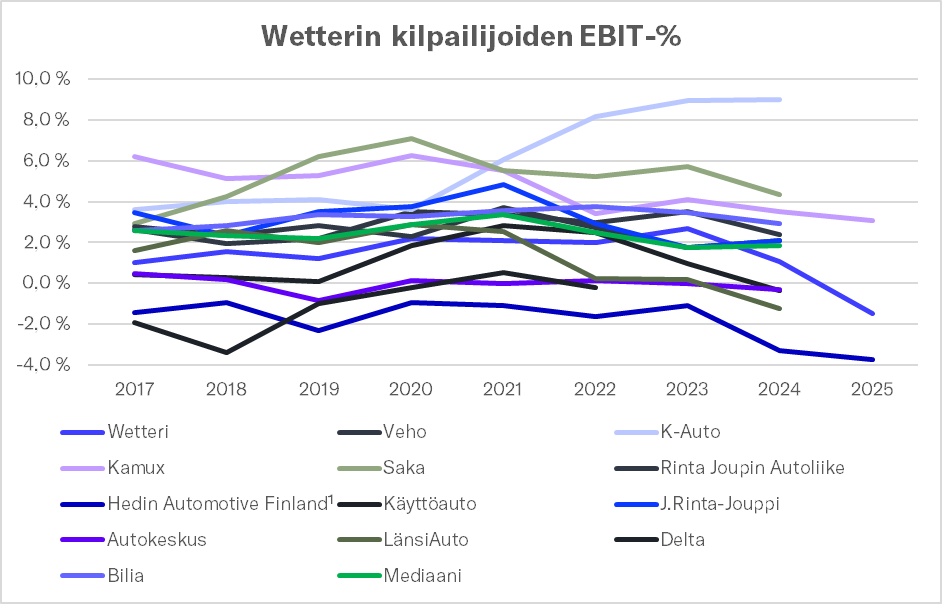
In 2024, the median EBIT% of the sample was 1.8%, while in 2017–2022 it was 2.3–3.4%. Compared to those levels, the 2% EBIT you mentioned is no longer particularly impressive, but of course, company-specific differences are emphasized. The year 2025 was weaker than the previous year for those whose figures are already public (i.e., Wetteri, Hedin’s Finnish operations, and Kamux’s Finnish operations), reflecting how deep the automotive industry is trudging right now. Of course, K-Auto stands out here and has been able to improve its profitability to a very high level, unlike the rest of the industry, which highlights the company’s competitiveness.
In any case, from these positions, I believe Wetteri’s prerequisites for improving its earnings level are good, driven by the company’s own efficiency programs and the potential for market recovery. The growth in the used car business outlined by the current strategy does not excite me at this stage, as the company’s track record in passenger car sales is what it is, and there is no basis yet for the 3% EBIT margin target in light of the figures. Of course, the new management has only been at the helm for half a year, so the decisions they have made are not yet really visible in the numbers. Instead of branching out, the management is under clear pressure to continue making tough decisions to achieve a 2% EBIT, as due to significant financing costs, breaking even requires an EBIT margin of over 1.5%.
4 Likes
I have to ask out loud: on what grounds was the used car business placed at the strategic core if the market challenges were already clearly visible back then?
Now we hear that the market situation came as a surprise. But what exactly was the surprise? The problems in the used car market didn’t emerge in three months – they already existed when the strategic guidelines were established. The effects of VAT speculation on market prices are no secret, yet the move was made without a clear answer as to how Wetteri specifically differentiates itself in this arena.
The used car business is a demanding discipline. It requires deep pricing expertise, rapid inventory management, and years of experience with the specific dynamics of this market. These aren’t things that are built with a strategy document – they are built by the people and their expertise.
The results obtained so far do not provide very strong evidence that this expertise is already in-house. Of course, implementing a strategy takes time, but the direction and execution should still be visible at an early stage.
Hopefully, management can demonstrate concretely in the coming months that there is more to this than just a good idea on paper.
2 Likes
Yep. I would have understood the decision better in 2020, but since then, a significant portion of competitors have already shifted their business more heavily toward used cars.
I completely agree with this.
During the Capital Markets Day (CMD), I asked the business director in the Q&A how Wetteri aims to differentiate itself from established used car players who have used car sales strongly in their DNA. The business director highlighted the company’s status as a multi-brand house in the background, and through that, Wetteri’s used car trade is made as good as they can make it. However, the intention is not to directly challenge players like Saka and Kamux. (imo a weak claim, as they are competing for the same customers anyway).
For some, brand representations can provide a sense of quality, and new car sales undeniably act as a procurement channel for used cars. Historically, however, players focusing purely on used cars have been more profitable than the multi-brand houses enjoying those advantages, and the benefits of the multi-brand model’s procurement channel shrink as the used car business grows.
2 Likes
A rare moment of agreement with Thomas.
The used car business is such a deeply specialized field that a mere strategy document or the status of a multi-brand dealership is not enough if the core expertise is missing from the organization.
The heat of the used car market actually speaks to a rather bleak situation: the sales volume of new cars is so low that a car a couple of years old practically sells for the price of a new one, and still goes. In this environment, differentiating on price advantage or procurement channels is difficult because no one is really making a profit. I wonder, by the way, why the association of car importers hasn’t become more active in presenting clear TCO (Total Cost of Ownership) calculations to revive new car sales, but that’s probably a different discussion.
In Wetteri’s case, it would be interesting to see an investment in inspected used cars. The need is genuine: according to a KKV (Finnish Competition and Consumer Authority) study, used car sales are by far the most common reason for consumer contacts, and nearly two out of three vehicle-related matters concern used cars. In Finland, only 4–5 percent of used cars undergo condition inspection, meaning the market is practically unconquered. The industry saying holds true: if a car is in good condition, a technical inspection is nothing but excellent marketing for the seller. In an Excel spreadsheet, it looks like a mere expense item, but experience shows that repair costs can easily save more than double the invested money. However, this requires precisely the expertise and organization that Wetteri seems to be completely lacking in its current structure.
The brand selection also presents its own challenge. Volvo and Mercedes are excellent cars in terms of features, but both have known pain points when used: Volvo with battery problems and weaknesses in the ERAD (Electric Rear Axle Drive) all-wheel-drive system, and Mercedes with a manufacturer-imposed repair ban on batteries and new battery pricing that is in no way reasonable for the consumer. It’s no coincidence that car dealerships’ own auctions are full of hybrids, Volvos, and Mercedes – no one wants to take the repair cost risk. Systematic pre-inspection and an open condition report could significantly change this situation and serve as a genuine competitive advantage if the will and skill are found.
4 Likes
Here are Thomas’s comments when Wetteri announced it was acquiring Sports Car Center (SCC) Airport Helsinki’s maintenance business and starting used car sales & maintenance services in Helsinki.
They should have taken care of Northern Finland and heavy equipment, instead of venturing into business areas where their expertise is lacking, then they would have had good foundations to succeed in the future. Now the situation is such that the industry speculates that this is the first one to take a real tumble!
4 Likes
Wetteri bought the Helsinki maintenance business — but at what price and why?
The purchase price is puzzling. The target’s revenue is 9.6 million and operating profit is 0.2 million euros. For this, 2.1 million is being paid. The industry’s normal benchmark for a maintenance business of this size is around 4–5 times the profit. Here, it is over ten times. No specific justification for the higher price is provided in the press release.
The seller is financing the deal themselves. Wetteri is unable to pay in cash, so the seller provided a 1.25 million euro convertible bond. If the target were as attractive as suggested, the seller would have had other buyers in line. A condition is also included in the loan: if Wetteri does not pay the installments, the seller receives Wetteri shares. This does not sound like a situation where the buyer holds the trump cards.
Wetteri is now a tenant in premises it did not own before the deal either, and the real estate was not included in the deal. The CEO’s background is in the south, and this deal fits that picture well. The company’s interest is another matter. Truck sales and maintenance in Northern Finland were sold off, as were the heavy vehicle maintenance operations in Joensuu and Kajaani — both sales looked more like forced sales than strategic choices. These were the core competencies built by Wetteri over decades. Now they have been abandoned, and the same money is being put into leased premises in Helsinki.
The future of passenger car maintenance is also a question mark. In 2024, 15.4 percent fewer new passenger cars were registered than in the previous year, and the total amount remained 30 percent below the ten-year average. The year 2025 was even worse — 70,612 passenger cars were registered, which is nearly three percent below the already weak level of 2024. Fewer new cars mean fewer warranty services and scheduled maintenance in the coming years. This does not hit heavy vehicles in the same way — but that is exactly what Wetteri just gave up.
2 Likes
The number of passenger cars isn’t decreasing anywhere. New cars in the Helsinki metropolitan area are not sold by Wetteri, meaning they wouldn’t easily end up there for service anyway. At the moment, cars are being sold as used imports instead of new ones, which certainly doesn’t reduce the need for maintenance and repair services. This expansion by Wetteri into the Helsinki area doesn’t seem very cheap or sensible with this move.
@Thomas_Westerholm How much do you estimate Wetteri’s used car sales revenue grew in Q4/2025 vs. Q1/2026?
Here are Thomas’s pre-result comments as Wetteri prepares to report its earnings on Thursday
We expect the company’s revenue to have grown slightly and adjusted operating profit to have improved significantly from the weak level of the comparison period. In the report, our main focus will be on the progress of the earnings turnaround, the outlook, and the company’s tight balance sheet position. Alongside this, we will be following comments regarding the Helsinki maintenance business acquisition announced in April and the start of used car sales.
I’m left speechless; a company struggling with profitability and lacking any significant buffers in its cash reserves has completely undermined my confidence in the entire board of directors:
3 Likes
This might have been a pre-arranged deal from back when Simula made that overpriced takeover bid for the entirety of Wetteri.
1 Like
It’s even more silencing when you remember that the recipient of the severance package is the company’s main owner. So, the CEO of a company on the brink of bankruptcy paid himself 1.4M EUR out of the company and subsequently moved to the board… it seems Simula certainly knows how to handle compensation—no wonder he was even appointed as a member of the board’s remuneration committee 
6 Likes
I, for one, am surprised by the surprise. Time and again, those companies brought to the stock exchange via the back door by “Aktiiviomistajat” are just the same crap in a different package:
Surely no one still falls for the illusion that these companies are managed with professionalism or in a way that would actually benefit the retail investor?
6 Likes