The first cruise of this joint venture, Birka, is over, and the ship wasn’t even half full—according to the media, there were 591 passengers. This is especially notable since it is a ship without any car deck to generate additional revenue. On the other hand, competitor Tallink is moving Victoria I away from Helsinki and similar cruises for the summer, which makes one wonder if the market situation is currently a bit weak.
However, we should also monitor how the Helsinki-Stockholm situation will be reflected in the figures going forward with Cinderella. Apparently, some departures had full car decks as the strike situation got trucks moving. Then again, was Viking the only shipping company with some personnel on strike, meaning unaccompanied units are not being taken onto the car deck?
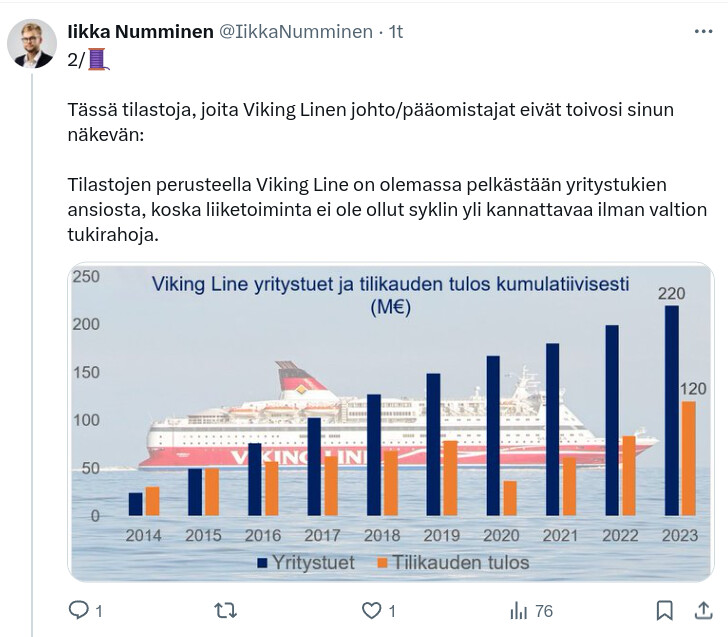
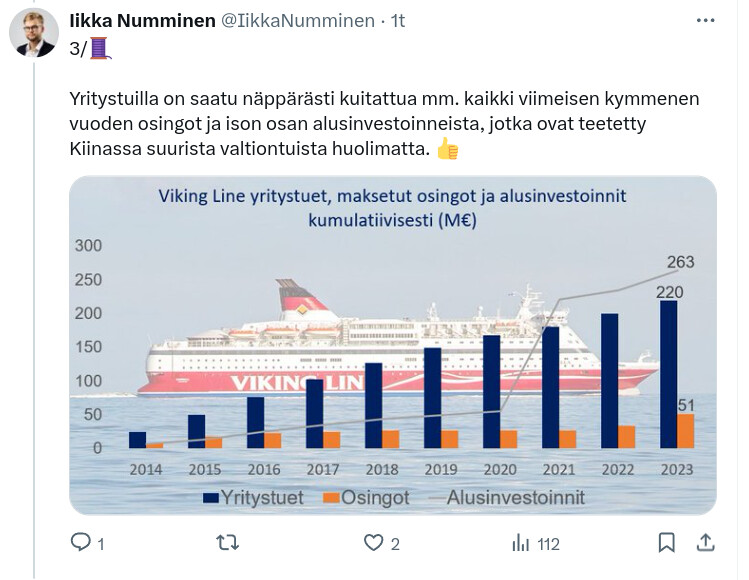
Hmm.. I wouldn’t exactly say that management wouldn’t want those to be seen. Those figures have been reported in the company’s annual report quite openly as follows (extracted from the 2023 report, and I’m sure figures from previous years can be found as well):
"State aid received, depending on the nature of it, is recognized as other operating revenue, as
employee compensation or as a decrease in advance payments, vessels under construction; see
Notes 2.3, 2.5 and 4.2. "
Whether these subsidies are actually needed is a slightly more complex matter in my opinion, even though I am not a shareholder in the company. For instance, point 2.3 refers to the support received from Traficom regarding traffic to Åland, which was not paid to the company last year. And point 2.5 deals with crew salary and social security costs; the company received €31.6M in these reimbursements related to social security and taxes from both Finland and Sweden. These are tied to the state’s desire to maintain domestic maritime personnel.
On the other hand, vessels from other companies also operate to Finland that do not receive these corresponding reliefs. So, it is certainly problematic from a competition standpoint.
But these are political decisions, and it’s not wrong at all for the company or its owners to communicate the conditions under which vessels can be maintained under the Finnish flag. It’s not the owners’ job to subsidize this activity either.
But we’re talking about small change here, and in these times it’s good to remember that such a large car ferry can very quickly move a significant amount of equipment and personnel to Åland, if the need arises. It would be a lot more expensive if the state started maintaining this kind of capability itself… Who knows what kind of agreements have been made between the state and the company regarding these .
And if one wanted those to be phased out, it should perhaps be done at the EU level and not just in Finland. And then there’s the matter of how those are reported in different places. It seems things are done slightly differently in Sweden; they provide support, but it doesn’t show up as business subsidies in the same way as in Finland.
Of course, it would be interesting to know if Birka Gotland, the joint vessel of the Gotland company and Viking Line, receives any support from Sweden. It differs from the other Viking ships, however, in that it doesn’t have a car deck. And of course, Eckerö Line also receives subsidies, from which VL benefits as a partial owner (that roughly 20% stake).
This also makes business sense. I just bought ferry tickets to Tallinn from Tallink, and an emissions fee of €5.30 was added to the ticket price. This is quite a lot, considering the cheapest tickets were otherwise €15-€20. Furthermore, currently, emissions trading only applies to carbon dioxide emissions from maritime transport. In 2026, emissions trading will expand to include methane and nitrogen emissions in shipping. Additionally, carbon dioxide emissions have been phased in, so they will only be fully implemented in 2026.
Just when Tallink has relatively new ships on the Helsinki-Tallinn route, Viking could bring an even more cost-effective ship there. XPRS will certainly fall behind Tallink’s new ones due to its cargo capacity. On the other hand, Viking doesn’t have a direct equivalent to Tallink’s 20-hour cruise product, so could Viking’s new ship be more of a compromise, with a slightly larger nightclub and also a spa section? XPRS doesn’t even have sauna facilities for passengers.
Of course, one must observe whether Eckerö would follow Viking’s ideas in that case and perhaps also get a similar Tallinn ship. (Since Viking owns about a fifth of Eckerö).
Helsinki-Stockholm is now a bit of a difficult case, with both competitors having old ships. So what is the future of that route even?
You who own Viking Line shares, aren’t you scared? I mean the situation in the Baltic Sea. It’s quite a risky and frightening thing overall, considering these cable breaks and other incidents. The situation seems to be escalating all the time. We’ll see what the next incident is and how NATO and others react to it. Terrible and sad.
I’ll be celebrating a milestone birthday in just over a year. I thought I’d celebrate my birthday by cruising with my loved ones for the first time in a long time. I wouldn’t be surprised at all if there weren’t any passenger ships sailing on the Baltic Sea then.
I might be a pessimist, or a realist. I don’t consider the aforementioned matter impossible at all. I hope I’m completely wrong.
Fairly stable performance for Viking Line in the first quarter, considering Easter falling in the second quarter this year. The competitive situation is tolerable, fuel prices are under control, SEK has strengthened somewhat at least since last year, but Birka Gotland is still a headache, for which a slightly more creative solution than Åland and Gotland cruises should now be found. I hope that, for example, Riga would gain popularity as an alternative destination for Swedes. A consistently solid 2* 0.50 EUR dividend / i.e., about 5% dividend yield year after year certainly provides a nice support level for this stock, and at least one doesn’t have to drown in news overload when following this stock. Income stocks are indeed sometimes sleep-inducingly boring; the only thing one can be excited about is what the future of Viking’s Helsinki-Stockholm route holds. I understand that Viking is committed to continuing this route, but it requires ordering two new vessels perhaps already in the coming years, and for that, in this confusing customs situation, a builder should preferably be found elsewhere than expensive Finland.
Helsingin Sanomat has an article about Viking’s electric ferry project. Apparently, they know how to apply for funding.. And it’s also said that they have applied for funding for two ships to Tallinn.. (I always wonder about Viking’s ownership of Eckerö when Eckerö also has a ship on that route and another on Vuosaari-Muuga) Viking Line paljasti HS:lle suunnitelmansa täysin sähköisestä Tallinnan-laivasta | HS.fi
Not entirely surprising, as technology is advancing tremendously in this field. At the same time, this means that old vessels will be run until the end before this investment, at least I would think so. The coming years will be spent on strengthening the balance sheet and liquidity at Viking Line, if such plans are ahead. Gabriella and Cinderella will honorably do their part, even though they are old ships.
Eckerö could become a kind of pilot for such a project, if a mini-version of an electric ferry were first made between Eckerö and Grisslehamn.
“The aim is to save approximately 36 million euros in 2026 from crew support for service personnel on Sweden ferries. This is the only corporate subsidy cut proposed by the Ministry of Finance.”
Strong Q2 from Viking Line despite dry-dockings, and now we are catching up on 2024 in terms of results. The share price reaction has been moderate at the time of writing, though upwards from yesterday. Viking Line still seems to be the easiest “no-brainer” investment for a dividend investor on the Helsinki Stock Exchange at this share price level. The flag state of the ships might change if the Finns Party-led Ministry of Finance gets its way, but it will not affect Viking Line’s earning level.
Here is SalkunRakentaja’s article about Viking Line’s results.
According to Viking Line, significant uncertainty is caused by the economic downturn in recent years in the company’s operating area, which has negatively affected customer spending habits. Uncertainty is also increased by the prevailing geopolitical situation and its potential impact, especially on energy prices. This uncertainty makes it difficult to predict the development of the passenger market.
Viking Line maintains its short-term outlook. The company’s Board of Directors still estimates that the 2025 profit before taxes will be at the 2024 level.
Subheadings:
Consumer caution is still Viking Line’s stumbling block
Viking Line is investing heavily in biogas, sixfold increasing its purchases and making it computationally possible to buy an amount of biogas equivalent to the annual consumption of its flagship, Viking Glory, in the future. This is welcome news for environmentally conscious consumers.
Strong Q3/2025 from Viking Line, and it should also be noted that associate company Eckerö Line is also performing well. The dividend is likely “safe” with these figures, and so this steady dividend payer, tailored for grandmas and grandpas, maintains its steady trajectory forward.
Birka, which is partially owned by Viking Line, managed a solid 2025, with 570,000 passengers. This is a good, or at least satisfactory, number for the future, considering that it is a fine but old and relatively small vessel. In my opinion, Birka’s value and potential have not been priced into Viking’s share, as this is a good start and, with the right conceptualization, Birka can find new markets. If nothing else, at a mature stage, it could even be listed as its own company in Helsinki or Stockholm. It’s great that this vessel, which was idle for a long time, is back in operation and generating cash flow.
Steady and reliable, almost completely predictable performance from Viking Line. The dividend remains at the same level as the previous year, and debts are being repaid as planned. Additionally, it is a relief that Birka is managing even reasonably well, so it hasn’t become a money pit for Viking Line. Meanwhile, loans are being repaid according to plan, leaving the company fully prepared in a few years to make a major investment in electric car ferries for the Tallinn route. As a very small upside, there is the development of Birka; if the cruise line gets properly back on its feet, it could perhaps become a new Kristina Cruises for the Baltic Sea. Similarly, the minority stake in Eckerö Line is an interesting strategic piece, as the latter has quietly strengthened its position in freight traffic between mainland Finland and Åland. A major question mark is the traffic between Helsinki and Stockholm, for which a vision needs to be established sooner or later. The fleet currently used for this route is starting to age (as is the case for the competitor as well).
The annual report came out, apparently only in Swedish. At the current rate of earnings, the company will be debt-free in three years, so new investment decisions can be expected in the spring of 2029. Fuel costs have been hedged, but the exact percentages were not clear to me, at least. However, Danish biogas powers ships on the Turku route. It’s a shame that similar solutions have not been found in Finland.



 .
.