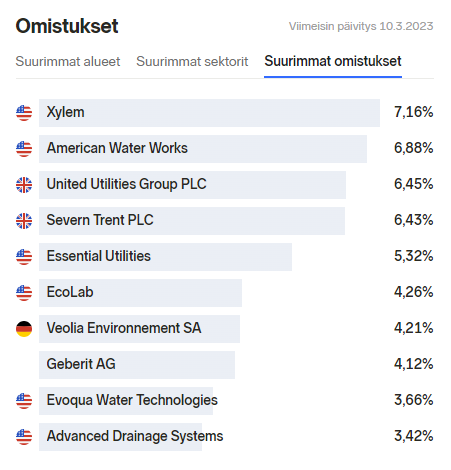
The ETF seems to include several water utilities (municipal water)? It’s a bit unclear to me whether they face penalties if there are problems with the drinking water supply, for example, due to drought?
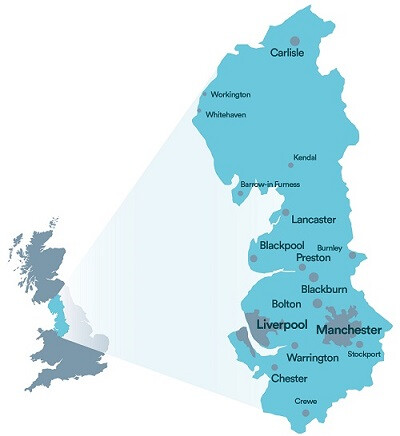
United Utilities currently supplies water to a population of 7.3 million people across the North West.
Severn Trent supplies 4.6 million households and business across the Midlands and Wales.
I wonder if there will be sanctions if the drought doesn’t ease and the water supply becomes more difficult? At the very least, one would expect volumes to decrease if water usage starts being restricted. https://twitter.com/CopernicusEMS/status/1635552266630430722
However, United Utilities seems to operate specifically in that area where there hasn’t been a drought.
Or is it just that water prices are raised when there’s a shortage? There might also be legislative obligations for water utilities.
In the United States, a certain water company went to court over rainwater because people had rainwater collection tanks; they claimed the rainwater was theirs since they owned the area’s water resources . I personally invested in a water fund precisely because of that future depletion of water resources, though it might be immoral .
I’ve been thinking about the kind of battering energy companies faced last year, and based on that, I imagine that water would trigger an even stronger reaction.
This is an interesting topic indeed! Regarding Nestle, there have been news stories and opinion pieces about water ownership rights for a long time. Personally, I think that in Europe, regulation will more quickly restrict the monetization of these necessities.
An interesting documentary series “Can you eat this?” (Voiko tätä syödä?) can be found on Areena, one episode of which deals with water, its sufficiency, and who (corporation vs. citizen) should have the right to water?
Looks like you were right! Even though the goal is to reduce water usage by 10 percent, so in my opinion, the net impact may well be +/- 0.
The water-saving plan includes 50 measures, such as fixing leaking pipes, adapting the way farmers and the nuclear industry use water and making water more expensive for those who use it in excess of basic needs.
Other measures included at least 180 million euros in emergency funding for the renovation of pipelines in some villages, as well as annual budget increases for public water utilities.
In Britain, water utility Thames Water has run into financial difficulties.
Thames Water serves 15 million customers across London and the southeast of England, and has come under intense pressure in recent years because of its poor record on leaks, sewage contamination, executive pay and shareholder dividends.
The future water crisis is a topic that attracts very little interest from the general public.
However, this will have devastating consequences unless the problem is solved through technology.
The demand for drinking water increases as the population grows, while the supply decreases as the climate warms, so supply and demand could fall into an imbalance.
I see a lot of potential in asset classes related to the availability and/or ownership of clean water, such as farmland, as well as companies involved in water purification and transport. Water-related business is also naturally defensive.
For index investors, there are interesting water ETFs, such as ticker IQQQ.
Below is a video explaining the water crisis and the related s/d situation in the future.
I take a different view here. There have certainly been water-related crises and there surely will be in the future, but it is such an essential basic need that I don’t believe there are much more fortunes to be made from it than from gravity or the air we breathe.
The changes are slow and are adapted to in thousands of different ways every day; someone somewhere stops farming when yields have remained poor on average over the years due to a lack of water, and someone else simultaneously establishes a new farm elsewhere where it has started raining more, etc. A local government sets up a desalination plant to make drinking water from seawater because solar energy is suddenly dirt cheap, etc.
Water is the ultimate bulk commodity, and that is how it’s supposed to be.
There is always a next big thing coming, where growth seems infinite and money is made at an unprecedented pace. Whether it’s cars, televisions, computers, mobile phones, 3D printers, cannabis, hydrogen…
Wait…
Investing in a sunset industry shunned by everyone, from which capital is fleeing rapidly, can be just as profitable as investing in growth and sectors where venture capital is pouring in.
Investing would be easy and everyone would be millionaires if you just put your money into a megatrend and waited contentedly. It’s just often not that simple.
 . I personally invested in a water fund precisely because of that future depletion of water resources, though it might be immoral
 .